Electric forklift weight affected engineering, safety, and logistics decisions across warehouses, factories, and ports. This article examined how service weight, shipping weight, and load capacity related to stability, counterweights, and battery mass. It analyzed structural and electrical design choices, from frames and masts to high-capacity 40,000 lb electric cushion trucks. It also linked forklift weight to floor loading, containerization, regulatory compliance, and practical optimization when selecting or specifying modern electric forklifts.
Defining Electric Forklift Weight And Key Terms
Defining electric forklift weight precisely allowed engineers and operators to size floors, doors, and transport equipment correctly. Weight terminology also linked directly to stability calculations, rated capacity, and regulatory compliance. This section clarified how service weight, shipping weight, counterweight, and battery mass interacted, and how typical weight ranges varied by class and capacity.
Service Weight, Shipping Weight, And Load Capacity
Service weight described the ready-to-work mass of the forklift. It included frame, mast, forks, counterweight, battery or fuel, oils, coolants, standard options, and the operator ballast. For 2025 models, service weight ranged from about 1,050 kg for a 1.5-ton electric stacker to roughly 62,000 kg for a 45-ton reach stacker. A typical 2.5-ton electric counterbalance truck had a service weight near 4,100 kg. Shipping weight differed because manufacturers often removed the mast, drained fuel, and excluded the battery to reduce transport mass. For example, a 3.5-ton diesel truck with a 4,750 kg service weight shipped at about 4,067 kg after removing the mast and consumables. Load capacity, in contrast, described the maximum permissible load at a specified load center and mast configuration, not the truck’s own mass.
Counterweight, Battery Mass, And Stability
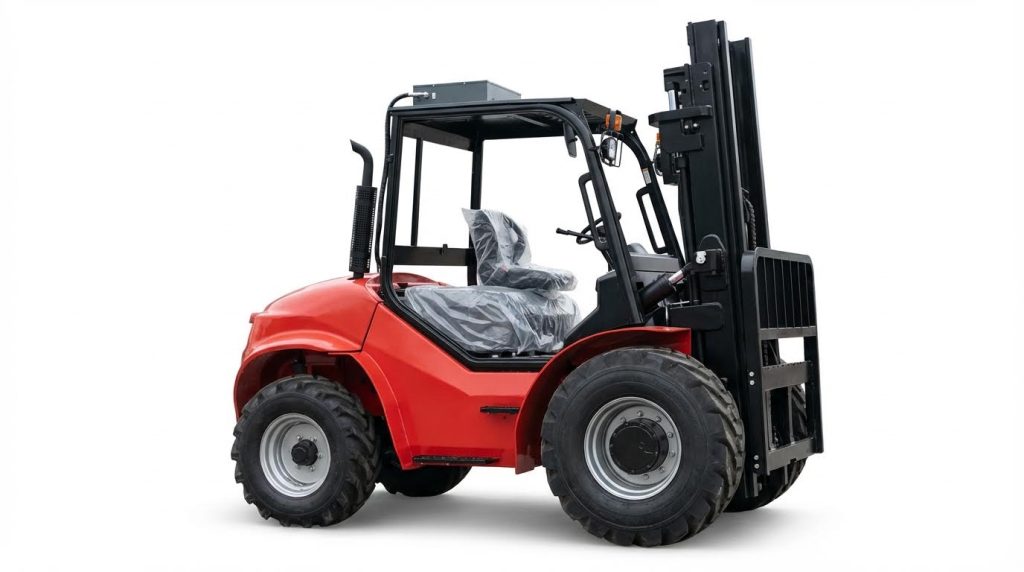
Electric forklifts relied on a rear counterweight and battery mass to balance forward tipping moments. The counterweight typically represented 20–30% of the truck’s total service weight. On a 2.5-ton electric forklift, the frame and counterweight could weigh around 1,800 kg, while a lithium-ion battery added about 1,250 kg. In many electric designs, the traction battery acted as part or all of the counterweight, which simplified packaging but locked weight into a fixed location. Stability analysis used the classic moment balance about the front axle, with counterweight and battery moments opposing the load on the forks. Engineers sometimes expressed the counterweight requirement with relations such as: counterweight mass ≈ (maximum load × (front overhang + load center)) ÷ wheelbase. Heavier counterweights increased stability and rated capacity but also raised floor loading and reduced maneuverability.
Typical Weight Ranges By Class And Capacity
Electric forklift weight scaled strongly with rated capacity and duty class. Class 1 electric rider trucks typically weighed between about 1,400 kg and 5,400 kg (3,000–12,000 lb). A standard 2.5-ton electric counterbalance truck weighed around 4,100 kg in service trim. Warehouse counterbalance models rated 1.5–4.0 tonnes, such as typical Clark, Yale, Linde, or Toyota units, usually fell in the 3,500–9,000 lb range. A 5,000 lb (≈2,300 kg) capacity truck often weighed about 9,000 lb (≈4,100 kg) unloaded and up to roughly 14,000 lb when carrying a full-rated load. High-capacity electric cushion forklifts with 15,000–40,000 lb ratings operated at substantially higher service weights, often exceeding 15,000 kg for 18–20 tonne capacities. Engineers selected weight and capacity combinations by balancing maneuverability, energy use, and required lift performance for each application.
Engineering Drivers Of Electric Forklift Weight
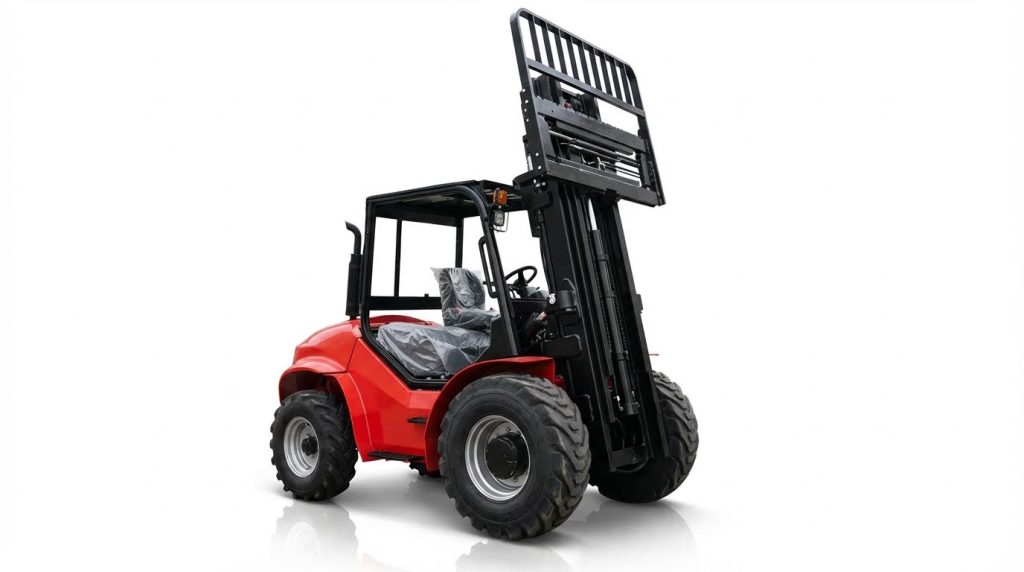
Engineering decisions fixed most of an electric forklift’s service weight before options or attachments. Structural stiffness, stability margins, and duty-cycle expectations dictated the baseline mass of the frame, mast, battery, and counterweight. Designers then balanced this mass against maneuverability, floor loading limits, and transport constraints. Understanding these drivers allowed specifiers to predict how configuration changes affected total weight and performance.
Frame, Mast, And Counterweight Design Choices
The frame and mast carried the primary structural loads and therefore dominated the steel mass budget. A 2.5-ton electric counterbalance truck with a 4,100 kg service weight typically allocated about 1,800 kg to frame and counterweight alone. Higher rated capacities or lift heights required thicker mast channels, larger cross-sections, and wider carriage plates, which increased mast and carriage weight above 500 kg. Counterweight mass, often 20–30% of total truck weight, provided the restoring moment to keep the rear axle loaded at the rated capacity and load center.
Designers selected counterweight geometry and material to meet stability tests while controlling footprint and rear overhang. Cast iron blocks, sometimes with lead inserts, packed mass into a compact volume; on electric trucks the traction battery often contributed part of this ballast. The stability triangle and ISO/EN stability tests constrained how far designers could reduce counterweight mass without sacrificing rated capacity. For warehouse models in the 3,500–5,000 lb capacity range, this resulted in typical unladen truck weights around 9,000 lb to maintain safe longitudinal and lateral stability.
Battery Chemistry, Size, And Energy Density
Battery selection strongly influenced electric forklift weight because the traction battery often doubled as a structural counterweight. A typical 2.5-ton truck used a Li-ion battery of about 1,250 kg within a 4,100 kg service weight, representing roughly 30% of the total mass. Lead-acid batteries of equivalent energy capacity weighed about 15% more, adding roughly 250 kg on the same truck. This additional mass increased stability margins but also raised floor loading, transport weight, and energy consumption per meter traveled.
Higher-capacity batteries (for example, 620 Ah versus 460 Ah) added around 190 kg, extending runtime but pushing service weight toward 5,000 kg once combined with other options. Future LFP chemistries, which were about 15% lighter than lead-acid for the same kilowatt-hours, reduced battery mass and therefore total truck weight by approximately 200 kg on a 2.5-ton model. Engineers had to re-balance counterweight design when switching chemistries to maintain the same rated capacity and load center, sometimes adding modular ballast to replace lost battery mass.
Attachments, Options, And Weight Growth Over Time
Options and attachments incrementally increased forklift service weight beyond the base specification. On a 2.5-ton electric truck, a sideshift carriage added roughly 90 kg, and a hydraulic fork positioner added about 120 kg, both mounted forward of the drive axle and therefore penalizing residual capacity. A full cab with HVAC added around 180 kg high on the structure, slightly raising the center of gravity. Switching from pneumatic to solid tires increased unsprung mass by about 70 kg but improved puncture resistance in harsh environments.
Battery choices also acted as options; changing from Li-ion to lead-acid could add 250 kg, while selecting a larger battery pack added another 190 kg. Safety and compliance features such as fire suppression systems contributed approximately 40 kg. Extra counterweight kits, often supplied in 200–300 kg slices, allowed capacity upgrades or stability margin increases but pushed service weight from 4,100 kg toward 4,930 kg in documented cases. Over a product’s life, retrofitted attachments and options could therefore increase service weight by more than 20%, with direct implications for floor loading, transport planning, and braking performance.
High-Capacity Trucks: 15,000–40,000 Lb Designs
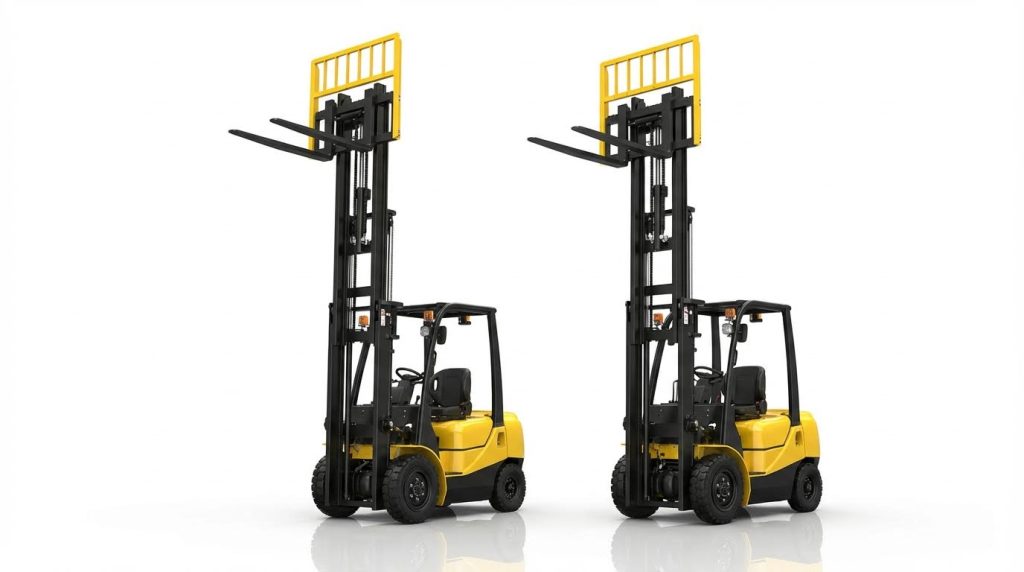
High-capacity electric cushion forklifts with rated capacities between 15,000 and 40,000 lb required substantially heavier structures and counterweights than standard warehouse trucks. Models such as THDE1500-24 through THDE4000-30 carried loads from 15,000 lb up to 40,000 lb, with corresponding increases in chassis width from about 63 in to 72.44 in and length to fork face from roughly 126 in to 156 in. The overhead guard height rose to about 94–103 in, reflecting the need for taller mast assemblies and
Weight, Performance, And Infrastructure Constraints
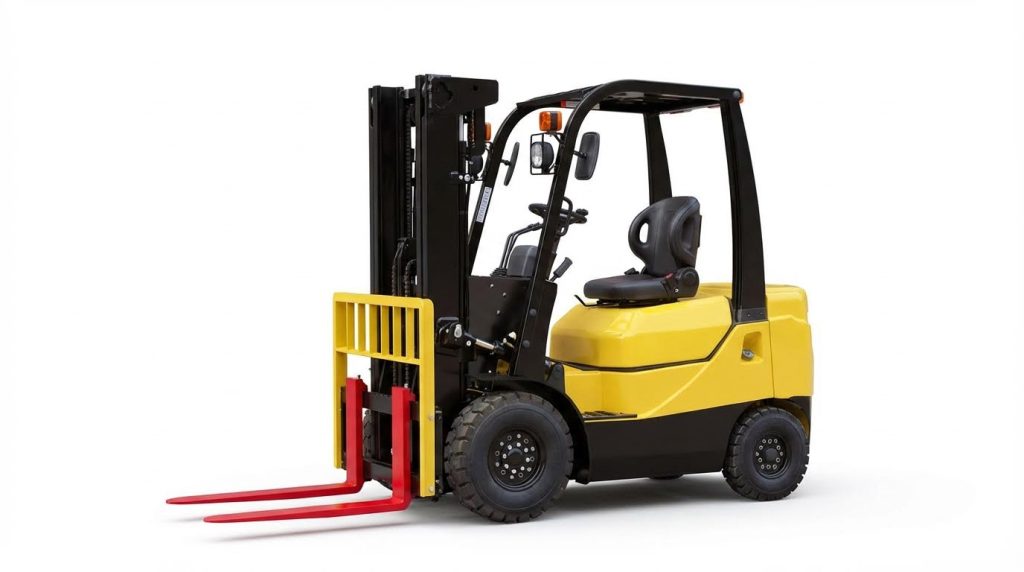
Electric forklift weight directly affected capacity, maneuverability, and the loads imposed on floors and transport assets. Engineers balanced truck mass, counterweight size, and battery selection against site limits such as slab rating, aisle width, and container payload. Understanding these interactions allowed correct truck sizing, safe operation, and compliant logistics plans.
Weight Versus Rated Capacity And Maneuverability
Forklift weight and rated capacity were strongly linked through stability requirements. A 5,000 lb (≈2,270 kg) capacity counterbalance truck typically weighed around 9,000 lb (≈4,080 kg) unloaded, with the counterweight contributing 20–30% of total mass. Higher capacity electric cushion models, such as 15,000–40,000 lb trucks, required significantly heavier frames and counterweights, which reduced maneuverability and increased energy demand. Lighter Class 1 electric riders in the 3,000–8,000 lb service weight range offered better agility in tight warehouse aisles but had lower lift capacities. Battery choice also influenced performance; heavier lead-acid packs improved stability but penalized acceleration and braking distances, while lighter lithium iron phosphate packs reduced weight and energy use but sometimes required supplemental counterweighting to preserve rated capacity.
Floor Loading, Mezzanine Use, And Slab Design
Forklift weight governed floor loading and determined whether a slab or mezzanine could safely support operations. A typical 2.5 ton electric forklift with a 4,100 kg service weight imposed contact pressures far above light warehouse slab ratings when concentrated on small tire footprints. Example calculations showed a 4,100 kg truck on a 2.1 m × 1.2 m footprint producing about 1,627 kg/m², which overloaded a 5 kN/m² (≈510 kg/m²) slab by a factor of 3.2. Even spreading load with a 12 mm steel plate to 3.75 m² only reduced pressure to about 1,093 kg/m², still unsafe for that slab rating. Correct engineering specified higher capacity slabs, for example 8 kN/m² (≈815 kg/m²) with adequate thickness and reinforcement, or restricted heavy truck access to ground floors. For mezzanines, engineers verified combined weight of truck, maximum load, and dynamic effects against structural design loads, often prohibiting standard counterbalance trucks and favoring lighter pallet jacks.
Transport, Containerization, And Shipping Limits
Service weight and shipping weight constrained how many forklifts fit safely into containers or on trailers. Shipping weight differed from service weight because manufacturers removed masts, drained fuel, or excluded batteries, reducing mass by several hundred kilograms per truck. For example, a 3.5 ton diesel forklift with a 4,750 kg service weight shipped at about 4,067 kg after removing mast, fuel, battery, and operator ballast, although freight planners still allowed roughly 4.2 tons to include loose components. Container stuffing matrices for a 40 ft high-cube with a 28,300 kg payload showed that seven 2 ton-class trucks at 3,680 kg each, or five 3.5 ton-class trucks at 4,750 kg each, approached weight limits while leaving margin for lashings and packaging. Larger units above 12 tons service weight usually required roll-on/roll-off or flat-rack transport. Engineers also considered axle load limits, ramp ratings, and center-of-gravity height during loading to prevent trailer instability.
Safety Margins, Data Plates, And Compliance
Accurate weight information underpinned safe forklift selection and use. The truck’s data plate specified service weight, rated capacity at a defined load center, and allowable mast heights, providing the reference for stability calculations and regulatory compliance. When plates were missing or illegible, best practice required consulting the manufacturer or official documentation rather than estimating weight. Engineers incorporated safety margins by limiting operational loads below nameplate capacity when adding heavy attachments such as sideshift carriages or fork positioners, which could add 90–120 kg and shift the center of gravity forward. Standards and regulations required that floors, docks, and mezzanines safely support the combined weight of truck, load, and attachments under dynamic conditions, not just static mass. Emerging tools, such as augmented reality weight lookup tied to cloud databases, improved accuracy by providing near real-time service weight data, including option packages, which supported better risk assessments and documented compliance.
Summary: Optimizing Electric Forklift Weight In Practice
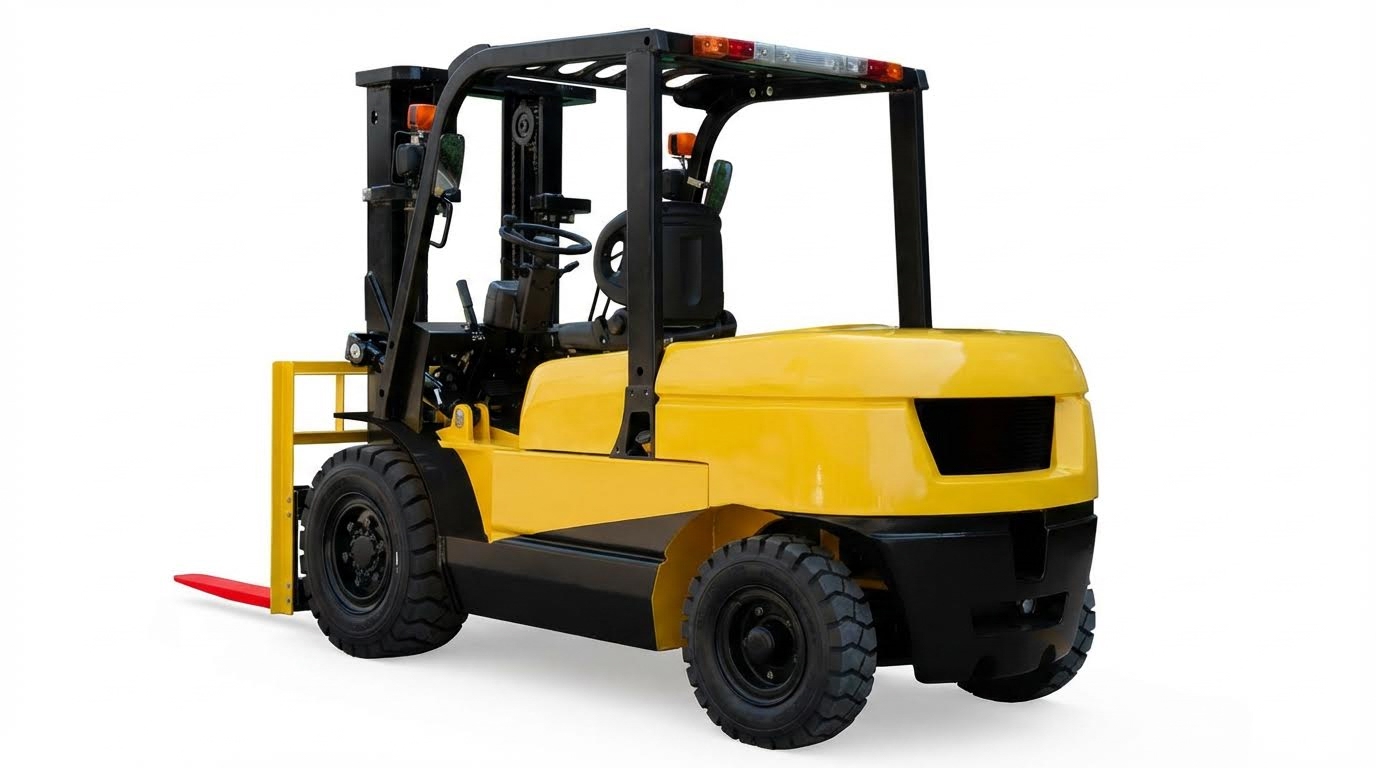
Optimizing electric forklift weight required balancing structural strength, counterweight mass, battery size, and attachment choices against rated capacity and stability. Service weight defined the ready-to-work condition, while shipping weight governed logistics and freight planning. Engineers and fleet managers used data plates, manufacturer documentation, and container stuffing matrices to ensure compliance with capacity, axle loads, and transport limits.
Industry practice showed typical electric trucks ranging from about 1,500 kg pallet stackers to 8,000 kg counterbalance units, with high-capacity designs reaching 18,000 kg and beyond. Heavier trucks delivered higher lift capacities but reduced maneuverability, raised energy consumption, and increased floor loading. Floor slab design, mezzanine ratings, and localized point loads under wheels became critical, especially where calculated pressures exceeded standard warehouse slab capacities.
Future designs increasingly leveraged lighter LFP batteries, more efficient SiC inverters, and optimized counterweights, sometimes using composites or modular ballast slices. These technologies reduced dead mass for the same load moment, enabling improved efficiency or higher residual capacity at a given service weight. Augmented-reality weight identification and cloud-linked data plates supported more accurate planning for shipping, racking clearances, and structural checks.
In practice, operators needed a structured process: verify service weight and axle loads from the plate, check floor and mezzanine ratings, and confirm container or trailer payload against real shipping weight with or without masts and batteries. They then selected battery chemistry and options with attention to incremental kilograms from cabs, sideshifts, and larger batteries. This disciplined approach allowed fleets to meet capacity and runtime targets while respecting safety margins and regulatory requirements, achieving a pragmatic balance between performance, infrastructure constraints, and lifecycle cost.