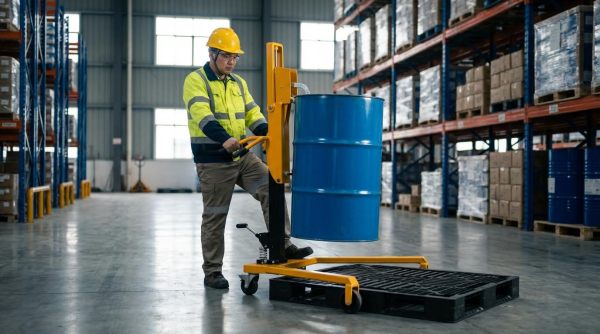
Facilities that search for how to easily move 55 gallon water drums usually face the same challenge. They must shift very heavy, sometimes hazardous loads without spills, injuries, or damage to floors and pallets. This article explains how to engineer safe drum handling systems from basic dollies up to automated manipulators.
You will see how drum weight, center of gravity, and failure modes drive risk assessments and regulatory duties across OSHA, HSE, EPA, and DOT rules. The article then compares manual and low-cost tools with semi-automated and automated options, including forklift attachments, tippers, and pumps. It closes with a structured method to select the right drum moving solution for water, chemicals, and mixed operations while keeping operators safe and throughput high.
Key Drum Handling Risks, Loads, And Regulations
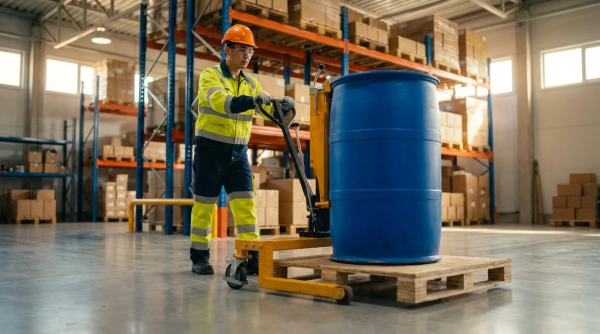
Engineers who study how to easily move 55 gallon water drums must first understand risk, load, and rule sets. Water drums look simple, but they behave like any other heavy, sometimes hazardous, container in motion. This section explains the forces, injury risks, and regulatory limits that shape safe handling methods for water and chemical drums in plants and warehouses.
Typical Drum Weights, Contents, And Failure Modes
A standard 55 gallon drum filled with water weighs roughly 200 kilograms including the drum. Chemical drums can weigh more due to higher density or heavy packaging. Plastic, steel, and fiber drums all react differently to impact, point loads, and clamp pressure.
Common failure modes during handling include:
- Dent or buckle of steel chimes under side impact.
- Rim cracking or puncture of plastic drums on sharp edges.
- Bung thread damage that causes slow leaks during transport.
- Pallet collapse from uneven drum placement or overload.
When planning how to easily move 55 gallon water drums, engineers should check:
| Parameter | Typical range |
|---|---|
| Filled mass per drum | 180–250 kg |
| Drum material | Steel, HDPE, fiber |
| Internal pressure | Near atmospheric for water; higher for heated or reactive contents |
| Drop tolerance | Limited; design for zero free fall |
Designers must avoid pressurizing drums to empty them and must keep them away from heat sources to prevent rupture.
Ergonomic And Musculoskeletal Risk Factors
Manual tilting or rolling of a 200 kilogram drum creates high compressive and shear forces on the spine. Repetitive pushing, pulling, and bracing to steer drums across floors raises the risk of shoulder and knee injuries. Poor floor conditions, such as slopes or wet patches, increase the force needed to start and stop motion.
Key ergonomic risk factors when moving full water or chemical drums include:
- High push and pull forces, especially on rough floors.
- Twisting the torso while stabilizing a rolling drum.
- Frequent bending to attach or detach handling tools.
- Extended reach when accessing drums in deep pallets or racks.
Engineering controls should target these factors before adding more staff. Practical steps include selecting low rolling resistance casters, limiting manual moves per shift, and using mechanical aids once drum counts or travel distances increase. This approach aligns with modern manual handling guidance in both the United States and United Kingdom.
OSHA, HSE, EPA, And DOT Rules That Affect Handling
Regulations do not describe how to easily move 55 gallon water drums step by step. Instead, they set boundary conditions that any method must respect. OSHA rules for drum handling prohibit pressurizing drums to discharge contents and restrict storage near heat or open flame. They also require guarding or isolation for large drums that hold flammable or toxic liquids.
Typical regulatory themes are:
- OSHA and HSE: Control of manual handling risks, guarding, and safe systems of work.
- EPA: Storage, labeling, and spill response for hazardous contents.
- DOT and transport rules: Approved drum types, closures, and salvage drums for shipment.
Drums that show bulging, corrosion, or crystalline deposits must not move until containment plans are in place. Sites must keep fire extinguishers suitable for the hazard near drum work areas. Employers must train workers on labels, hazard classes, and emergency alarms before they move or open drums.
Spill Containment, Fire Protection, And Zoning Basics
Even simple water drum moves share the same layout logic as chemical drum handling. The goal is to stop a leak from turning into a plant-wide event. Containment systems for drums that hold flammable or toxic liquids must hold at least 35 percent of the total stored volume according to OSHA rules for large containers. Many facilities use sumps, spill pallets, or bunded racks to reach this capacity.
Key design checks include:
| Aspect | Consideration |
|---|---|
| Containment volume | ≥35% of total flammable or toxic drum volume |
| Fire protection | Extinguishers sized to liquid class; clear access paths |
| Zoning | Segregate flammable, corrosive, and oxidizing drums |
| Access | Routes that allow fast evacuation and spill control |
Handling plans should minimize drum moves, especially for unstable or aging containers. When drums hold shock sensitive or explosive waste, only essential staff may stay in the area and barriers must shield operators. These rules strongly influence which handling tools, travel paths, and storage patterns an engineer can select for water and chemical drums.
Manual And Low-Cost Drum Moving Solutions

Manual and low-cost tools answer a common question in plants and warehouses: how to easily move 55 gallon water drums without strain or spills. These solutions fit low-volume work, short moves, and mixed storage areas where full automation is not justified. Engineering teams still need to size equipment correctly, match it to floor conditions, and respect manual handling limits. This section explains where dollies, trucks, cradles, racks, and palletizers work best, and where manual lifters reach their safe limits.
When Simple Drum Dollies And Trucks Are Sufficient
Drum dollies and drum trucks are often the simplest answer to how to easily move 55 gallon water drums on smooth floors. A typical dolly has a circular frame and four swivel casters that give 360-degree movement for standard 208 litre drums. Use dollies for short horizontal moves, low gradients, and clean, level concrete. Operators can push rather than lift, which lowers spinal compression and reduces slip risk compared with rolling drums by hand.
Drum trucks work better for thresholds, dock plates, or slightly uneven floors. They tilt the drum onto two large wheels, so the operator only manages a fraction of the mass as handle force. For safe use, sites should define limits for maximum distance, slope, and frequency per shift. Training must cover correct foot placement, controlled tilting, and keeping hands away from drum chimes and floor pinch points.
Using Cradles, Stands, And Racks For Short Moves
Cradles, stands, and racks support drums when the main goal is dispensing or short repositioning, not long transport. Drum cradles let an operator tip a vertical drum to horizontal with controlled leverage rather than brute force. Once horizontal, the drum stays in a stable cradle for pumping or gravity discharge, which reduces the need to repeatedly re-position heavy drums.
Stands and racks raise drums to a set height, so taps or pumps are easy to reach without deep bending or twisting. Tiered racks also separate incompatible chemicals by level or bay, which supports zoning and spill planning. For water and non-hazardous liquids, simple steel racks often suffice, but engineers must still check rack capacity against drum mass including contents. Racks should sit on flat floors and be anchored or braced if stacked vertically to prevent overturning during impact or seismic events.
Drum Palletizers For Safe Pallet And Floor Transfers
Drum palletizers bridge the gap between basic manual tools and powered handling when moving drums on and off pallets. They answer how to easily move 55 gallon water drums between floor and pallet positions without hand lifting or uncontrolled rolling. A palletizer typically grips the drum, raises it with a mechanical or hydraulic system, and allows precise placement on pallet boards or spill decks.
This controlled lift avoids common crush injuries to feet and hands that occurred when workers slid or tipped drums onto pallets. Palletizers also improve stability on wet or uneven floors because the drum stays clamped during travel. For engineering selection, key checks include:
- Rated capacity greater than the heaviest full drum plus safety margin.
- Compatibility with steel and plastic drums, including chime and diameter ranges.
- Minimum fork or leg clearance for the pallets in use.
- Turning radius that fits existing aisle widths.
In low to medium volume operations, one palletizer can often replace teams that previously manhandled drums, cutting both labor hours and recordable injuries.
Limitations Of Manual Lifters In Repetitive Tasks
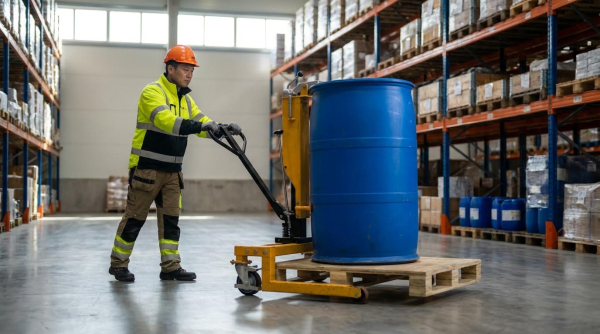
Manual drum lifters use hydraulic jacks or screw drives to raise drums with less effort than pure muscle. They suit occasional lifts, short travel distance, and flat, obstruction-free floors. However, they still rely on the operator for pushing, steering, and fine positioning. Over a full shift, this effort can create fatigue and inconsistent control.
In repetitive tasks, these limits become clear. Cycle times vary by operator strength and technique. Fatigue increases the chance of misaligned grips, side loading, or sudden release. Manual lifters also struggle in tight spaces where long handles and wheelbases reduce maneuverability. As lift frequency, drum mass, or hazard level rises, facilities should consider semi-automated solutions such as powered palletizers, manipulators, or Atomoving systems. This step change reduces peak push forces, standardizes handling cycles, and supports compliance with manual handling guidelines from OSHA or HSE.
Automated And Semi-Automated Drum Handling Options

Automated systems answer a common search question: how to easily move 55 gallon water drums with less risk. They reduce manual lifting, control drum motion, and support safe transfer of water and chemicals. This section compares key technologies so engineers can match load, frequency, and layout to the right solution.
Forklift Drum Attachments, Grabs, And Clamps
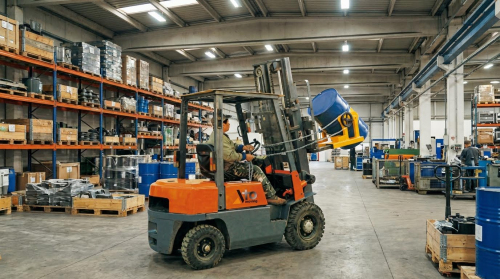
Forklift drum attachments are often the fastest way to move full 55 gallon water drums over distance. Typical designs include rim-grabs, fork-mounted clamps, and hydraulic squeeze heads. These tools let a standard forklift lift, transport, and place drums without manual contact.
For water drums, engineers usually focus on three points: grip reliability, floor conditions, and travel speed. A simple comparison helps frame selection.
| Aspect | Key points for 55 gallon drums |
|---|---|
| Typical drum mass | Up to about 250 kg for water |
| Attachment type | Rim grab, automatic clamp, or hydraulic squeeze |
| Best use | Dock loading, long aisle moves, pallet work |
| Risk control | Positive locking, no side impact, smooth acceleration |
Operators must keep speeds low, avoid sudden turns, and respect truck derating with attachments. For mixed fleets, quick-change fork sleeves or pin-type mounts help standardize across trucks.
Industrial Manipulators And Custom Gripping Tools
Industrial manipulators suit lines that ask how to easily move 55 gallon water drums in tight or congested areas. They suspend the drum from an articulated arm, often with powered lift and tilt. Custom grippers can clamp the drum body, chime, or top rim depending on drum material and label zones.
Compared with forklifts, manipulators give finer motion control near filling heads, mixers, or reactors. They can:
- Hold drums nearly weightless for the operator.
- Rotate or tilt for venting and bung access.
- Reach into enclosures or behind guards.
Designers check ceiling height, arm reach, and required degrees of freedom early in layout studies. For chemical drums, anti-spark construction and interlocks around pinch zones are standard considerations.
Integrated Drum Tippers, Rotators, And Pumps
Drum tippers and rotators automate emptying, not just carrying. A typical system lifts the 55 gallon drum, secures it with a clamp or band, and then rotates it under controlled speed. This control lowers spill risk and lets operators set repeatable pour angles and dwell times.
For water and compatible chemicals, integrated pumps often give better control than full tipping. Electric drum pumps with appropriate wetted materials can transfer liquids directly into process tanks or IBCs. Key selection factors include:
- Viscosity and chemical compatibility.
- Required flow rate and head.
- Explosion protection where vapors exist.
Engineers avoid pressurizing drums to discharge contents because standards prohibited that practice. Instead, they combine mechanical tippers or pumps with proper venting and spill containment.
Applying Digital Twins And Predictive Maintenance
Digital twins help answer how to easily move 55 gallon water drums at scale without new bottlenecks. A twin can model drum flows from receiving to storage and into processing. Engineers test different mixes of forklifts, manipulators, and tippers in software before buying equipment.
Sensors on grabs, clamps, and rotators feed data into maintenance systems. Typical signals include cycle counts, motor currents, and clamp pressure. Predictive algorithms then flag when grip pads, bearings, or hydraulic seals approach wear limits.
This approach reduces unplanned stops and protects drums from drops caused by mechanical failure. It also supports audits by logging each lift, move, and tip event. Plants can link these records to spill reports and near-miss data to refine handling rules over time.
Summary: Selecting The Right Drum Moving Method
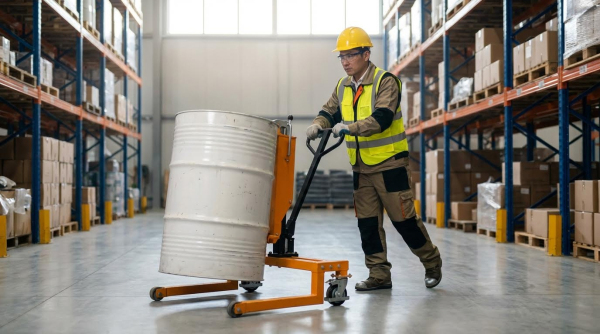
Teams that ask how to easily move 55 gallon water drums need a clear selection method, not guesswork. The right choice depends on drum weight, move distance, floor condition, spill risk, and operator exposure. The same logic applies to chemical drums, where regulations and containment rules add constraints. A structured decision process lets safety, engineering, and operations agree on one standard.
Manual tools such as drum dollies, trucks, and cradles suit low-frequency moves on flat floors. They keep costs low and need little training but still expose operators to push, pull, and balance forces. For frequent moves or mixed water and chemical drums, drum palletizers, forklift attachments, and industrial manipulators reduce strain and standardize handling quality. These systems also support compliance with OSHA, HSE, EPA, and DOT rules by limiting manual lifting and improving control during tipping and pouring.
Future layouts will combine mechanical aids with simple digital tools. Examples include checklists linked to asset IDs, basic sensors on critical lifts, and predictive maintenance on high-use tippers or rotators. Sites that handle 55 gallon water drums can start with a risk-based matrix: drum mass, path complexity, and contact time per operator. From there, they can scale from basic dollies to semi-automated solutions, always checking floor capacity, spill containment, and fire protection zoning before deployment.
Frequently Asked Questions
How to safely move a 55-gallon drum?
Moving a 55-gallon drum requires proper equipment and technique. Use tools like drum dollies, pallet jacks, or forklifts to handle the drum safely. Drum Handling Tips. Avoid manual lifting or rolling to reduce the risk of accidents.
- Use a drum dolly to tilt and transport the drum easily.
- Secure the drum with straps during transit to prevent tipping.
How much does a 55-gallon drum weigh when it’s full of water?
A 55-gallon drum filled with water weighs approximately 227 kilograms (499 pounds). This weight includes the water and the drum itself. Ensure proper handling equipment is used to avoid strain or injury.