
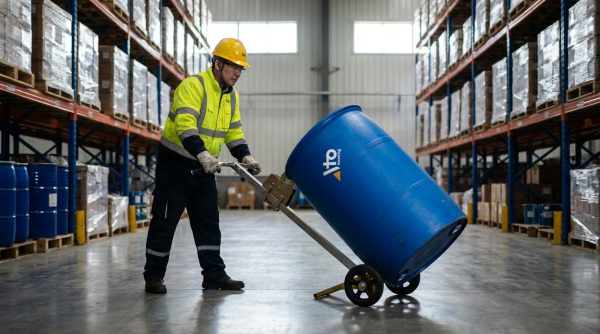
Transport planners who ask how to transport 55 gallon drums safely must control both containment and movement. This article covers the full framework from regulations to load design, focused on road vehicles and mixed-fleet operations.
You will see how DOT, PHMSA, and FMCSA rules shape decisions on drum closure, labeling, and securement hardware. The middle sections explain how to size straps and blocking, select pallets, and build stable unit loads that resist roll, shift, and vibration. The final summary links these practices into a repeatable standard that engineering, safety, and logistics teams can apply across lanes and carriers.
Regulatory And Risk Framework For Drum Transport
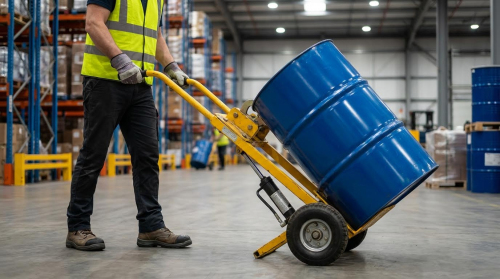
Engineers who study how to transport 55 gallon drums safely must start from regulation and risk. Road shipments sit under a tight framework that links packaging performance, hazardous material rules, and motor carrier duties. A clear view of this framework helps design securement, training, and inspection that actually match real failure modes on the road.
Key DOT, PHMSA, And FMCSA Requirements
U.S. rules for how to transport 55 gallon drums by road sit mainly in Title 49 of the Code of Federal Regulations. PHMSA set packaging and closure standards, including performance tests and closure instructions for steel and plastic drums. Part 178.601 defined design qualification and testing, while §§173.22 and 178.2 required anyone doing the final closure to follow the manufacturer’s instructions. FMCSA cargo securement rules required that drums could not leak, shift, roll, or fall from the vehicle under normal driving and emergency maneuvers.
For hazardous materials, DOT rules covered classification, packaging selection, training, and emergency response information. Carriers had to meet working load limit rules for tie-downs and anchor points, and maintain equipment so ratings remained valid. Facilities that loaded drums had to block and brace them so forward, rearward, and lateral forces from braking and cornering stayed within securement capacity. These requirements created a shared duty chain across packaging vendors, fillers, shippers, and motor carriers.
Hazard Classification, Labeling, And Placarding
Correct hazard class assignment was the first step in deciding how to transport 55 gallon drums under hazmat law. Classification drove UN packaging codes, packing groups, and allowed filling ratios. Once classified, each drum needed durable markings, including UN symbol, packaging code, test pressure or mass, and manufacturer details.
Hazard labels on the drum body had to match the primary and subsidiary risks, such as flammable liquid or corrosive. For open truck beds, any drum that currently held hazardous material, or had held it previously and was not cleaned, had to be treated as hazardous. That meant proper labeling and documentation. Vehicle placards were then selected based on total quantity and class on the vehicle, using the tables in 49 CFR.
Incorrect or missing labels and placards created major enforcement and response problems. Responders relied on them to select protective equipment and tactics after a spill. From an engineering view, clear marking also supported segregation rules inside trailers, so incompatible drums did not share the same blocking bay.
Incident Data: Typical Failure Modes In Transit
PHMSA incident data showed that how to transport 55 gallon drums safely was often a handling problem, not a drum design problem. Common failure modes included forklift punctures, dropped pallets, and drums that shifted due to weak blocking and bracing. Many leaks traced back to incorrect closure torque or missing cap seals on bungs and fittings.
In trailers and containers, engineers saw several repeat patterns:
- Insufficient blocking that allowed drums to slide under hard braking.
- Lack of anti-roll devices when drums shipped on their sides.
- Poor pallet quality that led to deck board failure and drum tipping.
- Uninspected reused drums with hidden damage.
Incident reviews showed that stable pallet design, verified strap tension, and quality pallets could prevent a large share of events. They also highlighted the need for routine inspection during long trips, especially after rough roads or emergency stops. Data-driven feedback loops from these incidents helped refine loading procedures and securement standards.
Roles Of Fillers, Shippers, And Carriers
The duty chain for how to transport 55 gallon drums involved distinct roles. Packaging manufacturers had to design and test drums to the correct UN performance level. They also had to supply clear closing instructions, including torque values for plugs and rings. Fillers then had to follow those instructions exactly and install cap seals where required to control tampering and contamination.
Shippers were responsible for correct classification, marking, labeling, and documentation. They selected pallets, unit load designs, and blocking schemes that matched the product and route. That included checking pallet gaps, deck stiffness, and drum orientation. Carriers and their drivers had to apply and inspect tie-downs, confirm that working load limits exceeded the expected forces, and refuse loads that were unstable.
Effective programs defined hand-off checks at each step. Typical examples included closure verification at the filler, load plan sign-off at shipping, and securement inspection by the driver before departure. When each party understood its defined role, the overall system controlled risk better than any single regulation or device could achieve.
Designing Securement: Straps, Blocking, And Bracing
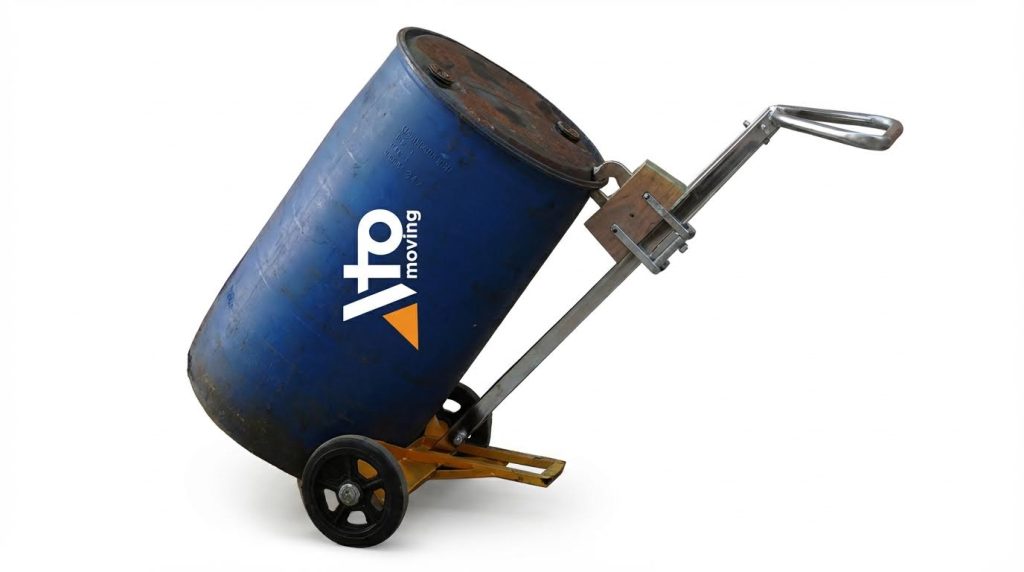
Designing securement is the core step in how to transport 55 gallon drums safely by road. The goal is to keep every drum fixed under braking, cornering, and impact loads. Engineers must link tie-down layout, blocking, and bracing to real vehicle dynamics and regulatory rules. Good design also reduces damage, leakage risk, and incident rates across an entire fleet.
Load Path, Inertia, And Tie-Down Force Calculations
Securement starts with a clear load path from each drum into the vehicle frame. The tie-down system must resist inertia from acceleration, braking, and cornering. A full 55-gallon drum often weighs more than 170 kilograms, so inertial forces grow fast at highway speeds.
Designers normally size forces using simple dynamic factors. Typical design assumptions include:
- Forward load: about 0.8 g during hard braking
- Rearward load: about 0.5 g during acceleration
- Side load: about 0.5 g during cornering or evasive moves
Required tie-down force equals drum weight multiplied by these factors, adjusted for friction between drum and deck. Engineers then check that the sum of strap capacities in each direction exceeds these loads with margin. Direct lashings to the chassis or anchor points create a shorter, stiffer load path and reduce drum movement. Crossed tie-downs help control both lateral and longitudinal shift for single or small drum groups.
Ratchet Straps, Chains, And Working Load Limits
Ratchet straps are the main solution for how to transport 55 gallon drums on flatbeds and in dry vans. They are light, quick to tension, and easy to inspect. Chains appear more on heavy steel coils or machinery but can support mixed loads that include drums.
Selection always starts from working load limit (WLL). Key checks include:
| Item | Consideration |
|---|---|
| Strap width | Common widths are 25–50 millimetres for road use |
| WLL | Must exceed design load with safety factor per carrier rules |
| Anchor hardware | Hooks and rings need equal or higher WLL |
| Condition | No cuts, burns, or severe abrasion |
Operators should route straps over the drum top to control tipping, not only around the waist. Straps must contact the drum without sharp edges that could cut webbing. Chains with binders can secure steel drums in mixed loads but require protection at contact points to avoid denting. Every tie-down device needs a visible WLL mark to support roadside inspection and internal audits.
Blocking, Bracing, And Anti-Roll Devices In Trucks
Blocking and bracing control movement that straps alone cannot stop. Drums are round, so they roll and wedge under impact unless the layout prevents it. Good blocking uses the vehicle structure and simple materials to create a tight, repeatable pattern.
Typical blocking and bracing elements include:
- Timber blocks or wedges fixed to the deck to stop rolling
- Cross boards between drums and bulkhead to resist forward travel
- Void fillers or dunnage bags to close gaps and prevent shift
- Side boards or lattice to stop lateral movement in vans and containers
Anti-roll devices such as chocks or drum cradles hold individual drums when loads are small or mixed. For palletized drums, blocking focuses on the pallet edges and corners instead of each drum. Engineers should design patterns that eliminate free space, since even small gaps let drums gain momentum and overload straps. Securement plans must also allow safe unloading, so workers do not face sudden drum movement when restraints are released.
Sensors, Telematics, And AI-Based Load Monitoring
Digital tools now support better answers to how to transport 55 gallon drums with consistent safety. Low-cost sensors can track vibration, shock, and tilt on pallets or inside trailers. Telematics units send this data to fleet platforms in real time.
Common sensor uses include:
- Shock logging to flag hard braking or impact events
- Tilt alarms when a stack or pallet reaches unsafe angles
- Temperature and humidity tracking for sensitive products
AI-based tools can scan these data streams across thousands of trips. They highlight routes, depots, or driving patterns that correlate with drum damage or leaks. Engineers can then adjust securement standards, strap counts, or blocking layouts based on measured risk, not guesswork. Over time, this feedback loop shifts securement design from static rules to a living standard that reflects real roads, real vehicles, and real incident history.
Palletization And Unit Load Stability For Drums
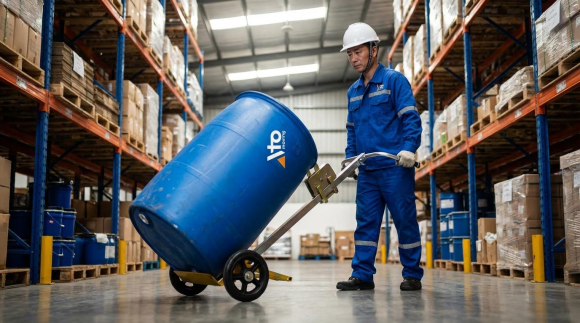
Palletization is central to how to transport 55 gallon drums safely and efficiently. A stable unit load reduces forklift damage, limits shifting in transit, and supports regulatory compliance. Good practice starts with the right pallet, a sound drum layout, and secure wrapping or strapping. The following sections explain how engineering choices in pallets, restraint systems, and digital tools control risk and lifecycle cost.
Pallet Selection, Layout, And Stack Height Limits
Pallet choice sets the foundation for unit load stability. For 55-gallon drums, operators typically use plastic or hardwood pallets with tight deck gaps. Industry guidance often limited top deck gaps to about 20 millimetres to avoid drum chime drop-through and point loading. Pallets must carry both static weight in storage and dynamic loads during transport.
Layout affects both stability and cube use. Common patterns include:
- Four drums on a 1 200 millimetre by 1 200 millimetre pallet in a square pattern
- Three drums on smaller pallets where trailer width is constrained
Square patterns give better symmetry and reduce eccentric loading. Drums should sit fully on deck boards with no overhang. Mixed layouts in the same trailer row increase gap sizes and allow more movement during hard braking.
Stack height limits depend on drum design, fill level, and route conditions. Engineers check:
- Compressive strength of drums and pallets
- Trailer floor rating and warehouse slab capacity
- Stability under 0.5 g to 0.8 g longitudinal deceleration
Many operators restrict palletized drum stacks to one pallet high in road transport to reduce toppling risk. Where two-high stacks are used in storage, they often rely on racking or interlayer boards to spread loads.
Strapping, Drum Clips, And Corner Protection
Strapping is a primary tool in how to transport 55 gallon drums on pallets. It turns loose cylinders into a single rigid block. Steel strapping offers high strength and low stretch, which suits heavy or hazardous loads. Polyester strapping is lighter, corrosion resistant, and better for long routes with vibration.
Good practice usually includes at least two horizontal straps per pallet layer. Straps pass over drum chimes or through pallet openings to lock drums to the base. Tension must stay below strap yield but high enough to resist inertial forces during emergency braking or cornering. Operators routinely combine:
- Horizontal banding around the drum group
- Vertical banding tying drums and pallet together
Drum clip devices link adjacent drum rims and prevent relative movement. They improve lateral stiffness and reduce the chance of shear failure in straps. Corner and edge protectors spread strap pressure and prevent cutting into drum shells or lids. They also help maintain strap tension by reducing local deformation at contact points.
Correct strap placement, tension verification, and visual inspection before loading are critical steps. Poorly tensioned or misaligned straps are a frequent root cause in incident reports.
Overpacks, Slipcovers, And Vibration Resistance
Overpacks and slipcovers improve both protection and stability, especially for long-haul or export moves. Cardboard slipcovers, often two-ply or three-ply, enclose the entire drum group and create flat faces for banding. They protect against dents, abrasion, and minor impacts from forklifts or other cargo.
Vertical banding secures slipcovers to the pallet and drums. A common pattern uses at least two bands in each direction. This creates a boxed unit load that behaves more like a cuboid than four separate cylinders. That shape resists side pressure from adjacent pallets and reduces the chance of drums working loose.
Vibration during road or rail transport can slowly relax loose structures. To manage this, engineers focus on:
- High-friction interfaces between drums and pallets
- Minimal internal gaps within the drum cluster
- Restraint systems that avoid fretting or wear at contact points
Overpacks also help contain leaks if a closure fails. For hazardous products, they support secondary containment strategies and simplify clean-up after minor incidents.
Digital Twins And Lifecycle Cost Optimization
Digital tools now shape how to transport 55 gallon drums with lower risk and cost. Digital twins of pallets, drums, and trailers let engineers simulate braking, cornering, and vibration before changing packaging designs. These models combine drum mass, centre of gravity, strap stiffness, pallet strength, and trailer dynamics.
With a digital twin, teams can compare options such as:
- Wood versus plastic pallets over several reuse cycles
- Two versus four straps per pallet
- Different slipcover thicknesses or materials
Outputs include predicted movement, strap loads, and contact pressures under defined duty cycles. This helps avoid over-engineering while still meeting safety margins and regulatory expectations. It also highlights where small design changes, like a different pallet deck pattern, can reduce damage rates.
Lifecycle cost models link simulation results to real spend. They include pallet purchase and repair, drum damage, product loss, labour time, and claim costs. Operators then select palletization standards that minimize cost per delivered litre while keeping incident probability acceptably low. As sensor data from trailers and warehouses grows, digital twins can update with real-world loads and refine assumptions over time.
Summary: Safe, Compliant Drum Transport Practices
Safe road transport of 55-gallon drums depends on three pillars. First is regulatory compliance. Second is engineered securement. Third is disciplined operating practice. Anyone searching how to transport 55 gallon drums must integrate all three.
From a regulatory view, operators must follow DOT, PHMSA, and FMCSA rules for packaging, securement, and hazardous materials. That includes correct UN-rated drums, proper closures, documented torque on fittings, and use of cap seals where required. Hazard classes, labels, and placards must match the actual contents, not just the last known use of the drum.
From an engineering view, securement design must resist acceleration in braking, cornering, and impact events. Drums on pallets need sound pallet decks, tight strapping, and protection at edges and chimes. Blocking and bracing must remove free play in every direction and stop rolling. In-vehicle anchor points and tie-downs must meet working load limits with a clear safety margin.
Operationally, trained staff must,
Frequently Asked Questions
How to safely move a 55-gallon drum?
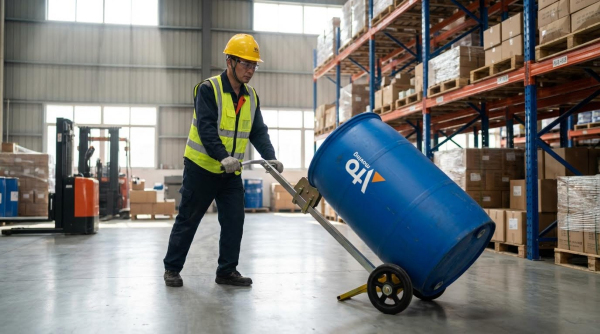
Moving a 55-gallon drum requires the right equipment to ensure safety. Forklifts, pallet jacks, and drum dollies are essential tools for this task. Attempting to roll or lift these containers manually increases the risk of accidents. Drum Handling Guide.
What is the best way to transport full 55-gallon drums?
To transport full 55-gallon drums, brace the drum with your foot to prevent it from sliding, and shift your weight to the rear foot. Pull and drag it a few inches to the left then to the right. Use the push/pull method by using one hand to pull the far chime and the other hand to push against the wall. USDA Drum Moving Tips.
Will a 55-gallon barrel fit in a car?
A 55-gallon barrel typically does not fit in a standard car due to its size and weight. It’s recommended to use a truck or a van with adequate space and load-bearing capacity. Ensure proper securing to avoid movement during transit.