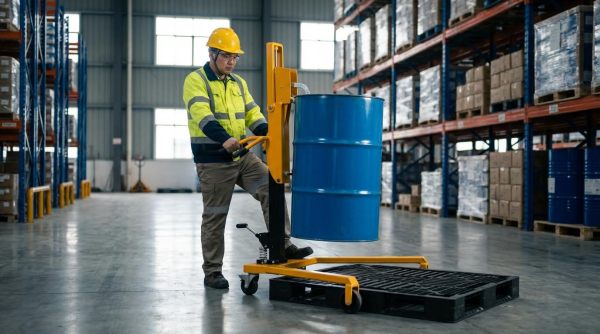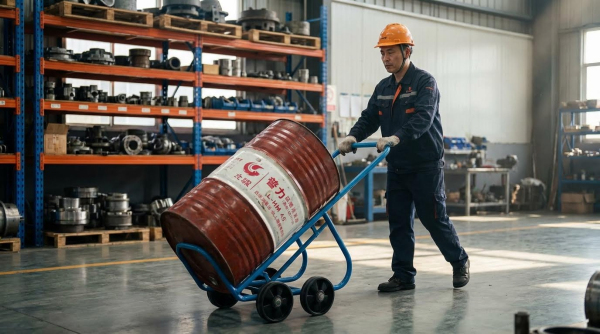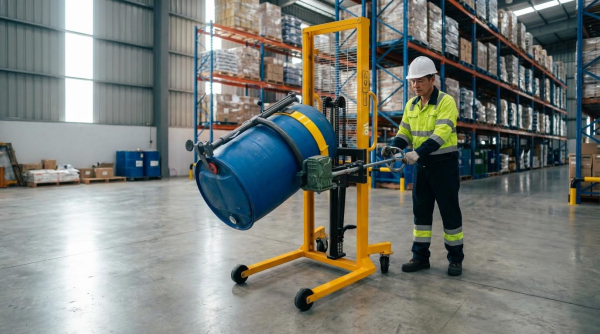
Drum stackers are one of the most effective tools for moving, lifting, rotating, and storing drums safely and with minimal labor. This article explains what drum stackers are, how they work, and how to use a drum stacker efficiently in real-world operations. You will see the key engineering specs, safety practices, and layout choices that impact throughput and risk. Use it as a practical guide to select the right equipment, train operators, and justify your investment with clear cost-benefit logic.
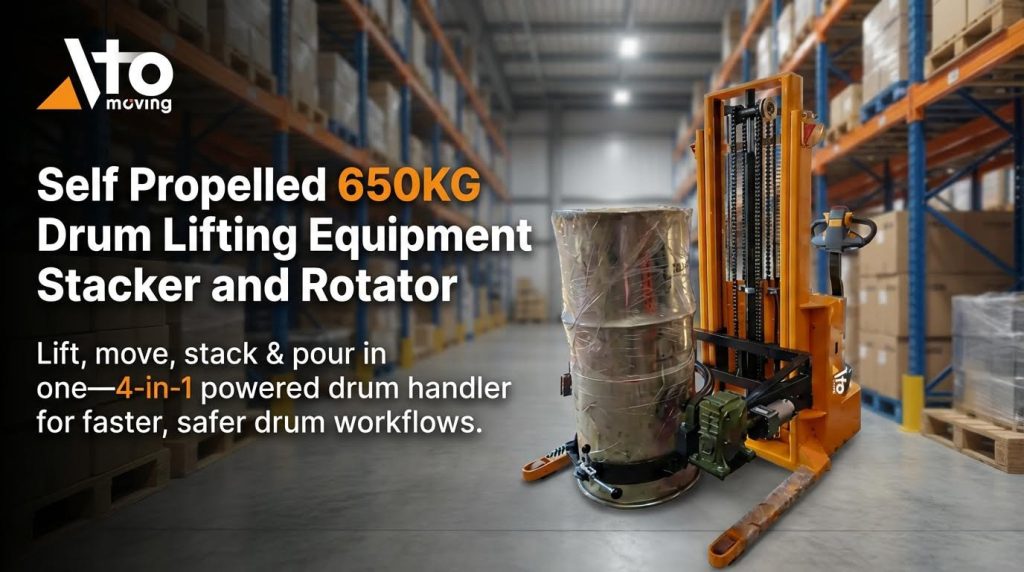
What Drum Stackers Are And How They Work
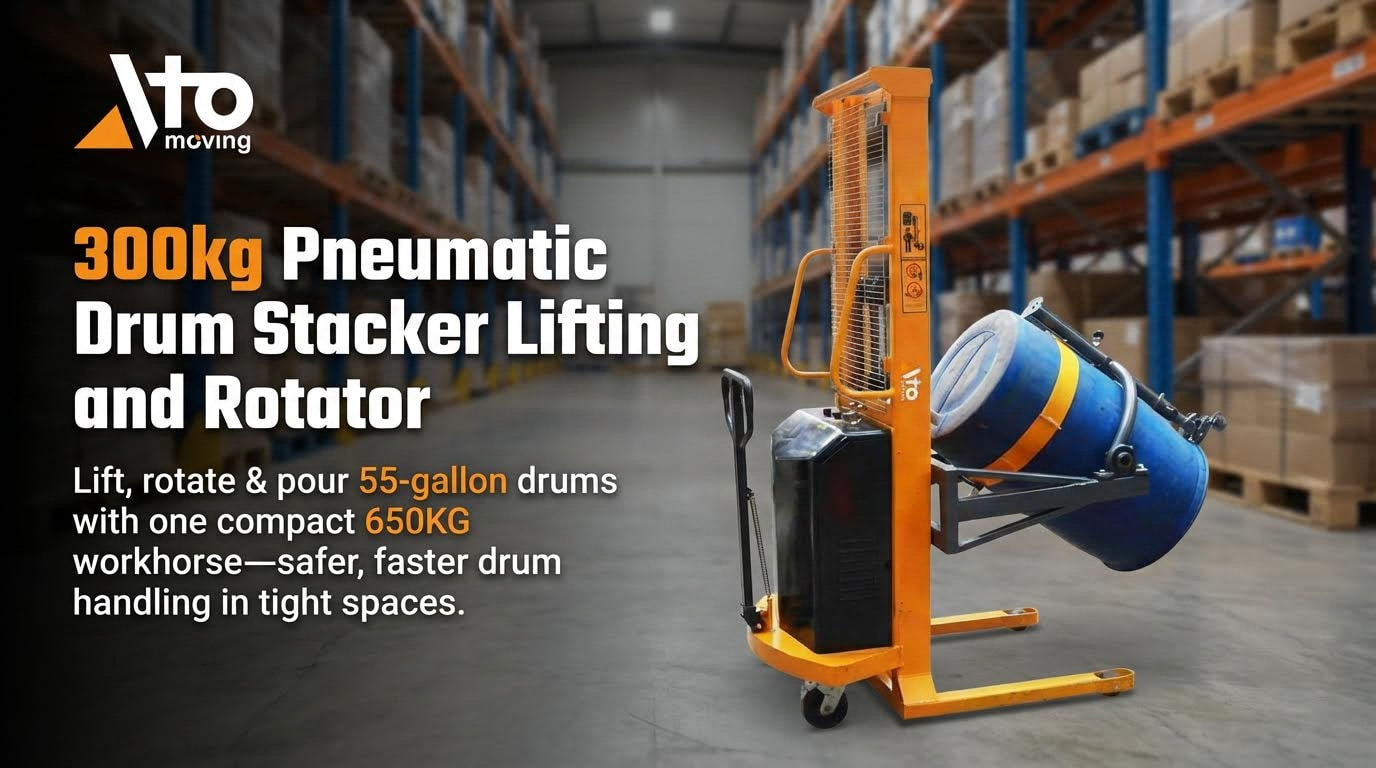
Core functions and operating principles
Drum stackers are specialized material handling devices designed to lift, transport, stack, and often rotate standard drums safely and efficiently. Typical units handle up to 450 kg (about 1,000 lbs) for 200 liter / 55 gallon drums, covering steel, plastic, and fiber types for common industrial applications. Knowing how to use a drum stacker starts with understanding that the operator positions the unit around the drum, engages the grip mechanism, then uses a hydraulic or mechanical system to raise the drum to the required height.
Most drum stackers rely on hydraulic operation to multiply the operator’s input force and provide smooth, controlled lifting and tilting, which reduces physical strain and improves precision during handling cycles. Once lifted, the chassis and wheel set allow the drum to be transported to storage racks, process lines, or decanting stations. Many models incorporate a rotation head that can tilt the drum up to 180 degrees, enabling complete emptying into hoppers or mixing vessels while keeping the operator clear of the load path and minimizing manual handling. This combination of vertical lift, horizontal travel, and controlled rotation is what makes drum stackers a compact alternative to forklifts for drum-intensive operations.
Typical operating sequence
In most facilities, the basic sequence for how to use a drum stacker is: (1) approach and center on the drum, (2) close the clamp or chain around the drum, (3) lift to the required height using the hydraulic control, (4) travel to the destination with the drum kept low for stability, and (5) raise and, if equipped, rotate to pour before lowering and releasing the drum.
Key components and design features
To perform these functions safely, a drum stacker combines several key structural and mechanical elements. The mast and frame carry the vertical load, while forks or a cradle support the drum; for some designs, fork sections are solid steel, approximately 1 inch thick, 3 inches wide, and 30 inches long to provide a rigid support platform for typical drum sizes. Adjustable clamps, chain locks, or similar grip mechanisms secure the drum body or rim and prevent slipping or dropping during lifting and transport even when the drum is partially filled. A hydraulic pump, cylinder, and control handle or pedal provide the lifting force and allow the operator to meter the speed of raising and lowering for precise positioning.
The wheel and caster arrangement is critical for maneuverability and stability, especially in narrow warehouse aisles. Typical designs use heavy-duty swivel casters with brakes, allowing the operator to lock the unit during loading, unloading, and stacking operations to avoid unintended movement. Front and rear wheel diameters often fall in the 4 to 5 inch range, which balances low rolling resistance with floor condition tolerance for typical industrial floors. Many drum stackers also integrate a rotation head or gear mechanism at the drum cradle, enabling controlled 180 degree tilting for decanting tasks without manual tipping. Understanding these components and how they interact is essential when training operators on how to use a drum stacker correctly and when specifying equipment for demanding drum-handling environments.
| Key Component | Primary Function |
|---|---|
| Mast and frame | Carry vertical loads and provide structural stiffness during lifting and travel |
| Forks or cradle | Support the drum base or shell; transmit load to the mast |
| Clamp / chain lock | Grip the drum securely to prevent slipping or dropping |
| Hydraulic pump and cylinder | Provide lifting force and controlled vertical motion |
| Swivel casters with brakes | Enable maneuvering and secure positioning during handling |
| Rotation head (if fitted) | Allow controlled tilting or pouring up to 180 degrees |
Engineering Specs, Safety, And Performance
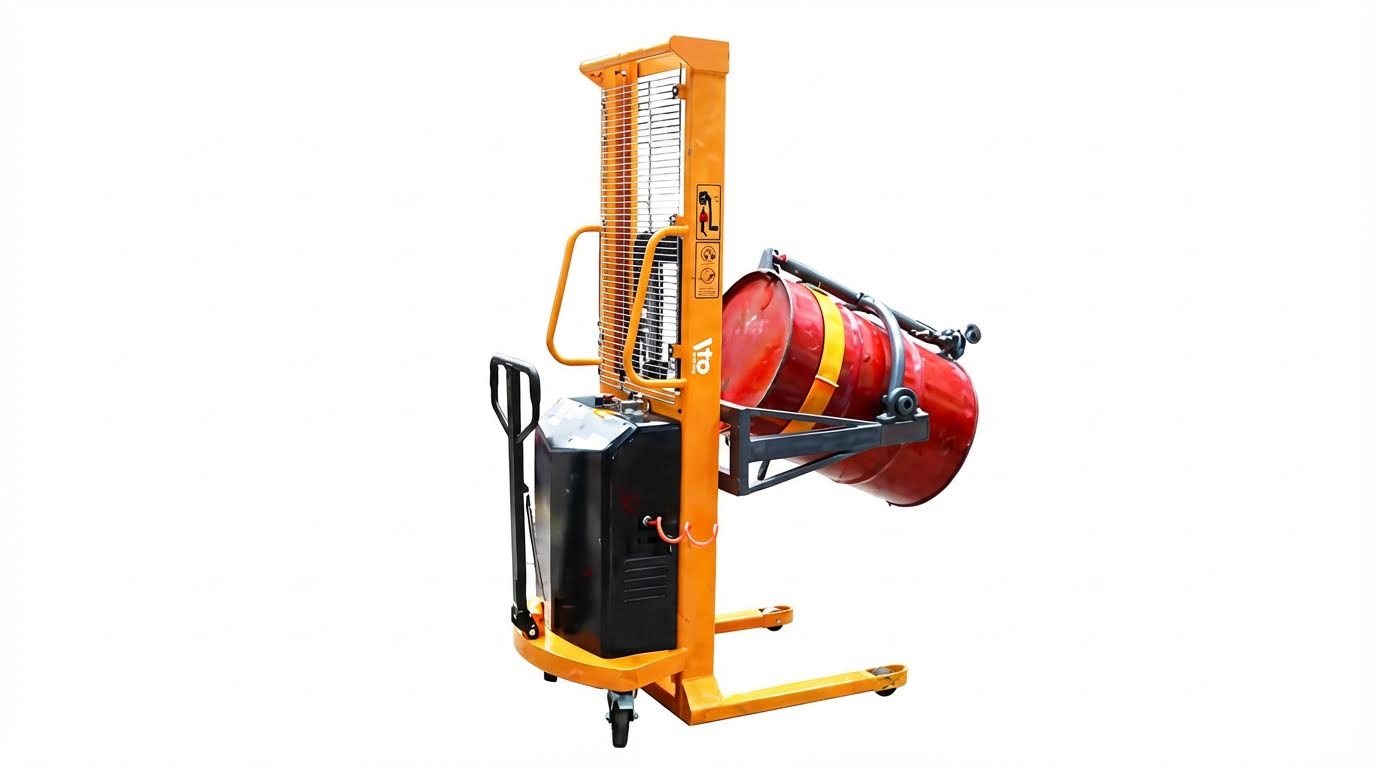
Load, lift height, and rotation capabilities
When planning how to use a drum stacker safely and efficiently, start with basic load, height, and rotation limits. Many industrial drum stackers are designed for loads up to 450 kg (about 1,000 lb) for standard 200 L / 55 gal drums, covering steel, plastic, and fiber types. Typical rated capacity is around 450 kg for standard drums. Operators must never exceed the nameplate capacity and should derate for off‑center loads or damaged drums.
- Lifting heights commonly range from about 1,500 mm to 3,000 mm, which allows stacking on mezzanines, racking, or into process hoppers. Typical lift ranges are 1,500–3,000 mm. Always compare maximum lift height with your rack beam elevations and door clearances.
- Many units provide up to 180° drum tilting for controlled pouring or full emptying into mixers and tanks. Integrated rotation systems often allow 180° tilt. Operators should pause rotation to let liquids settle and avoid sloshing that can destabilize the stacker.
- Hydraulic operation keeps effort low and movement smooth, which reduces ergonomic strain and improves control during lifting and tilting. Hydraulic pumps and valves provide controlled lifting and tilting. For safe use, operators should feather the controls, especially when handling high‑center‑of‑gravity loads.
Typical dimensional and capacity envelope
| Parameter | Typical range / value |
|---|---|
| Rated load | Up to 450 kg (≈1,000 lb) per drum (standard drum sizes) |
| Lift height | ≈1,500–3,000 mm max hook / cradle height (model dependent) |
| Rotation | Up to 180° drum tilt for emptying (manual or hydraulic) |
Stability, wheels, and grip mechanisms
Stability is a core engineering concern when defining how to use a drum stacker in tight warehouse aisles or on uneven floors. Frame geometry, wheel layout, and drum grip design all work together to keep the load inside the stability triangle. Many drum stackers use solid-steel fork or cradle structures; for example, forks around 1″ thick, 3″ wide, and 30″ long provide a rigid support base for 30 and 55 gallon drums. Typical fork dimensions are 1″ thick × 3″ wide × 30″ long.
- Raised heights from about 48″ to 86″ with a low lowered height near 1.5″ keep the center of gravity as low as practical during travel. Typical raised height is 48"–86" with a 1.5" lowered height. Operators should always travel with the drum at the lowest safe height.
- Front and rear wheel diameters around 4″–5″ help maneuverability while keeping the chassis compact for narrow aisles. Common wheel sizes are 4" to 5" diameter. Heavy‑duty swivel casters with brakes improve directional control and hold the unit in place during loading or pouring. Swivel casters with brakes are standard on many manual drum stackers.
- Grip mechanisms often use adjustable clamps, chain locks, or jaws that engage the drum rim or body to prevent slip or drop. Adjustable clamps or chain locks secure the drum during lifting and travel. Before each lift, operators should verify full clamp engagement and perform a short “test lift” a few centimeters off the floor.
- Shipping weight in the 380–590 lb range gives the frame enough mass to resist tipping while still being pushable by one person on good floors. Typical shipping weights range from 380 to 590 lb. Facilities should avoid steep ramps or soft ground that can compromise stability.
Key stability-related specs
| Feature | Typical spec / role |
|---|---|
| Fork / cradle design | Solid-steel, 1″ × 3″ × 30″ forks for drum support (bolted for 30 & 55 gal drums) |
| Wheel / caster system | 4″–5″ diameter front/rear wheels; swivel casters with brakes for control (model dependent) (manual stackers) |
| Grip mechanism | Adjustable clamps / chain locks to prevent drum slipping or dropping (rim or body engagement) |
Safety standards, training, and maintenance
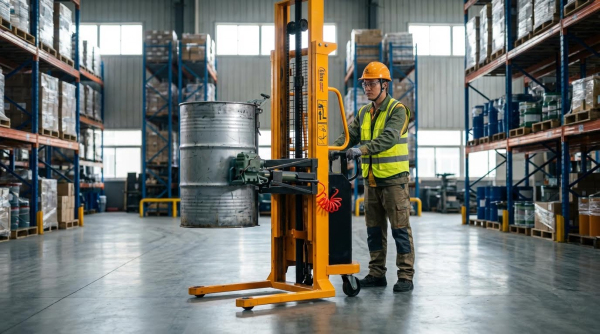
Safe practice for how to use a drum stacker depends as much on people and procedures as on hardware. Operators need formal training on safe handling, correct use of controls, and emergency response. Training programs should cover route planning, speed limits, stacking rules, and how to recognize unsafe drum conditions. Stacker operators also benefit from periodic recertification so that skills and awareness stay current. Operator training, safe handling techniques, and recertification are core safety requirements.
- Daily and periodic inspections should include hydraulic pumps, seals, clamps, and structural welds, with any leakage or deformation reported immediately. Routine checks of hydraulics, grip mechanisms, and fasteners are recommended. Lubrication of moving joints and tightening of bolts help maintain long‑term structural integrity.
- Warehouse layout must support safe drum stacker operation with clear travel lanes, marked height limits, and obstacle-free loading zones. Work areas should have marked exits, circulation routes, and height limits. Floor markings and warning signs reduce collision risks with pedestrians and racking. Movement areas and routes should be clearly indicated with signage and floor warnings.
- Material stacking rules are critical for drums and other cylindrical loads. Heavier items should always be stacked at the bottom, with stable, level bases and symmetric drum patterns. Guidelines call for heavy items on the bottom and symmetrical stacking for drums and barrels. Where drums are stacked on end, operators should use skids or plywood between layers to improve stability.
- Housekeeping and PPE policies complete the safety envelope. Clean, dry aisles reduce slip risks for push‑type drum stackers, while gloves, safety shoes, and eye protection reduce injury severity if an incident occurs. Good housekeeping and appropriate PPE are highlighted as key controls for manual material handling. Facilities should also maintain emergency plans and conduct drills for events such as spills, fires, or power outages. Emergency procedures and drills are recommended for fires, accidents, and outages.
Selecting And Applying Drum Stackers In Your Facility
Matching stacker types to applications
When you plan how to use a drum stacker in your facility, start by matching the equipment to drum type, weight, and task. Typical drum stackers handle up to 450 kg (1,000 lb) and work with standard 200 L / 55 gal drums, as well as smaller 30-gallon units in steel, plastic, or fiber construction. Define the main job: vertical storage, line feeding, drum decanting, or frequent short moves between workstations. Then select manual, semi-electric, or fully powered units based on duty cycle and operator availability.
- For simple stacking and retrieval: choose vertical lift stackers with fixed or limited rotation.
- For decanting or dosing: specify models with 180° rotation for full emptying into process vessels or IBCs using integrated tilt mechanisms.
- For mixed-height racking: check that lift height (often 1,500–3,000 mm) covers the highest storage position with clearance for safe maneuvering within your existing warehouse system.
Grip style is also application-specific. Adjustable clamps or chain locks are better where drums vary in diameter or surface finish, and they help prevent slipping during travel and rotation by securing the drum body or rim. In chemical, oil, and recycling operations, where spills are critical, prioritize positive mechanical grips over simple belt slings to maintain control through the full lift and tilt cycle.
Layout, workflow, and cost-benefit considerations
Correct facility layout is central to how to use a drum stacker safely and efficiently. Keep drum travel routes short and direct between receiving, storage, production, and waste areas, and mark circulation paths and crossings clearly to reduce collision risks with floor indicators and directional signs. Ensure loading and unloading zones have level, solid floors and adequate overhead clearance so drums can be raised to the required height without striking structures or racking beams. Good housekeeping, including prompt cleanup of spills and keeping aisles clear, supports consistent traction and maneuverability for the stacker wheels and reduces slip and trip hazards.
Key layout and workflow checks
- Confirm that stacker lift height matches rack beam elevations and drum stacking patterns.
- Allocate turning space at aisle ends based on stacker wheelbase and drum overhang.
- Place high-throughput drums near the front of storage to cut travel time, while low-use drums can sit further back following general material stacking guidelines.
- Use symmetrical stacking patterns and solid bases when drums are stored on end to maintain stability during handling between stacker cycles.
From a cost-benefit view, treat drum stackers as a logistics investment and evaluate them over several years. Include direct costs (equipment purchase, any battery systems, and extra attachments) and indirect costs such as operator training, layout changes, and integration with existing storage systems in your project scope. Quantify benefits in terms of reduced manual handling, lower injury risk, fewer spills, and higher throughput per shift, then discount future cash flows to calculate net present value and payback period using standard logistics CBA methods. Facilities that move high drum volumes or free up floor space by going vertical often recover stacker investments relatively quickly through labor savings, space consolidation, and reduced incident costs as shown in similar vertical stacking applications.
“”
Final Thoughts On Using Drum Stackers Efficiently
Drum stackers work best when engineering limits, layout, and training form one tight system. Capacity, lift height, and rotation range set the safe operating envelope. Frame geometry, wheel size, and grip design then keep the drum’s center of gravity inside that envelope during every move. When you respect these limits, you cut tip-over risk and protect both people and product.
Safe, efficient use also depends on how you design the work. Short, direct routes and clear floor markings reduce travel time and collisions. Solid, level loading zones and stable stacking patterns keep drums predictable under load. Daily checks of hydraulics, clamps, and welds catch problems early and keep performance consistent over years, not months.
For most facilities, the best practice is simple. Select drum stackers that match your heaviest drum, highest rack, and worst-case route. Train operators to travel low, clamp correctly, and respect nameplate ratings. Maintain strict housekeeping and PPE rules. When you follow these steps and choose well-engineered equipment from suppliers like Atomoving, drum stackers become a reliable way to raise throughput, reduce strain injuries, and handle drums with repeatable, engineered safety.
Frequently Asked Questions
How to Use a Drum Stacker Safely?
A drum stacker is used to lift and stack drums for storage or transport. Always ensure the stack height adheres to safety guidelines. For three-high stacking, do not exceed 10 feet, and for four-high stacking, do not exceed 13 feet 9 inches Drum Stacking Safety. Ensure drums are stable and secured against sliding or collapse.
- Inspect the drum stacker for damage before use.
- Position the stacker properly under the drum.
- Lift slowly and check stability at each level.
What Does OSHA Say About Stacking Pallets?
OSHA requires that cargo, pallets, and other materials be stacked to prevent sliding or collapse OSHA Stacking Rules. Always follow these guidelines to maintain a safe warehouse environment.
- Ensure even weight distribution across the pallet.
- Use tie-downs or wraps if necessary for extra stability.
- Regularly inspect stacks for signs of instability.