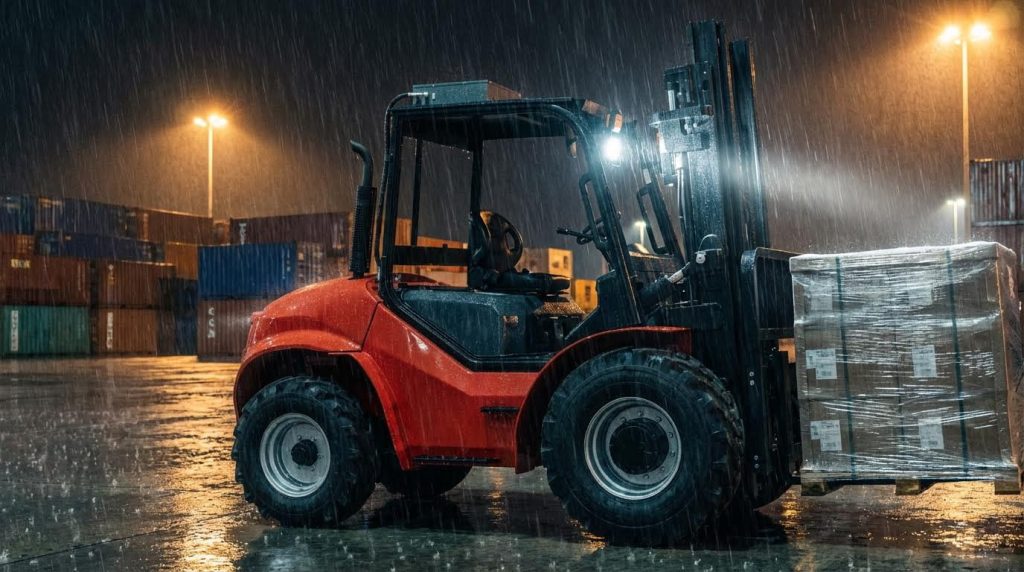
Electric forklifts and water do mix sometimes—but only under the right conditions. This guide explains when rain use is safe, how IP ratings and design features limit or enable outdoor work, and what operators must do to manage traction, visibility, and electrical risks. If you have ever wondered “can electric forklifts be used in the rain” for real-world loading bays and yards, you will find clear, data-based answers here. By the end, you will know how to specify, operate, and maintain trucks so wet weather hurts neither safety nor uptime.
When Is Rain Use Safe For Electric Forklifts?
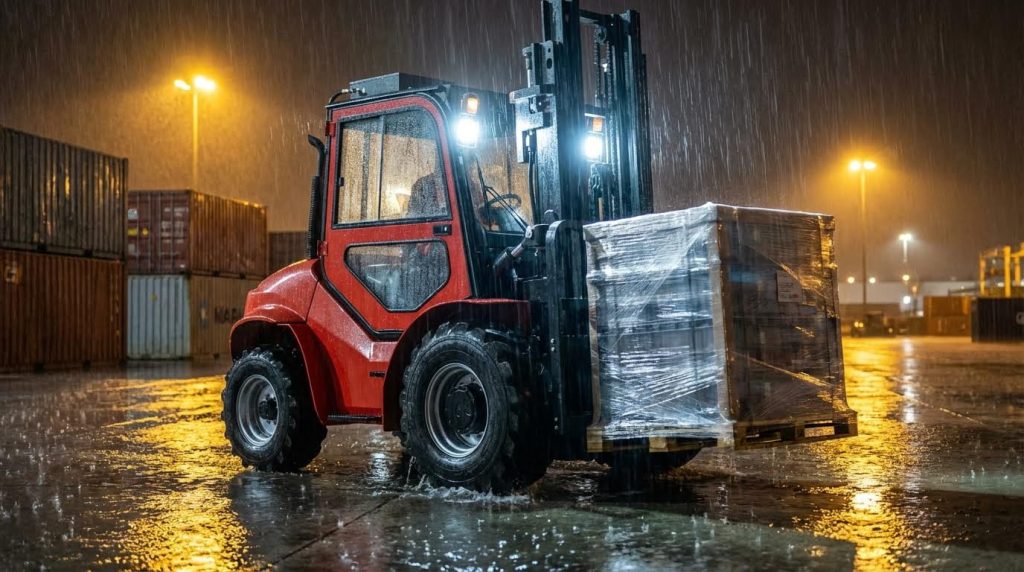
How IP ratings define “rain-capable” forklifts
If you are asking “can electric forklifts be used in the rain,” the first filter is always the IP rating. IP (Ingress Protection) tells you how well the truck and its components resist dust and water. For rain, the second digit (water) is the one that matters most.
| IP rating level | Water protection meaning | Typical suitability for rain use |
|---|---|---|
| IPX0–IPX2 | No protection to protection from vertical drips only | Indoor dry use only; not rain-capable |
| IPX3 | Protected from spraying water up to 60° from vertical | Very light, wind‑sheltered drizzle at most |
| IPX4 | Protected from splashing water from any direction | Generally accepted minimum for light to moderate rain with controls in place (IPX4 definition and rain use) |
| IP54 (common on warehouse trucks) | Dust‑protected and splash‑proof | Suitable for damp areas and light rain; not for heavy, prolonged rain or standing water (typical IP54 forklifts) |
| IP65 | Dust‑tight and protected from low‑pressure water jets | Suited to frequent outdoor work and heavy rain, but not immersion (IP65 explanation) |
| IPX8 | Protected for continuous immersion | Waterproof components; still not a license to drive through deep water with a forklift (IPX8 meaning) |
Each major electrical part has its own IP rating, and the “weakest link” governs the truck. If motors and controllers are IP65 but a key switch is only IP44, the effective rating of the forklift is IP44. Component‑specific IP ratings mean you cannot assume the whole truck is as protected as its best‑sealed component.
In practice, can electric forklifts be used in the rain? Yes, but only when the truck’s verified IP rating matches the actual exposure. As a rule of thumb, IPX4 or IP54 can handle short, light to moderate rain, while regular outdoor work in heavy rain calls for IP65‑level protection or better. None of these ratings justify driving into deep standing water or allowing prolonged soaking.
Quick IP‑based go/no‑go checklist
Generally acceptable for outdoor rain work when all are true:
- Forklift (or critical components) documented at IPX4 / IP54 or higher.
- Rain is light to moderate, not a thunderstorm or pressure wash.
- No standing water that could reach motors, battery, or connectors.
- Planned exposure time limited (often kept within 1–2 hours per shift) (recommended exposure limits).
High‑risk / avoid use when any are true:
- Unknown or sub‑IPX4 rating.
- Heavy, wind‑blown rain or hail.
- Water depth that can splash into battery compartments or motors.
- Use of high‑pressure hoses or washdowns during operation.
Typical indoor vs. outdoor duty cycles in wet weather
Even when the IP rating says a truck can tolerate rain, duty cycle in wet weather must stay conservative. Moisture raises both electrical risk and traction risk, so you manage exposure time, speed, and route, especially when you run mostly indoor fleets that only “poke outside” in bad weather.
Light indoor‑focused electric forklifts often have IP54‑level protection that coped with damp floors and occasional splashes, not hours of continuous rain. Typical IP54 warehouse trucks are best treated as “short‑trip outdoor visitors” in wet weather, not true outdoor workhorses.
| Use case | Typical environment | Rain exposure pattern | Key controls |
|---|---|---|---|
| Indoor truck, occasional outdoor doorway work | Warehouse with covered docks; short apron outside | Brief runs through drizzle or light rain; usually <15 minutes at a time | Keep speed low; avoid puddles; return under cover quickly; prioritize IPX4/IP54 or higher |
| Indoor truck shuttling between buildings | Campus layout with short outdoor links | Repeated short outdoor legs, possibly totaling 1–2 hours per shift in wet conditions (recommended limit) | Plan routes on hard, well‑drained pavement; schedule around heavy storms; use cab/awnings; enforce post‑rain inspections |
| Outdoor‑rated electric forklift | Yards, loading areas, construction supply, etc. | Regular operation in wet conditions, including moderate to heavy rain | Specify higher IP (e.g., IP65 components), traction tires, and GFI; enforce reduced speeds and strict “no deep water” rule (outdoor design features) |
Across all these scenarios, wet surfaces increase stopping distance and reduce stability, so duty cycles in the rain must assume lower average travel speed and longer task times. OSHA guidance emphasized slower driving and careful handling on wet or uneven ground.
- Plan outdoor trips so the truck spends as little time as practical in active rainfall.
- Keep operations on hardened, well‑drained surfaces; avoid gravel ruts and soft ground where water pools.
- Stop work and return indoors if rain intensity, wind, or water depth exceeds what the truck’s IP rating and tires can safely handle.
So, can electric forklifts be used in the rain? They can, but only with the right IP rating, tightly controlled exposure time, and a duty cycle that respects wet‑surface traction limits and keeps electrical components out of standing water.
Key Design Factors For Wet-Weather Operation
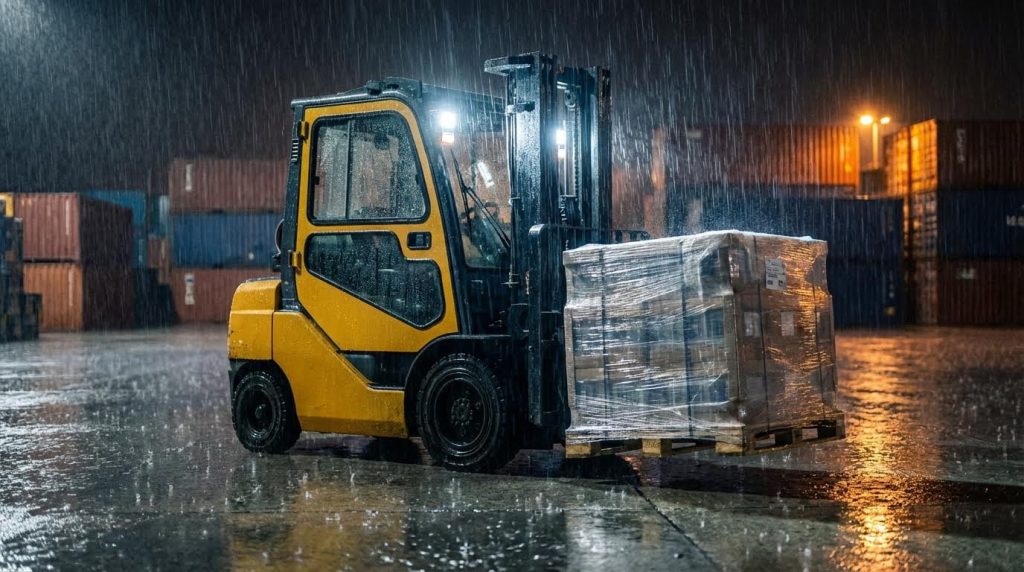
Understanding key design factors is essential when asking can electric forklifts be used in the rain. In wet conditions, the limiting factors are almost always IP protection of components, battery compartment design, and traction on slippery surfaces. The following sections break down where typical electric trucks are vulnerable and what to look for if you expect regular rain exposure.
Component-level IP ratings and weak points
Overall forklift IP ratings are only as strong as the weakest component. Each motor, controller, switch, and connector has its own ingress protection level, and the truck’s practical rating equals the lowest of these. Component-Specific IP Ratings
| Item | Typical IP level | Rain suitability | Key notes for users asking “can electric forklifts be used in the rain” |
|---|---|---|---|
| Standard warehouse truck (overall) | IP54 | Light rain / splashes only | Protected from dust and splashing water, but not heavy rain or standing water. IP Ratings for Electric Forklifts |
| Outdoor‑oriented electric truck | IP65 (typical target) | Regular heavy rain | Dust‑tight and resistant to low‑pressure water jets, but not immersion. IP Ratings for Electric Forklifts |
| Minimum for light rain use | IPX4 | Light to moderate rain | Protected against splashing water from any direction; exposure should be time‑limited. Acceptable Conditions for Use |
Weak points are usually small, low‑cost parts rather than the main drive motor. Typical vulnerable components include:
- Key switches and start/stop buttons with lower IP ratings (e.g., IP44).
- Joystick assemblies and control pods with open slots or bellows.
- Exposed connectors, relays, and junction boxes under the floor plate.
- Lighting and signal fixtures with degraded seals.
- Open harness entries into the chassis or mast.
Moisture ingress at these points can cause short circuits, corrosion, or intermittent control faults, raising both downtime and safety risk. Operational Risks in Rain
Why the “weakest IP link” governs real-world use
Even if motors and controllers are IP65, a single IP44 key switch or open connector can admit water, creating a failure path or shock hazard. In practice, you must treat the truck as if every component shares the lowest rating when deciding whether it should operate in heavy rain or near standing water. Component-Specific IP Ratings
Battery technologies and compartment protection
Battery choice and compartment design heavily influence whether and how can electric forklifts be used in the rain. Water around high‑energy batteries introduces corrosion, tracking paths, and potential shock or fire hazards, especially if drainage and sealing are poor.
| Aspect | Lead‑acid batteries | Lithium‑ion batteries |
|---|---|---|
| Water sensitivity | High – exposed terminals and vent caps are vulnerable to corrosion and contamination. Battery Protection | Better sealed, but still must avoid direct water contact on housings and connectors. Battery Protection |
| Typical compartment design | Open‑top steel tray; often vented to atmosphere. | More likely to use sealed modules and closed compartments. |
| Required protection in rain | Sealed compartment with gasketed covers and effective drainage to keep water off terminals. Battery Compartment Design | Sealed compartment plus protected high‑voltage connectors and BMS wiring. |
| Post‑rain maintenance focus | Check for corrosion, clean and dry terminals, verify vent caps and cables. Post-Rain Maintenance | Inspect seals, connectors, and harness grommets for leaks and moisture. |
Key design and maintenance features that support safe wet‑weather operation include:
- Sealed battery compartments with formed drainage paths so water cannot pool around terminals. Battery Compartment Design
- Corrosion‑resistant coatings on trays and nearby structural members to slow rust. Corrosion-Resistant Coatings
- Ground Fault Interruption (GFI) circuits that detect leakage current in wet conditions and shut the truck down before shock risk arises. Ground Fault Interruption (GFI)
- Dry, well‑ventilated charging areas that are protected from rain and spray. Battery Care in Wet Environments
- Post‑rain inspection and drying of battery connectors, harnesses, and compartment floors. Post-Operation Maintenance
Failure modes if the battery area is not protected
Without proper sealing and drainage, rainwater can sit in the tray, bridging terminals and accelerating corrosion. This raises resistance, heats connections, and can eventually cause arcing or loss of power. In extreme cases, moisture paths can combine with damaged insulation to create a shock or fire hazard, especially on older lead‑acid systems. Battery Protection
Traction, tires, and stability on wet surfaces
Even when electrics are electrically protected, many incidents in rain start with lost traction, extended stopping distances, or reduced stability. Wet floors and yards lower the friction coefficient between tire and ground, so braking and steering margins shrink quickly.
| Factor | Dry conditions | Wet conditions | Design / setup response |
|---|---|---|---|
| Surface friction | Higher; shorter stopping distances. | Lower; skidding and hydroplaning risk increase. Surface Conditions in Rainy Weather | Specify suitable tires, reduce travel speeds, improve drainage. |
| Tire type | Cushion or smooth tires work well on clean, dry floors. | Cushion tires lose grip quickly; deep‑tread pneumatics perform better. Tire Selection for Outdoor Use | Use pneumatic or outdoor‑rated tires with water‑dispersing tread patterns. |
| Control systems | Basic traction control may rarely intervene. | Traction control is more active, limiting wheel spin on slick patches. Traction Control Systems | Specify trucks with traction control for frequent outdoor wet use. |
Key design and maintenance elements that improve traction and stability in rain include:
- Pneumatic or solid pneumatic tires with deep tread for outdoor yards, instead of smooth cushion tires. Tire Selection for Outdoor Use
- Regular tire inspections for wear, cuts, and correct tread depth, with immediate replacement of damaged tires. Tire Maintenance in Wet Conditions
- Traction control systems that modulate torque to prevent wheel spin when accelerating on slick surfaces. Traction Control Systems
- Yard and dock designs with proper drainage so water does not pool in travel paths. Environmental Adaptations for Safety
- Good lighting and visibility aids so operators can see puddles, slopes, and obstacles. Visibility Enhancements in Rain
From a stability standpoint, reduced friction means side‑slope limits and cornering speeds that feel safe in the dry can become unsafe in the wet. Operators need to cross uneven areas at an angle to keep wheels in contact and avoid sudden steering inputs or mast movements that can trigger a tip‑over on slick ground. Surface Conditions in Rainy Weather
How traction links back to the core question
Even if IP ratings and batteries are fully rain‑ready, poor traction can still make wet‑weather operation unsafe. For a realistic answer to “can electric forklifts be used in the rain,” you must evaluate tire type, surface condition, and drainage with the same rigor as electrical protection. Only when all three—IP, battery protection, and traction—are addressed together can you treat an electric forklift as truly rain‑capable.
Final Guidance On Using Electric Forklifts In The Rain
Safe rain operation depends on how well you match truck design, IP protection, and duty cycle to real weather and site conditions. IP ratings define the electrical limits, but traction, surface drainage, and battery protection decide whether the risk stays controlled over time. If you push indoor‑rated, IP54 warehouse trucks into long, wet shifts, you invite failures in weak components and higher accident rates on slick ground.
Engineering and operations teams should treat the lowest IP‑rated part as the true limit, then build procedures around it. Use sealed battery compartments with good drainage, outdoor‑rated tires, and, where needed, GFI and traction control. Keep exposure short for indoor trucks, and reserve heavy, sustained rain work for forklifts with IP65‑level components and outdoor packages from suppliers like Atomoving.
As a best practice, create a rain operations plan that links “go / slow / stop” decisions to IP rating, rainfall intensity, water depth, and surface condition. Train operators to avoid standing water, cut speed on wet pavement, and carry out post‑rain inspections. When you align design, specification, and procedures this way, electric forklifts can work in the rain without trading safety for uptime.
Frequently Asked Questions
Can electric forklifts be used in the rain?
Electric forklifts can be used in the rain, but only if they have an appropriate water ingress protection rating. Forklifts rated ‘IPX4’ or higher are safe to operate in rainy conditions. The water ingress rating indicates how well the forklift is protected against water. For example, a zero means no protection, while an 8 means the forklift is fully waterproof and could even be submerged in water up to 9 feet deep. Forklift Safety Guide.
Are there risks when using electric forklifts in wet conditions?
Using electric forklifts in wet conditions poses several risks, including corrosion, electrical problems, and slippery surfaces that make operation less safe. These risks are similar to those faced by other material handling equipment like scissor lifts. It’s important to ensure the equipment is designed for outdoor use and has adequate protection against water. Regular maintenance checks can help mitigate these risks and keep the forklift functioning safely.