
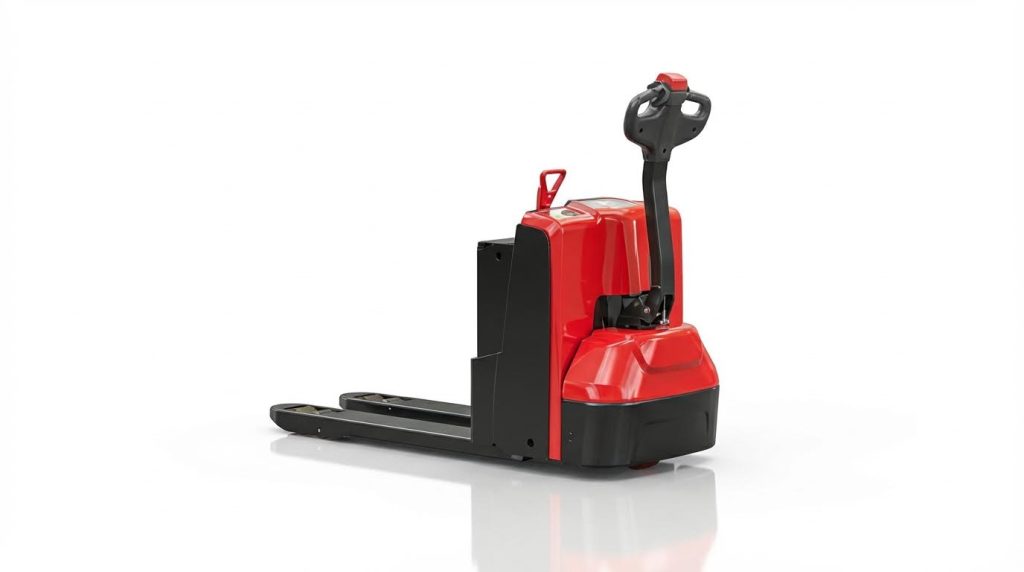
Using engineering reality, the answer to “can a pallet jack lift a car” is that while some pallet jacks may match a car’s weight on paper, they are absolutely not designed or safe for lifting vehicles. This article explains how pallet jacks actually work, why car frames, floor loads, and stability factors make this practice dangerous, and which standards and regulations forbid such misuse. You’ll also see safer alternatives for moving heavy or irregular loads and a final engineering verdict on why you should never use a pallet jack to lift a car.
How Pallet Jacks Work And What They’re Designed For
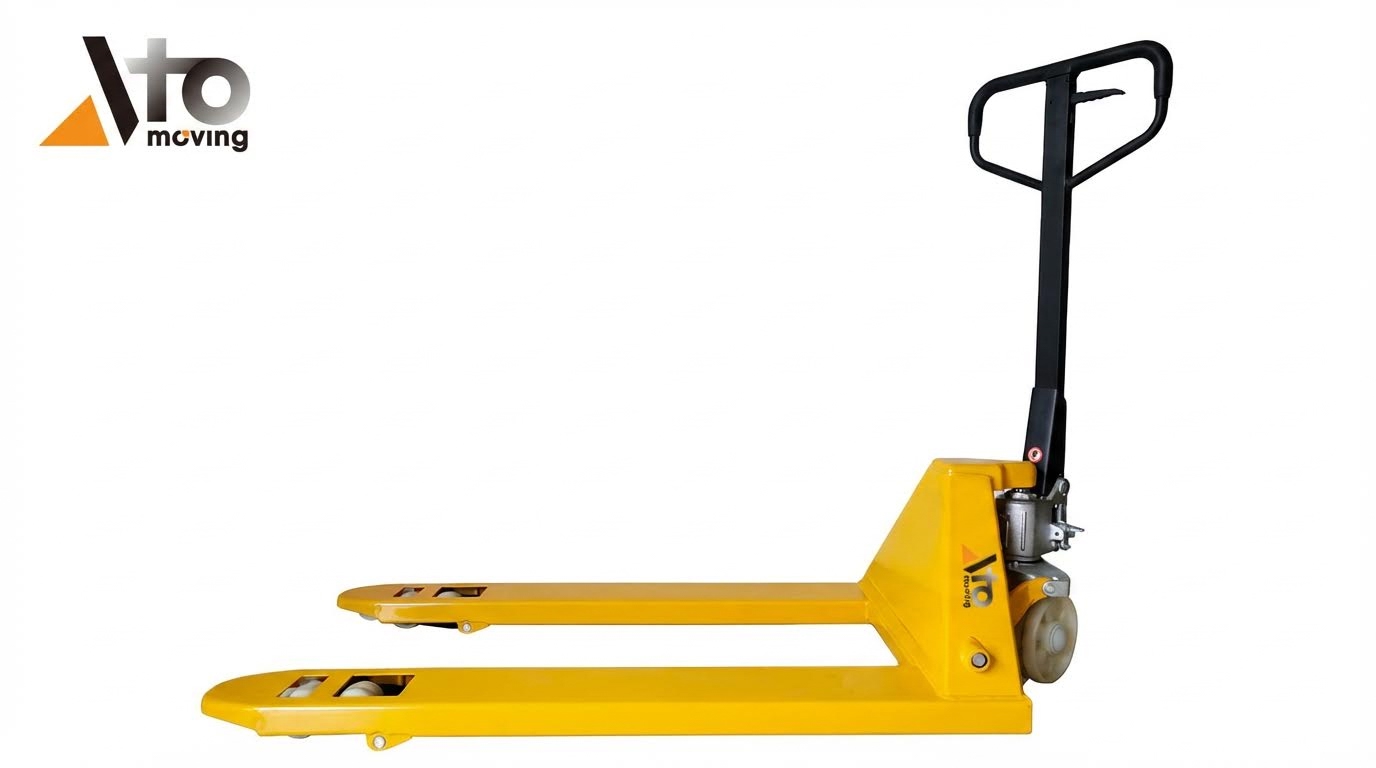
Pallet jacks are low‑lift industrial trucks engineered to raise palletized loads a few centimeters for horizontal transport, not to act as vehicle or car jacks. Understanding how they generate lift, how they are rated, and how stability is defined explains why asking “can a pallet jack lift a car” is fundamentally a misuse of the equipment.
Hydraulic lifting principles and rated capacity
The hydraulic system in a pallet jack multiplies hand or electric input using Pascal’s law, and the resulting rated capacity assumes ideal palletized loads at a defined load center. Manual pallet jacks use a simple pump actuated by the drawbar; powered units use an electric motor to drive the pump, but the underlying physics is the same.
When you stroke the handle on a manual pallet jack, you pressurize hydraulic fluid, which transfers force uniformly through the system to a small cylinder that raises the fork linkage. This follows Pascal’s law: pressure applied to a confined fluid transmits equally in all directions, allowing a modest hand force to lift several thousand kilograms. Typical manual pallet jacks weigh about 75–90 kg and are rated for roughly 2,000–3,000 kg (4,400–6,600 lbs) of load under standard test conditions. Electric pallet jacks are heavier at about 180–320 kg, with common capacities in the 2,000–2,500 kg range due to added motor and battery mass.
Rated capacity is not just a “maximum weight”; it is defined at a specific load center (typically around the geometric center of a standard pallet) with the load fully supported along the fork length. Dynamic effects—turning, braking, floor bumps—can momentarily increase effective loading on the structure beyond the static value, which is why engineers build in a safety factor and why operators are advised not to run at the absolute nameplate limit during real operations. Attempting to treat a car body as if it were a compact pallet ignores these assumptions about uniform support and center of gravity.
| Parameter | Typical Manual Pallet Jack | Typical Electric Pallet Jack | Field Impact |
|---|---|---|---|
| Tare weight | 75–90 kg | 180–320 kg | Heavier units press harder into the floor, improving traction but increasing floor load and pushing effort. |
| Rated capacity | 2,000–3,000 kg | 2,000–2,500 kg | Defines safe load under ideal pallet conditions; exceeding it risks structural deformation or failure. |
| Lift mechanism | Manual hydraulic pump | Electric motor‑driven pump | Same physics; powered units reduce operator fatigue but obey the same capacity limits. |
| Typical use case | Short, low‑frequency moves | Longer, high‑frequency moves | Choosing the right type reduces operator strain and improves throughput. |
💡 Field Engineer’s Note: The question “can a pallet jack lift a car” ignores that capacity is tested with flat pallets; when you shift to narrow contact points like car frame rails, you concentrate stress and can bend forks permanently long before reaching the nameplate limit.
How engineers decide pallet jack capacity
Designers size the hydraulic cylinder, frame, and forks so that under rated load the highest stresses stay below material yield with a safety factor. They also assume a defined load center and include allowances for dynamic loads during braking and turning. The nameplate capacity is therefore already a compromise between strength, weight, and cost—not a challenge to see “how much more” the truck can survive.
Tare weight, stability, and load center limits
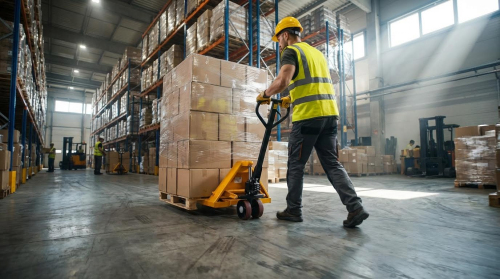
The tare weight and geometry of a pallet jack are tuned for stability with flat, evenly distributed pallet loads at a known load center, not for lifting point loads like car frames or axles. Stability is a balance between the truck’s own mass, wheelbase, fork length, and where the combined center of gravity sits as the load is raised and moved.
Most of a manual pallet jack’s mass—over 70%—sits in the steel frame and forks, with the hydraulic unit and wheels making up the rest to provide a rigid, low‑slung structure. In electric units, the motor, controls, and especially the battery add substantial weight; lead‑acid batteries alone can weigh 60–70 kg, while lithium‑ion packs typically weigh 20–30 kg and slightly reduce overall tare. That tare weight acts as a counterweight: if it is too low relative to rated capacity, the truck becomes twitchy and prone to tipping during turns or on uneven floors.
Engineers define load center as the horizontal distance from the fork face to the load’s center of gravity. Rated capacity assumes the center of gravity stays within that design envelope and that the load is stable and evenly distributed. Real‑world guidance stresses that operators should verify the load mass against the nameplate in kilograms, stack the heaviest items at the bottom, and keep weight evenly spread to avoid instability during normal operation. Overhanging or high‑center loads are discouraged because they shift the center of gravity outward.
| Factor | Engineering Role | What Happens If Misused | Field Impact |
|---|---|---|---|
| Tare weight | Acts as counterweight to resist tipping and wheel slip. | Too light for the rating → poor stability, easier to tip on turns or ramps. | Don’t assume “lighter is better”; under‑mass trucks feel nervous at high loads. |
| Fork support area | Spreads load across fork length and width. | Point loading on a small area (e.g., car frame) concentrates stress and bends forks. | Always use full fork support under pallets; avoid narrow, rigid contact points. |
| Load center | Defines where the rated load can safely sit. | Center of gravity too far forward reduces rear wheel traction and increases tip risk. | Keep the heaviest mass low and centered over the forks. |
| Dynamic loading | Accounts for acceleration, braking, and floor defects. | Sudden stops or bumps spike stress beyond static rating. | Operate below max rating when floors are rough or slopes are present. |
From a stability standpoint, a car is the opposite of a good pallet load: the mass is high, long, and uneven, and you can only contact a few narrow points. Even if the gross vehicle mass is within the nominal 2,000–3,000 kg rating, the load center will be off, the forks will not fully support the chassis, and dynamic forces can easily exceed what the slender fork tips are designed to handle. That is why, in professional environments, we treat the question “can a pallet jack lift a car” as a red flag for misuse rather than a legitimate application to be engineered.
Why “more capacity” doesn’t fix bad load geometry
Buying a higher‑capacity pallet jack to handle an irregular load like a car does not solve the underlying geometry problem. The limiting factor becomes fork bending and tip‑over risk from a shifted center of gravity, not just total kilograms. Proper vehicle handling equipment supports the frame at multiple designed lift points to keep stresses within safe limits.
Why Lifting A Car With A Pallet Jack Is Unsafe
Lifting a car with a pallet jack is unsafe because vehicle weight, tiny contact areas, dynamic forces, and regulatory limits all combine to overload the jack, the floor, and the car’s frame far beyond their intended design.
When people ask “can a pallet jack lift a car,” they usually look only at the tonnage rating and ignore where and how that weight is applied. A pallet jack is rated assuming a flat, palletized load with an even footprint and a defined load center on warehouse-grade floors. A car is a flexible, irregular structure with suspension points, thin floor pans, and concentrated loads on small jack pads or tires. That mismatch is what creates the real danger.
💡 Field Engineer’s Note: In real warehouses, I’ve seen forks permanently bent just from running near rated capacity on bad floors—trying the same trick under a car body is asking for hidden damage and sudden failure.
Vehicle weight, contact points, and frame loading
Vehicle weight and contact geometry make lifting a car with a pallet jack dangerous because the load is concentrated into small, non-pallet contact points that exceed the design assumptions for forks and vehicle structure.
| Factor | Typical Value / Condition | Why It’s a Problem Under a Car | Field Impact |
|---|---|---|---|
| Passenger car mass | ≈ 1,300–1,800 kg (2,800–4,000 lbs) typical range | Appears “within” pallet jack rating, but only if load is palletized and evenly supported. | Operators falsely assume “weight is OK,” ignoring load shape and support points. |
| Manual pallet jack capacity | ≈ 2,000–3,000 kg (4,400–6,600 lbs) rated on nameplate | Capacity assumes a standard pallet with full fork support and correct load center. | Using the same rating under a car violates the conditions the rating is based on. |
| Fork contact area under car | Narrow fork tips or edges (tens of cm²) vs pallet deck (thousands of cm²) | Mass is concentrated into tiny contact patches on floor pan, exhaust, or subframe. | High local stress bends car sheet metal, crushes pipes, or punctures components. |
| Vehicle structure design | Designed for load at tires, suspension, and jack points; thin floor pans elsewhere | Forks rarely line up with true jack points; most contact is on weak sheet metal. | Hidden structural damage, alignment issues, and compromised crash performance. |
| Pallet jack tare weight | Manual ≈ 75–90 kg; electric ≈ 180–320 kg typical ranges | Tare acts as counterweight only when load is centered and low; under a car, center shifts unpredictably. | Jack can “see-saw” or unweight a wheel, suddenly shifting load and denting the car. |
| Load center assumption | Capacity based on load evenly distributed along forks and centered laterally | Car weight sits between axles, not neatly over fork length; one fork may carry most of the load. | One fork overloads, increasing risk of permanent bending and sudden collapse. |
Even if the raw number suggests that can a pallet jack lift a car in theory, the engineering reality is that the contact geometry and frame design are completely incompatible. The jack rating is a system rating—fork length, load center, distribution—not a blanket “any object under X kg” permission.
Why “it worked once” is not proof of safety
In the field, I often hear “we’ve done it before and nothing broke.” That usually means the material stayed just under its yield point that time. Repeating the stunt, or doing it on a slightly weaker spot on the car body, can push it past yield and cause permanent deformation or cracking with no warning.
Dynamic forces, floor loads, and tip‑over risk
Dynamic forces and floor loading make using a pallet jack under a car especially hazardous because movement, braking, and uneven floors multiply the effective load and shift the center of gravity outside the jack’s stable footprint.
| Dynamic / Floor Factor | Typical Range / Condition | Technical Risk | Field Impact |
|---|---|---|---|
| Dynamic load amplification | Loads near rating can exceed static weight when turning or stopping due to motion | Small bumps or steering inputs spike forces above rated capacity at the forks. | Forks or frame can deform or fail suddenly while a person is near the car. |
| Floor load capacity | Must support equipment + maximum load per guidance | Car + pallet jack concentrates several tons onto small wheel footprints. | On weak concrete or asphalt, wheels can punch in, tilting or dropping the car. |
| Wheel contact patches | Small polyurethane or nylon wheels; very high ground pressure | Any crack, drain cover, or expansion joint becomes a tipping lever. | One wheel dropping into a defect can twist the jack and shift the car sideways. |
| Center of gravity height | Raised car places CG far above fork level | Higher CG reduces stability margin; small lateral shifts cause big torque at wheels. | Increased tip‑over risk if the car is nudged, pushed, or partially rolled. |
| Uneven load distribution | Car mass biased to engine end; not symmetric | One end of the jack can be overloaded, even if total mass seems “within” rating. | Jack yaws or twists under load, damaging both the jack and vehicle. |
| Operating at upper limit | Guidance recommends avoiding full rated load in normal use for safety | Using near‑maximum capacity with poor load geometry eliminates safety margin. | Any extra force—pushing, pulling, or floor impact—can exceed design factors. |
💡 Field Engineer’s Note: Standard pallet jacks are designed for smooth, flat warehouse slabs; once you introduce slopes, drains, or outdoor asphalt, the rolling resistance and ground pressure change enough that “on paper” capacities no longer protect you.
From a physics standpoint, the question is not just “can a pallet jack lift a car off the ground,” but “can it keep that car stable while you move, steer, and stop on a real floor.” With a tall, narrow load like a vehicle body, the answer is no—the stability triangle is too small and the center of gravity too high and mobile.
How small bumps create big forces
When a loaded wheel hits a 10–20 mm floor lip, the jack has to lift that portion of the load vertically in a fraction of a second. That creates a short, high-force impulse at the forks—often well above the static weight of the car—right where the car body is least able to handle it.
Regulatory and compliance issues (OSHA/ANSI)
OSHA and ANSI rules make lifting cars with pallet jacks a compliance violation because they prohibit exceeding rated capacity, altering intended use, and operating industrial trucks in ways that reduce the original safety factor.
- Rated capacity must not be exceeded: Industrial trucks, including pallet jacks, are required to stay within their posted rated capacity, and all capacities must be clearly shown on the equipment nameplate. OSHA 1926.602 treats overloading as a direct safety violation.
- Use outside design intent is a de facto modification: Using forks as improvised vehicle lifts changes how loads are applied to the structure, effectively modifying the truck’s use without manufacturer approval, which standards explicitly forbid without updated capacity markings and analysis. Modification rules require written approval for changes affecting capacity or safety.
- Load assessment duties on the operator: Safe operation guidance requires operators to verify the mass and stability of loads against the pallet jack’s rated capacity and to avoid unstable or unevenly distributed loads. Best-practice guidance explicitly calls for stable, evenly distributed loads, which a car is not.
- Training and safe‑use expectations: Powered industrial truck training requirements obligate employers to teach only manufacturer‑approved, standard operating methods. OSHA training rules do not recognize using pallet jacks as vehicle lifts, so supervisors who allow it assume liability.
- Multi‑truck “workarounds” still must follow capacity rules: Even if two pallet jacks are used together under a car, each individual jack must still remain within its own rated capacity share. OSHA’s multi‑truck rule makes it clear that doubling up equipment is not a legal workaround.
- General duty to maintain equipment condition: Guidance on inspections and predictive maintenance stresses checking forks for straightness and damage and removing compromised trucks from service. Safety training resources assume normal palletized loads, not concentrated automotive loads that can bend forks beyond safe reuse.
💡 Field Engineer’s Note: In an incident review, “we thought the pallet jack could lift the car” will not stand up against clear OSHA language about rated capacity, modifications, and operator training—this is exactly the kind of misuse those rules are written to prevent.
From a compliance perspective, the answer to “can a pallet jack lift a car” is irrelevant: what matters is that using it that way violates how the capacity plate, standards, and training are defined. Even if the car comes off the ground, the operation is non‑compliant and exposes both the operator and employer to enforcement and liability.
Safer Ways To Move Heavy Loads In Industrial Settings
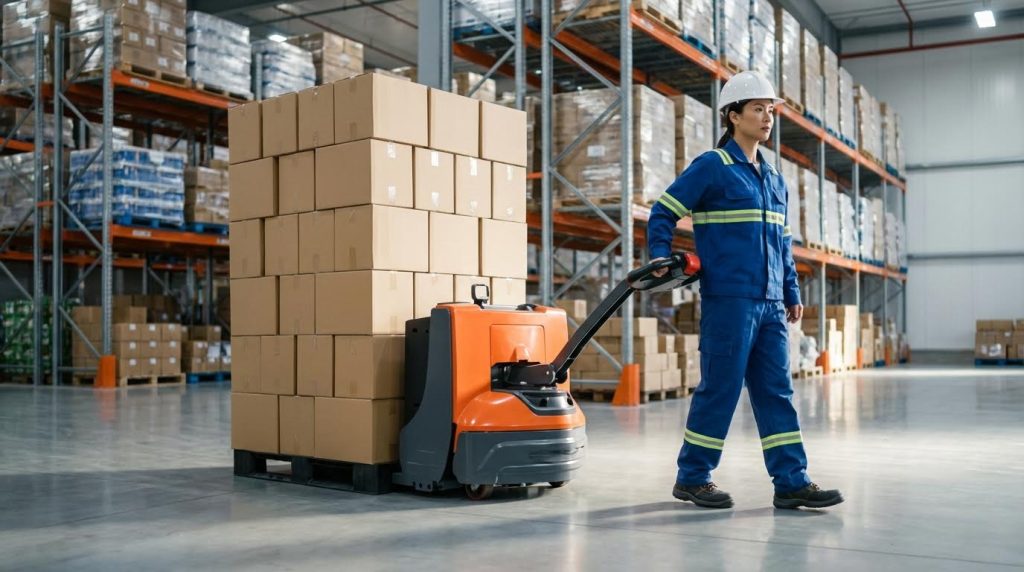
Safer methods for moving heavy loads rely on matching equipment type, rated capacity, and floor conditions to the task instead of asking “can a manual pallet jack lift a car” and improvising with the wrong tool.
When you choose equipment for heavy loads, you design a system: truck capacity, tare weight, floor strength, operator skill, and traffic patterns must all line up. If any piece is wrong, your incident rate and damage costs go up fast.
The sections below show how to choose the right hydraulic pallet truck for normal warehouse work, and which alternatives you should use when the load looks more like a car than a pallet.
💡 Field Engineer’s Note: Any time you’re tempted to “just throw it on a manual pallet jack,” stop and ask: Is this load fully palletized, evenly supported, and within the nameplate rating? If not, pick a different tool.
Choosing the right pallet jack for your application
Selecting the right pallet jack means matching rated capacity, duty cycle, and floor conditions to your actual load profile instead of testing limits with edge cases like “can a pallet jack lift a car.”
| Selection Factor | Typical Options / Ranges | Field Impact |
|---|---|---|
| Rated Capacity | ≈ 2,000–3,000 kg (4,400–6,600 lbs) for manual units [source] | Ensures the jack can handle peak pallet mass with safety margin; never size from “can a pallet jack lift a car” scenarios. |
| Tare Weight | Manual ≈ 75–90 kg; electric ≈ 180–320 kg [source] | Heavier units resist tipping but increase floor loading and push/pull effort. |
| Duty Cycle / Distance | Short, low-frequency vs. long, high-frequency runs [source] | Determines whether a manual jack is sufficient or an electric unit is needed to reduce operator fatigue. |
| Power Source | Lead‑acid vs. lithium‑ion batteries for electric jacks [source] | Impacts tare weight, charging strategy, ventilation needs, and availability in multi‑shift operations. |
| Floor Load Capacity | Must support jack tare + max rated load [source] | Prevents slab cracking and localized failure under wheel contact points. |
| Environment | Dry ambient vs. cold storage, wet, or uneven floors [source] | Drives wheel material choice, corrosion resistance, and speed limits for safe traction. |
| Load Geometry | Standard pallets vs. long, tall, or unstable loads [source] | Determines fork length and whether a pallet jack is appropriate at all. |
Start by mapping your real loads: maximum pallet mass in kg, average mass, and how often you handle the top 10% of heavy loads. Rated capacity on the nameplate must exceed that maximum, with extra margin for dynamic forces when turning or braking [source].
Then check your floor. Combine the heaviest pallet with the heaviest truck you plan to use and confirm the slab, mezzanine, or trailer deck is rated for that total mass and point loading under the wheels [source].
Manual vs. electric pallet jack decision guide
For low‑frequency, short‑distance work, an ≈80 kg manual hydraulic pallet jack is usually optimal, minimizing capital cost and maintenance [source]. For high‑frequency, long‑distance moves, an electric jack with lithium‑ion battery reduces operator fatigue and cuts tare weight by ≈40 kg compared with lead‑acid designs, improving maneuverability and reducing floor stress [source].
- Verify capacity on the nameplate: OSHA requires industrial trucks to operate within posted rated capacity; never size a jack on the theory that “if it can move a car, it can move this pallet.” [source]
- Assess load stability: Stack heavy units low and distribute weight evenly on the pallet to keep the center of gravity inside the wheelbase and reduce tip risk [source].
- Inspect equipment before use: Check forks, wheels, hydraulics, and controls daily; remove damaged units from service until repaired to prevent structural failure under heavy loads [source].
- Control speed and path: Plan routes that avoid potholes, spills, and steep ramps; in cold stores, slow down and keep forks low because ice reduces friction and amplifies sliding risk [source].
- Allow safety margin: Avoid operating at the top of the rated capacity; dynamic loads during turning and braking can momentarily exceed static ratings and deform forks or frames [source].
Alternatives for moving vehicles and irregular loads
Safer alternatives for moving vehicles and irregular loads include purpose‑built vehicle jacks, dollies, and industrial trucks, because pallet jacks are engineered for palletized loads, not for lifting cars, frames, or point‑loaded objects.
This is where the question “can a pallet jack lift a car” becomes the wrong engineering question. The right question is: “What tool keeps frame stresses, floor loads, and operator risk within design limits for this specific load?”
| Load Type / Scenario | Recommended Equipment | Why It’s Safer Than a Pallet Jack | Field Impact |
|---|---|---|---|
| Passenger car repositioning in a workshop | Automotive floor jacks + jack stands; vehicle skates/dollies | Designed contact points on frame; low lift height; wide base to resist tipping. | Controlled, predictable lifting with redundancy; minimizes risk of frame damage or sudden drop. |
| Rolling a disabled vehicle short distances on smooth floor | Under‑wheel dollies / wheel skates | Supports each wheel directly; keeps vehicle on its own suspension. | Low ground pressure and good maneuverability without lifting the chassis. |
| Moving irregular machinery (non‑palletized) | Machine skates + toe jacks; cribs | Spreads load over multiple skates; jacks engage low structural points. | Reduces point loading on floors; allows millimetre‑level positioning. |
| Heavy, long loads (steel, beams, panels) | Forklift, side‑loader, or multi‑directional truck | Higher capacity, mast and carriage designed for off‑center loads. | Improves stability and control; complies with industrial truck standards such as ANSI B56.1. |
| Frequent vehicle movement in production or logistics | Specialized vehicle movers / tuggers | Couples to tires or hitch points; rated for vehicle mass and traction requirements. | Reduces manual effort and keeps operators clear of pinch points. |
- Respect rated capacities: OSHA requires that no industrial truck be loaded beyond its rated capacity, even when multiple trucks share a load [source]; this alone rules out “creative” car‑on‑pallet‑jack setups.
- Avoid unapproved modifications: You must not add platforms, cradles, or brackets to a pallet jack to carry vehicles or odd loads without written manufacturer approval and updated capacity tags [source].
- Use proper lifting for people and vehicles: Industrial trucks used to lift personnel require guarded platforms and shutoff controls [source]; by analogy, vehicles also demand purpose‑designed supports, not pallet forks.
- Train operators on limitations: Operator training should explicitly cover what pallet jacks are not allowed to move—cars, non‑palletized machinery, or people—reducing the temptation to improvise [source].
💡 Field Engineer’s Note: Any time the load has wheels, a curved frame, or only a few hard contact points, assume a pallet jack is the wrong tool. Choose equipment that supports the load where the designer intended, not where it happens to touch the forks.
Final Engineering Verdict: Don’t Use Pallet Jacks To Lift Cars
These factors turn the forks into pry bars against thin sheet metal and suspension parts. Dynamic forces from bumps, steering, and braking then multiply stresses beyond design limits and can bend forks, crack frames, or drop the vehicle without warning. At the same time, concentrated wheel loads can overload floors and create sudden tilt or punch‑through.
OSHA and ANSI rules also treat this use as a clear misuse. You exceed the intended application, erase the built‑in safety factor, and violate training and capacity requirements. “It worked once” does not remove legal or safety exposure.
Operations and engineering teams should set a simple rule: use pallet jacks only for stable, palletized loads within the nameplate rating. For vehicles and irregular loads, specify purpose‑built jacks, stands, dollies, skates, or vehicle movers from qualified suppliers such as Atomoving, and train operators to treat any car‑on‑pallet‑jack idea as a hard stop, not a workaround.
Frequently Asked Questions
Can a pallet jack lift a car?
No, a pallet jack is not designed to lift a car. While it can handle heavy loads like palletized goods, cars are significantly heavier and not suited for this equipment. Pallet jacks typically have a maximum lifting capacity of 3,000–5,500 lbs (1,360–2,500 kg), far less than the weight of most vehicles. Pallet Jack Weight Limits.
What should you never do with a pallet jack?
Never use a pallet jack to lift objects it wasn’t designed for, such as cars or extremely heavy machinery. Avoid overloading it beyond its weight limit, which is usually between 3,000–5,500 lbs (1,360–2,500 kg). Additionally, don’t operate it on uneven or steep surfaces, as this can cause instability and accidents. Safe Pallet Jack Practices.
How much weight will a pallet jack lift?
A standard pallet jack can lift between 3,000–5,500 lbs (1,360–2,500 kg). Higher-capacity models are available but come at a significantly higher cost. Always check the manufacturer’s specifications before purchasing or using one for heavy loads. Pallet Jack Capacity Guide.