
If you have ever asked “what is the lifting capacity of the pallet jack” for your site, you already know how critical the answer is for safety and uptime. This article explains how pallet jack lifting capacity is defined, what typical ratings look like for manual and electric units, and how geometry and load position change what you can safely move. You will see how to match rated capacity to your actual loads, apply basic engineering checks, and use best practices to avoid overloads and tip risks. By the end, you will be able to read a capacity plate with confidence and set clear, safe limits for your operations.
Understanding Pallet Jack Lifting Capacity Basics
What “lifting capacity” really means on a data plate
On a pallet jack, “lifting capacity” on the data plate is the maximum load the truck can safely lift and move when used exactly as intended. It assumes a specific load center (typically around 24 inches / 600 mm from the fork heel for standard pallets) and a level, firm floor. For most standard manual pallet jacks, this rated capacity is about 2,500 kg (5,500 lb) under these reference conditions standard manual pallet jacks typically have load capacities of 2,500 kg (5,500 lbs). The data plate does not guarantee that the pallet jack can handle the same weight if the load is off-center, stacked high, or overhanging the forks.
- The rated number answers the common question “what is the lifting capacity of the pallet jack” only for a correctly positioned, evenly distributed load.
- If the center of gravity of the load shifts forward or to one side, the effective lifting capacity drops due to increased overturning moment and reduced stability unevenly distributed loads increase the risk of tipping and reduce effective lifting capacity by 10–20%.
- The data plate capacity already includes a built-in safety factor, so operators must never exceed it; running above the rating accelerates wear and can lead to structural failure.
Why load position matters even if weight is under the rating
Even when the total weight is within the stamped capacity, a load placed beyond the specified load center increases the moment arm on the forks and chassis. As the center of gravity moves away from the truck, the overturning moment grows, which can overload wheels, bend forks, or cause loss of steering control.
Typical capacities for manual and electric pallet jacks

Manual and electric pallet jacks cover different capacity bands and duty cycles. Standard manual units are commonly rated around 2,500 kg (5,500 lb), with heavy-duty versions up to about 3,000 kg (6,600 lb) and lighter specialty models in the 1,360–2,000 kg (3,000–4,400 lb) range general load capacities for manual pallet jacks. A typical “standard pallet jack lifting capacity” often quoted in warehouses is 5,500 lb (2,500 kg) a standard pallet jack typically supports a maximum load of approximately 5,500 pounds (2,500 kilograms).
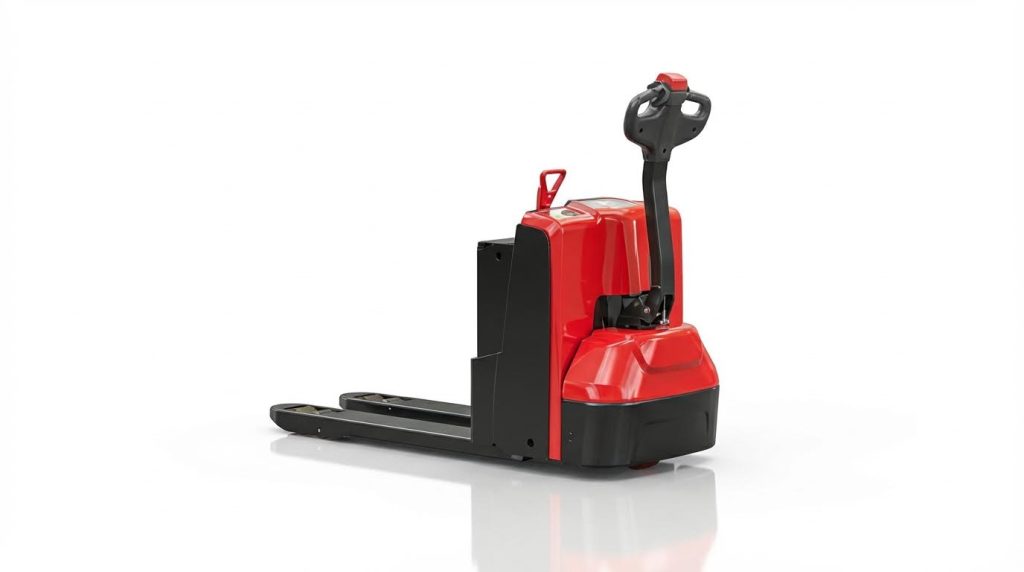
Electric pallet jacks, especially walkie types, are commonly rated around 1.5 tons (1,500 kg) for normal fork positions. However, when the forks are fully extended or handling longer pallets, their safe capacity is often reduced to roughly 1,000–1,200 kg as leverage and deflection increase when the forks are fully extended, the maximum load capacity is typically reduced to approximately 1-1.2 tons. This is why operators must always read the specific truck’s plate and not assume every jack answers “what is the lifting capacity of the pallet jack” with the same number.
| Type | Typical rated capacity | Notes |
|---|---|---|
| Standard manual pallet jack | ≈2,500 kg (5,500 lb) | Most common rating for standard 1,200 mm / 48 in pallets standard pallet jack lifting capacity |
| Heavy‑duty manual pallet jack | Up to ≈3,000 kg (6,600 lb) | Used for dense loads and higher duty cycles heavy-duty models can support up to 3,000 kg (6,600 lbs) |
| Light / specialty manual pallet jack | ≈1,360–2,000 kg (3,000–4,400 lb) | Compact or narrow units for specific applications specialty models generally range between 1,360-2,000 kg |
| Electric pallet jack (nominal) | ≈1,500 kg (1.5 t) | Full rating applies at standard load center and fork position electric pallet jack rated for 1.5 tons can safely handle loads up to that weight |
| Electric pallet jack (forks fully extended) | ≈1,000–1,200 kg | Capacity reduced due to increased leverage and reduced stability maximum load capacity is typically reduced to approximately 1-1.2 tons |
Link between capacity, load center, and lifting height
Standard pallet jacks usually lift to only about 7.5–8 in (19–20 cm) above the floor, while high-lift versions can reach 31–33 in (79–84 cm) standard pallet jacks generally lift loads to a height of about 7.5 to 8 inches; high-lift pallet jacks can achieve lifting heights ranging from 31 to 33 inches. As lifting height and load center increase, stability margins shrink, so effective safe capacity may be lower than the plate value for tall or overhanging loads.
Engineering Factors That Define Safe Load Capacity
Load center, CG, and weight calculation fundamentals
When people ask what is the lifting capacity of the pallet jack, they really need to understand how load center and center of gravity control the usable capacity. The basic load weight comes from the formula W = m × g, where mass is multiplied by gravity to get force. This is the standard way to calculate load weight for lifting equipment. In practice, pallet jack ratings assume the load’s center of gravity sits at a specific “load center” distance from the fork heel, typically around 24 inches (600 mm) for standard pallets. Manufacturers specify this load center on the data plate to define the rated capacity. If the load is longer, uneven, or overhangs the forks, the effective center of gravity moves forward and the safe working capacity drops, even though the nameplate rating does not change. For irregular loads made of several items, the combined center of gravity is found using CG = (Σ mi × ri) / Σ mi, which averages each part’s mass and distance from a reference point. This method is standard in lifting calculations. Keeping that combined CG close to the specified load center is critical to avoid reduced stability and tipping risk.
Fork length, extension, and their impact on capacity
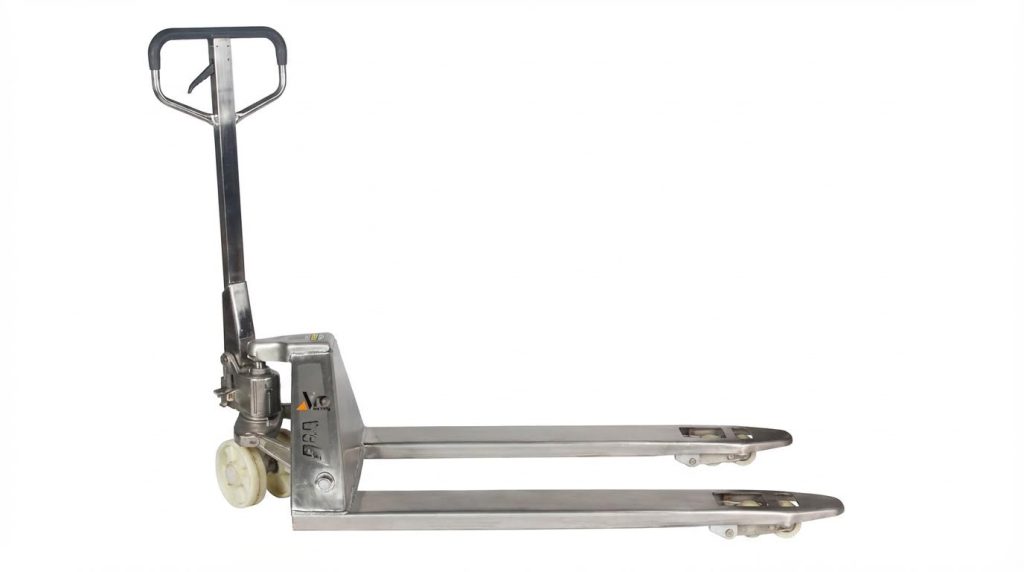
Fork geometry is one of the main engineering answers to what is the lifting capacity of the pallet jack in real use, not just on paper. Longer forks allow handling longer pallets or two pallets at once, but they also increase the lever arm from the jack’s front wheels to the load’s center of gravity. As the load center moves further from the support point, the bending moment in the forks and frame rises, which reduces the safe load capacity. For electric pallet jacks, this effect is very clear: a unit rated for 1.5 tons at its standard load center typically needs its capacity reduced to about 1.0–1.2 tons when the forks are fully extended. This reduction protects against tipping and structural overload when the load is carried farther out. The same principle applies to manual pallet jacks: if the load extends well past the fork tips or is picked up only on the fork ends, the effective load center is larger than the rated value, so operators should derate the load even if the nameplate capacity is not exceeded. Good practice is to keep the heaviest part of the load over the front wheels and fully support the pallet along the fork length to minimize bending stresses and maintain stability. Even weight distribution along the forks allows the jack to carry closer to its rated capacity.
Safety factors, standards, and maintenance influences
From an engineering standpoint, what is the lifting capacity of the pallet jack is always defined with a built-in safety factor and assumes the truck is in good condition. Lifting design commonly uses a factor of safety greater than 1 so that the structure can withstand loads above the working limit without failure. For some lifting devices, standards recommend working loads not exceeding about one-third of ultimate strength, effectively using a 3:1 safety factor. This approach is used to ensure a wide margin between break strength and rated load. However, these margins assume the pallet jack is inspected and maintained. Worn wheels, bent forks, leaking hydraulics, or cracked welds all reduce real-world capacity and stability. Industry guidance for lifting equipment calls for regular inspections, preventive maintenance, and prompt removal from service if defects or overload damage are found. Scheduled inspections, documented repairs, and adherence to manufacturer limits are key parts of safe lifting practice. For pallet jacks, that means checking forks for deformation, verifying hydraulics lift smoothly, and confirming wheels and bearings roll freely so the equipment can safely carry its rated load over time.
Matching Pallet Jack Capacity To Your Application
Calculating the capacity you actually need
When you ask “what is the lifting capacity of the pallet jack” for your site, start from the loads you actually move, not from a catalog value. First, list your heaviest typical pallets (including packaging) and add a safety margin of about 10–20% to cover variations, damaged pallets, or occasional overloads. Standard manual pallet jacks usually range around 2,500 kg (5,500 lb), with heavy‑duty versions up to about 3,000 kg (6,600 lb), and lighter specialty units in the 1,360–2,000 kg (3,000–4,400 lb) band. Electric pallet jacks of about 1.5 t rating safely handle up to 1,500 kg in standard conditions, but their effective capacity typically drops to roughly 1,000–1,200 kg when the forks are fully extended. Always compare your required capacity with the data plate rating at the specified load center (commonly 24 in / 600 mm for standard pallets). If your loads are long, top‑heavy, or extend beyond the pallet, treat the catalog rating as a maximum and de‑rate further, or select a higher‑capacity or longer‑fork model to keep the load center within the rated distance.
- Step 1: Determine maximum real load (product + pallet + packaging).
- Step 2: Add 10–20% safety margin to that weight.
- Step 3: Check that this value is below the pallet jack’s rated capacity at the correct load center.
- Step 4: Increase capacity or change equipment if you routinely approach or exceed 80–90% of the rating.
Applying load distribution and handling best practices
Even if the data plate answers “what is the lifting capacity of the pallet jack,” you only achieve that number with correct load distribution and technique. Manual jacks around 2,500 kg rating and electric units up to 1.5 t rely on the load sitting square and central on the forks; uneven distribution can cut effective lifting capacity by roughly 10–20%. Place the heaviest part of the load over the front wheels and keep the load’s center of gravity close to the pallet jack’s front face to maximize stability. For standard 1,200 mm pallets, aim to keep the load center near 600 mm; if product overhangs or is stacked unevenly, the load center shifts forward and the safe capacity drops, so operators should treat the rated value as a limit, not a target. Secure the load with wrap or bands to prevent shifting, insert forks fully, lift only to the minimum travel height (about 7.5–8 in for typical units) , and avoid sharp turns, ramps, and rough surfaces with a full load.
- Distribute weight evenly across both forks; avoid single‑fork lifting.
- Keep the load low and centered while traveling to reduce the overall center of gravity.
- Slow down, widen turning radius, and avoid sudden stops with heavy or tall loads.
- Remove damaged pallets or unstable stacks from service instead of “making them work.”
Key Takeaways On Pallet Jack Lifting Capacity
Pallet jack lifting capacity is not just a single number on a plate. It is an engineering limit that assumes a defined load center, stable geometry, and a jack in good condition. When the center of gravity moves forward, sideways, or higher, the overturning moment rises and real capacity drops. Longer forks and extended electric forks act like longer levers, so engineers and supervisors must derate loads in those cases.
Safe use depends on three pillars working together. Correct capacity selection with a margin above real load. Correct load positioning so the center of gravity stays near the rated load center and over the front wheels. Correct maintenance so forks, hydraulics, and wheels still match the original design assumptions. If any pillar is weak, the risk of tipping, structural damage, and downtime rises fast.
For operations teams, the best practice is clear. Treat the data plate as a hard limit, not a target. Train operators to think in terms of load center, not just weight. Standardize checks, inspections, and derating rules, and choose Atomoving pallet jacks with capacity and geometry that match your heaviest, longest, and most awkward loads. This approach keeps people safe and keeps product moving.
Frequently Asked Questions
What is the lifting capacity of a pallet jack?
The lifting capacity of a pallet jack typically ranges from 2,000 to 6,000 pounds (907 to 2,721 kilograms). Pallet Jack Weight Guide notes that manual pallet jacks generally handle between 4,500 to 5,500 pounds (2,041 to 2,495 kilograms), while heavy-duty models can lift up to 10,000 pounds (4,536 kilograms).
Can a pallet jack lift a car?
No, a pallet jack is not designed to lift a car. While it can theoretically lift objects as heavy as a car if within its weight limit, using a pallet jack for this purpose is unsafe and risks damaging both the jack and the car. For automotive lifting, specialized equipment is recommended. Forklift vs Pallet Jack Guide.