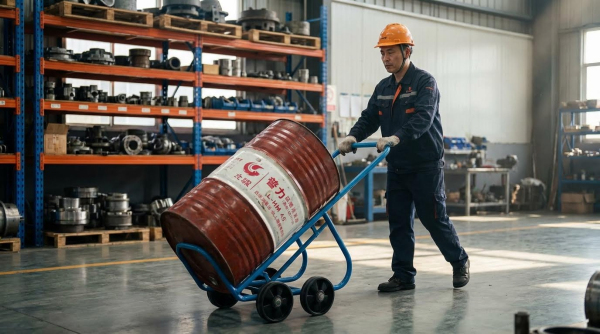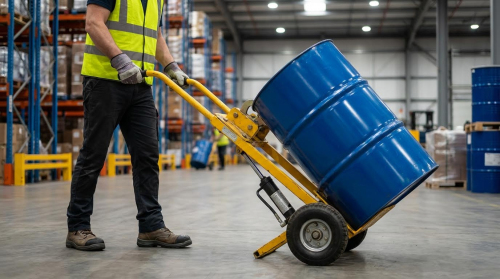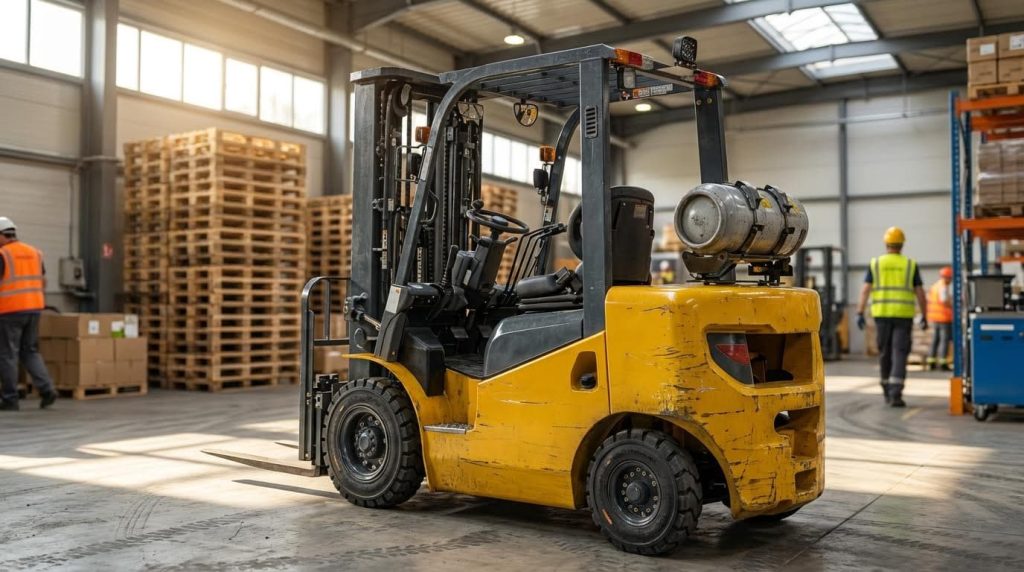
Indoor operation of LPG forklifts introduced complex interactions between exhaust chemistry, ventilation design, and worker exposure limits. This article examined how key pollutants from LPG exhaust affected indoor air quality and compared typical concentrations with OSHA and ACGIH thresholds. It then reviewed the regulatory framework, testing methods, and engineering controls needed to keep carbon monoxide and other gases within compliant ranges. Finally, it discussed how ventilation, maintenance, aftertreatment, and fleet design choices, including the use of electric units, could support safe and efficient indoor material handling with LPG forklifts from manufacturers such as Atomoving.
Indoor Air Quality Risks From LPG Forklift Exhaust
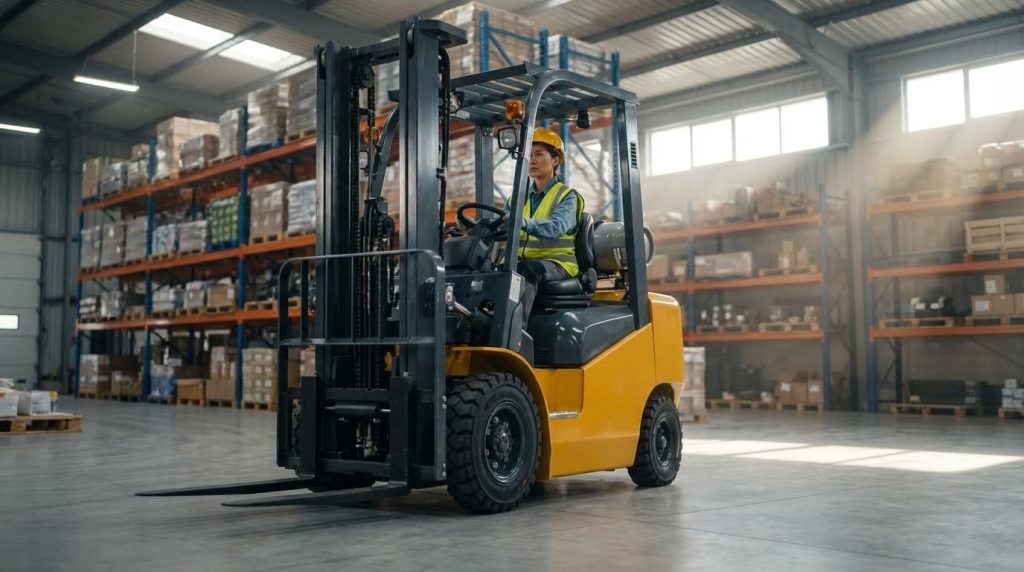
Indoor LPG forklift operation created complex air quality challenges. Exhaust streams introduced concentrated pollutants that diluted unevenly in real facilities. Understanding pollutant species, concentration ranges, and exposure mechanisms allowed engineers to design effective controls. This section linked tailpipe chemistry with worker exposure conditions in typical warehouse and logistics environments.
Key Exhaust Pollutants And Typical Concentrations
LPG forklift exhaust contained carbon monoxide (CO), nitrogen oxides (NO and NO₂), unburned hydrocarbons, butane, sulfur dioxide, carbon dioxide, and water vapor. Regulatory and industrial hygiene practice focused on CO, NOx, and hydrocarbons because they drove acute health risks indoors. Newer propane forklifts in good tune could reach CO exhaust concentrations near 0.5% by volume, or about 5,000 ppm. Older or poorly maintained units often produced 2–4% CO, equivalent to 20,000–40,000 ppm at the tailpipe. Jurisdictions such as Ontario recommended maximum tailpipe CO of 1% (10,000 ppm) for LPG forklifts, while well-tuned engines with catalytic aftertreatment could reduce tailpipe CO further, to around 100 ppm under favorable conditions.
Health Effects And Exposure Symptom Profiles
CO acted as the dominant acute hazard because it bound hemoglobin and reduced oxygen transport. At elevated ambient concentrations, workers experienced headaches, dizziness, nausea, and impaired judgment, often first reported in warehouse complaints to regulators. Continued exposure at higher levels risked loss of consciousness and fatal poisoning, which hospitals confirmed through blood gas testing that triggered mandatory reporting. Nitrogen dioxide irritated the respiratory tract and could exacerbate asthma or other chronic lung conditions, even when CO remained within limits. Hydrocarbons contributed to eye and throat irritation and indicated incomplete combustion, signaling poor engine tuning and elevated fuel consumption.
Comparing Tailpipe Emissions To Ambient Limits
Exposure standards referenced ambient air, not raw exhaust, so dilution and ventilation determined actual worker dose. ACGIH Threshold Limit Values set time-weighted averages for an 8-hour shift at 25 ppm for CO, 25 ppm for nitric oxide, and 3 ppm for nitrogen dioxide. OSHA fixed the CO permissible exposure limit at 50 ppm over eight hours, while some Canadian provinces adopted values near the ACGIH 25 ppm guideline. Ontario recommended that warehouse ambient CO not exceed 35 ppm, significantly lower than allowable tailpipe levels. Because a forklift could emit thousands of ppm CO at the exhaust, even short operation in poorly ventilated spaces could drive area concentrations above these limits within minutes, requiring continuous or periodic monitoring.
High-Risk Indoor Scenarios And Confined Spaces
Risk peaked when LPG forklifts operated in large but poorly ventilated or compartmentalized buildings. A single 1.8 L LPG unit running in an unventilated warehouse of about 60,000 m³ could push CO above exposure standards in roughly 30 minutes. Confined locations such as semi-trailers, small storage rooms, or ship holds amplified hazard because exhaust accumulated faster than it dispersed, even when the building as a whole met nominal ventilation criteria. Cold weather increased risk when doors, windows, and vents remained closed to retain heat, trapping pollutants near workstations and loading docks. Operations inside transport trucks or against dock doors required particular attention, including task-specific ventilation, job rotation, and CO monitoring to keep localized exposures within regulatory limits. Forklifts equipped with forklift drum grabber attachments or rough terrain pallet truck capabilities needed additional scrutiny in such environments. Furthermore, using a manual pallet jack in confined spaces could help reduce emissions by minimizing forklift usage.
Regulatory Limits, Standards, And Testing Methods
Indoor LPG forklift operation relied on a layered regulatory framework that addressed both exhaust output and worker exposure. Authorities focused on limiting ambient concentrations of hazardous gases rather than prescribing detailed engine designs. Facilities needed to understand how tailpipe concentrations translated into workplace air quality to remain compliant. Effective programs integrated standards, monitoring, and maintenance into a single control strategy.
OSHA, ACGIH, CARB, And Provincial Requirements
OSHA in the United States set enforceable workplace exposure limits and required employers to maintain safe indoor air quality. For carbon monoxide, OSHA specified a permissible exposure limit of 50 ppm as an 8-hour time-weighted average in 29 CFR 1910.146 and related sections. ACGIH published Threshold Limit Values that many jurisdictions adopted or referenced, including CO at 25 vppm, nitric oxide at 25 vppm, nitrogen dioxide at 3 vppm, butane at 800 vppm, and sulfur dioxide at 2 vppm. In Canada, provincial Ministries of Labour enforced comparable limits, often aligning with ACGIH TLVs while issuing guidance specific to LPG forklift use indoors.
Engine-out emission criteria for LPG forklifts built before California Air Resources Board regulations allowed CO exhaust concentrations up to approximately 0.5–1.5% and NOx up to 2000–3000 ppm, depending on category. CARB Tier standards later tightened allowable emissions, and Tier III engines incorporated on-board diagnostics that triggered a malfunction indicator when emissions exceeded calibration thresholds. Ontario guidance recommended a maximum tailpipe CO concentration of 1% (10,000 ppm) for LPG forklifts and an ambient CO ceiling of 35 ppm in workplaces. Inspectors retained discretion on sampling locations and procedures, which sometimes created disputes over measured compliance.
CO, NOx, And Hydrocarbon Exposure Thresholds
Regulators distinguished between tailpipe concentrations and ambient exposure limits in occupied spaces. ACGIH TLVs for LPG exhaust constituents reflected 8-hour time-weighted averages, with CO and nitric oxide each at 25 vppm, nitrogen dioxide at 3 vppm, and butane at 800 vppm. OSHA’s CO limit of 50 ppm TWA provided a less conservative but enforceable federal baseline, while some jurisdictions chose 25 ppm to align directly with ACGIH guidance. For indoor LPG operations, facilities often adopted internal action levels below regulatory limits to provide a safety margin and trigger corrective measures before noncompliance.
Engine emission targets supported these ambient objectives. Properly tuned modern LPG forklifts could achieve tailpipe CO levels near 0.5% (5,000 ppm), while poorly maintained units might emit 2–4% CO, corresponding to 20,000–40,000 ppm. Such high exhaust concentrations significantly increased the ventilation requirement to maintain ambient CO below 25–50 ppm. Hydrocarbon and NOx thresholds from engine standards and catalyst design criteria ensured that oxidation or three-way catalysts operated within safe temperature and conversion ranges. Facilities needed to coordinate engine tuning, catalyst performance, and ventilation capacity to keep all pollutants below occupational exposure thresholds.
Ambient Monitoring, TWA Assessment, And CO Alarms
Ambient monitoring verified that forklift exhaust did not drive workplace concentrations above regulatory limits. Facilities used portable or fixed CO meters to measure representative locations, including breathing zones near operators, loading docks, and confined areas such as inside semitrailers. Measurements needed to support 8-hour time-weighted average calculations, which required periodic or continuous logging rather than single spot checks. OSHA investigations often followed hospital reports of CO poisoning, with officers collecting multi-hour CO data to determine TWA exposure and identify peak locations.
CO alarms with audible and visual indicators provided early warning in high-risk zones. Properly configured systems used alarm setpoints below regulatory limits, for example at 25 ppm for a pre-alarm and 35–50 ppm for evacuation or operational changes. Facilities had to consider sensor placement, ensuring coverage near forklift travel paths, charging or parking areas, and zones with historically poor airflow. Integration of CO monitoring data with ventilation controls, work scheduling, and forklift dispatching enabled dynamic risk reduction. Documentation of monitoring results supported compliance demonstrations and informed adjustments to maintenance or ventilation strategies.
Tailpipe Emission Testing And Five-Gas IR Analyzers
Tailpipe testing quantified engine-out emissions and confirmed that forklifts operated within acceptable CO, HC, and NOx ranges. Technicians typically used five-gas infrared analyzers capable of measuring CO, carbon dioxide, hydrocarbons, oxygen, and NOx with high accuracy. These analyzers provided real-time concentration data in ppm or percent, allowing precise adjustment of fuel mixture, ignition timing, and idle speed. Recommended practices kept tailpipe CO below 1%, with well-tuned engines frequently achieving levels below 0.5% under steady conditions.
Portable analyzers with integrated printers generated emission reports for safety and maintenance records. Annual or more frequent testing was advised for trucks operating indoors for 75–100% of their runtime, because small drifts in tuning could quickly translate to large increases in exhaust concentrations. Testing needed consistent procedures, including engine temperature stabilization, defined load or idle conditions, and standardized probe placement in the exhaust stream. Results informed decisions on catalyst replacement, engine overhaul, or removal of noncompliant units from indoor service. Regular tailpipe testing, combined with ambient monitoring, formed a closed-loop verification system for both regulatory compliance and worker protection.
Engineering Controls For Safe LPG Forklift Operation
Engineering controls formed the primary barrier between LPG forklift exhaust and indoor workers. Effective control strategies combined airflow management, emission reduction at the engine, and appropriate powertrain selection. Facilities that integrated these elements reduced both regulatory risk and operating cost while maintaining productivity.
Ventilation Sizing, Distribution, And Cost Impacts
Ventilation requirements scaled with engine power and duty cycle. A typical 60 hp LPG forklift without a catalyst required about 2.4 m³/s (5000 cfm) of outdoor air to keep indoor CO within guideline values during continuous indoor operation. In large warehouses, non-uniform air distribution created pockets of elevated CO near loading docks, inside semi‑trailers, or at high-rack aisles with poor mixing. Engineers therefore evaluated not only total flow rate but also supply and return locations, throw patterns, and air change effectiveness.
Winter operation introduced a strong energy penalty. Heating 2.4 m³/s of make‑up air from 0 °C to 18 °C for a single forklift, 8 hours per shift and 21 shifts per month, could exceed 500 USD of additional electrical heating cost at 0.06 USD/kWh. Facilities often tried to reduce this cost by closing doors or dampers, which increased CO accumulation risk and noncompliance with OSHA or provincial limits. A more robust approach combined moderate ventilation with low tailpipe emissions, demand‑controlled airflow based on CO sensors, and zoning strategies that concentrated higher ventilation rates where LPG trucks actually operated.
Engine Tuning, Maintenance, And Fuel Control
Engine tuning directly influenced raw exhaust CO and fuel consumption. Well-maintained LPG engines typically achieved exhaust CO below 1% by volume, and many units operated near 0.5% with correct air–fuel ratio adjustment. In contrast, neglected engines could emit 2–4% CO, which produced tailpipe concentrations between 20,000 and 40,000 ppm and rapidly overwhelmed indoor air quality, even with substantial ventilation. Maintenance programs therefore incorporated scheduled tune‑ups based on engine hours, plug and ignition inspection, valve and governor checks, and verification of fuel system integrity.
Accurate feedback required quantitative exhaust analysis. Facilities used CO analyzers based on infrared absorption to set mixture and idle speed, because these instruments offered stable, repeatable readings at low CO fractions. Targeting approximately 0.5% CO at warm idle generally aligned with good fuel economy and minimized unburned hydrocarbons. Cold starts generated temporarily higher CO, so operators ideally started trucks outdoors and avoided extended idling indoors. Reducing CO from about 7% to 0.5% could save roughly 700 gallons of fuel annually per truck, which equated to around 2800 USD at 4 USD per gallon, while simultaneously lowering indoor exposure risk.
Catalytic Aftertreatment: Oxidation And 3-Way Systems
Catalytic aftertreatment lowered tailpipe emissions beyond what tuning alone achieved. Oxidation catalysts, often called 2‑way systems, oxidized CO and hydrocarbons into carbon dioxide and water. When upstream CO levels were already controlled near 0.5–1%, these devices reduced tailpipe CO to near 100 ppm, greatly easing the ventilation burden and helping facilities maintain ambient CO well below 25–35 ppm limits. However, catalysts required engines in good mechanical condition; excessive raw CO or hydrocarbon levels increased exothermic heat release, which risked catalyst overheating and premature deactivation.
Three‑way catalysts handled CO, hydrocarbons, and NOx simultaneously. They operated best at stoichiometric conditions, where the air–fuel ratio balanced reducing species (CO, HC) against NOx. Closed‑loop electronic fuel control with an oxygen sensor maintained this balance, similar to on‑road automotive systems. In post‑CARB Tier III‑type engines, diagnostic functions triggered a malfunction indicator when emissions exceeded calibration thresholds. Properly integrated 3‑way systems allowed very low tailpipe CO and NOx, enabling reduced ventilation rates without breaching OSHA, ACGIH, or provincial ambient standards. Nonetheless, plants still needed periodic emission testing and catalyst inspection to confirm sustained performance.
Design Choices: LPG Vs Electric And Hybrid Fleets
Powertrain selection formed a strategic engineering control for indoor environments. LPG forklifts offered fast refueling and robust performance for mixed indoor–outdoor use, but they introduced CO, NOx, and hydrocarbon emissions that required ventilation, maintenance, and monitoring infrastructure. In large, high-throughput warehouses, the cumulative ventilation energy and compliance management costs sometimes exceeded the incremental capital cost of electric trucks. Electric forklifts eliminated exhaust emissions at the point of use, which simplified indoor air quality management and allowed tighter building envelopes with lower heating loads.
Fleet optimization often produced the best outcome. Facilities assigned electric trucks to high-density indoor aisles, cold storage, and confined loading zones, while reserving LPG units for outdoor yards, ramps, and applications demanding longer continuous operation or higher power. Hybrid strategies could also include phased replacement of older high‑emitting LPG units with newer low‑emission engines equipped with 3‑way catalysts and electronic controls. Engineering evaluations compared life‑cycle costs by accounting for fuel, ventilation energy, emission control hardware, maintenance labor, and potential downtime from CO incidents. This system-level view helped operators balance productivity, worker health protection, and regulatory compliance in a defensible, data-based manner.
Summary: Safe, Efficient Indoor LPG Forklift Use
Indoor operation of LPG forklifts required a tightly managed balance between productivity, air quality, and regulatory compliance. Exhaust streams contained carbon monoxide, nitrogen oxides, hydrocarbons, and trace sulfur compounds at tailpipe concentrations that could reach tens of thousands of ppm without controls. Once diluted in building air, these emissions still needed to remain below ambient limits such as 25–50 ppm CO over an 8-hour time-weighted average, as referenced by OSHA and ACGIH guidelines. Facilities that ran LPG units indoors for most of their duty cycle had to treat air quality engineering as a core part of fleet management rather than an afterthought.
Industry practice evolved toward a layered control strategy. Correct ventilation sizing on the order of 2.4 m³/s per 60 hp engine, coupled with airflow audits, addressed bulk dilution but introduced heating-energy penalties, especially in cold climates. Engine tuning programs using infrared CO analyzers kept exhaust CO below about 0.5–1% and improved fuel economy, while catalytic aftertreatment pushed tailpipe CO down to near 100 ppm when engines operated within specification. Three-way catalyst systems with closed-loop electronic control further reduced NOx and hydrocarbons, aligning indoor fleets with post-CARB emission expectations and easing compliance with provincial and federal exposure limits.
Practical implementation required site-specific design choices. High-duty indoor applications increasingly justified a shift toward semi electric order picker and electric forklifts for zero exhaust emissions at the point of use, with LPG reserved for mixed indoor–outdoor or high-load tasks. Where LPG remained in service, operators combined ventilation, preventive maintenance, catalytic systems, and continuous or periodic CO monitoring with alarms. Future trends pointed to wider adoption of real-time gas monitoring, smarter ventilation controls linked to pollutant sensors, and gradual electrification of high-utilization indoor fleets. Taken together, these measures allowed facilities to maintain safe exposure margins, control operating costs, and adapt as emission and occupational health standards continued to tighten. Additionally, equipment like the scissor platform lift and walkie pallet truck offered alternatives to enhance material handling efficiency while reducing reliance on LPG-powered units.