
Designing or checking a scissor platform always comes back to geometry: arm length, working angle, platform size, and actuator stroke. This guide explains how to calculate height of scissor platform lift motion from basic right‑triangle relationships and how those same angles drive stroke, force, and stability. Using simple trigonometry and practical engineering ranges, you will see how to size arms, estimate stroke, and compare single versus double scissor layouts.
Fundamentals Of Scissor Lift Geometry

Key geometric parameters and definitions
Understanding how to calculate height of scissor lift starts with a clear set of geometric variables. Designers typically track the scissor arm length, working angle, base span, compressed height, and platform width. These parameters let you convert a 2D linkage sketch into real platform stroke, stability, and required actuator force. Using consistent symbols and a simple right‑triangle model keeps later calculations traceable and easy to check.
- L – Length of one scissor arm between pivots (hypotenuse of the triangle).
- θ – Working angle of the arm to the horizontal; low θ means the lift is near closed, high θ near full height.
- H – Current platform height above the floor or base reference.
- C – Compressed (minimum) height including structure and platform thickness.
- W – Horizontal distance between lower pivots on the base; often close to platform length or width.
In a single scissor stage, each pair of crossing arms forms a symmetric “X”. The upper joints support the platform, while the lower joints slide or pivot on the base. As θ increases, the base span reduces and the platform rises, all governed by basic trigonometry. Once these parameters are defined, you can relate required stroke, maximum height, and load path without guessing.
Why these parameters matter for design checks
These geometric variables feed directly into stability and force checks. Platform overhang relative to W affects tipping margins. Arm length L and angle θ drive the mechanical advantage seen by the actuator. Compressed height C sets pit depth or loading ramp design. Getting these right early avoids major redesigns later in the project.
Right‑triangle relationships in a scissor mechanism
The core geometry of a scissor platform lift reduces to a right triangle in side view. One arm of length L acts as the hypotenuse. The vertical leg is the net lift (H − C), and the horizontal leg is half the base span, W/2. This simple model is the foundation for any method on how to calculate height of scissor lift from linkage geometry.
| Triangle Element | Scissor Component | Typical Symbol |
|---|---|---|
| Hypotenuse | Scissor arm between pivots | L |
| Opposite side | Lift above compressed height | H − C |
| Adjacent side | Half base span | W/2 |
| Angle | Arm angle to horizontal | θ |
Using trigonometry, the main relationships are: sinθ = (H − C)/L and cosθ = (W/2)/L. Rearranging gives H = C + L·sinθ, which is often the starting point when you know arm length and angle and want platform height. Conversely, if target H and C are fixed, you can solve for the minimum L or required θ range.
Always keep (H − C) ≤ L in your design model. If (H − C)/L > 1, the geometry is impossible in practice and indicates that arm length or compressed height must be adjusted.
These right‑triangle relations also explain why scissor lifts are inefficient at very low angles. When θ is small, a small change in H demands a large change in horizontal span and high actuator force. Most practical designs therefore operate within a moderate angle band, often from about 15° in the lowered state up to a safe upper angle well below full vertical. This range balances achievable stroke, force, and stability for industrial platforms from Atomoving and similar solutions.
Using the triangle to sanity‑check a concept layout
As a quick check, sketch L and θ, then compute H = C + L·sinθ and W = 2L·cosθ. Compare W with your available platform length and base frame size. If W is larger than the frame, the arms will not fit. If H is below your required working height, you either need a longer L, a higher maximum θ, or a multi‑stage (double) scissor arrangement.
Calculating Stroke, Height, And Working Angles
Deriving platform height from arm length and angle
To understand how to calculate height of scissor lift from its geometry, treat each scissor arm pair as a right triangle. The arm length L is the hypotenuse, the vertical rise is (H − C), and the horizontal half-span is W/2. Using basic trigonometry, the working angle θ between the arm and the horizontal is defined by sinθ = (H − C)/L. Rearranging this gives the platform height above the floor as H = C + L·sinθ, which is the core relation for sizing stroke and checking whether a given arm length can reach a target height.
- θ depends on required lifting height, arm length, and platform width.
- Typical working range is about 15° (low) to 75° (high) for practical designs.
- As θ increases, height rises but horizontal stability margin (span) decreases.
Always verify that (H − C)/L ≤ 1. If it is greater than 1, the assumed height is not achievable with the chosen arm length.
| Parameter | Symbol | Role in height calculation |
|---|---|---|
| Arm length | L | Sets maximum possible rise for a given angle |
| Compressed height | C | Minimum platform height including structure |
| Working angle | θ | Controls instantaneous lift height and force |
| Platform height | H | Resulting height from C + L·sinθ |
Using cosine and span for additional checks
Besides sine, you can use cosine to check horizontal span and fit: horizontal half-span = L·cosθ, so total base span ≈ 2L·cosθ for a simple single-stage pair. Combining this with the height equation ensures the geometry fits within the available pit, base frame, and platform footprint.
Determining required arm length for a target stroke
Stroke is the difference between maximum and minimum platform height. For a single scissor stage, stroke S = Hmax − Hmin. Using the height relation H = C + L·sinθ, and assuming the same compressed height C, the stroke becomes S = L·(sinθmax − sinθmin). To find the required arm length L for a desired stroke, rearrange to L = S / (sinθmax − sinθmin).
- Select realistic working angles (for example 15° to 60–75°) to keep forces and stability acceptable.
- Use the resulting L to check platform length and base span constraints.
- Confirm that the chosen L also respects clearance for pivots, actuators, and safety devices.
| Design input | Typical choice | Effect on arm length |
|---|---|---|
| Desired stroke S | Application-specific | Higher S increases required L |
| Minimum angle θmin | ≈ 10–20° | Lower θmin increases L and actuator force |
| Maximum angle θmax | ≈ 60–75° | Higher θmax reduces L but tightens clearances |
For long strokes, consider multi-stage (double or triple) scissor arrangements instead of pushing single-arm length to extremes, which can compromise stiffness and stability.
Checking feasibility with a quick numeric estimate
As a rough guide, if you limit θmax to about 45°, the effective stroke of one arm is roughly 0.7·L. That means the scissor length should be about 1.4 times the required stroke. This aligns with the common rule-of-thumb: Effective stroke ≈ L × 0.707 at 45°.
Relating actuator stroke to scissor travel and force
The actuator in a scissor mechanism does not move vertically; it changes the angle between the arms. This creates a geometric “lever” so that a relatively short actuator stroke can generate a much larger vertical travel. The ratio between platform stroke and actuator stroke depends on pivot locations and the angle range. Mounting the actuator closer to the central joint increases lift height per unit actuator stroke but also increases required actuator force.
- Actuator stroke is usually significantly shorter than platform stroke.
- Mechanical advantage varies with angle: forces are highest at small θ (near fully lowered).
- Force requirement can be estimated from F ≈ (W + WA/2)/tanθ for a single mechanism, where W is payload plus platform weight and WA is arm weight.
| Design aspect | Influence of actuator position | Engineering trade-off |
|---|---|---|
| Vertical travel per actuator stroke | Increases as actuator moves closer to mid-joint | Improves stroke utilization but raises force demand |
| Required actuator force | Peaks at small θ and with high mechanical leverage | Impacts actuator sizing and structural strength |
| Speed of platform | Varies with angle and leverage ratio | Must be checked against safety and control limits |
Always size the actuator for the worst case: lowest working angle, maximum load, and maximum required speed. Underestimating this can lead to stalling or structural overload.
Practical steps to link actuator stroke to lift stroke
1) Define required platform stroke and load. 2) Choose arm length and angle range using the trigonometric relations for height. 3) Lay out actuator and pivots in CAD to measure the actuator length at minimum and maximum heights. 4) The difference between these lengths is the required actuator stroke. 5) Use the force equation and motion analysis to verify that actuator thrust and speed are adequate across the full angle range.
Design Choices, Applications, And Selection Criteria
Matching platform size, stroke, and load capacity
When you work out how to calculate height of scissor lift from linkage geometry, you must also check that platform size and load match the structure. The effective stroke depends on arm length and working angle, so platform length must be long enough to house the scissor at both minimum and maximum height. A larger platform can host longer arms and more link stages, which increases achievable stroke but also adds self‑weight and required actuator force. Load rating then follows from arm section strength, joint design, and the minimum working angle at which the lift must still carry full load.
- Define maximum working height and minimum closed height to get required stroke.
- Choose platform length so it exceeds scissor length plus safety allowance.
- Estimate total load: payload + platform + arms + accessories.
- Check that arm angles at full load stay within a safe range, typically 15–75°.
| Design Aspect | Influence On Geometry | Engineering Implication |
|---|---|---|
| Platform length | Sets maximum practical scissor length | Limits stroke and maximum height |
| Platform width | Defines base span W in the right‑triangle model | Affects stability and required arm angle |
| Stroke requirement | Drives arm length and number of stages | Impacts weight, cost, and pit depth |
| Rated load | Determines section size and actuator force | Controls motor / pump sizing and safety factors |
Always verify that the chosen platform size and scissor geometry still meet load and stability requirements at the lowest working angle, where mechanical advantage is worst.
Practical selection tips for platform and load
Start from the application: handling pallets, vehicles, or workpieces. Add space for guards and operator clearance to get platform size. From the required stroke, estimate a realistic arm length and angle range, then check that the resulting base span fits the installation area. Finally, size actuators using force formulas that include payload, platform, and arm weight, and verify against relevant standards such as ANSI/OSHA for stability and safety margins.
Single, double scissor, and alternatives for high stroke
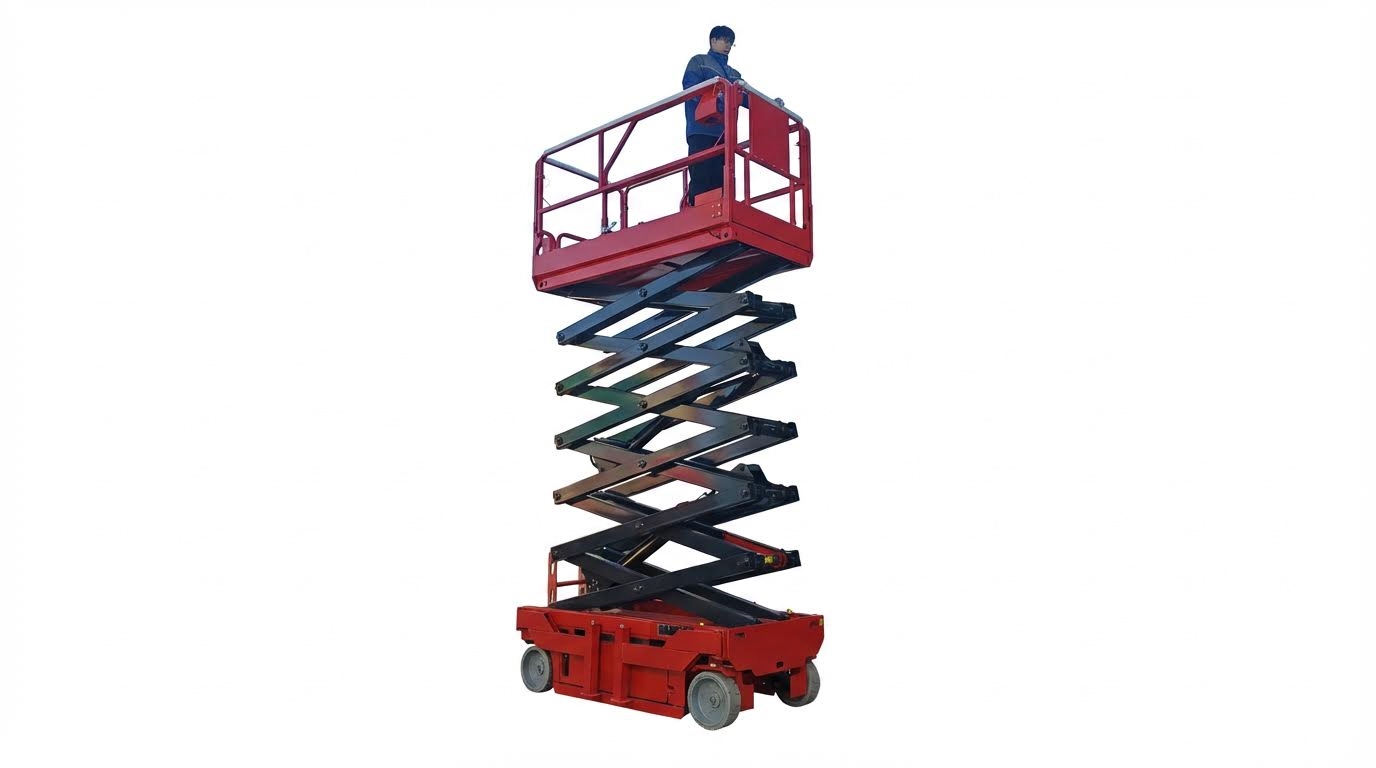
For moderate stroke, a single scissor mechanism is usually the simplest answer when deciding how to calculate height of scissor lift and convert it into hardware. As required stroke approaches the limit set by sin(θ) and practical arm angles, designers either increase arm length or stack mechanisms. A double scissor table places two single units in series, roughly doubling stroke for the same platform length but increasing closed height and structural load. Where very high lift is needed with a compact platform, column or mast‑type lifts become alternatives to classic scissor geometry.
- Single scissor: Best for low–medium stroke, low closed height, and easy maintenance.
- Double scissor: Suited to higher stroke in the same footprint, but needs higher pits or greater overall height.
- Column / mast lifts: Useful when stroke is large and platform is small, independent of scissor length.
| Configuration | Typical Stroke Range | Main Advantages | Main Limitations |
|---|---|---|---|
| Single scissor | Low to medium | Simple, low closed height, fewer joints | Stroke limited by arm length and angle |
| Double scissor | Medium to high | Higher stroke with same platform plan size | Higher weight, closed height, and cost |
| Column / mast | High | Stroke not tied to platform length | More complex structure and installation |
Do not force extreme stroke from a single scissor by driving arm angles near vertical; stability, force demand, and wear all worsen rapidly.
When to consider Atomoving-style engineered systems
For demanding industrial duty cycles, high loads, or constrained shafts and pits, engineered systems similar to those offered by Atomoving can balance geometry, actuator placement, and structure. In these cases, engineers often combine multi‑stage scissors with guided columns, custom actuator ratios, and tuned platform stiffness. Early kinematic modelling of height, angle range, and actuator stroke helps avoid late changes in pit depth, building interfaces, or safety guarding.
Summary Of Practical Design And Safety Considerations
Scissor lift performance always traces back to clear geometry. Arm length, working angle, base span, and compressed height set the real stroke and stability window. When you respect the right‑triangle limits, you avoid impossible layouts and hidden weak points. The sine and cosine relations link platform height and base span to arm length and angle, so engineers can size arms and platforms with confidence instead of guesswork.
Stroke targets then drive choices between single and multi‑stage scissors. If the design pushes arm length or angles near vertical, stiffness falls and actuator forces rise fast. In that case, a double scissor or column solution usually gives a safer, more durable lift. Actuator stroke and position must match the worst case: lowest angle, maximum load, and required speed. This keeps the system away from overload and stalling.
The best practice is simple: freeze the application requirements first, then build a geometric model before metal is cut. Use the triangle equations to check height, span, and stroke, and verify forces at low angles. When in doubt, treat stability and actuator capacity as hard limits. That approach delivers safe, repeatable platforms, whether you design in‑house or specify engineered Atomoving systems.
,
Frequently Asked Questions
How to Calculate the Height of a Scissor Lift?
To calculate the height of a scissor lift, you typically need to consider the platform height and the working height. The platform height refers to the vertical distance from the ground to the top of the platform when the lift is fully extended. The working height, on the other hand, is the platform height plus the average height of a person (approximately 2 meters). This gives you the maximum height a worker can comfortably reach while standing on the platform.
- Platform height: Measure the vertical distance from the ground to the top of the platform when fully extended.
- Working height: Add approximately 2 meters to the platform height for ergonomic access.
What is the Formula for Calculating Scissor Lift Height?
The height of a scissor lift can also be determined using engineering formulas if you’re designing or analyzing the lift. One common formula involves load and mechanical factors. For instance, in scissor lift design, the relationship between the load to be lifted (W), the arm length (a), and the angle of actuation (α) is critical. However, this is more relevant for engineers than operators. For practical purposes, always refer to the manufacturer’s specifications for accurate height details.
For advanced calculations, consult engineering resources like Scissor Lift Design Formulas.