
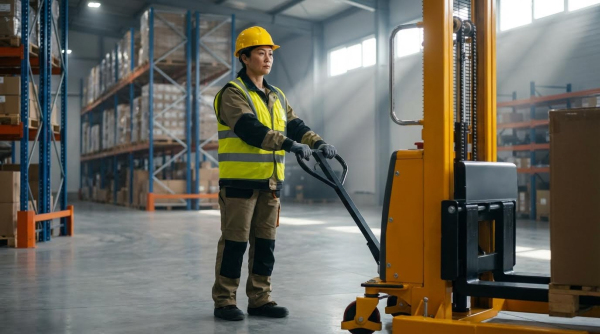
Straddle stackers steer primarily through the powered drive wheel under the operator’s tiller, while the load wheels in the straddle legs mainly support and track the load. Understanding which wheels steer a straddle stacker helps you predict turning radius, stability, and safe maneuvering in tight warehouse aisles.
This guide explains how the steering wheel, tiller arm, and wheel layout work together, and how factors like straddle width, load center, and floor conditions limit what you can safely do on your site.
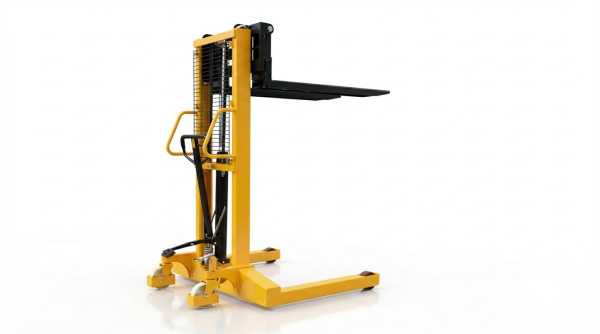
How Straddle Stacker Steering Actually Works
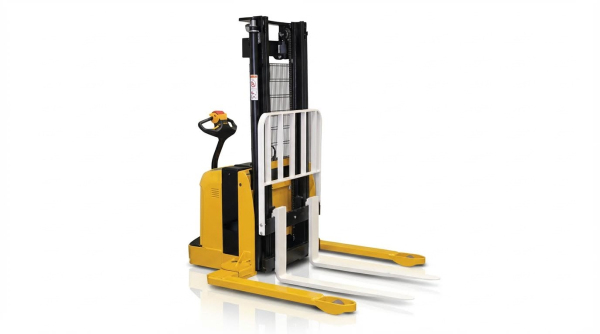
Straddle stackers steer primarily on the single powered drive wheel under the operator/tiller, while the load wheels in the straddle legs mostly track and stabilize the load. Understanding which wheels steer a straddle stacker helps you judge turning clearance, floor demands, and tip‑over margins.
Most walkie straddle stackers use a 4‑wheel layout: one central drive/steer wheel plus two front load wheels in the straddle legs, with an additional stabilizer or support wheel on some designs. The compact chassis and ergonomic tiller concentrate steering forces at the rear drive wheel, letting the legs simply follow the path of the truck. Full‑electric models use this geometry for maneuverability in tight aisles.
💡 Field Engineer’s Note: If operators complain that the stacker “crabs” or scrubs on tight turns, it is usually the load wheels on rough or uneven floors, not the drive wheel, that are binding. Check floor joints, gradients, and wheel condition before blaming the steering unit.
Drive wheel versus load wheels
The drive wheel both propels and steers the straddle stacker, while the load wheels mainly carry vertical load and stabilize the legs.
- Drive/steer wheel under the tiller: This wheel is powered and linked to the steering head, so turning the tiller rotates the drive unit through a large angle for tight turns. This is the wheel that actually steers the machine.
- Load wheels in the straddle legs: These small polyurethane wheels carry most of the pallet weight and follow the arc set by the drive wheel. They stabilize the load and define the effective outer turning envelope.
- Compact chassis effect: With the drive wheel close to the operator and the legs tracking the load, the truck can work in narrower aisles than a conventional forklift of similar capacity. This cuts required aisle width without sacrificing vertical capacity.
Many full‑electric straddle stackers use non‑marking polyurethane wheels for both drive and load positions, giving good shock absorption and reduced floor damage. These wheel materials help maintain stability under loads up to about 1,000 kg (2,200 lbs) while keeping rolling resistance reasonable on smooth warehouse floors. Dual masts and polyurethane wheels work together to keep the truck stable under rated capacity.
How to tell which wheels steer your specific stacker
Look under the operator/tiller area. The wheel housed in the drive unit, usually centered or slightly offset at the rear, is the steering wheel. Turn the tiller with the power off and watch which wheel rotates through a wide angle. The front leg wheels should only roll; they will not pivot like casters on most straddle stackers.
Tiller arm, caster action, and steering input
The tiller arm converts small hand movements into large angular changes at the drive/steer wheel, while the fixed load wheels and any small stabilizer casters simply follow.
- Tiller as steering lever: The operator walks behind or beside the truck and swings the tiller left or right. This changes the drive wheel angle and sets the turning radius.
- Steering geometry and turning radius: Because the drive wheel sits close to the operator, a modest tiller swing can pivot the truck sharply around the loaded straddle legs. This geometry is what makes straddle stackers so effective in confined aisles.
- Limited caster action at the legs: On most models, the load wheels are fixed in the leg and do not swivel. Any small trailing casters or support wheels only self‑align to reduce scrubbing. This keeps the load path predictable but demands reasonably flat floors.
- Electric assist and control: Full‑electric units combine the tiller input with electric drive and braking. This lets the operator feather speed and steering together for precise pallet placement in high‑density racking.
Overall maneuverability depends on the interaction of steering angle, overall length, and straddle layout. A compact chassis and advanced tiller controls let the drive wheel swing through a wide angle and pivot the truck around the load, which is why straddle stackers can operate in aisles that would be too tight for sit‑down forklifts. Short overall length and optimized wheel layout directly improve turning radius and maneuverability.
Operator feel: what “heavy” steering usually means
If the tiller feels heavy or the truck resists turning, check for flat‑spotted load wheels, damaged leg welds, or floor dips under the legs. The drive wheel steering motor rarely fails first; it is more common for extra drag at the front legs to make steering feel stiff, especially with the mast raised.
Steering Geometry, Turning Radius, And Stability
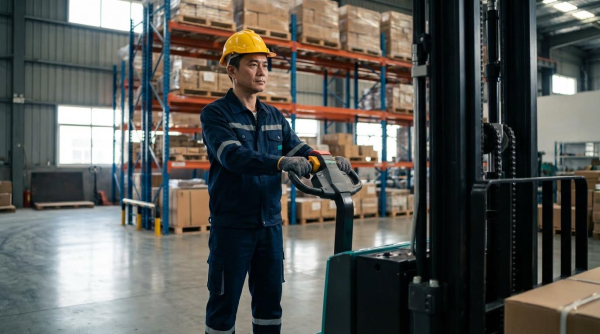
Steering geometry in a straddle stacker defines how the drive wheel and load wheels interact to turn, how tight the machine can rotate, and how safely it stays upright under load. When you ask which wheels steer a straddle stacker, you are really asking how the drive wheel, caster load wheels, and straddle-leg layout work together to balance maneuverability and stability in your aisles.
Wheel layouts: 4‑wheel, 5‑wheel, and compact chassis
Wheel layout determines which wheels steer a straddle stacker, how tight it can turn, and how stable it remains when the mast is raised. Most full-electric straddle stackers use a compact chassis with a single driven/steer wheel near the operator and two load wheels in the straddle legs that mainly carry weight and track the load. Typical 4-wheel designs combine this drive wheel with dual load wheels.
In practice, the drive wheel under the tiller is the primary steering wheel, while the load wheels act mostly as followers that roll in the path set by the drive wheel. This is very different from large straddle carriers where separate steering axles can provide multi-mode steering and 360° flexibility. Those machines use dedicated steering wheels plus driven wheels to maneuver long containers, whereas a warehouse straddle stacker usually packages both drive and steering into one compact wheel assembly.
| Wheel Layout | Typical Wheel Roles | Steering Behavior | Operational Impact |
|---|---|---|---|
| 4-wheel (common electric straddle stacker) | 1 drive/steer wheel + 2 load wheels in straddle legs + small stabilizers/rollers | Drive wheel turns via tiller; load wheels mostly follow | Good stability and tight turning in aisles around 2.4–2.7 m |
| 5-wheel (drive + tandem casters) | 1 drive/steer wheel + 2 main load wheels + 2 auxiliary casters | Drive wheel steers; casters swivel to share load | Smoother over joints, slightly larger turning radius |
| Compact chassis (short body, high mast) | Drive/steer wheel close to operator; load wheels tight under mast | Very responsive steering but sensitive to uneven floors | Allows work in narrower aisles, but needs better floor quality |
Because the drive wheel both propels and steers, its position relative to the mast and straddle legs strongly affects turning radius. A compact chassis places the drive wheel close to the operator and the mast, shortening overall length and reducing the swept path. This compact layout improves maneuverability in confined spaces and narrow aisles.
- Drive/steer wheel location: Near the operator and mast – Reduces overall length and turning radius.
- Load wheels in straddle legs: Close to the load footprint – Increase lateral stability under pallets.
- Auxiliary casters/rollers: Near chassis corners – Help share weight and prevent frame grounding on ramps.
- Non-marking polyurethane tires: High impact resistance – Maintain grip and stability without damaging floors.
In higher-capacity designs, manufacturers often add extra wheels or casters to keep floor pressure within limits while still letting the drive wheel do the steering. This protects warehouse floors and reduces flat spots on load wheels, which are a common failure mode when heavily loaded over long distances. Flat-spotted load wheels are frequently seen where floor joints are poor or loads are near rated capacity.
💡 Field Engineer’s Note: On very smooth, sealed concrete, a compact single-drive-wheel chassis feels agile and precise. On rough or jointed floors, that same setup can “hunt” or shimmy, and operators over-correct the tiller, which increases turning radius and stresses the drive wheel assembly.
How to visualize turning radius from wheel layout
Imagine the drive wheel drawing a circle on the floor as you turn the tiller to full lock. The outermost corner of the straddle leg traces a larger circle. The distance between these circles is set by chassis length and straddle leg projection. Shorter chassis and tighter steering angle shrink both circles, which is why compact 4-wheel layouts are favored for dense racking.
Straddle leg width, load center, and tip‑over risk
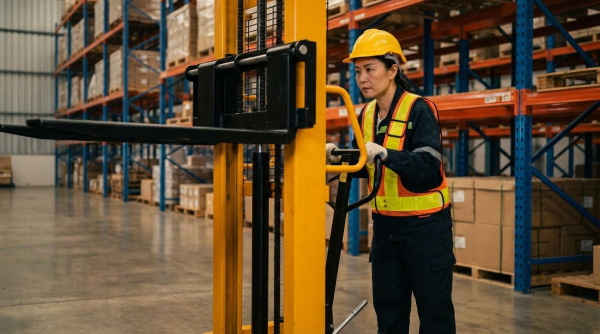
Straddle leg width and load center together define the stability triangle that keeps a straddle stacker upright and control how close you can run to tip-over when turning or lifting. Every unit has a rated capacity set by load center and lift height, and exceeding that envelope sharply increases tip risk. Typical electric straddle stackers carry 700–1,800 kg up to about 5 m, with capacity defined at a specific load center.
The straddle legs push the “footprint” outwards, widening the base of support under the pallet. Wider legs improve lateral stability but restrict which pallets you can enter and how close you can get to racking. The steering wheel does not move these legs sideways; instead, the drive wheel turns the whole machine around a point set by the wheelbase and leg spacing. When operators ask which wheels steer a straddle stacker, they often underestimate how much the fixed straddle width, not just the steering wheel, limits safe maneuvering near racking posts.
| Parameter | Typical Range / Behavior | Effect on Stability | Best For… |
|---|---|---|---|
| Straddle leg inside width | Adjustable to fit common pallet widths | Wider = better side-to-side stability | Handling mixed pallet sizes near capacity |
| Load center distance | Typically 500–600 mm from fork heel (varies by model) | Longer load center reduces rated capacity | Long pallets where de-rating is acceptable |
| Lift height | Up to about 5,000 mm | Higher lift raises center of gravity | Medium-height racking with moderate loads |
| Rated capacity | 700–1,800 kg at rated load center | Operating near limit shrinks safety margin | Heavier loads in well-controlled aisles |
As the mast raises, the combined center of gravity of truck and load moves upward and often slightly forward. If the load is not fully against the backrest, the effective load center increases, pushing the center of gravity closer to the edge of the stability base. Best practice is to keep the pallet tight to the backrest and never exceed the nameplate rating.
- Wide straddle, short load center: – Maximizes stability margin for high lifts.
- Narrow straddle, long load center: – Increases tip-over risk, especially when turning with raised forks.
- Off-center loads on forks: – Shift the center of gravity sideways towards one leg.
- Dynamic effects in turns: – Side forces during steering push the center of gravity toward the outer leg.
Tip-over risk grows quickly if an operator turns while lifting, or travels with the load high. The steering wheel may feel light and responsive, but the real limit is whether the center of gravity stays inside the polygon formed by the drive wheel and the two straddle legs. Once it passes that edge, no amount of steering input can recover the truck.
💡 Field Engineer’s Note: In the field, most side-tip incidents on straddle stackers did not come from broken parts. They came from a “perfect storm” of a high mast, slightly oversized pallet, narrow straddle setting, and a sharp steering correction to avoid an obstacle. Train operators to straighten the truck before lifting and to lower before tight turns.
Reading the capacity plate for stability limits
The capacity plate links weight, load center, and lift height. If the plate lists 1,200 kg at 600 mm load center and 3,000 mm height, that rating does not apply at 4,500 mm or with the load hanging 700 mm out. Always assume capacity drops as you go higher or farther out, even if the plate does not show a full de-rating curve.
Maneuvering in narrow aisles and floor condition limits
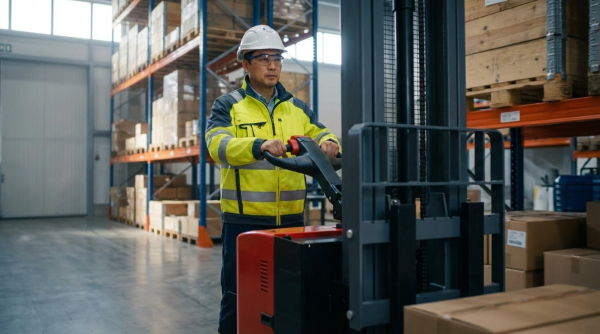
Maneuvering in narrow aisles depends on steering angle, overall length, and straddle width, but it only stays safe if the floor is smooth and strong enough to support the concentrated wheel loads. Compact straddle stackers place the drive wheel close to the operator and mast, which tightens the turning radius and allows work in aisles narrower than those needed for sit-down forklifts. This compact chassis design is one reason they are popular in dense warehouse layouts.
The answer to which wheels steer a straddle stacker is straightforward in tight aisles: the single drive wheel at the tiller does nearly all the steering work, while the load wheels in the straddle legs simply follow and carry the load. But the real aisle requirement is set by the outer corners of the straddle legs as they swing. Poor floors, expansion joints, or slopes can cause those load wheels to bounce or dig in, effectively increasing the turning radius and making the truck feel “stiff” to steer.
| Factor | Influence on Maneuvering | Floor Sensitivity | Operational Impact |
|---|---|---|---|
| Overall chassis length | Shorter length = smaller turning radius | Low to medium | Allows tighter turns at aisle ends and cross-aisles |
| Straddle leg projection | Longer legs swing a wider arc | Medium | Needs more clearance around racking and columns |
| Steering angle of drive wheel | Higher angle = tighter pivot | Medium to high | Full-lock turns can overload outer load wheel on rough floors |
| Floor flatness and joints | Unevenness causes rocking and wheel unloading | High | Reduces effective stability and steering precision in narrow aisles |
| Wheel material (polyurethane, etc.) | Soft wheels absorb shocks and provide grip | High on rough surfaces | Improves comfort but can wear faster on abrasive floors |
Full-electric straddle stackers often run on non-marking polyurethane wheels that provide impact resistance and shock absorption. These wheel materials help keep the truck stable and protect the floor, but they also require reasonably smooth concrete. Deep cracks, potholes, or steep ramps can overload a single wheel, twist the mast, or cause the tiller to kick.
- Narrow aisles with good floors: – Compact 4-wheel straddle stacker is ideal; drive wheel steering is precise.
- Moderate aisles with mixed floor quality: – Consider layouts with extra casters or slightly wider aisles to reduce rocking.
- Areas with slopes or dock plates: – Keep loads low and speed reduced to limit dynamic instability.
- High-density racking: – Plan aisle width from the outer sweep of the straddle legs, not just the chassis body.
Good maneuvering also depends on disciplined operating technique. Operators should match speed to load, keep the center of the load low, and distribute weight evenly across the forks. In narrow aisles, small steering inputs with the tiller are safer than rapid, full-lock swings, especially when the forks are raised to staging height.
💡 Field Engineer’s Note: When laying out a new warehouse, I always test a loaded straddle stacker in the tightest proposed aisle with cones marking the rack posts. If the operator needs more than one steering correction to exit the aisle end, the turning radius is too tight for real-world floor wear and operator variability.
Checking floor condition before deploying straddle stackers
Walk each aisle and mark any joints, slopes, or repairs. Pay special attention where straddle legs will track under lower rack beams. If you see spalling, cracks, or ponding water, repair these areas before relying on narrow-aisle maneuvering. A smooth, level floor is as important as the steering design when it comes to preventing tip-overs and wheel damage.
Specifying The Right Steering Setup For Your Site
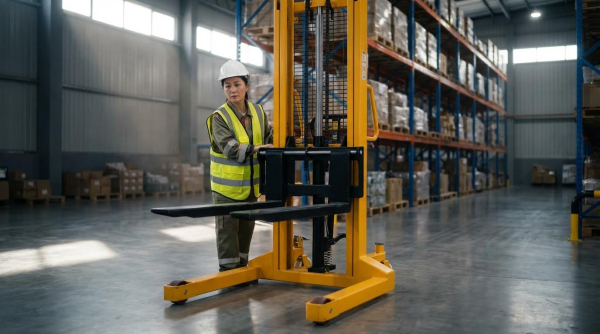
Specifying the right steering setup for your straddle stacker means matching wheel layout, chassis size, and controls to your aisle width, load profile, and floor quality so operators stay safe and productive. When you ask which wheels steer a straddle stacker, you are really asking how the drive wheel, load wheels, and straddle legs must work together in your specific warehouse geometry.
- Start from the building, not the brochure: Measure aisles, doorways, gradients, and floor joints – the site limits the steering options more than the datasheet does.
- Design around your heaviest, highest load: Use the worst-case pallet and rack level – this is what defines safe steering stability.
- Think in paths, not points: Map the full turning path at intersections and rack ends – this prevents “looks OK on paper” but jams in reality.
- Balance agility and robustness: Tighter steering is not always better on poor floors – sometimes a slightly larger, more stable chassis wins.
💡 Field Engineer’s Note: Before buying, tape the proposed outer turning circle on the floor and walk it with operators. You will quickly see if the steering geometry really works around columns, dock plates, and blind corners.
Matching steering design to aisle width and rack layout
Matching steering design to aisle width and rack layout means choosing wheel layout, chassis length, and steering angle that let the stacker turn, square up, and place pallets without shuffling or over-swinging into racks.
Modern full-electric straddle stackers typically use a compact 4‑wheel layout with a single powered drive/steer wheel near the operator and two load wheels in the straddle legs that track the load. This configuration, combined with an ergonomic tiller, gives excellent maneuverability in tight aisles and around racking. Reference In practice, when you ask which wheels steer a straddle stacker in a warehouse aisle, the answer is: the rear drive wheel does almost all the steering, while the straddle-leg load wheels mainly support and stabilize the load path.
| Design Factor | Typical Options / Effects | Operational Impact in Aisles |
|---|---|---|
| Wheel layout | 4‑wheel with single drive/steer wheel and two load wheels in straddle legs | Good stability and tight turning in narrow aisles; drive wheel near operator improves control in confined spaces |
| Chassis length (overall length) | Shorter chassis reduces turning radius; longer chassis improves longitudinal stability | Short chassis fits tighter cross-aisles but can feel more “nervous” at height; long chassis needs wider aisles |
| Straddle leg width | Adjustable or fixed width to clear pallets and loads | Wider legs improve lateral stability but need wider aisles between pallet loads |
| Steering angle at drive wheel | Large steering angle for tight turns | Allows turning in narrower aisles but demands smooth floors to avoid scrubbing and shock loads |
| Rated capacity and mast | About 700–1,800 kg and up to 5 m lift height Reference | Higher capacity and lift height increase stability demands and may require slightly wider working aisles |
- Aisle width vs. turning radius: The compact chassis and close-coupled drive wheel allow straddle stackers to work in narrower aisles than conventional forklifts, provided turning paths at rack ends are checked. Reference
- Rack layout: Denser rack layouts benefit from small outer turning radius and precise tiller control – this minimizes “multi‑point turns” at rack ends.
- Load dimensions: Adjustable straddle legs and forks help accommodate different pallet and load sizes – critical when mixing 1,000 mm and 1,200 mm pallets in the same aisle. Reference
- End‑of‑aisle behavior: Ensure the truck can turn, align, and back out without the counterweight or operator position swinging into uprights or pedestrians – this is where steering geometry matters most.
How to practically check aisle fit before purchase
1) Mark your narrowest aisle width and the pallet overhang on the floor. 2) Ask for the stacker’s overall length and turning radius. 3) Chalk the outer swing of the drive wheel and operator position at a 90° turn. 4) Confirm at least 100–150 mm clearance from racks and columns throughout the turn.
💡 Field Engineer’s Note: If your aisles are already tight, avoid “just fits” steering geometries. Add at least 100 mm safety margin for real-world factors like pallet overhang, worn wheels, and operator steering variability.
Battery type, duty cycle, and maintenance implications
Battery type, duty cycle, and maintenance practices directly influence how consistently the steering system responds, how long components last, and how safe the stacker feels during long shifts.
Full-electric straddle stackers rely on their battery and electric drive system to power the drive/steer wheel, mast hydraulics, and safety systems. Reference As battery voltage sags late in the shift, steering response and travel speed can soften, which matters in tight aisles where precise control is critical. Matching battery capacity to duty cycle prevents operators from “pushing” tired equipment and over-correcting steering in narrow spaces.
- Battery capacity vs. shift length: Size the battery so steering and drive performance remain consistent for the full shift – this avoids sluggish steering late in the day.
- Electric steering and controls: The ergonomic tiller and control electronics need clean power; weak batteries can cause erratic responses or fault codes that interrupt work. Reference
- Duty cycle: High-throughput sites with many lift/lower and steering cycles per hour should plan for more frequent preventive maintenance, especially on drive and load wheels, mast, and hydraulics.
- Wheel material and wear: Non‑marking polyurethane wheels offer good impact resistance and shock absorption, supporting stability and comfort but still need regular inspection for flat spots and damage. Reference
| Maintenance Focus Area | What to Check | Why It Matters for Steering & Safety |
|---|---|---|
| Battery and cables | Charge level, connector condition, corrosion, damage | Prevents voltage drops that make steering inconsistent and avoids unexpected shutdowns in aisles |
| Drive/steer wheel | Wear, flat spots, damage, mounting security | Maintains predictable steering response and reduces vibration that can unsettle loads |
| Load wheels in straddle legs | Flat spots, chunking, free rotation | Ensures smooth tracking of the load and avoids sudden resistance during tight turns |
| Hydraulic system | Leaks, fluid level, cylinder seals | Stable mast movement prevents sudden shifts in center of gravity during steering |
| Safety and control systems | Emergency stop, brakes, horn, key switch | Allows quick recovery if steering input or path judgment is wrong in tight spaces |
Regular pre‑operation inspections should include steering, brakes, mast, straddle legs, and wheels, along with safety systems and energy systems such as battery and hydraulics. Reference Logging maintenance data by date, hours, and work done helps spot patterns like accelerated wheel wear on rough floors or under‑sized batteries for the duty cycle, both of which directly affect how the steering system behaves in your site.
💡 Field Engineer’s Note: If operators complain that steering “feels heavy” or “grabs” only at certain times of day, check battery state and wheel condition before blaming the truck design. Undercharged batteries and flat-spotted wheels are the most common culprits in real warehouses.
Final Thoughts On Straddle Stacker Steering Systems
Straddle stacker steering works only as well as the match between drive wheel, straddle legs, load, and floor. The single drive/steer wheel gives tight turns, but the fixed load wheels and leg width actually set your safe operating envelope. If you ignore those limits, turning radius shrinks on paper but risk grows on the floor.
Geometry and stability are linked. Short chassis and high steering angles help in narrow aisles, yet they push more load into a small floor area and make the truck sensitive to joints and slopes. Wide straddle settings, short load centers, and smooth concrete keep the center of gravity inside the stability triangle, even when the mast is high.
Operations and engineering teams should start with the building, then choose the steering layout. Measure aisles, check floors, and design around the heaviest, highest pallet. Size the battery to keep steering consistent all shift. Maintain drive and load wheels so the truck tracks cleanly.
The best practice is simple: treat steering, stability, and floor quality as one system. When you do that, a well‑specified straddle stacker from Atomoving will steer precisely, protect your racks and floors, and keep operators safe in tight warehouse spaces.
Frequently Asked Questions
Which wheels steer a straddle stacker?
A straddle stacker typically steers using the rear wheels, similar to forklifts. This design allows for better maneuverability in tight spaces and precise positioning of loads. The rear-wheel steering setup enables the equipment to rotate around its front wheels, which support most of the load.
Do forklifts steer with the front wheels?
No, forklifts generally steer using the rear wheels. This unique steering mechanism allows the forklift to turn sharply and navigate confined warehouse spaces efficiently. Forklift Safety Basics.
What should you do before using a straddle stacker?
Before operating a straddle stacker, it’s important to perform pre-operation safety checks. Inspect the equipment for any visible damage, check fluid levels, and ensure that all safety features are functioning correctly. These steps help prevent accidents and maintain equipment longevity. Straddle Stacker Safety Tips.