
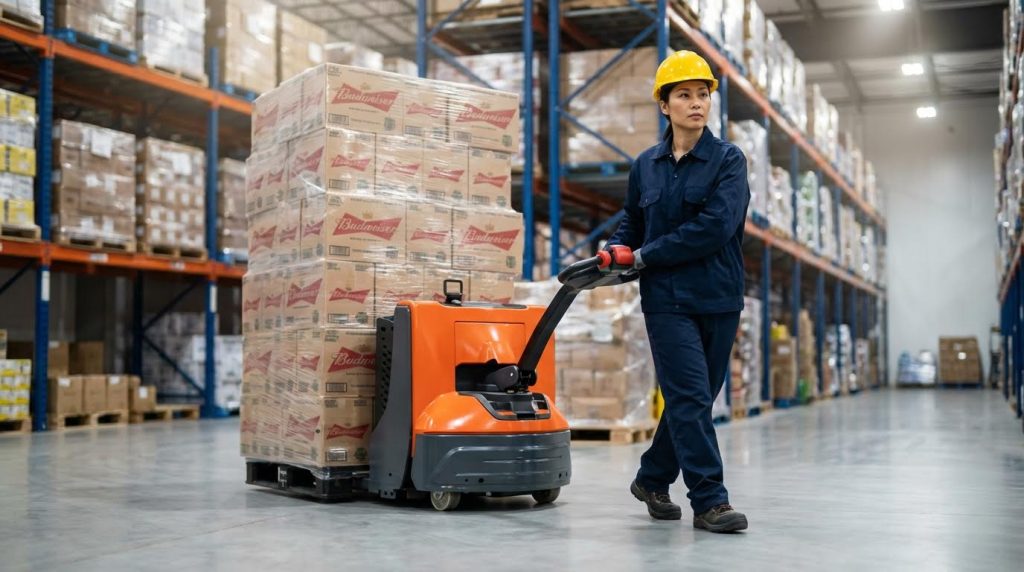
Electric pallet jacks are powered low‑lift trucks designed to raise pallets just high enough for safe transport, with specialized variants capable of stacking up to several metres. They solve three core problems in warehouses: reducing manual strain, moving heavy loads quickly, and keeping operations within safe lift‑height and stability limits. This guide explains exactly how high an electric lift pallet jack will lift, how far it can travel per charge, and how fork geometry affects real‑world stability and floor clearance. You’ll also see how to match lift height and range to docks, racking, cross‑docking, and other industrial applications so you can specify the right equipment with confidence.
Key Lift Heights, Fork Geometry, And Ranges
Lift height and fork geometry determine how high an electric lift pallet jack will lift, how safely it carries a load, and whether it fits your pallets, docks, and racking patterns in real operations.
This section explains the real-world limits behind the question “how high will an electric lift pallet jack lift,” then ties those heights to fork dimensions, load centers, and stability envelopes. You will see why a few millimetres in fork height or a few hundred millimetres in mast height can be the difference between smooth dock work and chronic pallet damage or tipping risk.
Typical lift heights by pallet jack type
Typical lift height by pallet jack type ranges from about 180–205 mm for standard electric pallet jacks up to roughly 1,600–5,000 mm for high‑lift and stacker units, which directly answers how high an electric lift pallet jack will lift.
| Truck Type | Lowered Fork Height (approx.) | Maximum Lift Height (approx.) | Typical Capacity Range | Primary Use Case | Field Impact (What it means in operation) |
|---|---|---|---|---|---|
| Low‑lift walkie / pedestrian electric pallet jack | 75–85 mm lowered fork range | 180–205 mm (≈ 7–8 in) max lift range | ≈ 1,400–3,000 kg, up to 5,000 kg heavy‑duty capacity data | Ground‑level transport, docks, truck loading | Clears dock plates and floor defects while keeping centre of gravity low for maximum stability and fast travel. |
| Rider / stand‑on low‑lift pallet jack | ≈ 75–85 mm | ≈ 180–205 mm | ≈ 2,000–5,000 kg | Longer horizontal runs, cross‑dock, staging | Same lift envelope as walkies, but higher speed and range; not suitable for stacking into racking. |
| High‑lift pallet truck (no mast, scissor style) | Similar to low‑lift at entry | Up to ≈ 1,000 mm for scissor types ISO 3691‑5 ranges | Up to ≈ 1,000 kg capacity data | Ergonomic work positioning, light loads | Raises pallets to waist height for picking/packing; not for driving around at full height due to stability limits. |
| Electric stacker / high‑lift pallet jack with mast | Typically 75–90 mm | ≈ 1.6–5.0 m mast height stacker data | ≈ 1,000–2,000 kg (varies by model) | Stacking in low to medium racking, staging | Allows 2–4 beam levels in typical warehouses; residual capacity drops as height and load centre increase. |
| Standard electric pallet jack (general spec snapshot) | 75–85 mm | ≈ 7.5 in (≈ 190 mm) typical figure | ≈ 1,000–3,600 kg (2,200–8,000 lbs) capacity range | Universal warehouse pallet handling | Optimized for ISO pallets and truck beds; not intended for high stacking or acting as a reach truck replacement. |
From an engineering standpoint, ISO 3691‑5 defines “low‑lift” pallet trucks as having lift heights up to 300 mm and capacities up to about 2,300 kg, which aligns with these practical ranges standard definition. In real warehouses, most electric walkies and riders stay closer to 180–205 mm because that is enough to clear dock plates and rough floors without raising the centre of gravity unnecessarily.
💡 Field Engineer’s Note: If operators are asking “can we go a bit higher?” on a low‑lift electric pallet jack, that’s usually a sign you actually need a stacker or forklift. Pushing low‑lift gear beyond ~200 mm with improvised blocks or ramps is a classic root cause of tip‑overs and pallet breakage.
How to interpret “how high will an electric lift pallet jack lift” in specs
Spec sheets often show “lift height” and “fork height, lowered.” For low‑lift units, when someone asks how high will an electric lift pallet jack lift, the practical answer is: “enough to get the pallet 180–205 mm off the floor, not to put it into racking.” High‑lift and stacker units are the exception, with masts in the 1.6–5.0 m band for stacking applications mast ranges.
Fork dimensions, load centers, and stability
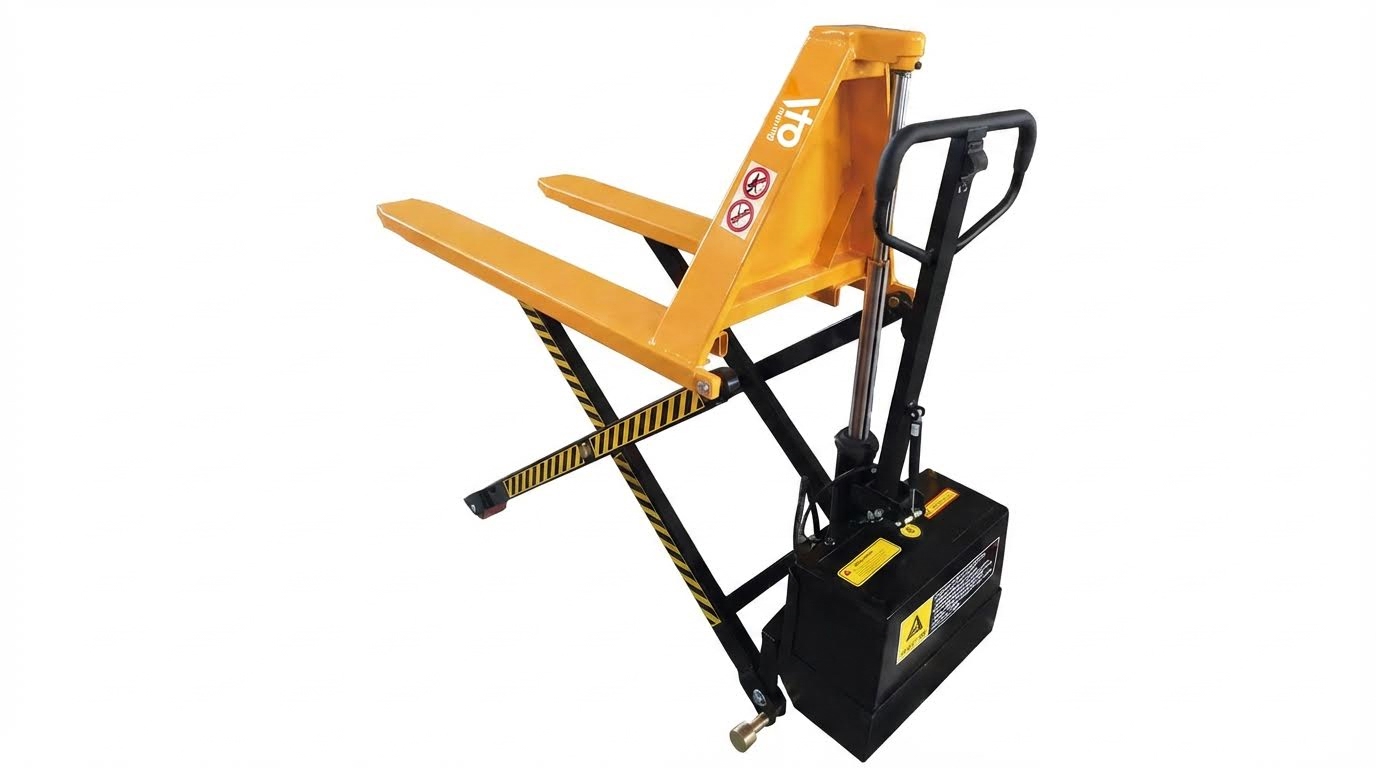
Fork dimensions and load centers control how safely a pallet jack carries its rated load; longer forks and off‑centre loads increase tipping risk even when lift height stays within published limits.
| Parameter | Typical Range / Value | Engineering Meaning | Field Impact on Stability & Usability |
|---|---|---|---|
| Fork length (overall) | ≈ 1,150–1,300 mm for standard electric pallet jacks fork length data | Matches common ISO pallet footprints so the load sits between fork wheels and close to the drive axle. | Too long increases turning radius and tail swing in tight aisles; too short leaves pallets unsupported and increases fork tip damage. |
| Fork width (overall across both forks) | ≈ 520–685 mm common ranges (aligned to pallet entry) | Must align with pallet opening width so forks engage stringers cleanly without binding. | Incorrect width leads to broken boards, skewed entry, and higher risk of side‑tip when lifting poor‑quality pallets. |
| Standard rated load center | 600 mm from fork heel for many low‑lift trucks load center reference | Assumed horizontal distance from the fork face to the load’s centre of gravity when rating capacity. | If the load centre moves beyond 600 mm (long pallets, overhang, or tall stacked loads), effective safe capacity drops and tipping risk rises. |
| Rated capacity at standard load center | ≈ 1,400–3,000 kg typical; up to 5,000 kg heavy‑duty capacity data | Maximum mass the truck can safely lift and move when the load’s centre of gravity is at the rated load centre. | Overloading or pushing the centre of gravity forward reduces residual capacity, especially noticeable on ramps and uneven floors. |
| Lift height vs. stability envelope | Low‑lift: ≤ 300 mm per ISO 3691‑5 standard limit | As forks rise, the combined centre of gravity moves upward, shrinking the allowable tilt and acceleration before tip‑over. | This is why low‑lift jacks are limited to ~200 mm: enough clearance without creating forklift‑like tip risk in pedestrian environments. |
| Axle loads (drive and load wheels) | Governed by rated capacity and gradient limits (≈ 6–10% laden) stability info | Distribution of weight between drive wheel and fork wheels defines traction, braking, and floor loading. | High axle loads on small polyurethane wheels can crush weak concrete or damage dock plates; check floor ratings before specifying heavy‑duty units. |
From a physics perspective, lift height, fork length, and load centre interact. Even though a low‑lift electric pallet jack only raises 180–205 mm, a long or top‑heavy load can move the centre of gravity outside the stability triangle, especially on ramps or uneven floors. That is why standards require stability at specified gradients, often up to 6–10% when laden gradient ranges.
- Correct fork engagement: Fully insert forks so the pallet deck boards sit over the fork length, keeping the load centre near the rated 600 mm point and reducing bending stress on forks.
- Avoid excessive overhang: Limit product overhang beyond the pallet footprint; extra length pushes the centre of gravity forward, cutting effective capacity even at low lift heights.
- Respect gradient limits: Treat the published maximum gradient (often 6–10% laden) as a hard limit; beyond this, the combination of fork height and shifted load centre can cause runaway or tip‑over.
- Match fork length to pallet family: Standard 1,150–1,300 mm forks suit ISO pallets; special long or short pallets should trigger a re‑check of load centre and turning radius before deployment.
💡 Field Engineer’s Note: Most “mystery tip‑overs” with pallet jacks are not about the 200 mm lift height; they come from bad geometry—forks only half‑way in, odd‑sized pallets, or stacked loads that move the centre of gravity 100–200 mm forward. Train operators to think in terms of where the weight sits, not just what the data plate says.
Technical Factors Governing Lift And Travel
Technical factors governing lift and travel define how high an electric lift pallet jack will lift, how long it will run, and how safely it accelerates, brakes, and holds loads in real warehouse conditions.
These factors are mainly the hydraulic system, the battery and duty cycle, and the traction/lift motors with their braking and control electronics. Together they set hard limits on lift height, capacity, travel speed, and runtime, which is the real engineering answer behind the question “how high will an electric lift pallet jack lift” under load, all shift long—not just when it is brand new and fully charged.
💡 Field Engineer’s Note: When you see a truck that “won’t reach rated height,” nine times out of ten it is weak hydraulics or a tired battery, not a bad mast. Always test lift at rated load and 80% state of charge.
Hydraulic design, cylinders, and pressure limits
Hydraulic design, cylinders, and pressure limits determine both how high the forks can travel and how much weight they can safely raise at that height without bursting hoses or overloading the frame.
The hydraulic pump, cylinder bore, and stroke set the maximum fork elevation, while system pressure defines the safe load at that elevation. For low‑lift electric pallet jacks, typical lowered fork height is about 75–85 mm and maximum lift is about 180–205 mm, just enough to clear floor irregularities and dock plates while staying very stable under load. High‑lift and stacker‑type pallet trucks use longer‑stroke cylinders and masts to reach roughly 1,6–5,0 m for stacking applications in racking.
| Hydraulic Factor | Typical Range / Behavior | Field Impact |
|---|---|---|
| Lowered fork height | 75–85 mm | Enters standard pallets with minimal floor clearance; reduces pallet damage and snagging. |
| Max lift height (low‑lift walkie) | ≈180–205 mm (≈7,5 in) | Enough to cross dock plates and rough floors; not for stacking, but ideal for transport. |
| Max lift height (stacker‑type) | ≈1,6–5,0 m | Supports low to medium racking; requires tighter stability control and operator training. |
| System working pressure | Limited below seal/hose ratings | Prevents hose bursts; controller may cut lift if pressure exceeds safe threshold. |
| Cylinder bore & stroke | Sized for capacity and height | Large bore increases capacity but raises pressure and frame loads; longer stroke gives height. |
| Standards definition | Low‑lift ≤300 mm per ISO 3691‑5 | Clarifies that pallet jacks are for transport; higher lifts move into “stacker” category. |
Standards such as ISO 3691‑5 classify low‑lift pallet trucks as having lift heights up to 300 mm and capacities up to about 2 300 kg, while scissor‑lift pallet trucks can reach around 1 000 mm or 1 000 kg based on stability limits. Designers keep working pressure safely below seal and hose ratings to mitigate burst risks, and electronic controllers monitor hydraulic pressure or motor current to stop lift if overload conditions appear.
How hydraulics answer “how high will an electric lift pallet jack lift?”
From a design perspective, “how high will an electric lift pallet jack lift” is fixed by cylinder stroke and mast height. In the field, effective lift height is reduced by worn components, air in the hydraulic oil, or low battery voltage slowing the pump. That is why a truck that once reached 205 mm may only reach 180 mm under full load if maintenance is overdue.
Battery chemistry, duty cycles, and runtime
Battery chemistry, duty cycles, and runtime govern how consistently an electric pallet jack can reach its rated lift height and travel range across a shift, especially under intensive, multi‑shift duty cycles.
Most walkie pallet jacks use 24 V battery systems with capacities around 70–200 Ah, giving roughly 4–8 hours of mixed operation per charge depending on load, travel distance, and lift frequency in typical warehouses. Lithium‑ion batteries hold voltage more steadily than lead‑acid, so lift speed and maximum achievable height stay much more consistent until the battery management system cuts off at low state of charge for protection.
| Battery / Duty Factor | Typical Value / Behavior | Field Impact |
|---|---|---|
| System voltage | 24 V common on walkies | Standardizes chargers and parts; adequate for low‑lift and moderate travel speeds. |
| Capacity range | ≈70–200 Ah | Supports ≈4–8 hours of mixed use per charge; heavier lifts and longer runs shorten runtime. |
| Lead‑acid behavior | Voltage sag at high discharge | Lift slows and may stall near max height late in shift, especially at or near rated load. |
| Lithium‑ion behavior | Stable voltage, opportunity charging | More consistent lift and travel; quick top‑ups during breaks extend effective daily range. |
| Travel speed (walkie) | ≈4,5–6 km/h loaded; up to ≈8 km/h unladen | Matches pedestrian pace; faster travel increases current draw and shortens runtime. |
| Rider / stand‑on speed | ≈6–10 km/h | Better for long runs; requires stronger braking and careful operator training. |
Duty cycle—the ratio of lifting and traveling time to idle time—directly affects how far the truck can work into its shift before performance drops. High lift counts per hour draw much more current than simple horizontal moves, so two trucks with identical batteries can have very different runtimes if one is used mainly for stacking and the other for dock shuttling.
💡 Field Engineer’s Note: If operators complain that “it won’t lift to height after lunch,” look at charging habits and lift counts, not just the battery label. A 24 V, 150 Ah pack abused with no opportunity charging will behave like a much smaller battery.
Motors, braking, and control for safe operation
Motors, braking, and control systems ensure that an electric pallet jack accelerates, lifts, and stops smoothly while staying within stability and structural limits at its rated lift height and speed.
Modern electric pallet jacks use AC traction and lift motors with inverters that deliver precise torque control, keeping fork elevation stable even close to maximum lift height under varying loads. Regenerative braking converts kinetic energy back into electrical energy during deceleration, slightly extending runtime and reducing mechanical brake wear on high‑traffic routes.
| Motor / Control Factor | Typical Capability | Field Impact |
|---|---|---|
| Traction motor type | AC with inverter drive | Provides smooth acceleration and speed control; improves tire life and operator comfort. |
| Lift motor control | Current‑limited, pressure‑monitored | Stops lift if overload is detected, preventing structural damage and unsafe height gains. |
| Regenerative braking | Energy recovery on decel | Marginally increases runtime; reduces brake maintenance and heat on ramps. |
| Safety monitoring | Overcurrent / overpressure cut‑outs | Prevents lifting beyond design limits; directly protects against tipping and component failure. |
| Travel speed management | Load‑and mode‑dependent limits | Slows truck when loaded or in tight areas, helping meet OSHA/ISO safety expectations. |
Safety functions ensure hydraulic pallet trucks only lift to designed heights within safe stability envelopes, and controllers inhibit further lift when hydraulic pressure or motor current exceed thresholds in real‑world use. Combined with proper operator training on rated capacity and load positioning, these systems keep both lift and travel within the limits assumed by ISO 3691‑5 and typical OSHA/ANSI powered industrial truck rules.
Why control systems matter for maximum usable lift height
Even if the hydraulics could physically push higher, the control system will stop lift once it hits the programmed height or senses overload. That is why two trucks with similar masts can have different answers to “how high will an electric lift pallet jack lift”—the electronics enforce the safe design limit, not just the steel and cylinders.
Matching Lift Height And Range To Applications
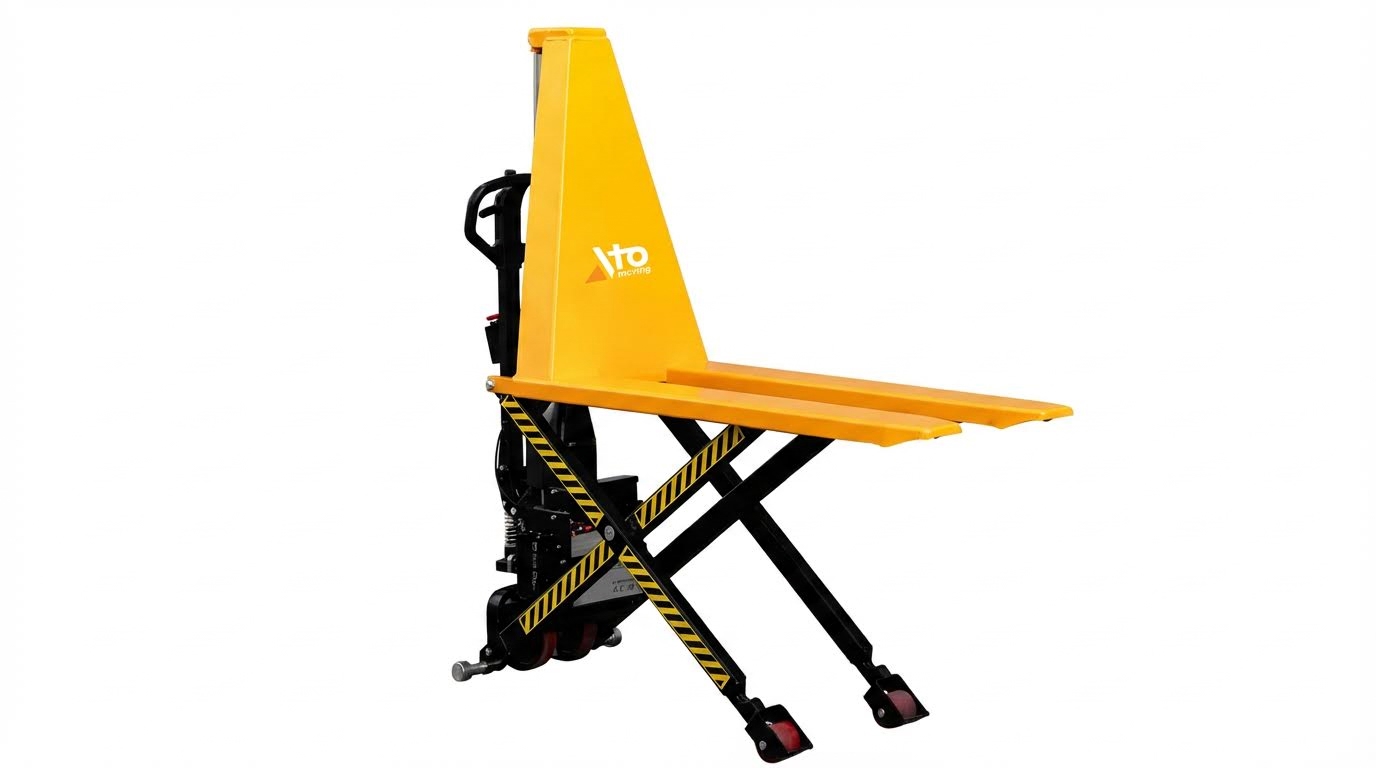
Matching lift height and range means choosing an electric pallet jack whose maximum fork elevation and battery runtime safely cover your pallet heights, dock geometry, and travel distances without over‑specifying or under‑powering the fleet.
This is where the practical version of “ how high will an electric lift pallet jack lift” meets your building: dock heights, racking beam levels, and aisle lengths. Standard walkie pallet jacks usually lift only 180–205 mm, while high‑lift and stacker units reach roughly 1,6–5,0 m for stacking and staging in typical warehouse applications. Your job is to align these lift bands and travel ranges with real-world tasks so operators stay within safe stability envelopes and battery capacity all shift long.
💡 Field Engineer’s Note: When selecting lift height, always check the highest pallet or beam plus 150–200 mm clearance for safe entry/exit – then confirm the truck’s residual capacity at that height, not just its base rating.
Low‑lift walkies for docks and floor transport
Low‑lift walkie pallet jacks are designed for short to medium horizontal runs at floor level, lifting pallets only about 180–205 mm to clear floor irregularities, dock plates, and truck beds without stacking in most facilities.
If you are asking “how high will an electric lift pallet jack lift” in a loading‑dock context, low‑lift walkies are the baseline answer: they typically start at a lowered fork height of about 75–85 mm and raise to roughly 180–205 mm, just enough to float a pallet over uneven floors and dock transitions while keeping a low center of gravity. These units are optimized for docks, staging lanes, and in‑aisle transport where pallets stay on the ground or on truck decks rather than being stored in racking.
- Typical lift band (low‑lift walkies): About 75–85 mm lowered to 180–205 mm raised, aligning with ISO pallet entry heights and providing just enough clearance for dock plates and floor imperfections.
- Primary use cases: Loading/unloading trailers, shuttle moves between dock and staging, and floor‑level replenishment where no vertical stacking is required.
- Capacity and stability: Commonly rated from about 1,400–3,000 kg, with heavy‑duty versions up to roughly 5,000 kg, assuming a 600 mm load center for stability on flat floors and moderate gradients in general warehouse conditions.
- Range and speed fit: Typical travel speeds of about 4,5–6 km/h under load and 4–8 hours of mixed operation from 24 V, 70–200 Ah batteries match dock‑centric, stop‑start duty cycles.
- Best environments: Cross‑docks, food & beverage floors, and e‑commerce inbound where throughput is governed by trailer turns, not racking height.
When a low‑lift walkie is the wrong choice
If pallets ever need to be placed above about 300 mm (for example, second‑tier staging, conveyor in‑feeds, or low beam racking), a low‑lift walkie is outside the ISO low‑lift definition and should not be stretched into a stacking role based on low‑lift truck standards.
💡 Field Engineer’s Note: For dock work, lift height beyond ~200 mm rarely improves productivity – but it does raise the center of gravity. Prioritize fast, smooth low‑lift performance and tight turning radius over extra vertical travel.
High‑lift and stacker units for racking and staging
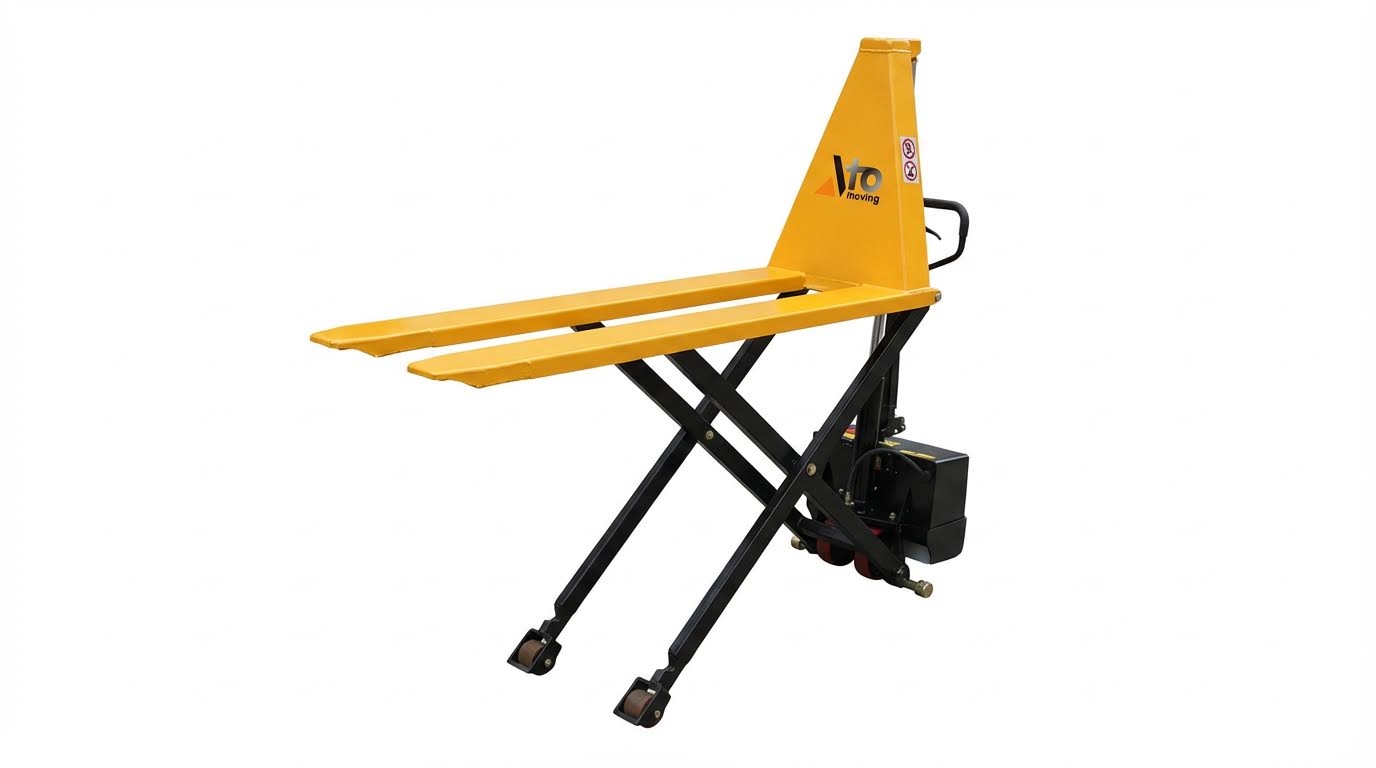
High‑lift and stacker pallet jacks are electric pallet trucks with masts that raise loads from roughly 1,6 m up to about 5,0 m, enabling block stacking and low‑ to mid‑level racking where low‑lift walkies cannot reach in typical warehouse layouts.
From an application standpoint, these are the machines that truly answer “how high will an electric lift pallet jack lift” for vertical storage: high‑lift or stacker‑type pallet trucks typically cover a band from about 1,6 m up to roughly 5,0 m, with fork geometry still tuned to standard 1,150–1,300 mm pallet lengths used in racking operations. They trade some maneuverability and ground‑level speed for controlled, stable vertical movement at defined load centers.
| Parameter | Typical High‑Lift / Stacker Range | Typical Low‑Lift Walkie Range | Field Impact |
|---|---|---|---|
| Max lift height | ≈1,6–5,0 m | ≈180–205 mm | Determines which racking levels you can serve; above ~1,6 m you move from floor transport into true stacking. |
| Lowered fork height | ≈75–85 mm | ≈75–85 mm | Both types still enter standard pallets; differences show up at raised height, not at ground entry. |
| Rated capacity (at 600 mm load center) | ≈1,000–2,300 kg typical | ≈1,400–3,000 kg typical | Stackers often derate at height; always verify residual capacity at your top beam level. |
| Travel speed (laden) | ≈4,5–6 km/h | ≈4,5–6 km/h | Similar pedestrian speeds; operator productivity hinges more on lift/lower time and travel distance than top speed. |
| Battery capacity | ≈70–200 Ah, 24 V | ≈70–200 Ah, 24 V | Vertical lifting consumes extra energy; for frequent stacking, choose higher Ah or lithium‑ion for consistent lift performance. |
| Turning radius | Often ≥1,550 mm | ≈1,350–1,550 mm | Taller masts and counterweight requirements slightly increase aisle width; check against your racking layout. |
- Primary use cases: Placing pallets into low‑ to mid‑level racking, building floor stacks 2–4 high, and feeding mezzanines or conveyors elevated above dock level.
- Lift height selection: Choose mast height by your top storage level plus handling clearance; typical ranges of 1,6–5,0 m cover most small‑ to medium‑bay racking in standard warehouses.
- Stability and standards: ISO 3691‑5 classifies low‑lift trucks at ≤300 mm; above this, stackers must meet tougher stability and braking criteria, especially at gradients of about 6–10% laden for safe operation.
- Energy and duty cycle: Because vertical lifting draws additional current, stacker fleets benefit from higher‑capacity batteries or lithium‑ion packs that maintain voltage and lift speed deeper into the shift in intensive use.
- Best environments: Small warehouses without full counterbalance trucks, retail backrooms with short racking, and production cells needing vertical buffer storage close to the line.
How to pick between a stacker and a full forklift
If your required lift height stays within roughly 5,0 m and pallet weights are moderate (often ≤2,300 kg), a stacker‑type electric pallet jack can replace a sit‑down forklift in tight aisles. Once you exceed that height or need frequent travel over long distances, a dedicated forklift usually offers better stability and ergonomics for the operator.
💡 Field Engineer’s Note: The most common mistake with stackers is spec’ing mast height correctly but ignoring aisle width. Always verify turning radius and required clear aisle against your narrowest racking bay before you sign off on the model.
Final Considerations For Specifying Electric Pallet Jacks
Electric pallet jacks only work safely and productively when geometry, hydraulics, power, and controls all align with the job. Lift height, fork dimensions, and load centre define the true stability window, not the nameplate rating. If you push a low‑lift truck into stacking duties or accept long, top‑heavy loads, you move the centre of gravity outside the stability triangle even at 200 mm.
Hydraulic design and battery selection then decide whether the truck can reach its rated height and range all shift. Undersized batteries or poor charging habits quietly cut usable lift and runtime. Motor control and braking finally cap the system by limiting speed, enforcing overload cut‑outs, and keeping stopping distances predictable on ramps and rough floors.
The practical outcome is clear. Treat ISO 3691‑5 low‑lift and stacker limits as hard design lines. Choose lift height by your highest pallet plus working clearance, then confirm residual capacity at that elevation. Match fork length and width to your pallet family and aisle geometry. Size batteries and chemistry to your real duty cycle, not a sales brochure. When in doubt between two models, favor stability, operator control, and energy margin; that is where Atomoving‑style engineering delivers lower risk and lower lifetime cost.
Frequently Asked Questions
How high can an electric pallet jack lift?
An electric pallet jack can typically lift loads to heights ranging from 6 inches to over 20 inches, depending on the model. These machines are commonly used in environments like warehouses and distribution centers where frequent lifting and lowering are necessary. For more details, check this pallet jack lift guide.
What is the minimum and maximum lift height of an electric pallet jack?
The minimum lift height for most electric pallet jacks is around 3 to 4 inches, while the maximum lift height usually ranges from 12 to 15 inches. Some models can extend beyond this range, but these are typical values for standard use. Always refer to the manufacturer’s specifications for precise measurements.