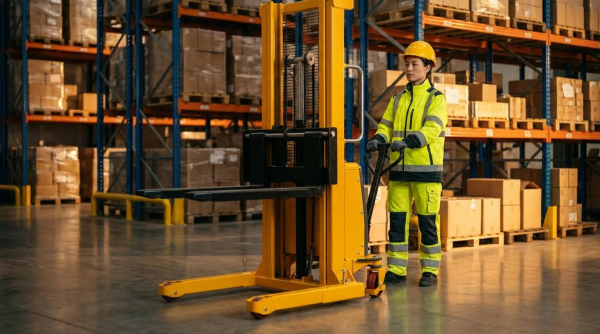
Straddle stacker lifts use hydraulic power, a guided mast, and wide straddle legs to raise palletized loads safely within tight warehouse aisles. This guide explains how the geometry, cylinders, chains, and powertrain interact so you can confidently answer “how does a straddle stacker lift work” and specify the right machine for real-world operations.
Core Mechanics Of A Straddle Stacker Lift
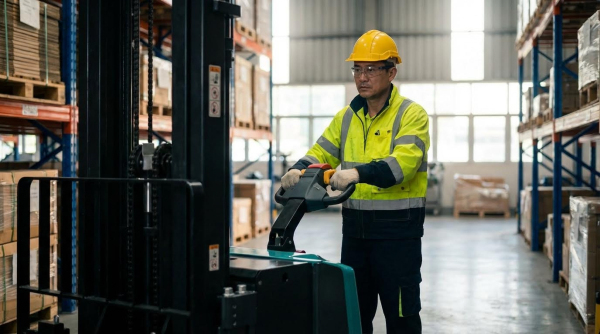
The core mechanics of a straddle stacker explain how the legs, hydraulics, and mast convert pump pressure into controlled vertical lifting. Understanding this is key if you are asking “how does a counterbalanced stacker lift work” for real warehouse use.
Straddle leg geometry and load path
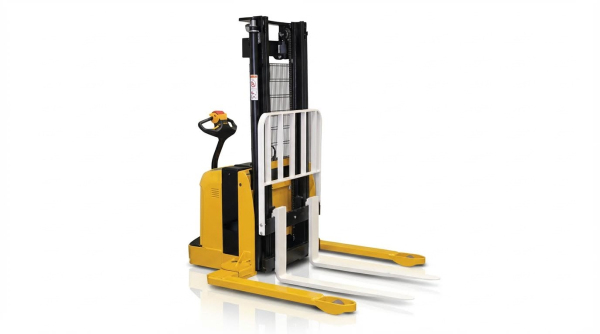
Straddle legs on a stacker create a wide, low frame that carries the load path from the forks down into the floor instead of through the truck body. This geometry is what lets the machine lift pallets and still stay upright in narrow aisles.
In a typical electric straddle stacker, the two legs run parallel to the forks and sit outside the pallet footprint. They form a stable base so the vertical load from the forks transfers straight down through the legs and wheels into the concrete, not just through the central chassis. That geometry directly affects rated capacity and stability limits, together with load center and lift height. Straddle stackers usually work in the 700–1,800 kg capacity band with lift heights up to about 5 m, so the leg width and wheelbase must keep the combined center of gravity inside the support polygon at those heights. Typical capacity and height ranges
| Parameter | Typical Range / Example | Operational Impact |
|---|---|---|
| Rated capacity | 700–1,800 kg | Defines maximum pallet weight at specified load center; limits dense or double-stacked loads |
| Max lift height | Up to ~5,000 mm | Higher lift increases overturning moment; demands wider straddle legs and careful driving |
| Straddle leg width (inside) | Sized to clear pallet or load footprint | Must fit around pallets while keeping wheels as far apart as possible for lateral stability |
| Wheelbase | Short for maneuverability | Improves tight turning but can increase mast sway and pitch at height |
| Chassis compactness | Short, narrow frame | Improves aisle performance but narrows stability triangle, especially when turning with raised load |
Because the legs sit under the load, operators must confirm the load physically fits between them and that the pallet stringers align with the forks. Poor fit or off-center loading shifts the center of gravity sideways, reducing the lateral stability that the leg spacing is supposed to provide. Narrower legs or shorter chassis improve maneuverability but reduce safety margins, especially with tall or top-heavy loads. Maneuverability and stability discussion
- Wide leg stance: Legs spread laterally – Increases the base width so the machine resists side tipping when turning or on uneven floors.
- Low load path: Weight flows into leg wheels – Reduces stress on the central frame and mast base, improving fatigue life.
- Clearance around pallets: Legs outside the pallet – Allows handling of closed-bottom pallets that normal fork-over stackers cannot lift.
- Compact chassis: Short wheelbase – Enables working in narrow aisles but requires slower travel at height.
- Load center control: Respect rated load center – Keeps the combined center of gravity within the support polygon, preventing tip-over.
How the load center interacts with straddle leg geometry
The rated load center (for example 500–600 mm from the heel of the forks) defines where the manufacturer assumes the load’s center of gravity sits. If the actual center of gravity is further out, the overturning moment grows faster than the counteracting moment from the leg footprint. That is why long, un-palletized loads or offset pallets can overload an otherwise “within capacity” stacker.
💡 Field Engineer’s Note: On polished or painted concrete, wide straddle legs can still slide sideways if the floor is dusty or oily. Treat the floor as part of your stability system; poor friction can make a geometrically stable truck behave like it is on ice during emergency stops or sharp turns.
Hydraulic pump, valves, and lift cylinder
The hydraulic pump, control valves, and lift cylinder convert motor power into smooth, controllable vertical fork movement. This hydraulic group is the heart of “how does a battery-powered stacker lift work” in day-to-day operation.
In an electric straddle stacker, a hydraulic pump driven by the traction battery pressurizes oil and sends it to a single main lift cylinder via directional and lowering-control valves. The pump and valves set lift speed and how precisely the operator can feather the forks up or down. Proper hydraulic maintenance is critical for avoiding leaks, jerky motion, or slow lifting. Hydraulic system overview
| Hydraulic Element | Typical Role / Example Data | Operational Impact |
|---|---|---|
| Lift cylinder | Bore sized for capacity; example 180 mm bore in heavy carriers at 16–18 MPa | Larger bore allows high lift capacity at lower pressure, improving component life and safety margins. Heavy-duty hydraulic example |
| System pressure | Around 16–18 MPa in heavy straddle carriers | Lower pressure for a given capacity reduces hose and seal stress, cutting leak risk. |
| Hydraulic oil volume | 5.0–6.0 L depending on lift height (2.5–3.5 m) | Taller masts need more oil to fill the cylinder stroke; underfilled tanks cause cavitation and slow or uneven lifting. Oil volume recommendations |
| Lift speed (example) | ~35 mm/s unloaded, ~25 mm/s loaded in heavy carriers | Defines how fast pallets can be raised; slower loaded speeds improve control and reduce dynamic shock. Lift speed reference |
On smaller warehouse stackers, the same principles scale down. The pump flow rate and cylinder area set the lift speed, while the maximum system pressure and cylinder bore determine how much weight the truck can raise within its rated capacity. Control valves meter the oil when lowering, preventing free fall and allowing fine positioning onto racking beams or truck decks. Regular checks of cylinders, hoses, and fittings for leaks and internal bypass help prevent slow, uneven lifts or creeping masts. Hydraulic maintenance practices
- Pump: Generates flow – Determines how quickly the forks can rise at a given load.
- Relief valve: Limits maximum pressure – Protects structure and prevents overload damage when operators attempt to lift too much.
- Lowering valve: Meters return flow – Gives smooth, controllable descent even with heavy pallets.
- Oil volume vs. height: More height needs more oil – Avoids cavitation and loss of lift at top stroke.
- Seal condition: Good seals prevent internal bypass – Stops masts from drifting down under load.
Typical hydraulic oil volumes vs. lift height
Guidance for a common electric straddle stacker shows about 5.0 L of oil for 2,500 mm lift, 5.5 L for 3,000 mm, 5.7 L for 3,300 mm, and 6.0 L for 3,500 mm. Underfilling below these values can cause foaming, noise, and loss of effective capacity at full height. Overfilling can cause spillage and aeration when the oil warms and expands. Oil level recommendations
💡 Field Engineer’s Note: In cold rooms, high-viscosity oil makes lift and lower sluggish for the first 10–15 minutes. If operators “rev” the hydraulics to compensate, pressure spikes can blow weak hoses. Use oil grades matched to the lowest ambient temperature and extend warm-up time instead of chasing speed.
Mast stages, chains, and lift kinematics
The mast, chains, and associated sheaves turn the straight stroke of the hydraulic cylinder into the vertical travel of the carriage and forks. Their geometry explains why the forks often move faster than the cylinder and how clear-view and multi-stage masts work.
In most electric straddle stackers, the lift cylinder is mounted in or behind the mast and drives a chain system. As the cylinder extends, it pulls or pushes chain runs over sheaves, multiplying the fork travel relative to cylinder stroke. At low lift heights, a simple single-stage mast may be enough, but for higher racking, duplex or triplex masts use nested rails and additional chain runs to keep the overall collapsed height down while still reaching around 5,000 mm. Proper chain tension and mast inspection are core items on any pre-operation checklist. Inspection checklist including mast
| Mast / Kinematic Element | Function | Operational Impact |
|---|---|---|
| Single-stage mast | One fixed outer rail, one moving inner rail | Simpler and stiffer; suitable for low lift heights where overhead clearance is generous. |
| Duplex / triplex mast | Two or three nested rail sets with chains | Achieves higher lift with a lower collapsed height, essential for low doors and high racking. |
| Chain and sheave ratio | Often 2:1 fork travel to cylinder stroke | Forks can move twice as fast as the cylinder, improving productivity without a huge cylinder. |
| Mast sway | Flex and play in rails and chains | More noticeable on compact chassis at high lift; requires slower movements near top levels. Mast sway discussion |
| Inspection points | Chains, anchors, rollers, welds | Worn or stretched chains and cracked welds are common failure modes that must be caught early. |
- Chains as motion multipliers: Cylinder stroke is “re-geared” – Allows a compact cylinder to deliver the full fork travel the application needs.
- Nesting mast rails: Stages extend sequentially – Keep the truck’s collapsed height low enough for doors and mezzanines.
- Guide rollers and bearings: Control rail alignment – Reduce friction and mast twisting when turning with a raised load.
- Regular chain checks: Look for elongation and corrosion – Prevents catastrophic failures under full load.
- Visual inspections: Include welds and mounting points – Early crack detection avoids sudden mast collapse.
What operators should check on the mast every shift
Standard pre-operation protocols require visual checks of forks, mast, chains, and welds before use. Chains should show even tension with no kinks; rollers should turn freely; and there should be no signs of impact damage or twisting. Any fault must be logged and the truck tagged out until repaired. Pre-operation protocols
💡 Field Engineer’s Note: When you retrofit higher masts on existing chassis, the extra height amplifies every bit of rail and chain play. Trucks that felt solid at 3,000 mm can feel “whippy” at 4,500 mm, forcing lower travel speeds and reducing real-world throughput even though the nameplate lift height went up.
Hydraulic, Mast, And Powertrain Design Details
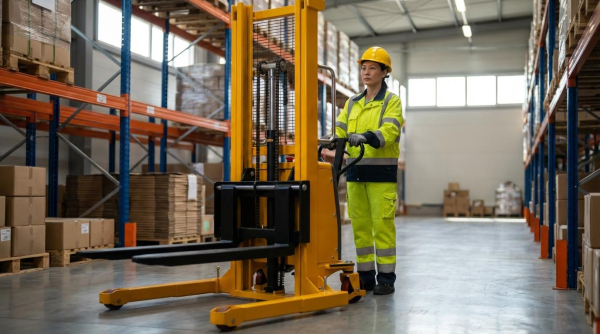
This section explains how hydraulic circuits, mast design, and electric powertrains work together to answer “how does a counterbalanced stacker lift work” in real warehouse duty cycles.
We will connect component-level specs to what you feel at the tiller: lift speed, stability at height, and battery runtime.
Single vs. duplex and triplex mast behavior
Single, duplex, and triplex masts all lift the forks using chains and cylinders, but each behaves differently for visibility, free lift, and stability at height.
On a straddle stacker, mast choice directly affects how high you can store, how early the mast blocks your view, and how “flexible” the truck feels when fully raised.
| Mast Type | Typical Stages | Key Feature | Operational Impact |
|---|---|---|---|
| Single (simplex) | 1 moving stage | No or very limited free lift | Good visibility but mast height grows immediately; best for low racks and dock work. |
| Duplex | 2 stages | Moderate free lift | Forks rise first with limited mast extension; useful in 2.5–3.5 m areas with low doors. |
| Triplex | 3 stages | High free lift and compact retracted height | Reaches up to about 5 m while staying short enough for standard doors; more chain and roller wear to monitor. |
Most warehouse straddle stackers in the 700–1,800 kg class use duplex or triplex masts to reach up to about 5 m while still fitting inside low door headers and containers for typical storage applications.
- Single mast: One outer channel and one moving inner carriage – simpler, cheaper, but tall even at ground level.
- Duplex mast: Fixed outer channel plus one inner stage – balances free lift and stability for medium-height racking.
- Triplex mast: Three nested channels with multiple chain runs – compact when lowered yet reaches high top beams.
As you add stages, chain routing and roller count increase, so inspection of chains, welds, and rollers becomes more critical to avoid sudden loss of lift or mast binding under load during operation.
How mast choice affects “how does a straddle stacker lift work” in practice
With a simplex mast, the operator sees more through the channels but hits height limits early. Duplex and triplex masts introduce free lift: the forks and carriage move first while the outer mast remains low, so the truck can work inside containers, under mezzanines, or through 2.1–2.3 m doors before the mast extends.
💡 Field Engineer’s Note: On triplex masts, slight chain stretch shows up as the carriage going out of level at full height. If operators report “one fork is higher,” check chain equalization and roller wear before blaming the hydraulics.
Hydraulic sizing, pressures, and lift speed
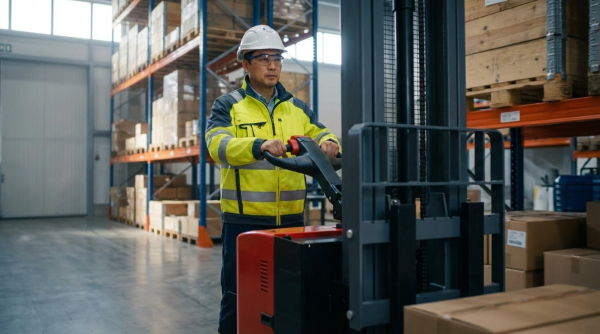
The hydraulic system on a straddle stacker converts motor power into lifting force using a pump, valves, and a lift cylinder sized for capacity, pressure, and lift speed.
Understanding these relationships explains why one truck feels “slow but strong” and another lifts fast but stalls near rated capacity.
| Hydraulic Parameter | Typical Value / Range | What It Controls | Operational Impact |
|---|---|---|---|
| System pressure | About 16–18 MPa on comparable lifting machines for high-capacity carriers | Max lifting force | Higher pressure allows smaller cylinders but demands better hoses and seals. |
| Cylinder bore | Scaled down from ~180 mm bore used on 40,000 kg carriers to suit 700–1,800 kg stackers | Lift capacity at given pressure | Larger bore increases capacity but slows lift for the same pump flow. |
| Pump flow | Chosen to give practical lift speeds such as 25–35 mm/s under load on comparable machines for safe stacking | Lift and lower speed | Higher flow raises the mast faster but increases motor current and battery drain. |
| Oil volume | About 5–6 L for 2.5–3.5 m lift heights in typical stackers | Stroke range and cooling | Too little oil causes cavitation at full height; too much overheats slowly but wastes space. |
In a typical unit, the hydraulic pump, control valves, and lift cylinder jointly determine how fast the forks rise, how smoothly they lower, and how precisely the operator can place a pallet during normal stacking.
- Pump and motor: The electric motor drives a gear or vane pump – this converts electrical energy into hydraulic flow.
- Control valves: Directional and throttle valves meter oil to the cylinder – they set lift, hold, and controlled lowering behavior.
- Lift cylinder and chains: Cylinder stroke multiplies through chains to move the carriage and mast stages – this is the mechanical “amplifier” that turns pressure into height.
Hydraulic oil volume scales with mast height: around 5 L at 2.5 m up to about 6 L at 3.5 m, so undersized tanks or low oil levels show up first as slow, noisy lifting near maximum height in daily checks.
What slow or uneven lifting usually means
If a straddle stacker lifts unevenly or slowly, technicians should first check oil level versus mast height, then inspect cylinders, hoses, and fittings for leaks or worn seals that cause internal bypass and loss of pressure before replacing major components.
💡 Field Engineer’s Note: In cold rooms near or below 0°C, standard hydraulic oil thickens and makes lift sluggish. Switching to low-temperature oil often restores normal lift speed without touching pumps or cylinders.
Electric drive, batteries, and regenerative braking
Straddle stackers use electric traction and lift motors powered by batteries, often with regenerative braking to recover energy during deceleration and lowering.
This powertrain design is central to how a straddle stacker lift works quietly and efficiently in indoor warehouses.
| Powertrain Element | Typical Options / Specs | Function | Operational Impact |
|---|---|---|---|
| Battery type | Lead-acid or lithium-ion packs sized to shift length and duty cycle for modern stackers | Energy storage | Lead-acid suits single-shift, lithium-ion suits multi-shift with opportunity charging. |
| Travel speed | About 3.5–4.0 km/h unloaded, slightly less when loaded for safety | Horizontal movement | Limited speed keeps stability margin high in narrow aisles. |
| Regenerative braking | Integrated in many electric stackers to improve efficiency | Energy recovery | Extends runtime by feeding power back during deceleration and controlled lowering. |
| Battery care | Regular inspections and clean terminals recommended | Reliability | Reduces mid-shift faults and voltage sag that slow lift and travel. |
Electric straddle stackers rely on the battery not just for traction but also for the hydraulic pump motor, so weak batteries show up as reduced lift speed, especially with heavy loads near the 700–1,800 kg rating range in normal warehouse use.
- Lead-acid batteries: Lower upfront cost, need regular watering and full charge cycles – best for predictable single-shift work.
- Lithium-ion batteries: Higher cost, fast opportunity charging – ideal for multi-shift or high-throughput operations.
- Regenerative functions: Traction and sometimes mast lowering feed energy back – reduce heating and extend effective runtime.
Why speed limits are built into the powertrain
Manufacturers cap travel speed to about 4.0 km/h unloaded and around 3.5 km/h loaded to keep the center of gravity inside the stability triangle during turns and braking, especially when the load is raised above the ideal low transport height for safe operation.
💡 Field Engineer’s Note: When operators complain that “lift is weak,” check battery voltage under load before blaming hydraulics. A sulfated lead-acid pack can drop voltage enough that the pump slows, even though the hydraulic circuit is perfectly healthy.
Applying Straddle Stackers In Real Warehouses
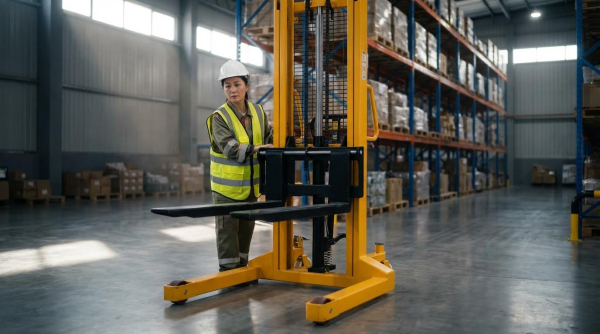
Applying a counterbalanced stacker in a real warehouse means matching its hydraulic lift, mast height, and straddle geometry to your loads, aisles, floors, and safety rules so it works efficiently every shift. If you understand how does a straddle stacker lift work, you can spec capacity, layout, and safety systems that avoid tip-overs, bottlenecks, and battery failures in daily operation.
- Capacity & geometry: Match kg rating, load center, and straddle width to pallets and racking – Prevents overloads and leg collisions.
- Environment: Check floor flatness, slopes, and congestion – Protects stability and mast life.
- Controls & data: Use sensors and telematics – Cuts damage, downtime, and training gaps.
💡 Field Engineer’s Note: Spec the truck to your worst-case pallet and aisle, not the average one. Most near-tip events I investigated came from “one odd load” or “that one tight bay” nobody designed for.
Matching capacity, load center, and aisle width
Matching capacity, load center, and aisle width ensures the straddle stacker’s hydraulic and mast system can safely lift your heaviest pallets without hitting racks or stalling in tight spaces. In practice, this is where most selection mistakes happen.
| Key Parameter | Typical Range / Example | What It Controls | Operational Impact |
|---|---|---|---|
| Rated capacity | 700–1,800 kg for many straddle stackers (source) | Maximum safe load at rated load center | Choose ≥15–20% above your heaviest real pallet to allow for wrapping, moisture, and variation. |
| Load center distance | Typically around 500–600 mm (e.g., 22 in ≈ 560 mm) (source) | How far the load CG can be from the fork face | Long pallets or overhanging loads effectively increase load center and reduce real capacity. |
| Lift height | Up to ~5,000 mm for many units (source) | Maximum racking level reachable | Higher lift increases mast sway and reduces residual capacity; needs flatter floors and better training. |
| Straddle inner width | Must exceed pallet width plus clearance | Whether legs can pass around pallet or stillage | Too narrow: legs hit pallet; too wide: reduced lateral stability in tight aisles. |
| Minimum aisle width | Set by chassis length + load + steering angle | Whether you can turn and right-angle stack | Undersized aisles force unsafe “shuffling” and diagonal approaches. |
- Confirm real pallet size: Measure length, width, and any overhang – Stops you from underestimating load center.
- Check load type: Drums, IBCs, tall cartons – High centers of gravity reduce practical capacity even if weight is within the plate.
- Link capacity to height: Use the truck’s capacity chart, not just the nameplate – Capacity can drop sharply above 3,000–4,000 mm.
- Map aisle geometry: Measure clear aisle, beam heights, and column intrusions – Ensures the stacker can turn and tilt without hitting steel.
How to quickly check if a stacker fits your aisle
Take the overall load length (fork heel to load end) plus 200–300 mm for clearance. Add the truck’s turning radius. That combined dimension must be less than your clear aisle width if you want true right-angle stacking without dangerous multi-point turns.
Stability, floor conditions, and safety compliance
Stability, floor conditions, and safety compliance determine whether a battery-powered stacker’s theoretical capacity can be used safely day after day without tip-overs or structural damage. The physics is simple: high loads, rough floors, and bad habits do not mix.
| Factor | Typical Data / Practice | Risk If Ignored | Best For… |
|---|---|---|---|
| Rated capacity & height | Example: 4,400 lb (≈2,000 kg) at 560 mm load center up to ~3,000 mm height (source) | Tip-over when lifting long or top-heavy loads at height. | Warehouses with consistent pallet types and controlled load geometry. |
| Travel speed | About 4.0 km/h unloaded, 3.5 km/h loaded recommended (source) | Loss of control in turns; impact with racking or pedestrians. | Short-haul, stop‑start warehouse moves where fine control beats speed. |
| Floor flatness & slope | Manual/electric stackers struggle on slopes above a few percent; potholes amplify mast sway. | Sideways instability, especially with raised loads; wheel and bearing damage. | Indoor, smooth concrete more than yard or ramp work. |
| Pre‑operation checks | Daily inspections of forks, mast, chains, brakes, and hydraulics (source) | Hidden cracks or leaks leading to sudden failure under load. | Any site wanting to comply with OSHA/ISO style safety regimes. |
| Load handling technique | Keep load low during travel; avoid sharp turns; even fork spacing (source) | Dynamic tip risk, especially with high CG loads and emergency braking. | Mixed-experience operator teams needing simple, repeatable rules. |
- Floor survey: Walk main routes and mark cracks, drains, and slopes – Route heavy or high lifts away from bad spots.
- Speed zoning: Define low-speed areas near docks, doors, and crossings – Makes 3.5–4.0 km/h limits meaningful in practice.
- Check hydraulics: Verify oil level vs. lift height (e.g., 5–6 L between 2.5–3.5 m) and inspect for leaks (source) – Prevents slow, uneven lifting that tempts operators to override controls.
- Training & PPE: Only trained operators with safety shoes and hi‑vis should drive (source) – Reduces foot injuries and hit‑by incidents in tight aisles.
💡 Field Engineer’s Note: If your floor has more than about 2–3% slope near docks, treat that area as “no high lifts.” Use the stacker only with the mast lowered there, or move those racks to flatter zones.
Typical daily safety checklist
Check forks for cracks or bending; mast and chains for damage; wheels and brakes for wear; hydraulic oil level and visible leaks; battery charge and cable condition; horn and any warning lights. If anything looks wrong, tag the unit out and log the fault before use.
Automation, sensors, and telematics integration
Automation, sensors, and telematics turn a basic straddle stacker into a data-driven tool that enforces safe limits and reduces unplanned downtime. They also give you hard evidence of how does a straddle stacker lift work in your specific warehouse, not just in a brochure.
| Technology | What It Measures / Does | Operational Benefit | Best Use Case |
|---|---|---|---|
| Mast height sensors | Continuous mast position feedback (source) | Auto-slow travel when forks are raised; prevents impacts with low beams. | Sites with mixed beam heights or mezzanines. |
| Load presence / weight sensors | Detects if forks carry a load; some estimate weight | Stops travel with raised empty forks; warns on overloads vs. capacity chart. | Operations with frequent partial pallets or loose goods. |
| Travel speed limiting | Configurable max speeds by mode or area | Enforces 3.5–4.0 km/h limits automatically in congested zones. | High-traffic cross‑aisles and dock approaches. |
| Telematics gateway | Logs hours, fault codes, battery status, impacts (source) | Supports predictive maintenance and identifies abuse or training gaps. | Fleets with multiple units and shifts. |
| Battery monitoring | Voltage, temperature, charge cycles | Prevents mid‑shift failures; optimizes charging windows. | Two‑ or three‑shift operations with electric stackers. |
- Start with “must have” sensors: Mast height, load presence, and impact logging – These tackle your biggest safety and damage costs first.
- Use telematics data: Review weekly which locations show most alarms or impacts – Often reveals a bad layout, not a bad driver.
- Link to maintenance: Trigger inspections by operating hours and fault codes, not just calendar – Aligns service with real usage.
- Integrate with training: Use real events (overloads, high‑speed turns) in refresher sessions – Makes training warehouse‑specific and credible.
💡 Field Engineer’s Note: When you add telematics, expect a spike in “problems” at first. You did not create new issues; you finally see the old ones. Use that first 90 days of data to fix layouts, signage, and rules before blaming operators.
Where automation fits in the overall lift system
The hydraulic pump, valves, and mast chains still do the physical lifting, but sensors supervise how far and how fast they move. Telematics then records each event. Together, they close the loop between “how the straddle stacker lift works” mechanically and how operators actually use it on your floor.
Key Takeaways For Specifying Straddle Stackers
Key specification takeaways link how does a straddle stacker lift work to what you should actually buy: match hydraulics, mast, and geometry to your pallets, aisles, and duty cycle, not just the nameplate capacity.
Use this section as a quick engineering checklist before you sign off on a straddle stacker spec or purchase.
1. Convert “How Does It Work?” Into Hard Specs
The way a straddle stacker lifts—hydraulics, mast, and load path—must translate into clear, written requirements on your datasheet.
- Hydraulics and lift circuit: Define required lift height (m) and lift speed (mm/s) based on your rack beam levels and cycle time – avoids undersized pumps and slow operation.
- Mast configuration: Choose between simple single/duplex masts or compact triplex for low doors but high racking – prevents “can’t reach top beam” surprises.
- Straddle geometry: Lock in inside/outside leg width and leg length – ensures the truck actually fits your pallets and aisles.
- Load path and center: Specify rated capacity at your real load center (e.g. 600 mm, not just the catalog default) – keeps the truck stable with your actual loads.
Why the load center must be on the spec
A typical straddle stacker might be rated around 2,000 kg at a 600 mm load center and about 3.0–5.0 m lift height. If your loads are longer or offset, the effective load center grows and the safe capacity drops, even though the nameplate number looks fine.
2. Match Capacity, Load Center, And Height To Reality
Capacity, load center, and lift height must be chosen as a system, not as three independent numbers.
| Parameter | Typical Range | Operational Impact |
|---|---|---|
| Rated capacity | 700–1,800 kg for many electric straddle stackers reference | Sets max pallet weight at the specified load center and lift height. |
| Load center distance | Typically 500–600 mm (about 20–24 in) reference | Longer loads push center of gravity forward and reduce safe capacity. |
| Lift height | Up to ~5,000 mm for many models reference | Higher lifting increases overturning moment and mast sway. |
- Define your heaviest pallet: Include product, pallet, wrap, and any dunnage – prevents silent overloading.
- Measure true load length: Long loads (e.g. 1,200 mm pallets with overhang) increase load center – reduces real capacity vs. catalog value.
- Check top beam height: Add clearance (≈150–300 mm) above the highest rack beam – ensures clean entry/exit without hitting beams.
💡 Field Engineer’s Note: When I validate specs on site, I always simulate worst-case: heaviest pallet, highest level, and slightly off‑center on the forks. If the selected stacker only “just” passes on paper, I move up one capacity class to keep a real safety margin.
3. Specify Hydraulic Performance, Not Just “Electric Lift”
The hydraulic system that makes a straddle stacker lift must be sized around your lift height and duty cycle, not guessed from a brochure.
- Lift speed requirement: Use target lift speed in mm/s (e.g. 80–150 mm/s loaded) – directly sets pump flow and motor power.
- System pressure band: Many compact lifting systems run around 16–18 MPa for high capacity with moderate stress reference – helps size hoses, valves, and seals.
- Oil volume vs. lift height: Higher masts need more hydraulic oil; for example, oil volume typically rises from about 5.0 L at 2.5 m to around 6.0 L at 3.5 m lift height reference – prevents cavitation and erratic lifting.
- Valve control strategy: Ask for proportional lowering and load‑holding valves – gives smooth, controllable fork positioning and prevents drift.
Hydraulic maintenance requirements to include in the spec
Call out access for inspecting cylinders, hoses, and fittings; and specify intervals for oil checks and seal replacement. Poor access increases maintenance time and encourages skipped inspections, which later show up as leaks and slow/uneven lifting.
4. Choose The Right Mast Type For Your Building Envelope
Single, duplex, and triplex masts behave differently, so choose based on door height, rack height, and operator visibility.
- Single/duplex mast: Fewer moving stages, simpler chains, and better stiffness – good for lower racking and open areas.
- Triplex mast: Very low collapsed height with high extended height – ideal where doors are ~2.1 m but racks approach 4.5–5.0 m.
- Free lift requirement: If you must lift pallets inside trailers or under mezzanines, specify free lift height – forks rise before the mast extends.
- Mast sway and chassis length: Short, compact chassis improve maneuverability but increase mast sway at height reference – affects driver confidence and stacking speed.
💡 Field Engineer’s Note: In very narrow aisles, operations often overspec triplex masts “just in case.” I usually check if a duplex with lower maximum height can still cover 95% of locations; the stiffer mast often lets operators work faster and with fewer rack strikes.
5. Lock In Straddle Leg And Aisle Geometry
Straddle leg geometry decides whether the truck can physically enter your pallet, turn in your aisle, and clear columns and dock levelers.
| Geometry Item | What To Specify | Best For… |
|---|---|---|
| Inside leg width | Must exceed pallet width (e.g. ≥ 900–1,000 mm for 800 mm pallets) | Ensures legs straddle the pallet without hitting stringers. |
| Outside leg width | Must fit aisle and rack upright spacing | Prevents leg collision with rack frames. |
| Leg length | Balance between stability and turning radius | Shorter for tight aisles; longer for heavy/high lifts. |
| Minimum aisle width | Compare to your narrowest aisle plus safety margin | Guarantees you can turn with a pallet raised just off the floor. |
- Map your worst aisles: Use the smallest clear width and tightest corner as your design case – avoids trucks that “work everywhere except Aisle 3.”
- Confirm pallet entry: Check that fork spread and leg spacing suit your pallet openings – important with non‑standard or CHEP-style pallets.
How to quickly validate aisle width
Take the truck’s published minimum aisle width, then add at least 100–200 mm for operator variation and floor imperfections. If your existing aisles are already fixed, this quickly filters out unsuitable models.
6. Specify Power System, Runtime, And Speed
Battery type, capacity, and travel speed must align with shift length, gradients, and safety rules in your facility.
- Battery chemistry: Electric straddle stackers typically use lead‑acid or lithium‑ion batteries reference – lithium suits multi‑shift, fast opportunity charging.
- Runtime requirement: Size battery for peak shift hours plus reserve – prevents mid‑shift failures and hot battery swaps.
- Travel speed: Typical unloaded speeds are around 3.5–4.0 km/h, reducing slightly when loaded reference – balance productivity with safety.
- Regenerative braking: Ask for regen on decel and lowering where available reference – extends runtime and reduces brake wear.
💡 Field Engineer’s Note: In cold rooms and freezers, lead‑acid batteries lose a lot of usable capacity. I always derate catalog amp‑hours by 20–30% for sub‑zero work and push strongly toward lithium if budgets allow.
7. Build Safety, Training, And Maintenance Into The Purchase
Straddle stacker safety depends as much on procedures and maintenance as on the machine’s raw design.
- Operator training package: Require formal training on controls, load balance, and emergency procedures reference – reduces tip‑over and collision incidents.
- Pre‑operation checklists: Make daily checks on forks, mast, chains, welds, hydraulics, and battery mandatory reference – catches issues before they become accidents.
- Documented maintenance schedule: Include daily checks plus periodic hydraulic oil changes and structural inspections, all logged with date and hours reference – supports warranty claims and lifecycle planning.
- Telematics and sensors: Consider height, load, and presence sensors plus telematics for fault codes and battery status reference – enables predictive maintenance and operator coaching.
Key safety limits to write into SOPs
Keep loads low while traveling, avoid sudden turns, and never exceed the rated capacity at the specified load center. Make it explicit that any hydraulic leak, bent fork, or damaged chain means the truck is tagged out until inspected and signed off.
💡 Field Engineer’s Note: When managers ask “how does a straddle stacker lift work,” I walk them through hydraulics, mast, and stability, then immediately tie that to training and inspection. People remember the physics better when they see how it links to real‑world near‑misses in their own aisles.
Key Takeaways For Specifying Straddle Stackers
Straddle stacker lifts work safely only when geometry, hydraulics, mast design, and powertrain all line up with real loads and floors. The wide straddle legs and low load path keep the center of gravity inside the support polygon, but this margin shrinks as lift height, load center, and mast sway increase. Hydraulic sizing then decides how confidently the truck can raise rated loads to those heights without shocks, drift, or cavitation. Mast type and chain condition control visibility, free lift, and stiffness, which directly affect operator confidence and stacking speed.
Electric drive, battery health, and regenerative braking finally set how consistently the truck delivers that performance across a full shift. Poor batteries or neglected maintenance show up as slow lift, reduced runtime, and risky operator workarounds. For engineering and operations teams, the best practice is clear: spec from the worst-case pallet, height, aisle, and floor, then lock those demands into capacity charts, mast choice, hydraulic performance, and leg geometry. Add sensors, telematics, and disciplined inspections to enforce these limits in daily use. When you follow this approach, an Atomoving straddle stacker can deliver stable, predictable handling and long component life instead of near-miss events and hidden overloads.
Frequently Asked Questions
How does a straddle stacker lift work?
A straddle stacker lifts loads using a hydraulic system that raises and lowers the forks. The forks are positioned on either side of the load, allowing the stacker to lift and move items with precision. This design makes it ideal for handling pallets in tight spaces. For more details, check out this Straddle Stacker Guide.
What should you do before using a straddle stacker?
Before operating a straddle stacker, always perform pre-operation safety checks. Inspect the equipment for damages, verify fluid levels, and ensure all safety features are functioning properly. Following these steps helps maintain a safe working environment. Learn more about Straddle Stacker Safety Tips.