Safe, efficient use of a straddle stacker starts with disciplined start‑up checks, correct control use, and proven load‑handling routines. This guide explains how to operate a counterbalanced stacker from pre‑shift inspection through shutdown, focusing on stability, braking performance, and hydraulic and electrical integrity so you can move manual pallet jack confidently and avoid preventable incidents in tight warehouse aisles.
Understanding Straddle Stackers And Safety Basics
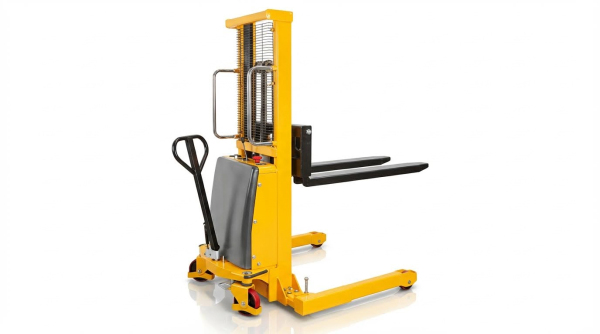
Straddle stackers are pedestrian-operated lift trucks with outriggers that “straddle” the load, and safe use depends on understanding their geometry, limits, and required training. If you want to learn how to operate a straddle stacker safely, start by mastering these fundamentals before touching the controls.
Unlike counterbalanced stackers, straddle stackers use low outriggers and a compact chassis to carry loads on pallets while keeping the overall length short for narrow aisles. Their stability, capacity, and stopping distance change quickly with mast height, load position, and floor conditions, so operators must treat every movement as deliberate, not casual.
- Pedestrian truck: Operator walks with the truck using a tiller – no overhead guard to “save you” if you get pinned.
- Outrigger legs: Legs run alongside the pallet – they define the stability base and trip hazards.
- Electric drive and lift: Battery, AC drive, and hydraulic pump – quiet, powerful, but unforgiving if misused.
- Short wheelbase: Tight turning radius – excellent for 2.4–2.7 m aisles but easier to overload sideways.
- Rated for pallets: Designed around standard pallet sizes and 500 mm load centers – non-standard loads need extra care.
Before any start-up checks or travel, operators must know how the truck stays upright, what standards apply, and why proper training is mandatory—not optional.
💡 Field Engineer’s Note: In real warehouses, most “mystery” tip-overs with straddle stackers came from side hits on outriggers or turning with a high load, not from lifting straight up. Train operators to think in 3D about the base, not just the forks.
Core components and stability geometry
The core components of a straddle stacker work together to keep the center of gravity inside the support area created by the wheels and outriggers. If you understand this stability geometry, you understand the physics behind almost every safe or unsafe move.
Key structural and functional elements include the chassis, mast, forks, lift chains, hydraulic system, drive system, and the straddle legs themselves. Each part affects where the combined truck-and-load center of gravity sits, and whether it stays inside the “stability triangle” (really a polygon for straddle legs) during lifting, braking, and turning. Structural inspections focus on these items because any distortion or wear shifts forces into unsafe patterns. Reference
| Component | Function | Key Inspection Focus | Operational Impact |
|---|---|---|---|
| Chassis & straddle legs | Carry truck mass and define support polygon | Cracks, bent legs, weld damage, corrosion | Distortion shifts center of gravity; reduces tip-over margin |
| Mast rails & rollers | Guide vertical motion of carriage and forks | Straightness, scoring, free roller travel, oil traces | Binding or misalignment causes jerky lift and side loading |
| Forks | Support pallet load | Cracks at heel, bends, twisted tips, thickness wear | Uneven forks twist pallets and shift load sideways |
| Lift chains | Transmit lift force from cylinders to carriage | Rust, tight links, stretched sections, anchor integrity | Unequal tension tilts carriage and load |
| Hydraulic system | Provides lifting and lowering force | Leaks, hose chafing, fluid level and condition | Loss of pressure can cause mast creep and uncontrolled lowering |
| Drive & load wheels | Support and move the truck | Flat spots, chunking, embedded debris | Uneven wheels change effective support points and braking |
During a 360° walk-around, technicians check the chassis, straddle legs, and welds for cracks, deformation, corrosion, or impact damage, and verify guards and covers are secure. Mast rails are inspected for straightness, corrosion, and scoring, ensuring rollers travel freely without binding, while oil traces can signal leaking lift cylinders or contaminated chains. Reference
Forks are examined for cracks at the heel, bends in the blade, or twisted tips, with both forks at the same height and locked positively. Fork thickness at critical sections is measured and compared to the manufacturer’s wear limit, and lift chains and anchor points are checked for rust, tight links, stretched sections, or damaged pins, with equal chain tension on both sides of the mast. Reference
Stability triangle, load center, and real-world balance
Stability for a straddle stacker is governed by a “stability triangle” (or polygon) and the load center distance, which together define how far you can push the machine before it tips. Anytime you change mast height, load position, or speed, you change that stability picture.
- Support polygon: Formed by the contact points of drive wheel and outrigger load wheels – this is your base of support.
- Combined center of gravity (CG): The CG of truck plus load must stay inside that polygon – if it leaves, you tip.
- Load center: Typically 500 mm from fork heel for standard pallets – longer loads push CG outward.
- Mast height: Raising the mast moves the CG up and often slightly forward – higher CG = smaller stability margin.
- Dynamic effects: Braking, turning, and bumps throw the CG toward polygon edges – this is why speed limits matter.
Guidance for how to operate a straddle stacker safely always stresses keeping loads low while traveling and centered fully on the forks. The stability triangle concept means the combined center of gravity of the truck and load must stay within a support polygon formed by the wheels and outriggers, with the load center typically specified as 500 mm from the fork heel for standard pallets. Extending the load center increases the load moment and risks tip-over. Reference
How to “see” the stability triangle in your aisle
Visualize straight lines between the contact patches of the drive wheel and each outrigger wheel; that is your stability polygon. As you raise a 1,000 kg pallet at a 500 mm load center, imagine a dot representing the combined center of gravity moving upward and slightly toward the load. Fast turns or sudden braking shove that dot toward the polygon edge. If you are near a rack upright or dock edge when that happens, there is no recovery time—only a tip or collision.
💡 Field Engineer’s Note: When training new operators on how to operate a straddle stacker, I always have them push an empty pallet to feel how light the steering is, then repeat with a full pallet kept at 50–100 mm height. The difference in “swing” during turns makes the stability concept real in under five minutes.
Applicable standards and operator training
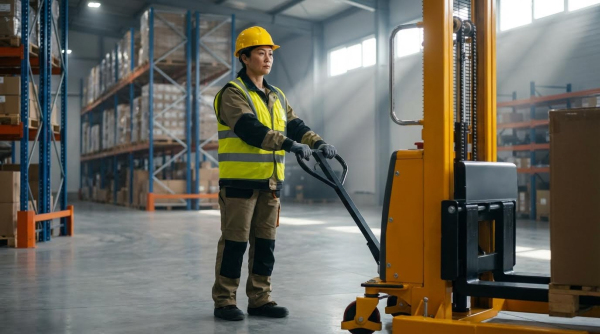
Safe straddle stacker operation depends on following recognized standards and providing formal, documented operator training—not just a quick handover talk. Standards define the minimum safety envelope; training converts that into everyday behavior.
Industrial truck standards and occupational safety rules require that employers assess the workplace, select suitable equipment, and ensure only trained and authorized operators use powered industrial trucks. For straddle stackers, that means specific instruction on pedestrian truck hazards, outriggers, visibility, and confined-space maneuvering, plus hands-on evaluation in the actual work environment.
- Formal theory training: Covers truck types, stability, rated capacity, signage, and site rules – builds mental model before touching the truck.
- Practical, supervised driving: Includes pre-use checks, low-speed maneuvers, stacking, and emergency stops – translates theory into muscle memory.
- Site-specific induction: Focuses on your aisles, gradients, doors, and pedestrian flows – generic training alone is not enough.
- Refresher training: Triggered by incidents, near misses, or observed bad habits – resets unsafe drift in behavior.
- Documentation: Training records, evaluation checklists, and authorization lists – prove compliance and help during audits.
Guides on how to operate a straddle stacker safely also emphasize routine pre-operation safety checks as part of the operator’s responsibility. Before use, operators inspect the battery and electrical connections, wheels, and forks for wear or damage, and verify that all safety features function while ensuring pathways are clear of debris or obstacles. Reference
Emergency protocols and maintenance routines also form part of a complete training and safety package. Operators learn how to respond to engine or power failures, fallen loads, and other emergencies, while maintenance teams follow schedules that include daily inspections and deeper periodic checks, documenting activities in maintenance logs to identify trends and prevent failures. Reference
💡 Field Engineer’s Note: The fastest way to raise safety is to tie authorization to specific truck types and areas. An operator cleared for low-level stacking in inbound lanes should not automatically be allowed to work in high-bay racking or on ramps without additional assessment.
Operating Controls, Load Handling, And Navigation
This section explains how to operate a straddle stacker safely by mastering controls, handling loads correctly, and moving through aisles without risking tip‑overs or pedestrian incidents. It turns theory into step‑by‑step, floor-ready practice.
- Focus: Control use, load handling, and travel – Core skills for anyone learning how to operate a straddle stacker.
- Goal: Minimize incidents and damage – By standardizing speeds, load heights, and traffic patterns.
- Method: Simple rules plus measurable limits – So supervisors can train, audit, and correct consistently.
Control layout, modes, and speed management
Straddle stackers use a tiller-mounted control head, multiple speed modes, and built‑in safety features that you must understand before moving a single millimeter. Knowing what each control does is the first step in learning how to operate a straddle stacker.
- Tiller / handle: Long arm used for steering and speed command – Keeps your body clear of the truck footprint.
- Directional switch / butterfly: Selects forward or reverse travel – Ensures the truck moves where you expect.
- Travel throttle: Proportional speed control – Small input = slow creep, large input = higher speed.
- Lift / lower buttons: Raise or lower forks with proportional control – Allows precise pallet engagement and beam clearance.
- Emergency reverse (“belly”) button: Instantly drives the truck away from the operator – Prevents crush injuries if you are pinned.
- Emergency stop: Cuts power to drive and hydraulics – Used for any unsafe or unexpected behavior.
- Mode selector (normal / creep / ECO): Limits acceleration and top speed – Improves control in tight aisles or around pedestrians.
Typical electric straddle stackers reach around 4.0 km/h without load and about 3.5 km/h at rated load in normal mode, though many facilities set lower internal limits for safety. Creep or “turtle” mode allows very low speed with the tiller near vertical, which is ideal for precise pallet alignment in tight spaces. Source
- Operator position: Stand slightly to one side of the tiller – Maintains an escape path if the truck rolls toward you.
- Hand placement: Use both hands when possible – Improves fine steering and avoids accidental commands.
- Start‑up movement: Begin with creep mode in congested areas – Reduces shock loads and wall impacts.
- Cornering: Decelerate before the turn, not in it – Prevents sudden weight transfer and loss of stability.
- Braking: Use smooth, progressive braking – Minimizes load shift and fork/roller stress.
How to set and enforce internal speed limits
Define maximum speeds by area type (e.g., 2–3 km/h in docks and picking aisles, higher in clear, marked travel aisles). Use controller settings where available, floor markings, and supervision. Combine with near‑miss reports to adjust limits.
💡 Field Engineer’s Note: In narrow aisles, operators often “fight” the truck by over‑steering and then correcting. Train them to use creep mode with the tiller more upright and very light throttle; this reduces oscillation and keeps the load within the stability envelope, especially when forks are raised for entry into racking.
Picking up, transporting, and stacking loads
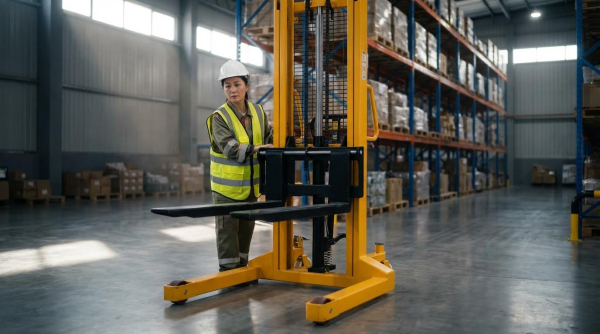
Safe load handling on a straddle stacker starts with respecting the capacity plate, then controlling load height and speed from pick‑up to set‑down. This is the practical core of how to operate a straddle stacker without tipping it or dropping product.
- Know your limits: Read the capacity plate before the shift – Confirms maximum mass and load center in mm.
- Check the load: Inspect pallet and wrapping – Weak or broken pallets fail before the stacker does.
- Align correctly: Approach loads straight and square – Prevents twisting the mast and forks.
- Use the right fork spread: Adjust forks to match pallet openings – Ensures both blades carry weight evenly.
For standard pallets, the rated load center is typically about 500 mm from the fork heel. Extending the load center (long, unbalanced, or overhanging loads) increases the overturning moment and can push the combined center of gravity outside the stability triangle. Source
| Handling Stage | Key Action | Typical Dimension / Value | Operational Impact |
|---|---|---|---|
| Approach | Drive straight at pallet with forks low | Forks 20–40 mm above floor | Prevents gouging floor and pallet entry beams |
| Fork entry | Insert forks fully into pallet | Fork tips protrude slightly from far side | Ensures full blade support and even loading |
| Initial lift | Raise load just clear of floor | 50–100 mm fork height | Keeps center of gravity low while traveling |
| Travel | Move with load lowered | Maintain 50–150 mm clearance | Maximizes stability and visibility |
| Pre‑stack lift | Stop, then raise to target level | Beam level + 30–80 mm | Avoids contact with racking during approach |
- Step 1: Verify capacity – Confirm load mass and center are within the plate rating before lifting.
- Step 2: Approach squarely – Keep outriggers clear of obstacles and do not angle into the pallet.
- Step 3: Insert forks fully – Partial entry causes broken boards and unstable loads.
- Step 4: Lift slightly – Raise only enough to clear the floor (50–100 mm) for transport.
- Step 5: Travel slowly – Keep speed low, especially with heavy or tall loads.
- Step 6: Stop to lift for stacking – Never lift or lower while turning.
- Step 7: Lower gently at destination – Prevent impact loads into the pallet and racking.
During transport, the load should remain in the lowest safe position with a clear line of sight, using reverse travel if the load blocks forward visibility in tight aisles. Sudden steering inputs, abrupt braking, or sharp turns with elevated loads significantly increase tip‑over risk, especially near the upper end of the mast travel. Source
Working on slopes and ramps
Avoid slopes whenever possible. If a short ramp is unavoidable, keep the load upgrade, travel in creep mode, and do not turn on the slope. Stop, lower, and re‑assess if the truck struggles or wheels spin. Never exceed the manufacturer’s rated gradeability.
💡 Field Engineer’s Note: Most tip‑overs in my audits did not come from overloaded pallets but from “micro‑habits” like turning with the forks raised one extra pallet height to save time. Enforce a hard rule: no travel above about 150 mm fork height except for the final approach into the rack or stack.
Aisle navigation, visibility, and pedestrian safety
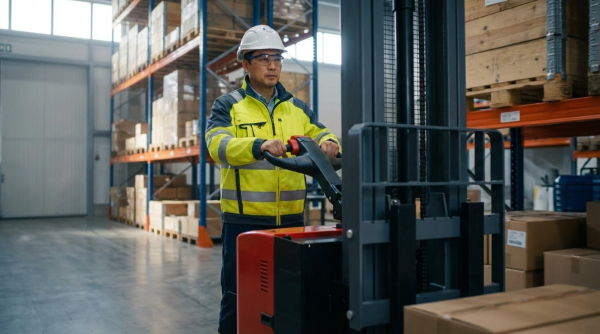
Safe aisle navigation combines low speed, clear sightlines, and strict separation from pedestrians. It is the part of how to operate a straddle stacker that prevents people strikes and racking collisions.
- Defined routes: Use marked travel and stacking aisles – Reduces conflicting movements and blind spots.
- One‑way systems: Set direction in narrow aisles – Prevents head‑on encounters and tight reversing.
- Line of sight: Never drive blind – Use reverse travel or a spotter if the load blocks view.
- Speed discipline: Slowest speeds in mixed traffic zones – Gives time to react to pedestrians and obstacles.
- Audible warning: Use horn at intersections and doors – Alerts others in noisy warehouses.
Facilities that separated travel aisles from stacking aisles and enforced one‑way flow in narrow runs significantly reduced near‑misses. Many also marked pedestrian crossings and “no‑go” zones around high‑activity racking to keep people out of the stacker’s turning envelope. Source
| Aisle Type | Typical Width (m) | Recommended Max Speed | Best Practice |
|---|---|---|---|
| Very narrow picking aisle | 1.8–2.2 m | Creep mode only | One‑way traffic, no pedestrians inside aisle |
| Standard pallet aisle | 2.5–3.0 m | ≈ 3.0 km/h | Stacking only, controlled entry, horn at ends |
| Main travel aisle | 3.0–4.0 m | Up to internal limit (often 3–4 km/h) | Mixed traffic, marked pedestrian crossings only |
- Step 1: Scan ahead constantly – Look 5–10 m ahead for pedestrians, pallets, and trucks.
- Step 2: Control entry to aisles – Slow, sound horn, and check mirrors or curtains at doors.
- Step 3: Keep to the center line – Avoid clipping racking legs or stacked goods.
- Step 4: Maintain escape space: – Do not trap yourself between truck, wall, or racking.
- Step 5: Yield to pedestrians – Stop fully and wait until they are clear of your path.
Pedestrian control measures that actually work
Use painted walkways, physical barriers near doors, and mandatory hi‑vis clothing. Add convex mirrors at blind corners, and train pedestrians to make eye contact and signal before crossing a travel lane. Enforce “no phone use” while walking in warehouse zones.
💡 Field Engineer’s Note: Many near‑miss reports mention “I didn’t see them until the last second.” In practice, this usually means the operator was watching the forks, not the aisle. Train operators to glance at forks only briefly and keep primary focus down‑aisle; use creep mode during any alignment that demands eyes on the load.
Final Thoughts On Safe Straddle Stacker Use
Safe straddle stacker operation depends on one linked system: sound equipment, trained people, and disciplined routines. Geometry, capacity, and braking limits are fixed by design, so supervisors must build processes that respect those limits every shift. If operators ignore the stability polygon, load center, or speed rules, no electronic aid will prevent every tip‑over.
Pre‑operation checks protect the stability structure before the truck moves. Inspecting masts, forks, chains, hydraulics, and wheels keeps the center of gravity where the designer intended. Locking out damaged trucks removes hidden risks that only appear under load or during hard braking.
On the floor, low load height, controlled speed, and straight approaches turn theory into real safety. Clear aisle layouts, one‑way systems, and strict pedestrian separation cut impact risk and keep the stacker inside a predictable envelope. Training must stay practical, site‑specific, and refreshed, with records that prove control.
The best practice for operations and engineering teams is simple: treat the straddle stacker as a precision lifting system, not a casual cart. Combine rigorous inspections, conservative speed and height rules, and documented training based on your layout and Atomoving equipment. When in doubt, slow down, lower the load, and stop the job until conditions are safe.
Frequently Asked Questions
How to Use a Straddle Stacker?
A straddle stacker is used to easily maneuver pallets through tight spaces in warehouses. To operate it, ensure you understand the controls and maintain a clear path. Warehouse Solutions.
What Should You Do Before Using a Straddle Stacker?
Before using a straddle stacker, perform a pre-operation check to ensure the equipment is in good condition. This includes checking the battery, hydraulic systems, and safety features. Follow a preventive maintenance checklist to avoid unexpected breakdowns.
Can a Straddle Stacker Lift Loads?
Yes, a straddle stacker can lift loads up to a certain height, often as high as 140 inches, depending on the model. It is highly maneuverable and capable of handling various load capacities efficiently. Raymond Basics.
What Safety Rules Apply When Operating a Straddle Stacker?
Follow the “Halo Rule,” which requires maintaining a three-foot distance from the stacker to create a safety zone. If anyone enters the danger zone within three feet, the operator must stop the machine immediately. Forklift Safety Tips.