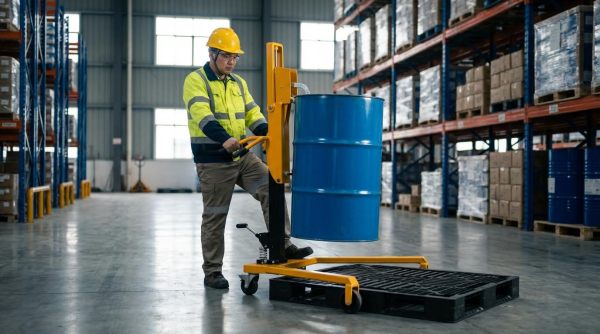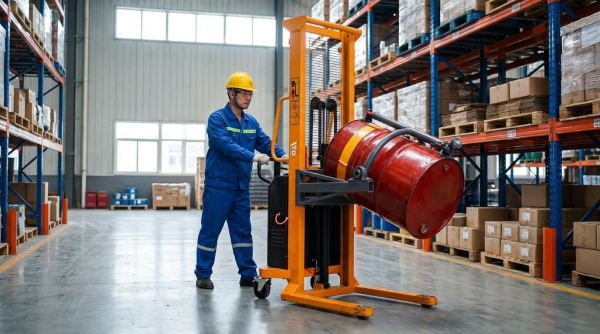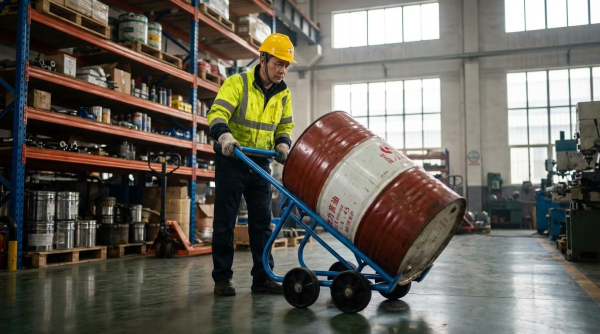
Knowing how to move oil drums safely starts with the right equipment and a clear understanding of liquid behavior, weight, and risk. This guide explains practical drum cart options, safe techniques, and selection criteria so you can move 200 L–205 L oil drums efficiently while protecting people, product, and floors.
Fundamentals Of Safe Oil Drum Movement
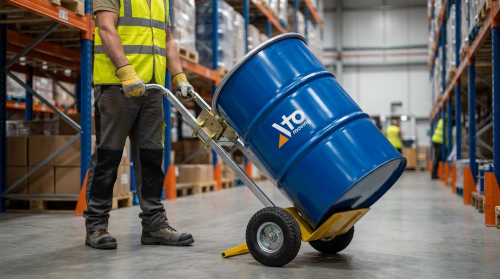
Fundamentally, safe oil drum movement means controlling weight, liquid slosh, and route hazards so a 200–300 kg drum never tips, leaks, or injures people. If you want to master how to move oil drums safely, you must first understand the load physics and regulatory expectations.
Load characteristics and liquid slosh effects
Load characteristics and liquid slosh effects determine how aggressively a drum will try to tip, slide, or overload your handling equipment when you start, stop, or turn. Treat every moving oil drum as a dynamic liquid tank, not a rigid block.
Full oil drums typically weigh about 200–300 kg, so you should select handling equipment with at least a 25% capacity margin above the actual drum weight to cope with dynamic forces and unknown overfills. In practice, that means specifying carts, trucks, or powered movers rated around 250–375 kg per drum when planning how to move oil drums in production or warehouse environments. Source for typical drum weights and capacity margins.
| Condition | Typical Fill Level | Slosh / Dynamic Effect | Key Control When Moving |
|---|---|---|---|
| Completely full drum | ≈ 100% of 200 L volume | Moderate slosh, mass behaves closer to a solid | Use equipment with ≥25% capacity margin, avoid hard braking |
| Partially filled drum | ≈ 50–80% of volume | Strong free-surface slosh, shifting centre of gravity | Reduce speed sharply, avoid sudden turns or ramps |
| Nearly empty drum | < 20% of volume | Light mass but unpredictable surges | Secure drum firmly; risk of bounce or tip-over on rough floors |
When a drum is upright and stationary, its centre of gravity lies on the drum axis; as soon as you tilt or accelerate, the liquid mass moves and pulls the centre of gravity off-centre. This is why sudden steering changes, emergency braking, or hitting a floor joint at speed can make even a “stable” 200 L drum feel like it wants to roll off a cart. Operators should move slowly, plan wide turns, and keep the drum as close to the floor as practical to maximise stability. Source for centre-of-gravity and slosh guidance.
- Speed control: Keep walking and truck speeds low – reduces liquid surge and tipping torque during starts and stops.
- Smooth path: Avoid potholes, broken floor joints, and steep thresholds – prevents sudden drum rocking and frame overload.
- Low lift height: Travel with the drum just clear of the floor – lowers the centre of gravity and improves overall stability.
- Positive restraint: Use clamps, straps, or formed cradles – prevents the shell from sliding or rotating under slosh loads.
- Correct wheels: Choose large-diameter, industrial wheels for rough ground – reduces shock inputs that amplify liquid motion.
Why partially filled drums are higher risk
Partially filled drums leave a large free liquid surface. When you accelerate, the liquid climbs the drum wall, shifting the centre of gravity toward the leading edge. This increases overturning moment and can exceed the safety margin of marginally sized dollies or trucks. That is why routes, speeds, and equipment choice should be more conservative for “half-full” drums than for completely full ones.
💡 Field Engineer’s Note: In real plants, more drum incidents occur with “light” or partially filled drums than with full ones, because operators underestimate the slosh. Treat every partially filled drum like a live load: lower the speed, increase following distance, and avoid side slopes above a few percent, especially when using narrow-wheelbase drum dollies.
Regulatory and risk assessment requirements
Regulatory and risk assessment requirements define how to move oil drums in a way that controls chemical, fire, and ergonomic risks along the entire travel route. You must combine chemical classification, route design, and certified equipment into one coherent handling plan.
Before any routine drum movement, a task-specific risk assessment should identify the liquid’s flammability, toxicity, and reactivity using its safety data sheet, then map potential spill and vapor zones along the intended route. This includes slopes, drains, confined spaces, and ignition sources that could turn a simple leak into a major incident. Typical controls include using sealed drum attachments, imposing low speed limits, and staging spill kits and absorbents at defined points along the path. Facilities that handle oil drums safely usually design traffic routes that avoid high pedestrian density and ensure secondary containment is available wherever drums are parked or transferred. Source for risk assessment and route controls.
| Risk Assessment Element | What You Check | Typical Control Measure | Operational Impact |
|---|---|---|---|
| Liquid classification | Flammability, toxicity, reactivity | Define PPE, ventilation, and ignition controls | Ensures compliant drum moves through safe zones only |
| Route survey | Slopes, thresholds, drains, confined spaces | Mark approved drum corridors and exclusion areas | Reduces chance of spills entering drains or pits |
| Traffic interaction | Pedestrian and vehicle crossings | One-way systems, speed limits, spotters | Prevents collisions involving 200–300 kg drums |
| Containment | Availability of bunds, sumps, spill pallets | Stage spill kits and drip trays at transfer points | Limits environmental impact if a drum leaks |
| Equipment suitability | Capacity, certification, condition | Use drum-rated trucks, dollies, or movers only | Minimises mechanical failure and tip-over |
Regulatory frameworks for drum handling require you to minimise manual lifting, manage hazardous materials safely, and control ignition risks in explosive atmospheres. That means choosing drum handling systems and components that limit mechanical sparking, keep surface temperatures within safe limits, and control static discharge, especially where vapours from oil or solvents may be present. Documented conformity and periodic inspections are essential to prove compliance during internal audits or external inspections. Source for regulatory and inspection requirements.
- Eliminate manual lifting: Use drum dollies, trucks, or powered movers – reduces spinal and shoulder loading on operators.
- Certified components: Specify compliant brakes, casters, and hydraulics in hazardous zones – controls sparks and static discharge.
- Defined drum routes: Mark floor lines and signage for “drum corridors” – keeps heavy liquid loads away from offices and crowded walkways.
- Spill readiness: Position absorbents, drain covers, and tools along routes – enables rapid containment if a drum leaks or is punctured.
- Training and permits: Authorise only trained operators for drum moves – ensures people understand both equipment limits and chemical hazards.
How this ties into everyday “how to move oil drums” decisions
Once you understand the regulatory and risk picture, everyday decisions like “Can I roll this drum across that ramp?” or “Do I need a powered mover here?” become clearer. If the route passes near drains, ignition sources, or confined spaces, you upgrade from a simple dolly to sealed drum trucks or powered movers, slow the operation, and add spill control at key points.
💡 Field Engineer’s Note: When planning new drum routes, walk the path with a full drum on the actual equipment during a controlled trial. Measure clearances, check ramp traction, and time the move. You will often discover small issues—like a tight doorway or unprotected drain—that are invisible on a CAD layout but critical for safe, compliant operation.
Drum Handling Equipment: Types, Design, And Performance
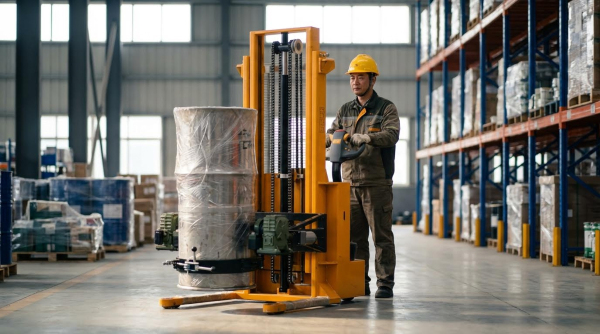
This section explains how different drum handling systems work so you can decide how to move oil drums safely, efficiently, and with the right level of mechanisation for your facility.
For typical 200 L–205 L oil drums weighing 200–300 kg, equipment choice directly affects spill risk, operator strain, and throughput. Below is how manual, hydraulic, and powered solutions compare in real-world use.
| Equipment Type | Typical Capacity Range | Main Function | Power Source | Best For… | Impact On how to move oil drums |
|---|---|---|---|---|---|
| Manual drum trucks / dollies / carts | Up to about 360 kg (1 full 205 L drum) | Short-distance horizontal movement | Human push / pull | Low frequency moves, small sites | Low-cost way to move single drums if floor is flat and traffic is light. |
| Hydraulic jacks, lifters, stackers | About 450–900 kg (1–2 drums) | Lifting drums from floor to pallet / rack height | Manual or electric hydraulics | Loading pallets, feeding process lines | Controls vertical lift so operators avoid direct lifting or tilting of drums. |
| Powered movers, dumpers, rotators | About 300–900 kg | Motorised transport, tilting, or rotating | Battery, mains, or vehicle hydraulic power | High-volume warehouses and production | Best for frequent moves, controlled pouring, and minimising manual effort. |
💡 Field Engineer’s Note: When you plan how to move oil drums, assume at least 25% extra capacity margin on any device. This cushions dynamic loads from liquid slosh during braking and turning and keeps structures and casters within safe stress levels.
Manual drum trucks, dollies, and carts
Manual drum movers are the simplest answer to how to move oil drums across short distances on reasonably smooth floors with low daily volume.
They rely on leverage and wheel design rather than motors, so ergonomics and surface conditions are critical. For full 200 L–205 L oil drums, the goal is to roll, not lift, while keeping the drum under positive control.
- Drum dollies: Low circular platforms with swivel casters – Allow 360° turning of a drum in tight aisles with minimal push force.
- Drum trucks / hand trucks: Tilting frames that hook or cradle the drum – Let one operator tip and wheel a single drum over longer distances.
- Drum handling carts with tilting frame: Purpose-built carts for 205 L drums – Enable one person to transport a full drum by hand, even where no mechanisation is practical. Source
| Manual Device | Key Design Features | Typical Use Case | Operational Impact |
|---|---|---|---|
| Drum dolly | Low deck, 3–4 swivel casters, circular frame | Re-positioning drums on smooth concrete | Ideal for rotating drums within 1–2 m, e.g. at filling or sampling stations. |
| Two-wheel drum truck | Tilt-back frame, small footprint | Short corridor transfers | Reduces need to roll drums on their chime, lowering damage and strain. |
| All-terrain drum cart | Large wheels ≥ 250 mm diameter | Outdoor yards and rough ground | Lets one operator cross thresholds, gravel, or drains without losing control. |
- Wheel size and type: Large wheels (≈250 mm, 10 in) suit soft or rough ground, while ball or barrow-style wheels work best on smooth concrete. This ensures lower rolling resistance and better control. Source
- Load capacity: Dollies and trucks for steel drums should allow a 25% safety margin over drum weight. This gives headroom for denser products and dynamic loads. Source
- Corrosion resistance: Chemical and oil service often needs corrosion-resistant frames and wheels. This keeps rolling resistance and structural strength consistent over time. Source
When to avoid purely manual drum movement
You should avoid relying only on manual drum trucks or dollies when daily moves exceed a few dozen drums, when ramps are steeper than about 2%, or where operators must cross thresholds and drains frequently. In those cases, hydraulic or powered aids reduce strain and spill risk, especially with partially filled drums that slosh aggressively.
Hydraulic jacks, lifters, and drum stackers
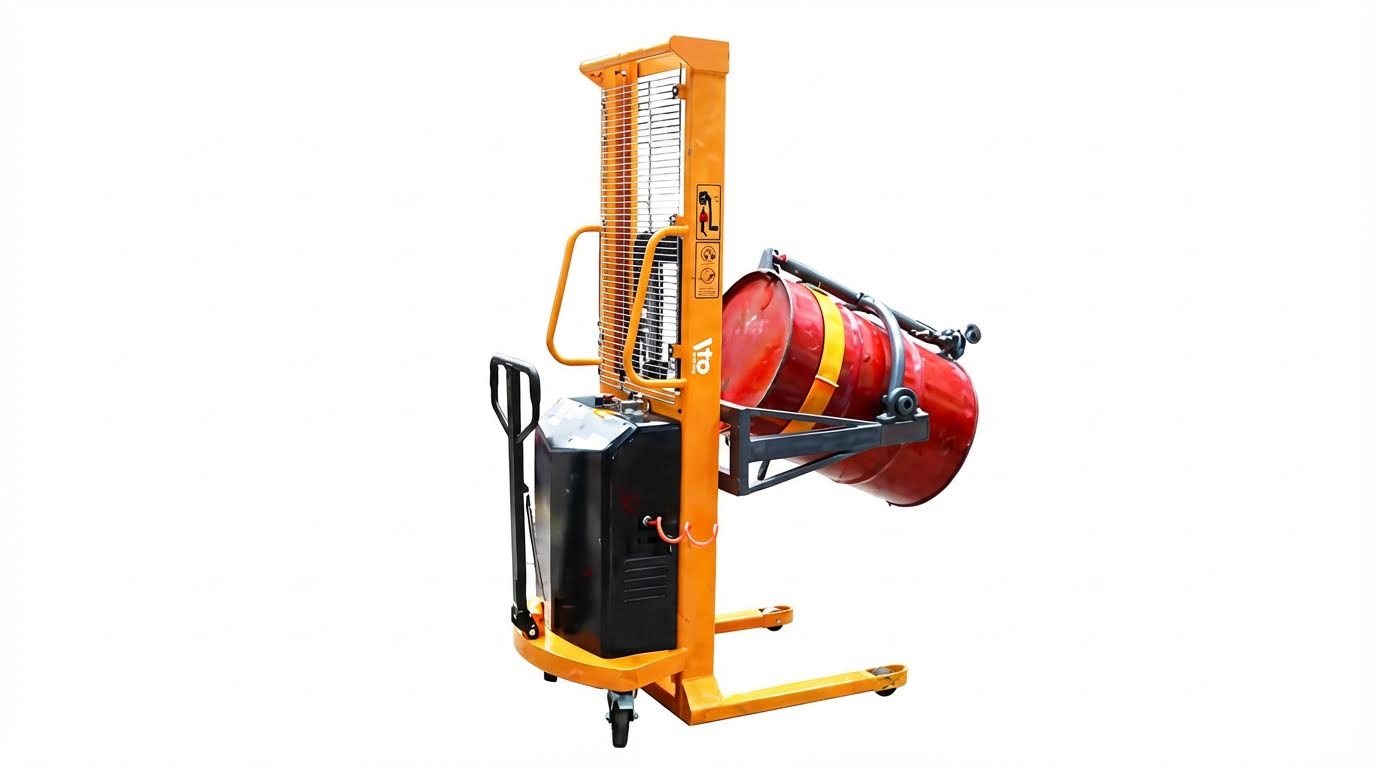
Hydraulic drum equipment is the most practical way to lift, palletise, and stack oil drums without manual hoisting, while keeping operators clear of pinch and crush zones.
These systems combine wheeled bases with hydraulic lift mechanisms so you can raise drums from floor level to pallet or racking height in a controlled way.
- Hydraulic drum jacks: Drum truck plus hydraulic lift – Lift a drum high enough to place it on a pallet, rack, or to elevate for easier emptying. Source
- Drum lifters and stackers: Vertical masts with manual, hydraulic, or electric lift – Handle the vertical dimension of how to move oil drums in tight plants, typically 450–900 kg capacity. Source
- Below-hook drum lifters: Crane or hoist attachments – Allow overhead lifting where floor space is congested. Source
| Hydraulic Device | Lift Mechanism | Typical Capacity | Vertical Reach | Operational Impact |
|---|---|---|---|---|
| Hydraulic drum jack | Foot pump or hand pump | ≈ 300–450 kg | Floor to pallet height (≈150–300 mm) | Ideal for loading a single drum onto pallets or low platforms. |
| Manual drum stacker | Hand pump hydraulic mast | ≈ 450–700 kg | Up to lower racking levels | Good for low-volume stacking where power is not available. |
| Electric drum stacker | Powered hydraulic unit | ≈ 700–900 kg | Multiple racking tiers | Supports frequent lifting cycles with minimal operator effort. |
- Grab geometry: Clamp rings, jaws, or straps must match drum diameter and rim profile. This prevents shell deformation and drop risk. Source
- Hydraulic integrity: Cylinders, hoses, and seals require periodic inspection for seepage and corrosion. Maintaining fluid levels and replacing oil at set intervals preserves lift performance. Source
- Ergonomics: Hydraulic lift removes the need to “dead-lift” or tilt a 200–300 kg drum. This mitigates spinal compression and shoulder loading compared with manual handling. Source
💡 Field Engineer’s Note: In cold rooms or outdoor yards below 0°C, hydraulic oil thickens and slows mast response. If you rely on hydraulic stackers to move oil drums, specify low-temperature hydraulic fluids and allow warm-up cycles to avoid jerky lifts that can amplify slosh.
Crane vs. floor-based drum lifters
Use below-hook drum lifters with overhead cranes where aisles are narrow or floor congestion is high. Use floor-based drum stackers where you have clear travel paths but limited headroom. Both must be rated for at least 25% over maximum drum mass and inspected to applicable lifting standards.
Powered drum movers, dumpers, and rotators
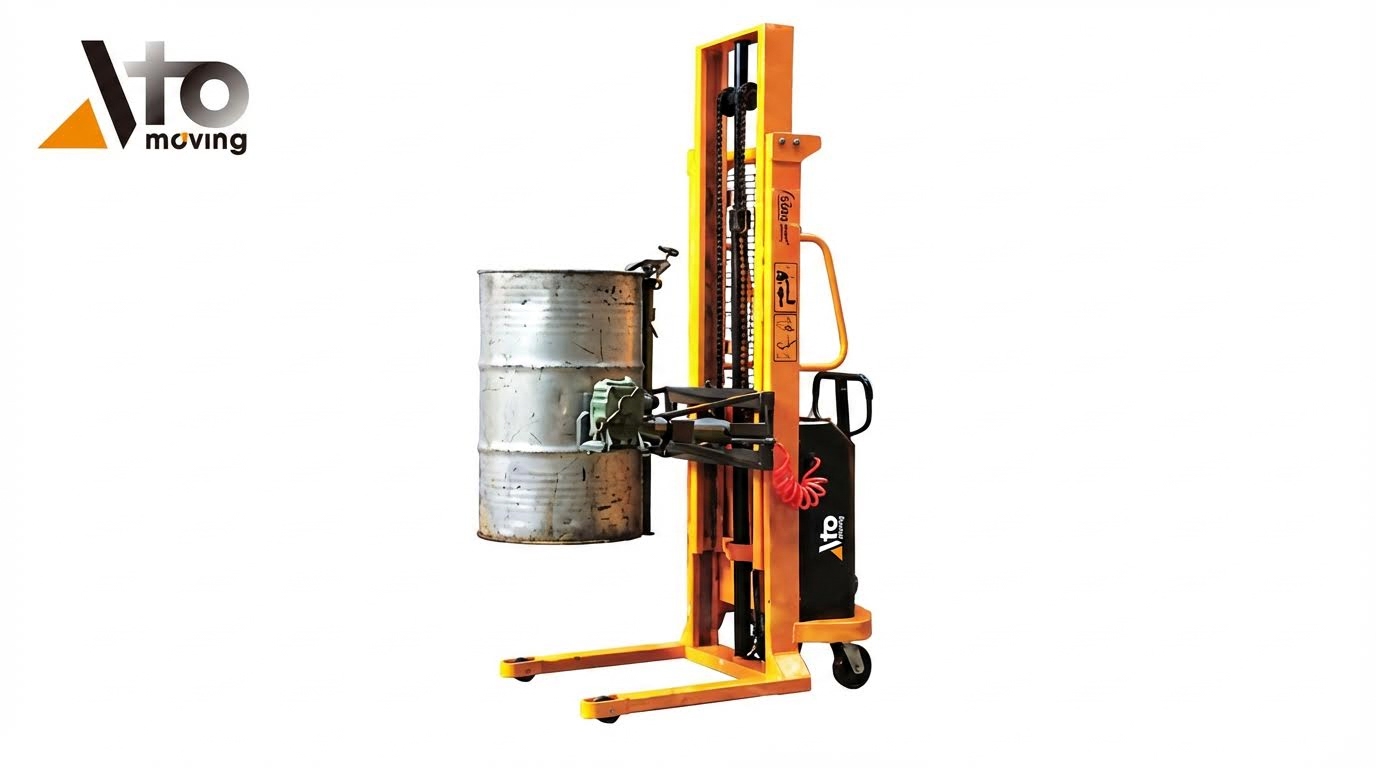
Powered drum systems are the safest and most efficient option when you need to move many oil drums per shift, or when you must tilt or rotate drums under tight process control.
They use battery, mains, or vehicle hydraulic power to reduce manual push forces and to control tilt or rotation speed, which directly limits liquid slosh and spill risk.
- Powered drum movers: Self-propelled or vehicle-powered units – Transport drums safely without manual pushing or pulling, ideal in large warehouses. Source
- Drum dumpers: Lift-and-tilt frames – Raise drums and pour contents into other containers or onto conveyors, eliminating manual tipping of 205 L drums. Source
- Rotators and tumblers: Axis-rotation systems – Rotate drums to re-suspend solids or blend additives without opening the drum, typically up to about 450 kg. Source
| Powered Device | Main Motion | Typical Application | Safety / Performance Features | Impact on how to move oil drums |
|---|---|---|---|---|
| Powered drum mover | Motorised travel | Warehouse drum transport | No manual push/pull, controlled acceleration | Ideal for long runs and high drum counts with reduced operator fatigue. |
| Drum dumper | Lift + controlled tilt | Decanting into hoppers or process tanks | Defined pour angle, guarding | Allows repeatable dosing while keeping operators clear of the pour zone. |
| Drum rotator / tumbler | Continuous rotation | Mixing settled drums | Guarding, interlocks | Lets you condition product without opening the drum, limiting contamination. |
- Guarding and interlocks: Rotators use fixed guards and interlocks to prevent access to rotating parts. This keeps limbs out of nip points during mixing or tumbling. Source
- Industry-specific uses: Food, beverage, and pharmaceutical operations use powered movers and dumpers to minimise handling and prevent spillage or contamination. This supports hygiene and product integrity requirements. Source
- Harsh-environment designs: Construction, mining, and oil and gas operations use rugged carts, dumpers, and movers designed for outdoor conditions. This keeps drum handling reliable on rough ground and in variable weather. <
Selecting Drum Handling Systems For Your Facility
Selecting drum handling systems for your facility means matching equipment to drum type, route, and workload so you can move 200–300 kg oil drums safely, with minimal manual effort and controlled liquid slosh.
Matching equipment to drum type and application
Matching equipment to drum type and application is the core of how to move oil drums safely without spills, shell damage, or operator strain.
Start by defining your “standard drum” and use that as the baseline. Most oil operations use 200–205 L drums weighing roughly 200–300 kg when full, so equipment should carry at least a 25% capacity margin above that load to cover density variation and dynamic forces from liquid slosh. Handling guidance for 200–300 kg drums recommends this margin to keep systems stable under braking and cornering.
Next, map your main tasks: pure transport, vertical lifting, dosing/emptying, or mixing. This determines whether you focus on drum dollies or basic drum trucks, lifters and stackers, dumpers, or rotators.
Task / Drum Situation Recommended Equipment Type Key Technical Features Operational Impact / Best For… Short, flat moves of full 200–205 L oil drums Drum dollies or basic drum trucks Low circular platform or tilting frame; swivel casters for 360° turning Fast moves in tight aisles; reduces rolling on drum chimes and base corrosion. Horizontal transport functions One-person manual transport where no mechanisation is practical Drum handling cart with tilting frame Hand-operated; large wheels for rough ground; suits 205 L drums Lets one operator move a full drum by hand across mixed surfaces. Tilting drum handling carts Lifting drums from floor to pallet or racking Drum lifters and stackers Manual, hydraulic, or electric lift; typical 450–900 kg capacities Controls vertical movement in confined warehouses; enables stacking and palletising. Vertical drum handling Feeding process vessels or conveyors with oil Drum dumpers / controlled pour systems Lift and tilt drum; mechanical or powered rotation Eliminates manual tipping of 200 L drums; improves dosing accuracy and spill control. Drum dumpers Re-suspending additives or sludge in closed drums Drum rotators / tumblers Roller or cradle support; guarded rotation around drum axis Mixes contents without opening the drum; suited to up to ~450 kg loads. Drum rotation systems Multiple drum moves per shift in large warehouses Powered drum movers Battery or forklift-powered traction; no manual pushing Efficient for high-volume routes; reduces strain and improves control of liquid slosh. Powered movers Overhead handling in congested process areas Below-hook drum lifters with cranes/hoists Mechanical grabs, web straps, or clamp rings matched to drum diameter Removes drum traffic from floor level; useful around fixed piping and equipment. Crane-integrated lifters Oil and gas, chemical, or hazardous liquids Hydraulic drum jacks, sealed movers, and dumpers Positive drum retention; controlled lift and tilt; options for sealed handling Minimises spillage and exposure when handling hazardous oil products. Hazardous liquid drum handling Different industries then fine-tune their choices. Chemical plants prioritise equipment that reduces spill risk and operator exposure, such as hydraulic drum trucks and powered movers for hazardous liquids. Food and beverage operations favour dollies and dumpers that minimise slosh and are easy to clean, to maintain hygiene and meet safety standards. Pharmaceutical facilities use hydraulic drum jacks and lifters that minimise manual handling and contact, protecting sensitive products. Construction and mining sites look for drum carts, dumpers, and movers with rugged frames and large wheels for outdoor and rough-ground use, while oil and gas facilities focus on transporters and dumpers that prevent spillage and protect high-value product. Industry-specific drum handling uses
- Steel vs plastic drums: Match clamp or grab geometry to drum diameter and rim profile – prevents shell deformation and drop risk.
- Corrosive vs non-corrosive oils: Use compatible coatings and seals – avoids rapid frame and wheel degradation.
- Open vs closed systems: Prefer sealed attachments for volatile or toxic liquids – reduces vapour and spill exposure along the route.
How to document “standard drum” specs for equipment selection
Record drum volume (L), material (steel/plastic), height and diameter (mm), typical fill mass (kg), closure type, and any special linings. Use these values when checking equipment datasheets and clamp compatibility.
💡 Field Engineer’s Note: For partially filled oil drums, slosh is far worse than in full drums. When you specify drum trucks or powered movers, assume higher dynamic side loads and insist on wider wheelbases and positive drum restraints, especially on routes with even slight slopes or tight turns.
Mobility, capacity, and duty-cycle considerations
Mobility, capacity, and duty-cycle considerations determine whether your chosen drum handling system will stay safe and economical once it is in daily use.
The same 200–300 kg oil drum behaves very differently on smooth indoor concrete versus gravel yards. You must coordinate wheel design, frame strength, and power source with your floor conditions and the number of drum moves per shift. This is where many facilities discover that “cheap” manual gear becomes expensive in injuries, downtime, and slow throughput.
Selection Factor What To Specify Typical Engineering Guidance Operational Impact / Best For… Load capacity Rated capacity of truck, cart, lifter, or dumper Use at least 25% margin above maximum drum mass (e.g., ≥375 kg for 300 kg drums) to cover dynamic loads and product density variation. Capacity margin recommendation Prevents overloading during braking, cornering, or when drums are partially filled and sloshing. Mobility – surface type Wheel diameter, material, and configuration For rough or soft ground, choose wheels ≥10 in (≈250 mm) diameter and robust frames. For lawns or similar, barrow-style wheels work; for smooth concrete, ball-style or caster wheels give low rolling resistance. Wheel and mobility guidance Ensures operators can push/steer safely and keeps drums stable over joints, drains, and thresholds. Mobility – route profile Wheelbase, brakes, and steering Longer wheelbase and reliable parking brakes for slopes and ramps; swivel casters for tight indoor aisles. Reduces tip-over risk on gradients and improves control in confined spaces. Duty-cycle / frequency of use Manual vs hydraulic vs powered systems Manual gear for rare or light-use tasks; hydraulic or powered devices for daily operations with multiple drums to cut strain and time. Manual vs powered selection Aligns capital cost with real workload, while protecting operators from repetitive overexertion. Environment and contaminants Materials, seals, and cleanability Choose industrial-grade wheels and frames for heavier loads; ensure equipment is easy to clean from oil sludge or chemical deposits. Heavy-duty and cleanable designs Extends equipment life and keeps rolling resistance predictable over time. Safety features Brakes, anti-slip, containment, visibility Specify sturdy brakes, anti-slip surfaces, and containment curbs; consider high-visibility colours or lighting on movers. Safety feature guidance Reduces slip, trip, and roll-away incidents along drum routes. - Manual carts and dollies: Best when you move only a few drums per week – low cost, but higher operator effort.
- Hydraulic drum jacks and stackers: Ideal for regular palletising and decanting – take the lift work out of how to move oil drums safely.
- Powered drum movers: Suited to large sites with many daily drum moves – remove manual pushing and keep speeds controlled.
Maintenance practices should also match duty-cycle. High-use equipment needs frequent inspections of wheels, frames, and hydraulic systems, plus routine cleaning and lubrication to keep handling forces low and predictable. Regular checks for cracked welds, bent frames, leaking seals, and flat-spotted wheels, along with correct hydraulic fluid levels, support safe, repeatable drum handling. Maintenance guidance for drum handling systems and preventive maintenance recommendations both emphasise pre-use checks before heavy operations.
Quick checklist: matching mobility to your drum route
Walk the full drum route and note: floor type (concrete, asphalt, gravel), slopes or ramps, thresholds and drains, tightest aisle width, and any outdoor sections. Use this survey to choose wheel diameter, tire type, and steering layout.
💡 Field Engineer’s Note: When you upgrade from manual to powered drum movers, do not keep the same tight turning patterns you used with hand trucks. The combination of higher torque, battery mass, and liquid slosh can overload weak floor spots and old pallet decks, so verify route strength and widen turning radii during commissioning.
Final Considerations For Safe, Efficient Oil Drum Handling
Safe oil drum handling depends on one integrated approach, not on any single device or rule. You must treat every drum as a live, dynamic load and design routes, equipment, and training around that reality. Capacity margins, low lift heights, and positive restraints work together to keep the centre of gravity inside a stable base, even when liquid sloshes or operators brake hard.
Risk assessments and regulatory checks then turn this physics into a safe working system. When you design drum corridors, control ignition sources, and stage spill gear, a leak or tip-over becomes a contained event instead of a major incident. Choosing manual, hydraulic, or powered solutions based on duty-cycle and floor conditions protects operators from overexertion and keeps throughput predictable.
The best practice is clear. Standardise your “reference drum,” enforce at least a 25% capacity margin, and match wheel design and frame strength to the worst part of each route. Combine this with documented inspections, operator training, and suitable Atomoving drum handling equipment. When you align these elements, your plant moves heavy liquid loads with low injury rates, fewer spills, and higher productivity.
Frequently Asked Questions
What is the best way to move oil drums?
To move oil drums safely and efficiently, use equipment specifically designed for drum handling. Options include drum trucks, forklift attachments, or below-hook drum lifters. Moving drums with a bare forklift fork is not recommended, as it can cause slippage or damage to the drum. Drum Handling Safety Tips.
How to transfer oil from one drum to another?
You can fit your drum with a faucet and siphon to transfer liquid into another container. These tools work best with drums positioned horizontally. Drum Draining Guide.