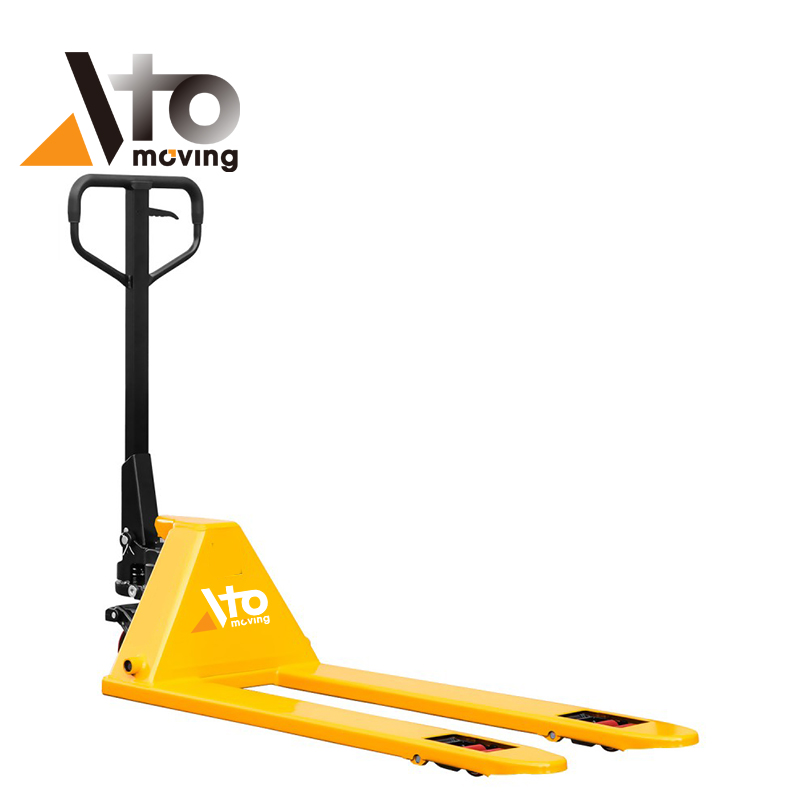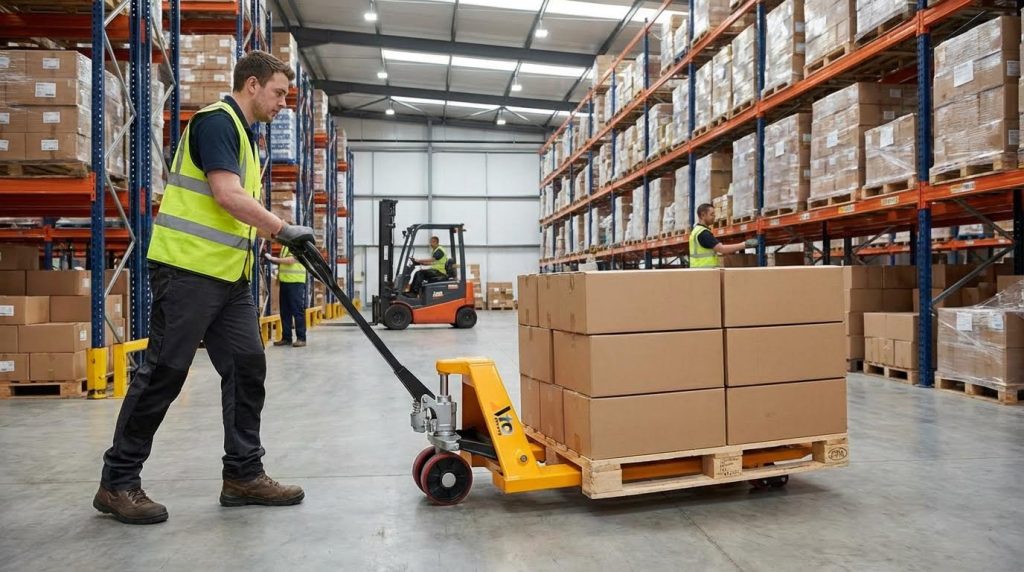
Pallet truck safety is about controlling weight, stability, and people movement so loads move smoothly without injuries or damage. This guide explains how to use a pallet truck safely, covering core physics, daily rules, warehouse hazards, and training requirements. You will see how capacity, load center, floor conditions, and visibility translate into real-world risks, and how structured training and inspections turn those risks into a controlled system.
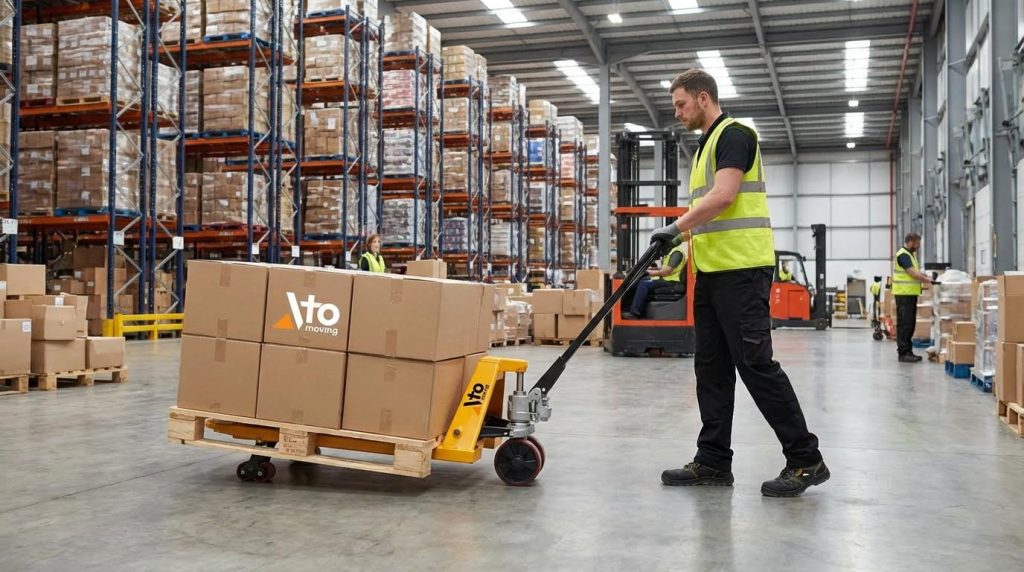
Fundamentals Of Safe Pallet Truck Operation
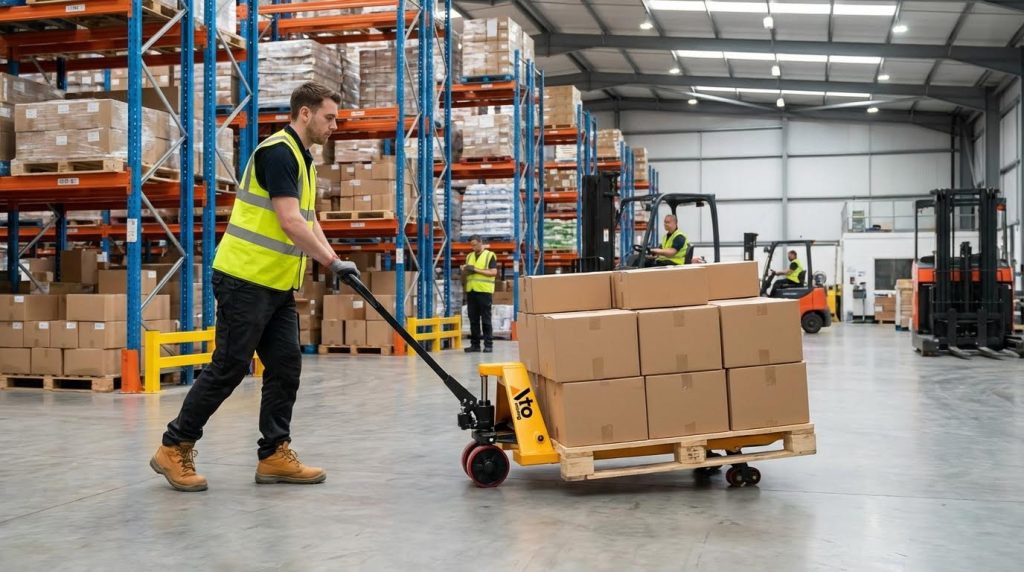
Fundamentals of safe pallet truck operation explain how to use a pallet truck safely by matching the right truck type to the job and keeping the load stable within its design limits. If operators understand truck types, load center, and center of gravity, they dramatically cut tip-over, crush, and collision risks in everyday warehouse work.
Types Of Pallet Trucks And Use Cases
Different pallet truck types suit different loads, distances, and floor conditions, and choosing correctly is the first step in how to use a pallet truck safely. Using the wrong type often forces bad practices like overloading, pulling instead of pushing, or poor visibility that lead to injuries.
| Pallet Truck Type | Typical Capacity (kg) | Key Features | Best For… | Operational Impact |
|---|---|---|---|---|
| Manual pallet truck | Up to ~2,000–2,500 kg (approx. 4,400–5,500 lbs) capacity range reference | Hand-pumped hydraulics, walk-behind, no power drive | Short internal moves on flat, smooth floors | Low cost and simple, but hard to control on slopes or rough floors. |
| Powered walkie pallet truck | Often 2,000–3,000 kg (4,400–6,600 lbs) overloading hazard context | Electric drive and lift, operator walks with tiller arm | Medium-distance runs, tighter aisles, frequent loading | Reduces strain and improves control, but still needs clear visibility and safe speed. |
| Rider / stand-on powered pallet truck | Similar to walkie, often toward upper end of 3,000 kg range | Operator platform, higher travel speeds | Longer horizontal transport, docks, cross-warehouse moves | Higher throughput, but collision risk rises without traffic rules and alerts. Collision discussion |
| High-lift / scissor pallet truck | Lower capacity than standard manual (often around 1,000 kg) | Scissor mechanism to raise pallet to work height | Feeding packing stations, reducing bending | Great ergonomics, but added pinch points at scissors. Pinch point hazards |
| Specialized / rough-floor pallet truck | Varies; often slightly reduced vs. smooth-floor models | Larger or different wheels for uneven floors | Loading bays with potholes, outdoor yards | Improves control on damaged floors, lowering risk on uneven surfaces. Uneven surface hazards |
- Match type to distance: Use manual trucks for short moves and powered units for repeated or long runs – cuts fatigue and loss of control.
- Match type to floor: Avoid standard pallet trucks on cracked or potholed floors – reduces sudden stops and tip risks on uneven surfaces. Uneven floor guidance
- Respect capacity rating: Never exceed the plate rating, usually in kg and at a defined load center – prevents fork or frame failure from overloading. Overloading hazard
- Consider ergonomics: Use high-lift trucks where operators pick from pallets all shift – reduces back strain and improper lifting injuries. Improper lifting techniques
How to choose the right pallet truck for your application
List your heaviest pallet weight in kg, the worst floor condition, and the longest travel distance. Then select the lightest, simplest truck that still covers all three. This minimizes cost while maintaining safe control margins.
💡 Field Engineer’s Note: In older warehouses with patched concrete, I often specify powered pallet trucks with higher-quality load wheels and strict speed limits in bad zones. This compensates for cracks and potholes that would otherwise throw a fully loaded manual truck off line and into racks or pedestrians.
Core Stability Concepts: Load Center And COG
Load center and center of gravity (COG) define how far a pallet’s weight sits from the forks and directly control whether a pallet truck stays stable or tips. Understanding these concepts is non‑negotiable if you want to know how to use a pallet truck safely with heavy or awkward loads.
On pallet and forklift trucks, the “load center” is the horizontal distance from the fork face to the load’s center of gravity. Forklift ratings are typically based on a 600 mm (24 inch) load center, meaning the center of gravity must sit 600 mm or less from the fork face to keep the truck within its rated capacity. Load center definition The same physics applies to pallet trucks: as the effective load center increases, stability and safe capacity decrease.
| Concept | What It Means | Typical Reference Value | Operational Impact |
|---|---|---|---|
| Load center | Distance from fork face to the load’s COG | 600 mm (24 in) common rating point for forklifts OSHA reference | Longer loads push COG forward, effectively reducing safe capacity and raising tip risk. |
| Center of gravity (COG) | Point where the load’s weight is balanced in all directions | Ideally central in the pallet footprint | Off‑center COG causes side‑to‑side lean and can pull the truck off line or drop the load. |
| Combined COG (truck + load) | Overall balance point of truck and load together | Must stay inside the support polygon of wheels | If it moves outside the wheelbase area, the unit tips or the load falls. |
| Load stability | How securely the load is arranged and restrained | Evenly stacked, wrapped or banded where needed | Loose or damaged loads shift COG suddenly, causing falls or crush hazards. Load stability guidance |
- Center the load: Place the pallet so the weight is centered between the forks – keeps the COG on the truck’s centerline and reduces side tip risk. Load distribution advice
- Keep heavy side toward the steer wheels: Arrange the heaviest part of the load nearest the truck’s main wheels – shortens the effective load center and improves control. Heaviest part toward front wheels
- Respect rated capacity at the stated load center: If you extend the load further out, treat the real safe capacity as lower – prevents invisible overloads that still “fit” on the forks. Capacity vs. load center
- Secure unstable loads: Wrap or band damaged or loose pallets before moving – avoids sudden COG shifts and falling product. Load stability requirement
Practical example: Long load vs. rated capacity
If a pallet truck is rated 2,000 kg at a 600 mm load center, that assumes the COG is 600 mm from the fork face. Put a very long pallet on so the COG moves to 800 mm and you effectively overload the truck even at 2,000 kg. The truck may not fail immediately, but steering becomes light and stopping distances increase, which is why overlength loads demand extra caution and reduced load weight.
💡 Field Engineer’s Note: When I investigate pallet truck “mystery” tip events, the cause is often not the total kg but a bad load center: tall, loosely wrapped pallets or long overhanging loads. Train operators to visualize where the weight really sits on the forks; once they think in mm instead of just “does it fit,” their incident rate drops fast.
“”
Training, Compliance, And Technology To Reduce Risk
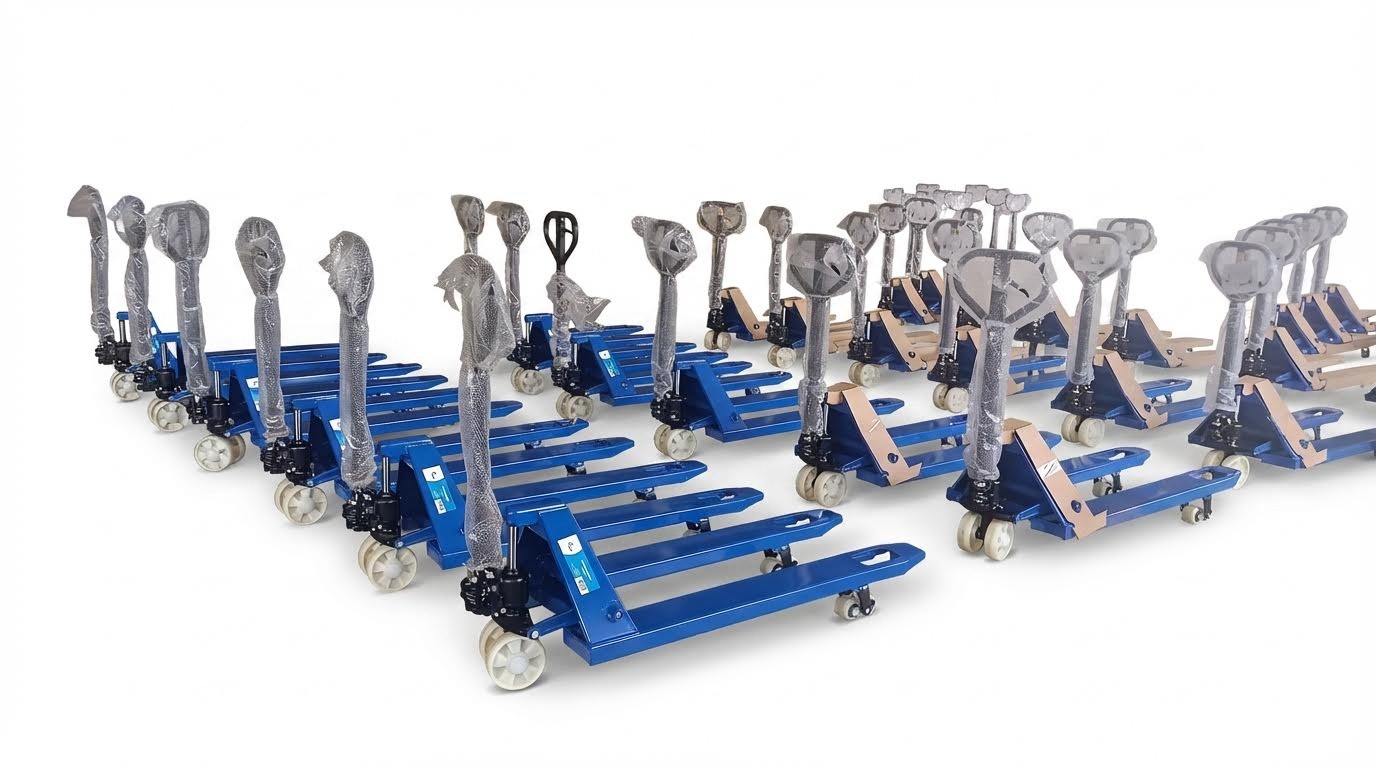
Training, compliance, and simple technology are the backbone of how to use a pallet truck safely in any warehouse. This section shows what to teach, how to document it, and which tools reduce day‑to‑day risk.
Operator Training Content And OSHA Alignment
Operator training content must combine theory, hands‑on practice, and evaluation that aligns with OSHA’s powered industrial truck rules, adapted for pallet trucks. The goal is consistent, predictable behavior under normal and abnormal conditions.
OSHA required employers to build a training program around safe truck operation principles, the specific vehicle types, and the hazards in that workplace. Training had to include both formal instruction and practical exercises, with operators evaluated and certified as competent before solo operation. OSHA training requirements give an excellent framework you can scale down for manual pallet jacks and scale up for powered pallet trucks.
| Training Module | Key Content | OSHA Linkage | Operational Impact |
|---|---|---|---|
| Truck Fundamentals | Controls, steering, braking, visibility, differences from cars | Truck‑related topics (controls, operation, limitations) | Reduces confusion and “wrong control” incidents in tight aisles. |
| Capacity, Load Center, Stability | Rated capacity, load center concept, off‑center and tall loads | Vehicle capacity and stability requirements | Prevents overload and tip‑risk when handling 1,000–2,000 kg pallets. |
| Load Handling | Approach, fork placement, load distribution, securing loads | Load composition, stability, and manipulation | Cuts falling‑load events and crushed‑pallet damage. |
| Workplace Hazards | Floor condition, ramps, narrow aisles, pedestrians | Surface conditions, pedestrian traffic, ramps, hazardous areas | Aligns driving behavior with real site risks, not generic rules. |
| Pre‑Use Inspection | Wheels, forks, hydraulics, brakes, visible damage | Inspection and maintenance responsibilities | Finds cracks, leaks, and bent forks before they fail under load. |
| Emergency & Near‑Miss Response | What to do after collisions, near misses, or equipment faults | Refresher triggers after incidents or unsafe operation | Turns incidents into learning events instead of repeated failures. |
- Formal instruction: Classroom or e‑learning on principles – builds the “why” behind every safe move.
- Practical exercises: Supervised driving with real pallets – translates rules into muscle memory.
- Site‑specific hazards: Your aisles, your ramps, your pedestrian flows – avoids training that only matches a textbook warehouse.
- Evaluation and sign‑off: Documented pass/fail criteria – proves the operator can actually apply training.
OSHA required operators to receive training on operating instructions, warnings, capacity, stability, visibility limits, and any inspections or maintenance they must perform. It also required coverage of surface conditions, load composition, pedestrian traffic, ramps, and other environmental factors that affect safe operation. Required training topics are a strong checklist when building a pallet truck curriculum.
How this applies to “how to use a pallet truck safely” training
To teach new staff how to use a pallet truck safely, map your course to OSHA’s structure: theory + practice + evaluation. Cover capacity, load distribution, surface conditions, pedestrians, and pre‑use checks as core modules, even for simple manual trucks.
💡 Field Engineer’s Note: When I audit sites, the biggest gap is not “no training” but training that ignores floor defects and tight turning spaces. Always walk the actual routes with trainees and show them where pallet trucks become unstable or hard to stop.
Practical Assessment, Refreshers, And Documentation

Practical assessments, timely refreshers, and clean documentation close the loop between training policy and daily pallet truck behavior. Without them, even well‑designed courses fade and bad habits return.
OSHA expected employers to evaluate each operator’s performance at least once every three years and to give refresher training whenever the operator showed unsafe behavior, had an accident or near‑miss, changed truck type, or when workplace conditions changed. Refresher triggers are especially relevant in busy pallet‑handling operations where layouts and volumes shift frequently.
| Assessment / Record | What To Check Or Record | Minimum OSHA Expectation | Best‑Practice Operational Impact |
|---|---|---|---|
| Initial Practical Assessment | Pre‑use check, load pick‑up, travel, lowering, parking | Operator evaluated and certified before solo use | Filters out unsafe habits before they hit live production. |
| 3‑Year Performance Review | Observed driving and load handling on real shifts | Formal evaluation at least once every 3 years | Catches drift in habits and new risky shortcuts. |
| Refresher After Incident | Incident review, retraining on failed behaviors | Required after accidents, near misses, or unsafe operation | Stops repeat accidents from the same root cause. |
| Change of Equipment Type | New control layout, braking, visibility, capacity | Refresher when assigned a different truck type | Prevents “old truck reflexes” from causing collisions. |
| Certification Record | Operator name, training date, evaluation date, trainer | Employer must maintain certification records | Provides proof in audits and focuses managers on who is current. |
- On‑truck skills test: Use real pallets and routes – shows if the operator can keep loads stable and avoid pedestrians.
- Standardized checklist: Same criteria for all assessors – removes guesswork and favoritism.
- Incident‑driven refreshers: Triggered by near‑misses or unsafe acts – links training directly to real risks on your floor.
- Simple digital log: Central record of dates and trainers – avoids gaps where uncertified staff still operate pallet trucks.
OSHA required that certification records include the operator’s name, the training date, the evaluation date, and the name of the person who conducted the training or evaluation. Certification documentation is not just for compliance; it also gives you a clear view of who is safe to assign to high‑risk tasks like tight‑aisle replenishment or trailer loading.
Simple template for a pallet truck operator skills test
Include at minimum: pre‑use inspection, picking a standard pallet, handling a partial or unstable load, navigating a blind corner with a spotter, ramp use if applicable, and correct parking / isolation of the truck. Score each step pass/fail with space for comments.
💡 Field Engineer’s Note: Tie every refresher to a real event: “We had a near‑miss at the inbound dock, so today we retrain everyone on visibility and speed at intersections.” Operators engage more when they see the direct link between training and the last close call.
Final Thoughts On Building A Safer Pallet Truck Program
A safe pallet truck program does not rely on one control. It blends sound engineering limits, clear rules, and proven training. When you match truck type to distance and floor, you cut strain and keep control margins high. When operators understand load center and center of gravity, they see why “does it fit?” is not enough and adjust weight, pallet quality, and routing before a tip‑over happens.
OSHA‑aligned training turns these ideas into habits. Theory builds the “why,” while on‑truck practice and formal evaluation prove who can work safely. Regular assessments, incident‑driven refreshers, and clean records keep skills current as layouts, volumes, and equipment change. Simple tools such as checklists, marked pedestrian routes, and digital logs make the system repeatable instead of personal.
The best practice is clear: treat pallet trucks with the same respect as forklifts. Set engineering limits, teach operators to think in load centers and wheelbases, and verify performance in the real aisles they use. When you do this, pallet trucks become a controlled, low‑risk part of your material flow instead of a hidden source of injuries and damage, and Atomoving equipment can perform to its full design potential.
Frequently Asked Questions
How do you work safely with a pallet truck?
To work safely with a pallet truck, always inspect the wheels, handle, and lifting mechanism for damage or wear before use. Ensure the forks are evenly positioned under the pallet and fully inserted. Avoid overloading by adhering to the truck’s specified weight limit. Use the handle to lift the load smoothly and avoid uneven surfaces to prevent accidents. For more details, refer to this Pallet Truck Safety Guide.
What are the hazards of using a pallet truck?
Common hazards when using a pallet truck include injuries from pushing or pulling over uneven surfaces, loads falling from the pallet truck, and collisions caused by striking or being struck by the truck. Always ensure the path is clear and level, secure the load properly, and be aware of your surroundings while operating the equipment. Learn more about these risks in this Pallet Truck Hazards Guide.
Should you push or pull a pallet truck?
It is generally safer to push a pallet truck rather than pull it. Pushing provides better control and reduces strain on your body. However, always assess the environment first—ensure the surface is even and free of obstacles. If pulling is necessary, do so slowly and with caution to maintain stability. This approach aligns with safe handling practices outlined in this Pallet Truck Safety Guide.