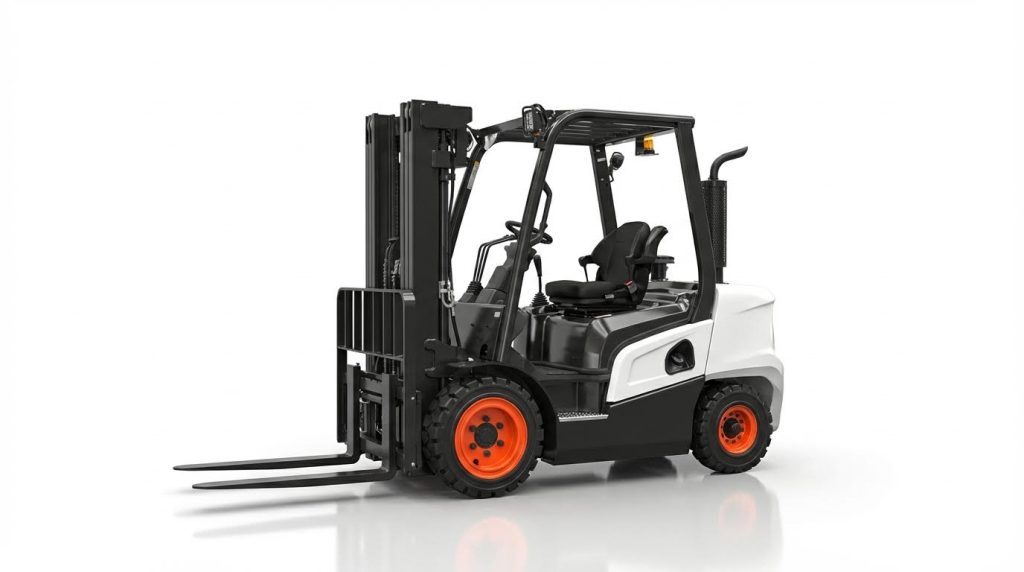
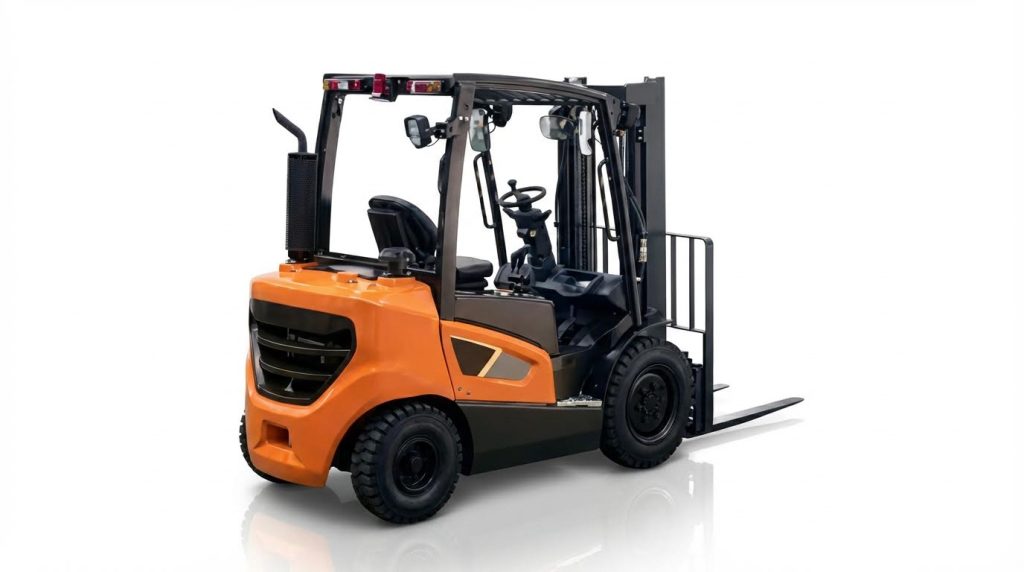
Diesel forklift fuel consumption per hour typically ranges from about 2 to 5 litres under normal site conditions, but can exceed 10 litres on heavy units. This guide explains real-world burn rates, what drives them up or down, and how to answer “how much diesel does a forklift use per hour” for your own fleet with engineering-level confidence.
Typical Diesel Forklift Litres Per Hour Explained
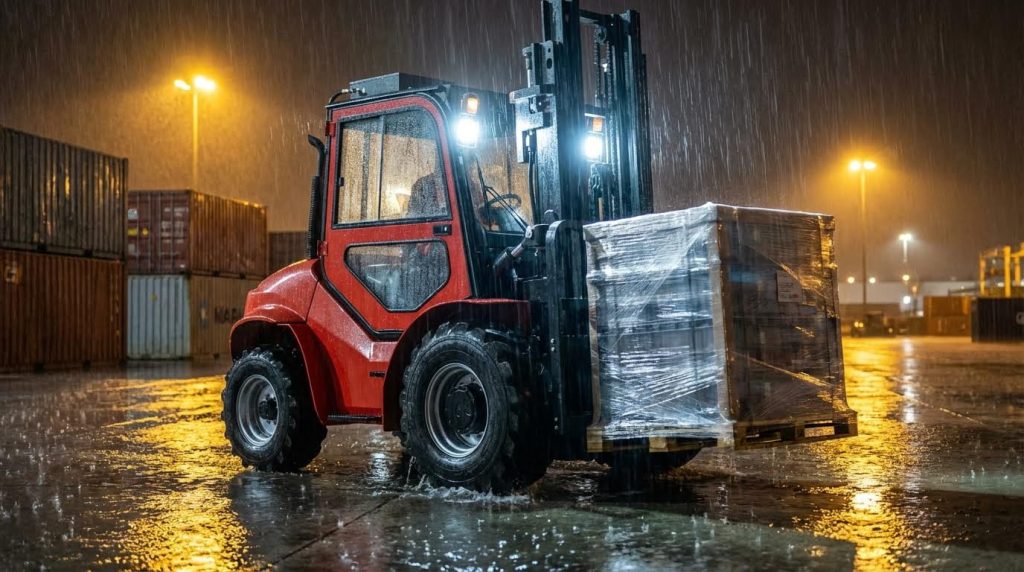
Typical diesel forklift fuel consumption ranges from about 2 to 5 litres per hour under standard conditions, but real sites often see higher numbers once load, terrain, and operator style are included.
If you are asking how much diesel does a forklift use per hour, the only honest answer is: it depends on capacity class and how hard you work the truck. The figures below give realistic planning numbers for most warehouses, yards, and loading docks.
| Question | Short Answer | Operational Impact |
|---|---|---|
| How much diesel does a small forklift use per hour? (1.5–2.5 tonne) | About 2–3 litres/hour in standard duty | One 43 L tank lasts roughly 14–18 working hours |
| How much diesel does a mid-size forklift use per hour? (3–5 tonne) | About 3–4 litres/hour on average | Plan 10–14 hours per 43 L tank; more if lightly loaded |
| How much diesel does a heavy forklift use per hour? (6–10 tonne) | Roughly 4–8 litres/hour depending on task | Tank changes become a shift-by-shift activity in tough yards |
| How much diesel does a very heavy forklift use per hour? (10+ tonne) | 10–15+ litres/hour in intense applications | Fuel cost becomes a major line item; layout and duty optimisation are critical |
| Overall typical range across fleets | 2–5 litres/hour for most mainstream units | Use 3–4 L/h as a budgeting baseline, then refine with site data |
Across mixed fleets, most diesel forklifts burn between 2 and 5 litres per hour, depending on load, engine size, and usage intensity under typical working conditions. Light-duty trucks under 2.5 tonnes usually sit at 2–3 L/h, mid-range 3–5 tonne machines at 3–4 L/h, and heavy units above 6 tonnes at 4–5+ L/h in standard duty.
💡 Field Engineer’s Note: When you calculate fuel budgets, always add a 15–25% buffer over catalogue “standard cycle” numbers. Real yards have slopes, congestion, and idling that the test cycles never fully capture.
Fuel burn by capacity class (1.5–10+ tonne)
Fuel burn rises with capacity class because bigger counterweights, engines, and hydraulics all demand more energy for every metre travelled and every pallet lifted.
| Capacity Class | Typical Rated Capacity | Typical Fuel Use (L/h) | Example Data Source | Operational Impact |
|---|---|---|---|---|
| Small diesel forklifts | 1.5–2.5 tonne | ≈2.5–3.8 L/h | Small units usually consume around 2.5–3.8 L/h in standard conditions for light industrial work | Best for warehouses and light yard work; one 43 L tank can comfortably cover a full shift |
| Medium diesel forklifts | 3–3.5 tonne | ≈2.5–3.9 L/h (≈3.2 L/h typical) | A 3 tonne model averages about 3.2 L/h in a standard duty cycle under test conditions | Common “all-rounder” in mixed sites; plan fuel for 2–3 tanks per week per truck on two-shift operations |
| Mid–heavy forklifts | 5–7 tonne | ≈4.5–8.0 L/h | Larger units in this band consume around 4.5–8.0 L/h depending on task severity | Suited to steel, timber, and block yards; fuel logistics must be planned like any other bulk supply |
| Heavy-duty forklifts | 10 tonne and above | 10–15+ L/h | Heavy-duty trucks can exceed 10–15 L/h in demanding applications such as ports and heavy manufacturing | Fuel cost per operating hour is high; even small efficiency gains produce big annual savings |
| Typical 3 tonne reference truck | ≈3 tonne | ≈2.5–3.9 L/h | A standard 3 tonne diesel forklift consumes about 2.5–3.9 L/h in operation in real-world fleets | Use this as a baseline when estimating site-wide fuel budgets for mid-size trucks |
From an energy perspective, diesel carries about 36 MJ per litre (around 9,900 Wh/L), and typical engines convert roughly 45% of that into useful work, giving about 4,455 Wh of usable energy per litre burned at the crankshaft. That is why even a few litres per hour represent a significant amount of lifting and travel work.
How to use these litres-per-hour numbers in budgeting
To turn litres per hour into annual fuel cost, multiply: average L/h × average operating hours per day × days per year × local diesel price per litre. For example, a 3 tonne truck at 3.2 L/h, working 8 hours per day, 250 days per year, at 2.0 currency units per litre, will burn about 6,400 litres and cost roughly 12,800 currency units per year in fuel alone. Use your own diesel price and hours to refine the estimate.
What “standard working conditions” really mean
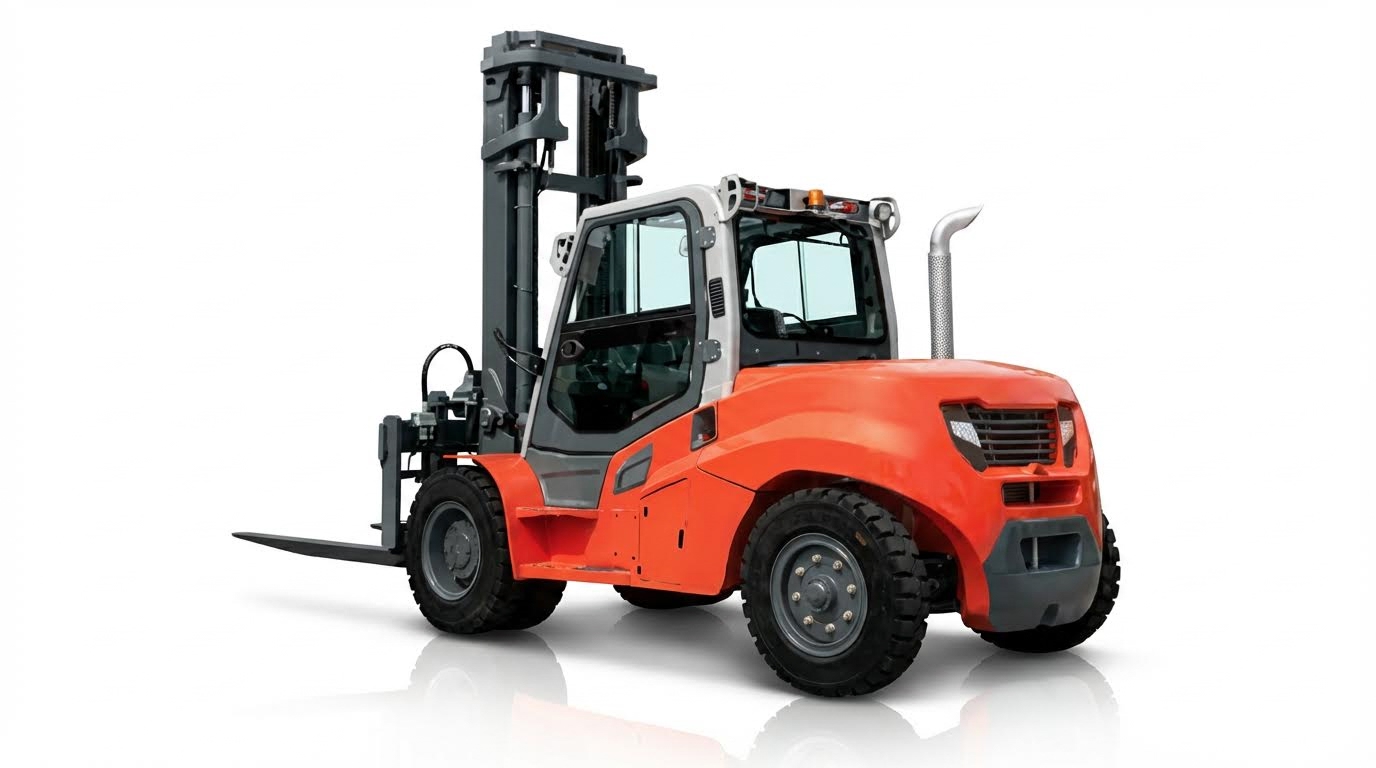
“Standard working conditions” usually mean a controlled duty cycle with moderate loads, flat floors, and limited idling—very different from a busy, congested yard.
Most published litres-per-hour figures are based on a defined test pattern, often similar to a VDI 60 duty cycle, where the truck lifts a set load, travels a fixed distance, and repeats at steady intervals under controlled conditions. In these tests, loads are close to but not at maximum rating, lift heights are moderate, travel paths are clear, and operators follow a consistent pattern.
- Moderate load, not full capacity: Test cycles assume loads around 60–70% of rated capacity – real sites often run closer to the limit on some shifts.
- Flat, firm surfaces: The floor is usually smooth concrete – no gravel, potholes, or ramps that increase rolling resistance and fuel draw.
- Limited idling: Engines are not left running between tasks – actual operators often idle while waiting for paperwork or loading.
- Steady driving style: No harsh acceleration or braking – aggressive driving in tight yards burns more diesel per pallet.
- Well-maintained truck: Clean filters, correct tyre pressures, and tuned engines – clogged filters and soft tyres can add 10–20% to fuel use.
In contrast, real-world conditions such as rough terrain, steep inclines, hot weather, or poorly maintained machines can increase fuel consumption significantly above these standard-cycle figures across many fleets. Continuous heavy lifting, long travel distances, and extended shifts without downtime all push litres per hour upward.
Why your site numbers are higher than the brochure
If you log fuel usage and find your forklifts burning more than catalogue values, the gap usually comes from three places: higher average load (closer to rated capacity), more idling between tasks, and tougher surfaces or gradients. Before blaming the engine, check tyre condition, air and fuel filters, and operator habits. Small changes here often close most of the gap between “standard” and “actual” fuel burn.
Engineering Factors That Drive Diesel Usage
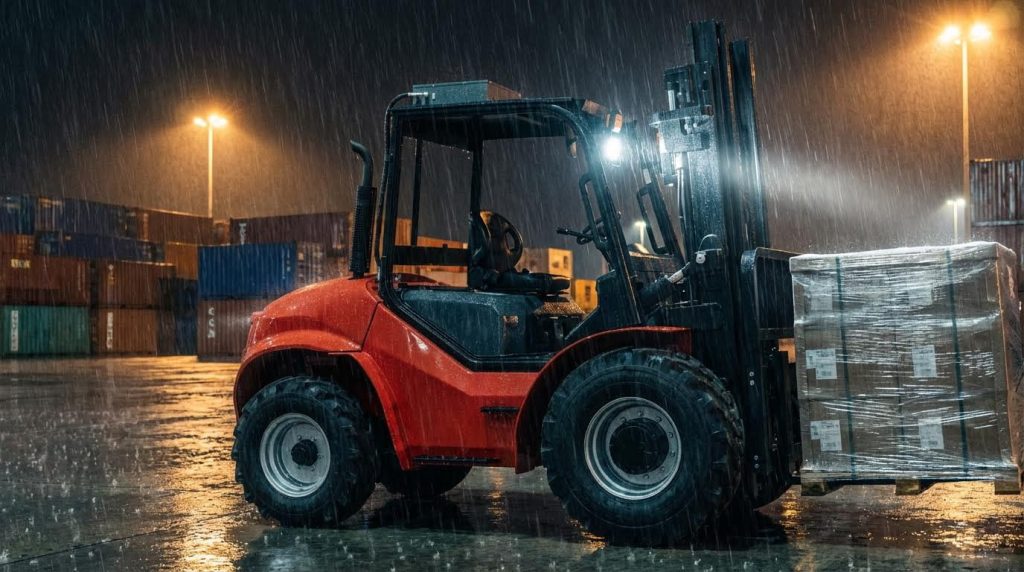
Engineering factors like load, lift height, travel pattern, terrain, and operator behaviour largely decide how much diesel a forklift uses per hour in real-world conditions. These variables can easily double or halve litres-per-hour versus brochure figures.
Under typical conditions, diesel forklifts burn about 2–5 L/hour, depending mainly on capacity, duty cycle, and environment. Light units under 2.5 tonnes use roughly 2–3 L/hour, mid-range 3–4 L/hour, and heavy-duty over 4–5 L/hour. These are average values, not guarantees.
To understand how much diesel does a forklift use per hour on your site, you must translate the spec-sheet litres-per-hour into your actual load profile, lift heights, travel distances, and operator habits. The sections below break down the main engineering drivers.
Load, lift height, and duty cycle intensity
Load, lift height, and duty cycle intensity directly control engine and hydraulic work, making them the primary drivers of diesel litres burned per hour.
Heavier loads and higher lifts demand more torque and hydraulic pressure, so the engine spends more time at higher throttle and fuelling rates. Standard fuel figures assume moderate loads and a defined duty cycle, but constant heavy lifts can push a “3 L/hour” truck closer to 5 L/hour.
| Operating Pattern | Typical Load & Lift | Duty Cycle Intensity | Fuel Use Impact | Operational Impact |
|---|---|---|---|---|
| Light handling | <50% of rated capacity, <3 m | Short lifts, long pauses | Near lower end of 2–3 L/hour range for small trucks | Good for pick/pack, low fuel per pallet |
| Mixed warehouse | 50–80% of capacity, 3–5 m | Regular lift/travel cycles | Typical 3–4 L/hour for 3–5 tonne class | Represents “standard” brochure figures |
| Heavy production | Near rated capacity, 4–6 m | Continuous cycles, little idle | Can reach 4.5–8+ L/hour on 5–7 tonne units | High fuel per hour, but high tonnes moved |
| Extreme duty | Max or overload, 6 m+ | Continuous, high-speed, multi-shift | 10–15+ L/hour on 10+ tonne units | Requires tight control of fuelling and maintenance |
Published capacity-class figures show this effect clearly. Small 1.5–2.5 tonne diesel forklifts typically consume about 2.5–3.8 L/hour, while 5–7 tonne units burn around 4.5–8.0 L/hour, and 10+ tonne forklifts can exceed 10–15 L/hour under heavy tasks. These numbers assume “standard working conditions”.
- Heavier load weights: More mass means higher torque demand – the engine injects more fuel every cycle to maintain speed.
- Higher lift heights: More potential energy in the mast hydraulics – the pump works longer at higher pressure, burning extra litres.
- Frequent lift cycles: Many lifts per hour – less idle time and more time at working RPM, so litres-per-hour rise quickly.
- Continuous vs intermittent duty: No breaks to cool or idle low – fuel use tracks engine-on time almost linearly.
How “standard working conditions” skew expectations
Manufacturers often base fuel figures on a VDI 60 or similar duty cycle. That usually means a defined mix of travel, lifting, and idling at moderate loads. If your plant runs near-rated loads and tall racking for full shifts, expect higher litres-per-hour than catalogue values.
💡 Field Engineer’s Note: When you move from 2.5 m to 6.0 m racking without changing truck size, fuel complaints usually follow. The hydraulics spend much longer at relief pressure, and operators hold the lift lever fully open. Plan mast height and capacity together, or you will “buy” extra lift height every day in diesel.
Travel distance, terrain, and site layout
Travel distance, ground conditions, and site layout determine how much tractive work the forklift must do, which can shift fuel consumption by several litres per shift.
Long runs with loads, rough yards, and tight layouts all force the engine to work harder and for longer. Even with the same loads and lifts, a poorly designed flow path can make two identical trucks show very different litres-per-hour on the fuel bowser.
| Factor | Condition | Effect on Fuel Use | Operational Impact |
|---|---|---|---|
| Travel distance | Short (≤30 m per move) | Lower litres/hour; more time lifting than driving | Typical indoor warehouse patterns |
| Travel distance | Long (>100 m per move) | Higher litres/hour; engine at load for longer | Common in yard or cross-dock operations |
| Terrain | Smooth concrete | Lowest rolling resistance, lowest fuel | Best for high-throughput, low-cost moves |
| Terrain | Gravel, mud, or potholes | More wheel slip and drag, higher fuel | Outdoor storage yards and construction sites |
| Inclines | Flat or <2% slope | Minimal additional fuel draw | Standard warehouse design target |
| Inclines | Ramps, docks, steep yards | Noticeable jump in litres/hour under load | Critical for sites with frequent dock work |
| Layout | Straight routes, wide aisles | Less braking and acceleration | Lower fuel per pallet and less wear |
| Layout | Maze-like, many tight turns | More stop–start driving, more fuel | Common in older or congested facilities |
Studies of diesel forklift fuel consumption show that forklifts that cover long distances, especially while loaded, consume more fuel due to sustained engine effort and higher travel speeds. Minimising unnecessary travel distances can significantly reduce fuel usage. This is especially visible on outdoor and cross-dock sites.
- Rough or soft surfaces: Gravel, mud, or broken concrete increase rolling resistance – the engine must supply more torque just to keep moving.
- Steep ramps and docks: Lifting the load plus the truck’s own mass up an incline – fuel burn spikes every time you climb.
- Stop–start traffic: Many intersections and pedestrian crossings – each acceleration from standstill wastes extra diesel.
Why two identical trucks show different litres-per-hour
On a smooth indoor loop with short runs, a 3-tonne truck might average around 3 L/hour. Put the same truck on a long, sloped yard route with rough ground, and you can see 4–5 L/hour or more, even with the same pallets per hour.
💡 Field Engineer’s Note: When a site complains that “the new truck uses more fuel,” I map the actual travel paths. A slight change in staging area or dock assignment that adds 40–50 m per trip can quietly add hundreds of litres per month, even though the truck spec never changed.
Operator behaviour and idle time management
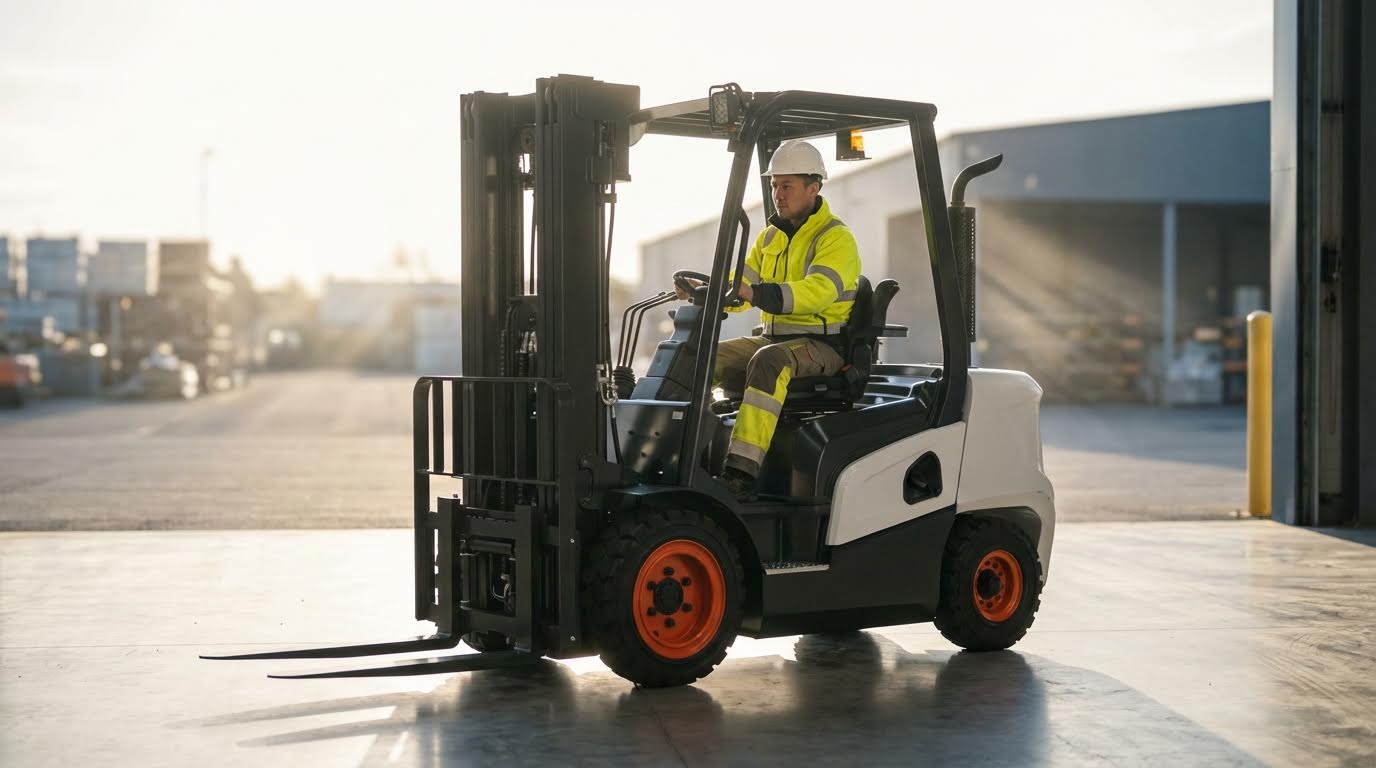
Operator behaviour and idle-time control often make the single biggest difference between theoretical fuel consumption and what you actually see on the diesel invoice.
Two operators on identical shifts can differ by more than 1 L/hour simply through driving style and idle habits. Hard acceleration, unnecessary engine-on time, and poor route discipline all push litres-per-hour up without moving any extra pallets.
- Idling when parked: Leaving the engine running during breaks or paperwork – burns fuel at zero productivity.
- Harsh acceleration and braking: Full-throttle starts and sudden stops – waste fuel as heat in the torque converter and brakes.
- Unplanned routes: Backtracking, deadheading, and detours – add travel distance and time under power.
- Poor gear and throttle control: Running at high RPM when not needed – raises instantaneous fuel flow for the same work.
Guidance from field data shows that leaving a forklift running when not in use is a major fuel waste. Operators should shut down the machine if it will be idle for more than a few minutes, and use smooth, gradual movements instead of aggressive driving. Proper route planning and gear use further reduce fuel draw.
How behaviour changes “how much diesel does a forklift use per hour”
On a mid-range 3–5 tonne diesel forklift that should average 3–4 L/hour, poor habits can push actual use into the 4–5 L/hour band. Across a 2,000-hour year, that extra 1 L/hour is roughly 2,000 litres of diesel – purely behaviour, not engineering.
💡 Field Engineer’s Note: When we install telematics and show operators their idle percentage by shift, fuel use usually drops 10–20% in a month without changing a single truck. Visibility alone makes people shut engines off and drive smoother.
Designing And Operating For Lower Fuel Consumption
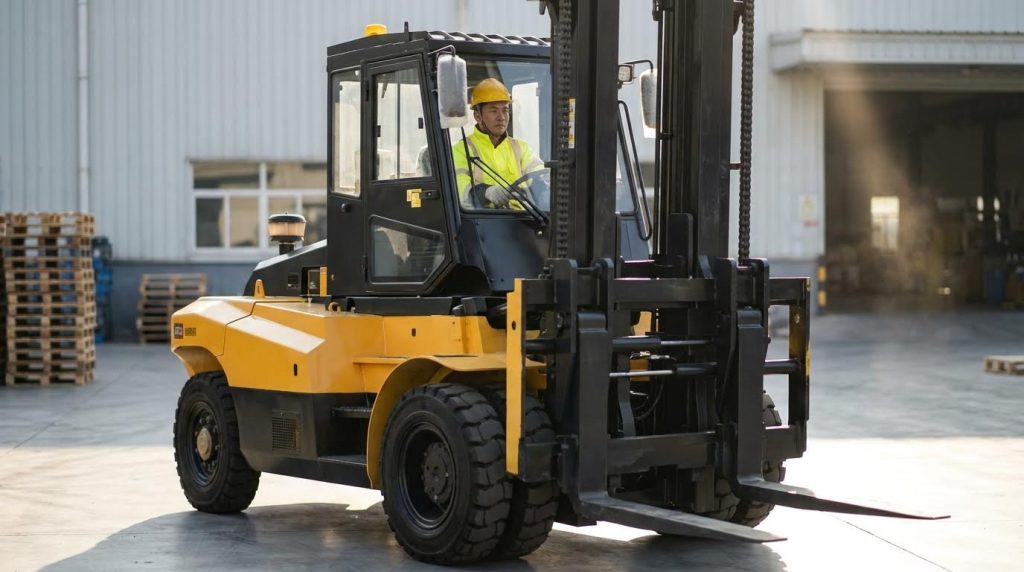
Designing and operating diesel forklifts for lower fuel consumption means matching the truck to the job, keeping it mechanically efficient, and using data and training to cut wasted litres per hour. When people ask how much diesel does a forklift use per hour, the honest answer is that engineering choices and operating discipline often swing fuel burn by 20–30% for the same capacity class.
- Goal: Cut litres/hour without losing throughput – Lower fuel bills and emissions at the same pallet count.
- Levers: Right-size capacity, maintain engines and tires, train operators, and use telematics – Attacks every major loss path.
- Result: A 3–5 tonne fleet that might burn 3–4 L/h can often be pushed toward the bottom of that band – Real cash and CO₂ savings.
Right-sizing forklifts to the job profile
Right-sizing forklifts to the job profile means choosing capacity, mast, and tires to match typical loads and duty, not rare peaks. This is the first engineering answer to how much diesel does a forklift use per hour, because oversizing or undersizing can easily waste 0.5–1.0 L/h on a 3–5 tonne machine. Source
| Typical job profile | Common (but wrong) choice | Right-sized choice | Operational impact |
|---|---|---|---|
| Loads 800–1,200 kg, occasional 1,500 kg | 4–5 tonne diesel | 2.0–2.5 tonne diesel | Lower truck mass and engine size, often 2–3 L/h instead of 3–4 L/h. |
| Loads 2,000–2,500 kg all shift | 2.5 tonne diesel at limit | 3.0–3.5 tonne diesel | Engine not at redline every lift, better longevity and similar L/h but more pallets/h. |
| Occasional 4,000 kg machinery, mostly 1,500–2,000 kg | 6–7 tonne diesel for all work | 3.0–3.5 tonne plus shared heavy truck | Heavy truck used only when needed; day‑to‑day work done at 3–4 L/h, not 4–5+ L/h. |
- Match capacity to 80–90% of lifts: Size for typical, not worst-case – Reduces truck weight and engine size, cutting base fuel burn.
- Use a “peak-load” strategy: Keep one high‑capacity unit for rare heavy lifts – Stops every pallet being moved by a fuel‑hungry heavy truck.
- Specify mast height realistically: Avoid over‑tall masts “just in case” – Shorter masts weigh less and reduce hydraulic demand per lift.
- Choose the right tire type: Cushion tires on smooth concrete, pneumatics only where needed – Lower rolling resistance means less engine torque and lower L/h.
- Align truck speed with site layout: No need for high‑speed gearing in tight, short‑run warehouses – Prevents overspec engines that never reach efficient operating zones.
How right-sizing changes litres per hour in practice
Light-duty diesel forklifts under 2.5 tonnes typically consume 2–3 L/h, while mid-range 3–5 tonne trucks burn around 3–4 L/h and heavier 6+ tonne units use 4–5+ L/h under similar duty. Reference fuel bands. Selecting a truck one size larger than needed locks you into the next fuel band for the life of the asset.
💡 Field Engineer’s Note: When I audit fleets, the biggest silent fuel leak is “just in case” capacity. One over‑spec 7 tonne truck doing 90% of 1.5 tonne work will quietly add thousands of litres per year compared with a 3–3.5 tonne unit sharing the workload.
Maintenance, tuning, and tire specification
Maintenance, tuning, and tire specification keep the engine breathing, burning, and rolling efficiently so every litre of diesel does maximum work. In real fleets, this alone often shifts fuel use by 10–20% at the same workload. Source
| Maintenance / spec item | Issue if ignored | Fuel impact | Operational impact |
|---|---|---|---|
| Air filters | Clogged, restricted airflow | Engine works harder for same power, higher L/h | Sluggish response, more black smoke, higher emissions. |
| Fuel filters & injectors | Contamination, poor spray pattern | Incomplete combustion, more litres per pallet | Rough idle, harder starting, risk of unplanned downtime. |
| Engine oil & tuning | Old oil, incorrect grade, out‑of‑tune engine | Higher friction losses, worse BSFC | Higher operating temperature, reduced engine life. |
| Tire pressure & type | Underinflated or wrong tread for surface | Higher rolling resistance, more torque required | Slower travel, more wheel spin on poor surfaces. |
| Hydraulic leaks & drag | Leaky hoses, worn pumps | Constant parasitic load on engine | Slow mast and tilt, heat build‑up in oil. |
- Run a strict PM schedule: Base intervals on engine hours and environment severity – Preserves combustion efficiency and keeps L/h close to spec.
- Inspect filters proactively: Change air, fuel, and oil filters before restriction alarms – Cheaper than burning extra diesel for months.
- Standardize tire pressures: Use daily checks and simple gauges – Prevents 5–10% fuel loss from soft tires and wheel drag.
- Match tire compound to floor: Harder compounds for smooth concrete, more compliant for rough yards – Balances grip and rolling resistance.
- Monitor engine health trends: Watch for rising L/h at same duty – Early warning of injector, turbo, or DPF issues.
Structured preventive maintenance programs can reduce diesel consumption by up to 20% by keeping filters, fluids, and combustion hardware in optimal condition. Reference
💡 Field Engineer’s Note: If a site tells me their 3 tonne trucks are suddenly using “over 4 L/h” with no change in workload, I check air filters and tire pressures before touching the fuel system. Nine times out of ten, the fix is cheap and fast.
Telematics, data tracking, and operator training
Telematics, data tracking, and operator training convert raw litres-per-hour data into behaviour change, cutting idle time and smoothing driving patterns. This is where you turn the generic question how much diesel does a forklift use per hour into a site‑specific KPI you can manage.
- Log real fuel use: Capture litres filled against engine hours – Builds an accurate L/h baseline by truck and shift.
- Track idle vs working hours: Use telematics to separate key‑on from hydraulic/travel activity – Reveals how much fuel is burned doing zero work.
- Benchmark operators: Compare L/h and idle ratios by driver on similar jobs – Identifies best practice and training needs.
- Map routes and cycles: Analyse travel distance and tight turn zones – Supports layout changes that reduce wasted travel metres.
- Targeted training: Coach on smooth acceleration, anticipatory braking, and shutting down during longer waits – Directly lowers L/h and wear.
| Telematics metric | Typical issue exposed | Corrective action | Fuel-saving effect |
|---|---|---|---|
| Idle time % of key‑on | Engines left running at docks or during breaks | Policy to shut down if idle > 3–5 minutes | Large sites often see 5–15% fuel reduction. |
| Harsh acceleration / braking events | Aggressive driving style | Operator coaching and performance feedback | Smoother cycles, lower L/h and less tire wear. |
| Average travel distance per pallet | Sub‑optimal layout or routing | Re‑position docks, racks, or staging areas | Fewer metres per pallet, less engine run time. |
| Fuel use spikes by truck | Developing mechanical problems | Trigger maintenance inspection | Prevents long periods of high, “mystery” fuel burn. |
Telematics systems that log engine hours, fuel use, idle time, and load profiles allow benchmarking litres per hour by shift, operator, and route, so you can act on deviations early. Reference
Typical training-led improvements
Training programs that focus on avoiding unnecessary idling, using smoother acceleration and deceleration, and planning routes to minimise backtracking have consistently reduced diesel forklift fuel consumption in the field. Source
💡 Field Engineer’s Note: When we first install telematics, idle time above 30% of key‑on is common. Once operators see their own dashboards and get basic coaching, it is realistic to pull that down below 15%, which directly lowers litres per hour without buying a single new truck.
Final Thoughts On Managing Diesel Forklift Fuel Use
Diesel forklift fuel consumption is not a fixed catalogue number. It is the outcome of engineering choices, site design, and operator behaviour acting together. Capacity class, load profile, lift height, and terrain set the physical work the engine must do. Maintenance standards, tire selection, and hydraulic health decide how much of each litre turns into useful work instead of loss.
When sites oversize trucks, accept rough layouts, or neglect filters and tires, litres per hour climb and stay high. Poor driving habits and long idle periods then add extra fuel burn with no gain in pallets moved. The reverse is also true. Right-sized forklifts, smooth travel paths, strict preventive maintenance, and trained operators can pull a fleet toward the lower end of each fuel band.
The best practice is clear. Treat litres per hour as a controlled KPI, not a surprise. Log fuel against hours, review data by truck and shift, and act on trends early. Use telematics where possible, and back the numbers with simple, focused training. This approach lets Atomoving customers cut fuel cost and emissions while keeping throughput stable or higher.
Frequently Asked Questions
How much diesel does a forklift use per hour?
A typical diesel forklift consumes about 4 to 8 liters of diesel per hour, depending on factors like engine size, load weight, and operating conditions. Larger forklifts or those working under heavy loads will consume more fuel. Regular maintenance, such as air filter cleaning and proper tire inflation, can help improve fuel efficiency.
What is the average lifespan of a forklift in hours?
Most forklifts last between 10,000 to 20,000 operating hours. High-quality forklifts can run comfortably for 2,000 hours per year with proper maintenance. Keep in mind that lifespan also depends on usage intensity and environmental conditions. Forklift Lifespan Guide.
How much does it cost to replace forklift batteries?
The cost of replacing forklift batteries varies based on battery type, capacity, and manufacturer. Lithium-ion batteries are more expensive upfront but offer longer lifespans and lower maintenance costs compared to lead-acid batteries. On average, you might expect to pay anywhere from €2,000 to €6,000 for a new battery. Proper care, including regular charging and avoiding deep discharges, can extend battery life significantly.