Forklift pallet capacity and safe stacking practices defined the operating envelope for modern warehouses, construction sites, and manufacturing plants. This article examined how rated capacity, load center, and load moment governed what a truck could safely lift and stack. It then explored engineering limits for vertical tiering, pallet geometry, and dynamic mast behavior, followed by how to select equipment, interpret high‑capacity specifications, and apply emerging sensor technologies. Finally, it summarized practical, standards-aligned methods to keep pallet handling within safe limits while maximizing throughput.
Core Concepts Of Forklift Capacity And Load Center
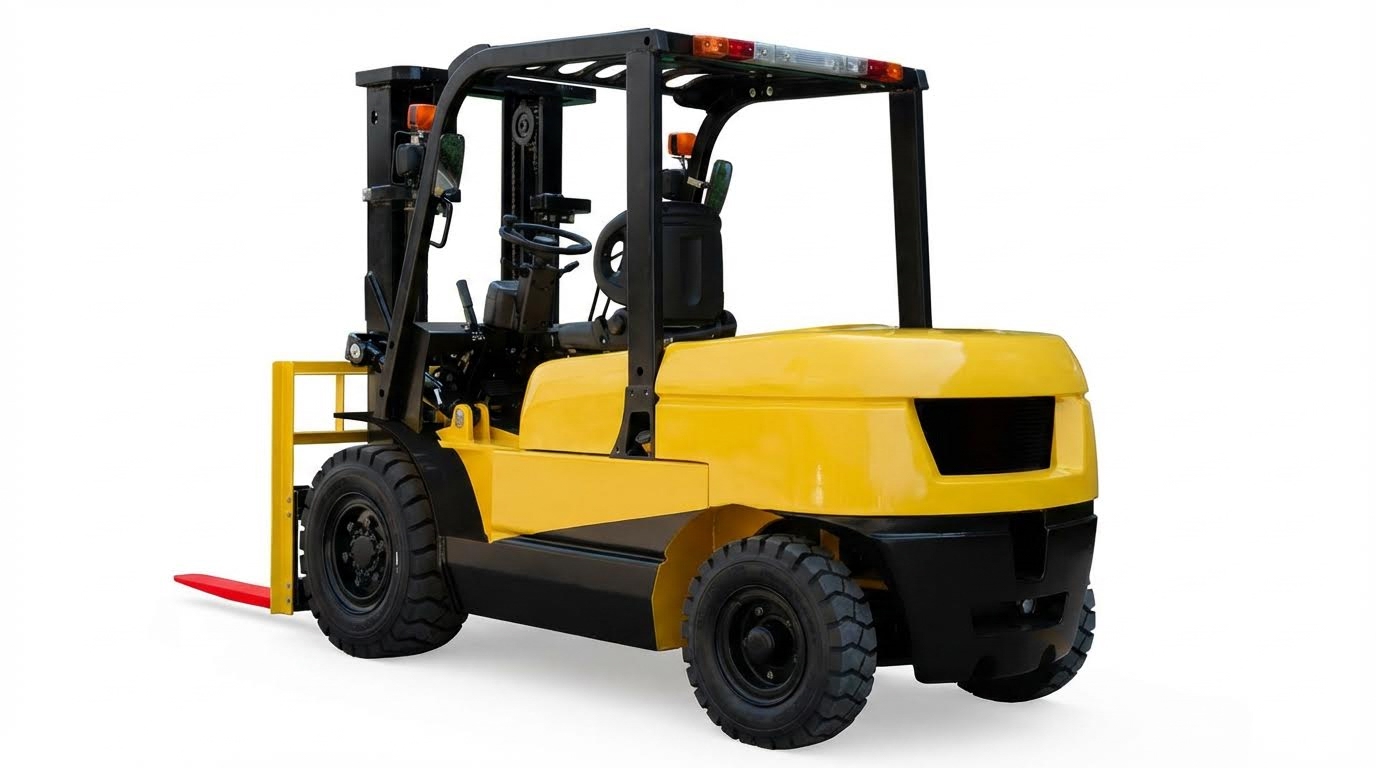
Understanding core capacity concepts allowed engineers and operators to translate nameplate ratings into real, safe pallet limits. Capacity, load center, and load moment defined the stability envelope of a forklift or loader, especially during stacking. These concepts connected directly to OSHA and ANSI requirements and governed how high and how fast operators could safely handle palletized loads. A clear grasp of these fundamentals reduced tipover risk and minimized structural overstress on masts, forks, and hydraulics.
Rated Capacity, ROC, And Load Moment Basics
Rated capacity, or Rated Operating Capacity (ROC), described the maximum load a machine could safely lift at a specified load center and mast configuration. Manufacturers determined ROC using stability tests that compared the overturning moment of the load to the restoring moment of the truck. Load moment equaled load weight multiplied by the horizontal distance from the fulcrum, typically the front axle or mast pivot. As the moment approached the truck’s stability limit, the risk of forward or lateral tipover increased sharply. Regulatory guidance, such as OSHA 29 CFR 1910.178, required that operators never exceed the rated capacity shown on the data plate. For loaders like the MYZG CL-500, ROC at a 24-inch load center set the baseline for all subsequent capacity calculations.
Standard 24-Inch Load Center And CG Shift
Most industrial forklifts used a standard 610 millimetre (24 inch) load center for rating, assuming a uniformly distributed, cube-like load. The load center represented the distance from the fork face to the load’s center of gravity (CG), not the pallet length. When loads extended beyond standard dimensions, the CG shifted outward, effectively increasing the load center. This shift increased the overturning moment even if the gross load weight stayed constant. As the mast tilted forward or the forks were raised, the combined truck–load CG moved toward the stability triangle’s edge, further reducing the allowable weight. High-capacity trucks, such as models rated between 25,000 and 80,000 pounds, still relied on this same 24-inch principle, so operators had to reassess capacity whenever handling long pallets or irregular cargo.
Calculating Safe Capacity For Real Pallet Loads
Real pallet loads rarely matched the ideal rating condition, so engineers used proportional formulas to estimate safe capacity. For a machine rated at a given ROC and standard load center, safe capacity equaled ROC multiplied by the ratio of standard load center to actual load center. The MYZG CL-500 example illustrated this: 5,000 pounds at 24 inches became 4,000 pounds at a 30-inch CG, before applying a safety margin. Applying a 20 percent reduction yielded a practical limit of 3,200 pounds for that pallet configuration. Operators also had to verify that the mast, forks, and attachments were rated for at least this load, and that stacking height did not exceed rack or overhead clearances. For high-tier operations, best practice reduced the working load further as mast extension increased, keeping the system within a conservative stability envelope.
Effects Of Attachments, Slope, And Altitude
Attachments, terrain, and altitude all reduced effective pallet capacity compared with nameplate values. Clamps, side-shifters, and fork positioners added dead weight ahead of the mast and moved the CG forward, so the truck’s capacity data plate had to reflect these reductions. On slopes greater than about 5 degrees, the combined CG shifted downhill, cutting stability by roughly 30 percent and requiring lower operating loads and slower travel. Uneven surfaces and dynamic maneuvers, such as braking or turning with an elevated pallet, further amplified effective load moments. Altitude affected combustion and hydraulic performance, with observed hydraulic efficiency losses of about 3 percent per 300 metres, which reduced practical lifting capability. Modern systems, including MYZG loaders, used tilt sensors and smart load monitoring to derate ROC automatically when slope or instability was detected, aligning operation with OSHA and ANSI safety expectations.
Engineering Limits For Pallet Lifting And Stacking
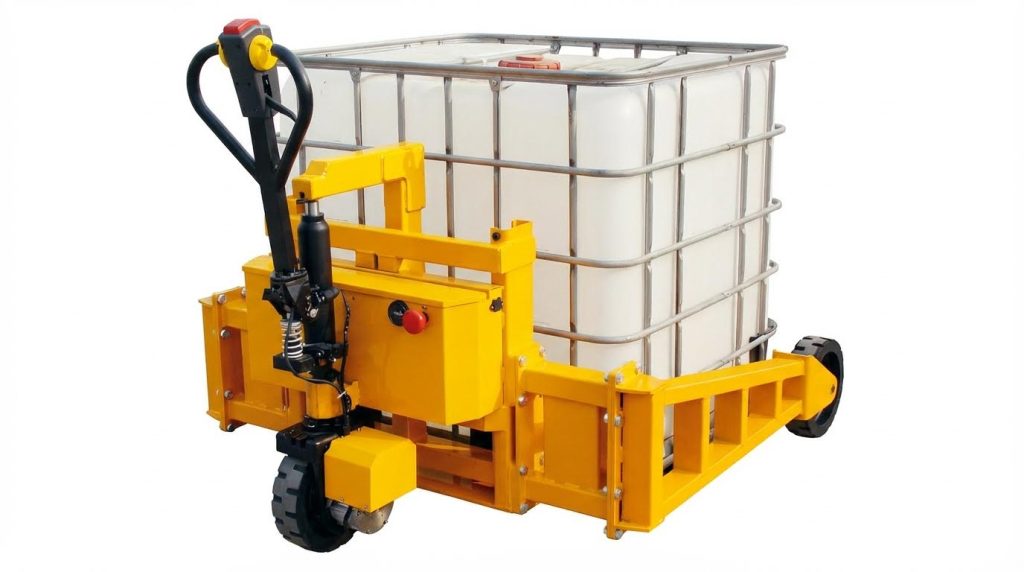
Engineering limits for pallet lifting and stacking depended on the interaction between forklift capacity, load geometry, and storage infrastructure. Designers and safety engineers evaluated static and dynamic load cases, including mast deflection, rack beam strength, and floor bearing pressure. Regulatory requirements such as OSHA 29 CFR 1910.178 and racking design standards like EN or RMI guidelines framed acceptable safety margins. Understanding these constraints allowed facilities to maximize vertical storage while maintaining stability and predictable handling behavior.
Vertical Tiering, Height Limits, And Rack Constraints
Vertical tiering limits arose from combined forklift capacity curves and rack or stack stability. As the mast extended, effective capacity decreased because the load moment increased with height and outreach. Standards and best practice required placing the heaviest pallets on the lowest tiers and progressively lighter loads above to keep the overall center of gravity low. For pallet flow and static racks, engineers sized beams and uprights for worst-case pallet mass, impact factors from forklift contact, and deflection limits to prevent beam sag that could misalign lanes.
Clearances also constrained vertical stacking. Operators needed sufficient overhead space above the top pallet for fork extraction, typically at least 100 to 150 millimetres, plus allowance for floor unevenness. High-capacity forklifts, with overhead guard heights around 2.6 to 3.0 metres, limited how high operators could work under mezzanines or low roofs. In free-stacking on the floor, stability governed height more than forklift reach; stacks of mixed-size or deformable loads required lower height limits to prevent column buckling or toppling.
Rack manufacturers recommended maximum pallet weights, beam spacing, and lane depths, especially for pallet flow systems up to 20+ pallets deep. Deep lanes introduced additional compressive forces and required speed controllers and ramp stops to manage kinetic energy. Ignoring these engineered constraints risked progressive collapse, where failure of one beam or upright propagated through adjacent bays. Facilities therefore documented height limits per aisle and trained operators to respect those limits.
Pallet Geometry, Load Uniformity, And Stability
Pallet geometry directly affected how close the load center stayed to the standard 600 millimetre (24 inch) design point. Overhanging loads shifted the center of gravity forward and upward, effectively derating the forklift and reducing the safe stack height. Uniform pallet sizes and square, evenly distributed loads created predictable behavior and allowed tighter tolerances in pallet flow lanes and racking. In contrast, mixed pallet footprints or irregular loads increased the risk of snagging, bridging, or uneven contact on rollers.
Stable stacking required vertical alignment of deck boards and stringers so that compressive forces transmitted straight down. Operators and planners placed the largest and heaviest pallets at the bottom of a floor stack and ensured that upper pallets matched or were smaller than the footprint below. Uneven distribution, such as heavier cartons on one side, created torsional moments that could twist pallets and cause rack beam point loading. Engineering reviews of pallet flow systems considered pallet material, whether wood, plastic, or metal, because stiffness and friction coefficients changed how loads accelerated and decelerated in the lane.
Safety guidance emphasized avoiding stacking pallets on edge or at angles, which removed direct bearing area and increased the likelihood of sudden collapse. Accessories like entry guides and pallet separators compensated for minor geometric variations by funneling pallets into the correct path and decoupling front pallets from rear compressive forces. For deformable loads, such as cement bags, engineers specified slip sheets, corner posts, or stretch wrapping to maintain a coherent unit load throughout the stack life.
Double-Stacking Pallets Without Exceeding Capacity
Double-stacking pallets multiplied the effective load on the forklift and on the supporting surface, so capacity calculations became critical. Operators first verified that the combined mass of both pallets, plus any attachment, stayed below the rated operating capacity at the actual load center. If the upper pallet overhung or if the lower pallet deformed, the center of gravity moved forward, requiring derating based on the load-moment relationship. Using formulas similar to Safe Capacity = ROC × (Standard Load Center / Actual Load Center) helped quantify these effects.
Best practice required using pallets of identical width and comparable stiffness when double stacking. Matching footprints ensured that the top pallet transferred load uniformly to the lower pallet, preventing punching or localized crushing. Facilities often specified heavy-duty bottom pallets for double-stacked configurations, particularly under high-density products like bagged cement. Stabilizers, bars, or shrink wrapping bound the two pallets into a
Equipment Selection, Specs, And Emerging Technologies
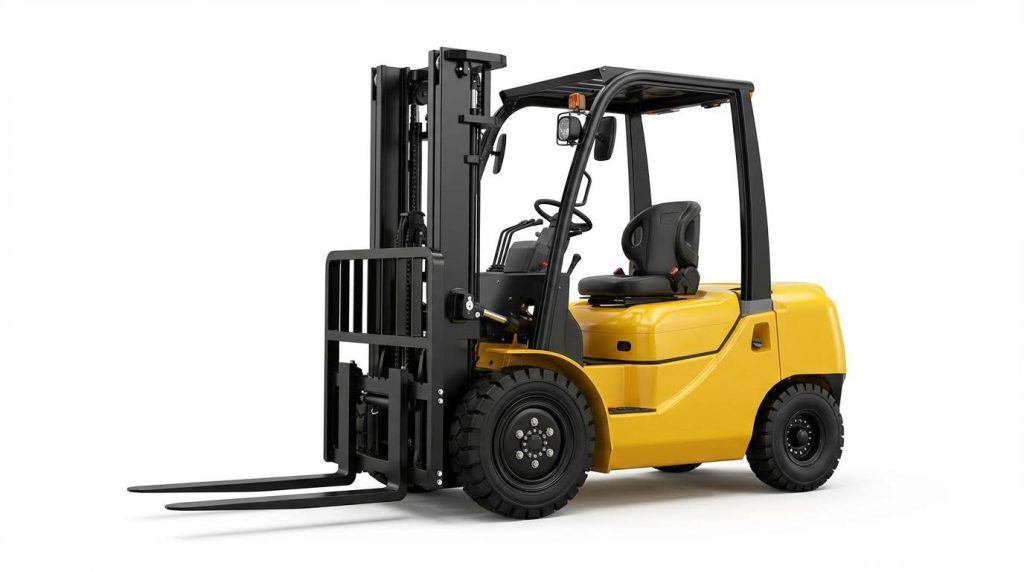
Equipment selection for pallet handling depended on matching forklift specifications to the heaviest, highest, and most frequent loads. Engineers evaluated rated capacity, load center, aisle geometry, and rack interface as a complete system. Emerging sensing and energy technologies improved safety margins and life‑cycle cost, but they did not replace correct capacity calculations. The following sections linked specification data, rack design, and digital tools into an integrated selection approach.
Comparing High-Capacity IC Forklift Specifications
High-capacity internal combustion (IC) forklifts addressed heavy indoor loads such as steel coils, paper rolls, and large palletized tooling. The Toyota high-capacity cushion series, for example, operated between 25,000 lb and 80,000 lb capacity at the rated load center. Models like THDC2500-24 and THDC3000-36 provided 25,000 lb to 30,000 lb capacity with travel speeds around 9.7–10.3 mph under full load and lift speeds from 20 to 61 feet per minute. Gradeability from roughly 31.5% to 73.7% allowed operation on moderate ramps, but capacity charts still governed safe use on slopes.
Dimensional constraints mattered as much as capacity. Right-angle stacking dimensions between about 167 in and 217.5 in dictated minimum aisle width for 90° turns into racks. Overall widths from 62 in to 85.5 in and lengths to fork face from 136 in to 184 in affected maneuverability near columns and dock doors. Overhead guard heights between roughly 103.6 in and 118.8 in limited use in low mezzanines or older buildings. The 5.7 L V8 engine and high-capacity cooling system supported continuous duty, but engineers still checked ventilation and emissions for indoor work.
For lighter but still heavy applications, diesel forklifts in the CPCD series offered capacities from 1,200 kg to 16,000 kg. Models such as CPCD80, CPCD100, and CPCD160 covered 8,000 kg to 16,000 kg, suitable for multi-pallet lifts or dense products like bricks and cement. When comparing series, engineers normalized capacities to a common load center, verified compliance with ISO/ANSI rating methods, and considered attachment derates. Safety systems like operator presence sensing, neutral safety switches, and restraint systems reduced operational risk but did not justify oversizing loads beyond the published de-rated charts.
Matching Forklift Class To Pallet Flow Rack Systems
Pallet flow racks introduced additional constraints because pallets moved by gravity over rollers or wheels. Typical systems ranged from 2 to 10 pallets deep and extended to 20+ pallets in high-density storage. Forklift selection therefore needed to consider not only capacity but also precise control at the lane face. Operators had to square the truck to the lane, lift pallets only 75–100 mm above the rails, and avoid striking upper loads or rack beams.
Class IV and V forklifts with cushion or pneumatic tires commonly serviced pallet flow systems, but their mast heights and right-angle stack dimensions had to match rack geometry. Entry guides on the rack assisted centering, yet fork carriage width and fork length still needed alignment with pallet stringer orientation and lane width. Engineers checked that fork insertion depth reached at least two-thirds of pallet length without contacting rear stops prematurely. They also coordinated overhead guard height with top beam elevation to maintain at least 150–200 mm clearance during high tiering.
Accessories such as speed controllers, pallet separators, and ramp stops influenced equipment choice. Speed controllers moderated pallet acceleration in deep lanes, reducing impact loads on the front pallet and mast. Pallet separators held rear pallets off the pick face, lowering push forces that the forklift had to counter when extracting the front pallet. Ramp stops defined the exact fork entry zone, so the selected truck needed fine inching control and clear mast visibility at that position. Safety codes required operators to use fall protection and PPE when working near elevated rack platforms, which further favored trucks with smooth hydraulic modulation and stable platforms.
Digital Sensors, Load Monitoring, And Predictive Tools
Digital load monitoring technologies enhanced traditional nameplate capacity by providing real-time feedback on load moment and center of gravity. Systems used pressure transducers in hydraulic circuits, mast tilt sensors, and fork-mounted strain gauges to estimate actual load and compare it to the rated operating capacity (ROC). For example, a loader with a 5,000 lb ROC at a 610 mm load center could use embedded logic to auto-derate capacity when the detected CG shifted to 760 mm. This reflected the same relationship as manual calculations such as Safe
Summary Of Safe Forklift Pallet Capacity And Stacking
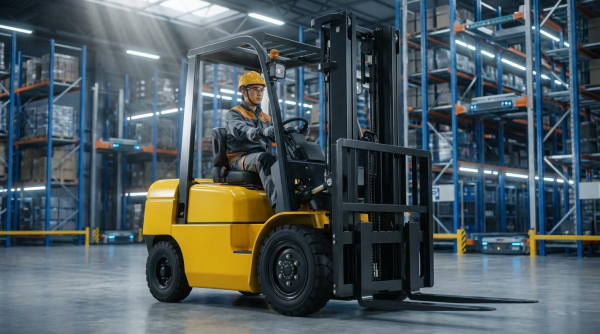
Safe pallet handling depended on understanding rated capacity, load center, and load moment. Operators had to treat nameplate capacity as valid only for the specified load center, usually 600 mm, and a uniformly distributed, centered load. Once the center of gravity moved outward or upward, effective capacity decreased, as shown by the 24/30 load-center derating example that reduced a 2 270 kg rating to 1 450 kg with a safety margin. High-capacity cushion trucks with ratings up to 36 000 kg illustrated how quickly stability margins shrank when handling long or uneven pallet loads.
Engineering limits for stacking required strict control of height, tiering pattern, and rack geometry. Facilities placed the heaviest pallets on lower tiers, respected rack beam ratings, and used pallet flow accessories like speed controllers, separators, and ramp stops to manage dynamic forces. Vertical tiering plans considered mast height, overhead guard clearance, and deflection at full lift, especially with deep-lane gravity systems up to 20 pallets deep. OSHA requirements in 29 CFR 1910.178 provided the baseline for mast tilt, fork positioning, and approach distances.
Equipment selection aligned forklift class, capacity range, and dimensions with aisle width, pallet size, and rack type. High-capacity IC cushion forklifts served heavy indoor loads, while other series covered 1 200 kg to 16 000 kg ranges for general warehouse work. Emerging technologies, including digital load monitoring, IoT sensors, and predictive tools, improved real-time awareness of load moment and stability. These systems supported automatic derating, tilt alarms, and maintenance planning.
Future material-handling strategies would combine higher capacities with tighter safety envelopes and lower energy use. Designers would balance compact truck geometry, advanced cooling, and cleaner powertrains with stricter monitoring of attachments, slope, and altitude effects on capacity. Implementing conservative derating rules, validated load charts, and operator training on CG behavior remained the most practical defense against tipovers and rack failures. As sensing and analytics matured, they would augment but not replace disciplined engineering design and procedural controls for safe pallet stacking.