Forklift emergency disconnects and safety devices formed the backbone of risk control in modern material handling fleets. This article examined how regulations and design standards shaped emergency stop architectures, inspection regimes, and technology choices. It connected global codes, functional safety targets, and legal exposure with practical engineering of disconnects, E‑stops, and safety circuits. The following sections guided engineers and safety managers in building safer, standards-compliant forklift systems using robust hardware, disciplined maintenance, and emerging digital tools.
Regulatory Framework And Design Standards
Regulatory frameworks for forklift emergency disconnects and safety devices linked electrical design, mechanical design, and operational practices. Authorities and standards bodies defined minimum performance for emergency stop functions, power isolation, and safety-related control systems. Engineers had to translate these rules into concrete design choices, including device selection, circuit architecture, and diagnostic coverage. Robust compliance reduced accident probability, limited legal exposure, and supported consistent safety performance across fleets.
Global And Local Codes Governing E‑Stops On Forklifts
Forklift emergency stops and disconnects sat under a mix of machinery, electrical, and occupational safety codes. Globally, IEC 60204-1 and ISO 13850 defined core requirements for emergency stop functions and electrical equipment of machines. In the United States, OSHA regulations mandated pre-shift inspections and safe operation, while NFPA 79 guided industrial electrical safety. In Japan, the Labor Safety and Health Law and related regulations required employers to install emergency stop devices where residual risk remained high, particularly for machinery with pinch, entanglement, or collision hazards. Local codes typically specified accessibility, installation height, and visibility of actuators, ensuring operators could trigger an emergency stop rapidly from expected work positions.
ISO 13850, IEC 60204-1, JIS, And EN ISO 13849-1 Basics
ISO 13850 established principles for emergency stop functions, including red actuators on a yellow background, mechanical latching, and direct opening action. IEC 60204-1 addressed the electrical equipment of machinery, requiring fail-safe design, use of normally closed contacts in safety circuits, and prevention of automatic restart after an emergency stop reset. JIS standards, such as JIS B 9700 and Japanese adoptions of ISO 13850, aligned national requirements with international practice while supporting enforcement under labor safety law. EN ISO 13849-1 provided a framework for designing safety-related control parts, introducing performance levels and probabilistic reliability metrics. Together, these standards pushed forklift designers toward redundant circuits, diagnostic monitoring, and systematic validation of safety functions.
Functional Safety Targets: PL, SIL, And Risk Reduction
Functional safety targets quantified how reliably an emergency stop or disconnect function had to perform. EN ISO 13849-1 defined performance levels (PL a to PL e) based on architecture, component reliability, and diagnostic coverage; forklift emergency stop circuits often targeted PL d or PL e due to high risk severity and exposure. IEC 61508 and related sector standards introduced Safety Integrity Levels (SIL 1 to SIL 3), with SIL 3 corresponding to very low probability of dangerous failure. Engineers used risk assessments to select appropriate PL or SIL targets, then chose dual-channel circuits, monitored safety relays, or safety PLCs to meet those targets. Verification and validation activities, including testing of fault detection and safe-state behavior, confirmed that calculated risk reduction matched real-world performance.
Legal Liability, Penalties, And Corporate Risk Exposure
Failure to implement compliant emergency stop and disconnect systems exposed organizations to significant legal and financial risk. Under Japan’s Labor Safety and Health Law, absence of required emergency stop devices could trigger penalties including imprisonment up to six months or fines up to 500000 yen, along with administrative measures such as use suspension orders. In other jurisdictions, regulators could levy fines, mandate corrective actions, or pursue criminal charges after serious incidents. Civil liability extended to compensation for injuries, fatalities, and property damage, with investigation reports often scrutinizing whether standards like ISO 13850, IEC 60204-1, and EN ISO 13849-1 were followed. Beyond direct penalties, non-compliance increased downtime, insurance costs, and reputational damage, making rigorous adherence to safety standards a core element of corporate risk management.
Forklift Emergency Disconnect And E‑Stop Architecture
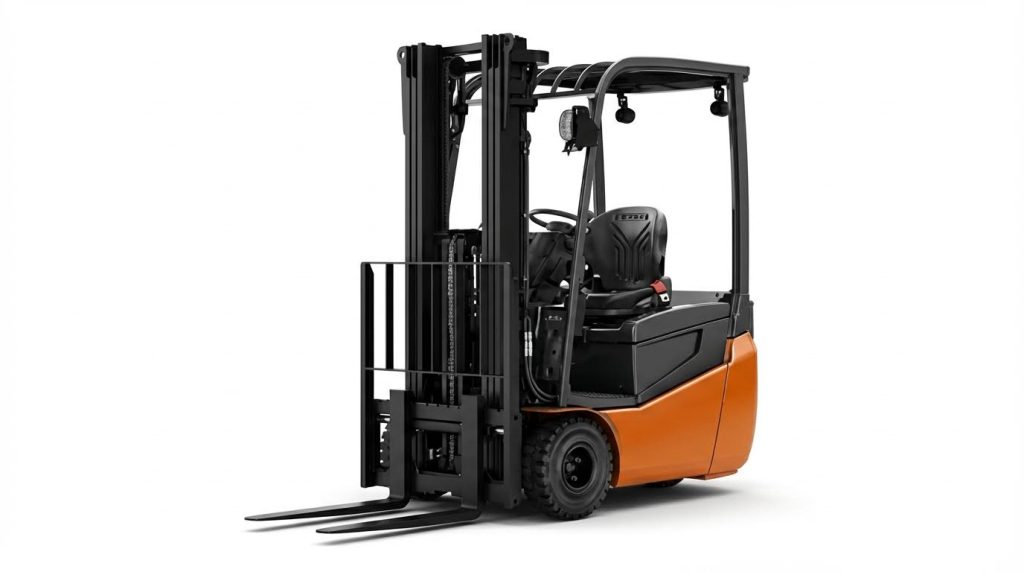
Forklift electrical and control architecture had to ensure that emergency actions removed motive power quickly and predictably. Engineers structured emergency disconnects, main contactors, and E‑Stops so that any single failure still drove the truck to a safe state. Modern designs combined hardware redundancy, monitored safety channels, and integration with presence detection and interlocks. This section described how these elements worked together to achieve compliant, robust safety performance.
Main Power Isolators, Contactors, And Emergency Disconnects
Main power isolators on forklifts provided a means to de‑energize all electrical functions, including traction, hydraulics, and auxiliary systems. Designers typically located the isolator or emergency disconnect where an operator or rescuer could reach it quickly, even in a collision scenario. The isolator fed one or more main contactors that switched high-current traction and pump circuits; safety circuits controlled these contactors through positively guided contacts. In an emergency shutdown, actuating the disconnect or associated emergency circuit removed coil power from the contactors, producing a fail-safe drop-out and opening the power path. Engineers specified breaking capacity, creepage distances, and arc suppression according to IEC 60204-1 and the truck’s maximum system voltage and short-circuit current.
E‑Stop Device Design: NC Contacts, Latching, And Direct Opening
Forklift E‑Stop pushbuttons used normally closed contacts so that any broken wire or contact failure tended to stop the machine. Standards such as ISO 13850 and IEC 60204-1 required a red actuator with a yellow background, mechanical latching, and direct opening action for reliability. When actuated, the button latched in the depressed position and mechanically forced the NC contacts open, independent of spring force or welding. Reset required a deliberate twist or pull action and did not automatically restart motion; the control system demanded a separate start command. Engineers avoided software-only E‑Stop implementations and ensured that E‑Stop circuits bypassed programmable logic for the final power removal stage.
Dual-Channel Circuits, Safety Relays, And Safety PLCs
To achieve higher performance levels, forklift E‑Stop and emergency disconnect circuits often used dual channels with independent NC contacts. Each channel routed through a safety relay or safety PLC input, allowing cross‑monitoring for short circuits, welded contacts, or wiring faults. The safety relay then controlled redundant contactor coils or force-guided relay outputs that interrupted traction and hydraulic power. For architectures targeting PL e or SIL 3, designers implemented diagnostic coverage, periodic self-tests, and fault exclusion assumptions consistent with EN ISO 13849-1 or IEC 62061. Safety PLCs additionally coordinated multiple safety functions, but final power removal still relied on hardwired, positively driven contacts.
Integration With Operator Presence And Interlock Systems
Operator presence systems, such as seat switches or floor pedals, complemented E‑Stops by preventing unintended motion when the operator left the control position. Interlock switches monitored parking brakes, direction selectors, mast positions, and guard conditions, and they inhibited traction or hydraulic movement when a hazardous state existed. Engineers integrated these devices into the same safety chain that controlled contactors, ensuring that any presence or interlock fault forced a safe stop. The architecture prioritized predictable behavior: E‑Stop functions overrode all other commands, while presence and interlocks governed enable conditions for motion. Proper integration reduced nuisance trips yet maintained compliance with functional safety targets and applicable industrial truck standards.
Inspection, Maintenance, And Emerging Technologies
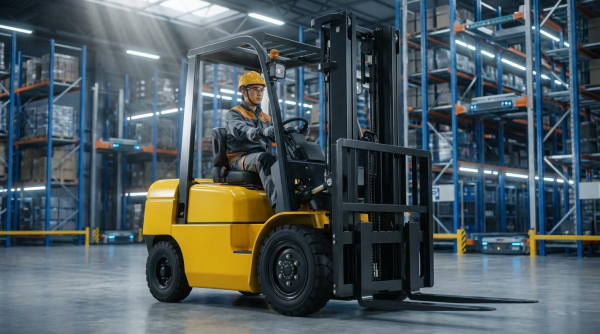
Inspection and maintenance practices defined the real safety performance of forklift emergency disconnects and safety devices. Engineering teams needed structured routines, measurable criteria, and reliable documentation to keep systems compliant and effective. Emerging digital tools and monitoring technologies then built on this foundation, enabling earlier fault detection and data-driven maintenance. The following subsections detailed how to integrate these elements into a coherent lifecycle strategy.
Shift-Start Inspections Of Safety Devices And Disconnects
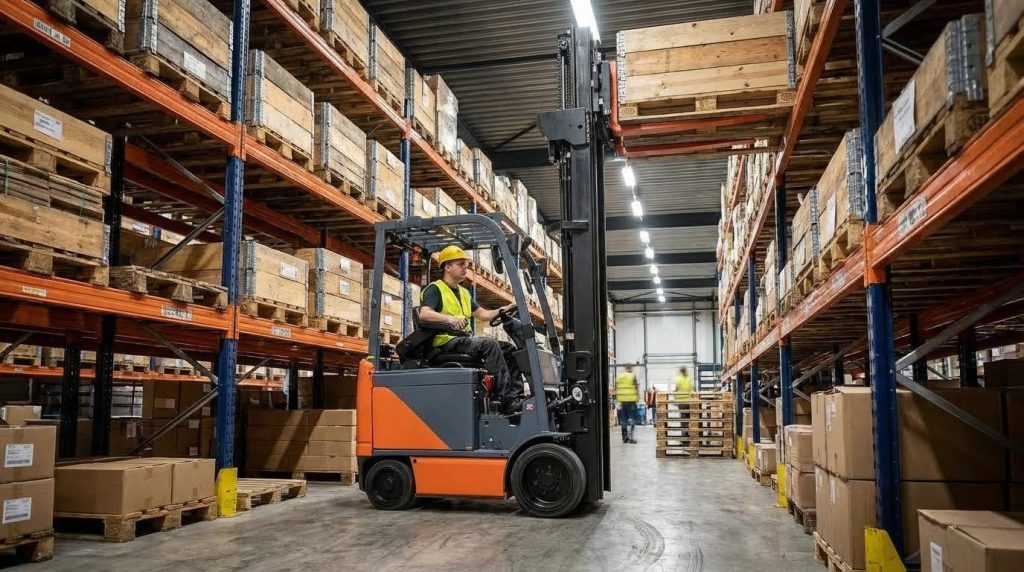
Shift-start inspections formed the first safety barrier before a forklift entered service. Regulations required operators to inspect the truck at the beginning of each shift, including emergency disconnects, E‑stops, horns, lights, and warning alarms. Operators checked that the main isolator or emergency disconnect deactivated all electrical functions when actuated. They verified that seat belts latched and retracted, parking brakes held on an incline, and brakes stopped the truck without pulling. Visual checks covered forks, chains, hydraulic lines, overhead guards, and load backrests for cracks, leaks, or deformation. Defective units had to be tagged out immediately, with clear lockout procedures and no operation until corrective maintenance closed the issue.
Periodic Testing, Documentation, And Failure Criteria
Beyond shift checks, engineering teams scheduled periodic functional and electrical tests of E‑stops and disconnects. Monthly tests typically confirmed positive mechanical latching, manual reset behavior, and reliable shutdown of all actuators when an E‑stop triggered. Quarterly tests used continuity measurements to verify correct opening of normally closed contacts and correct operation of both channels in dual-channel circuits. Teams inspected terminals for looseness, insulation damage, and corrosion, tightening connections to specified torque values. Clear failure criteria included delayed stopping, incomplete power removal, inconsistent latching, physical damage, or contact resistance outside design limits. Maintenance staff documented dates, findings, corrective actions, and replaced parts to support audits, legal compliance, and trend analysis.
Digital Tools, AI Monitoring, And Predictive Maintenance
Digital inspection tools transformed how facilities tracked forklift safety performance. Mobile applications allowed operators to complete standardized checklists, attach photos, and trigger automatic work orders when they recorded defects. Centralized databases stored historical inspection and repair records, enabling engineers to identify recurring issues with specific models, circuits, or environments. Where safety relays or safety PLCs supported diagnostics, systems logged channel faults, nuisance trips, and reset attempts for analysis. Emerging AI algorithms used this data to predict component degradation, such as contact wear or hydraulic seal failure, before an outage occurred. Facilities then shifted from purely interval-based maintenance to risk-based and condition-based strategies, improving uptime while preserving safety integrity levels.
Adapting To Harsh Environments And High-Duty Cycles
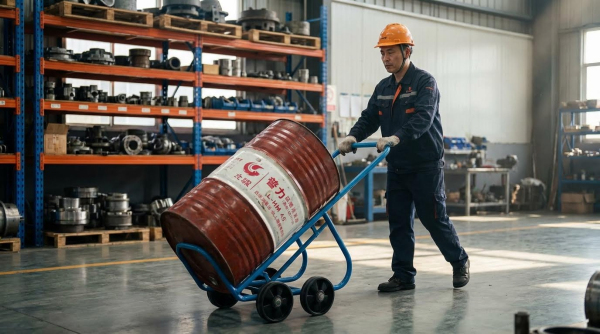
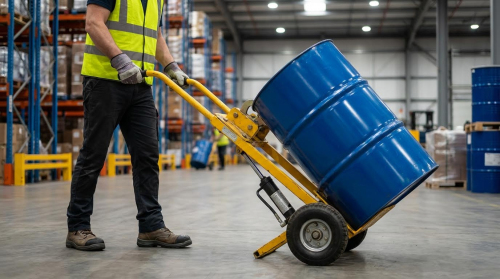
Forklifts operating in harsh environments imposed extra demands on emergency disconnects and safety devices. Dust, moisture, corrosive atmospheres, and vibration accelerated wear on pushbuttons, isolators, and wiring. Engineers selected components with appropriate ingress protection ratings and mechanical robustness, and they increased inspection frequency beyond standard monthly or quarterly intervals. In cold stores or outdoor yards, condensation and temperature cycling required sealed enclosures and careful routing of cables to avoid cracking. High-duty-cycle operations, such as multi-shift logistics hubs, justified more frequent testing of E‑stops, contactors, and safety relays because of elevated switching counts. Facilities often supplemented hardware with visual safety aids such as projected red-zone lights and laser floor markings to compensate for noise, congestion, and reduced visibility, maintaining clear separation between pedestrians and moving equipment. Forklifts equipped with specialized attachments like a forklift barrel grabber or a drum stacker required additional scrutiny to ensure compatibility with safety systems. Furthermore, integrating tools like a manual pallet jack into workflows demanded adherence to rigorous safety protocols.
Summary: Key Takeaways For Safer Forklift Systems
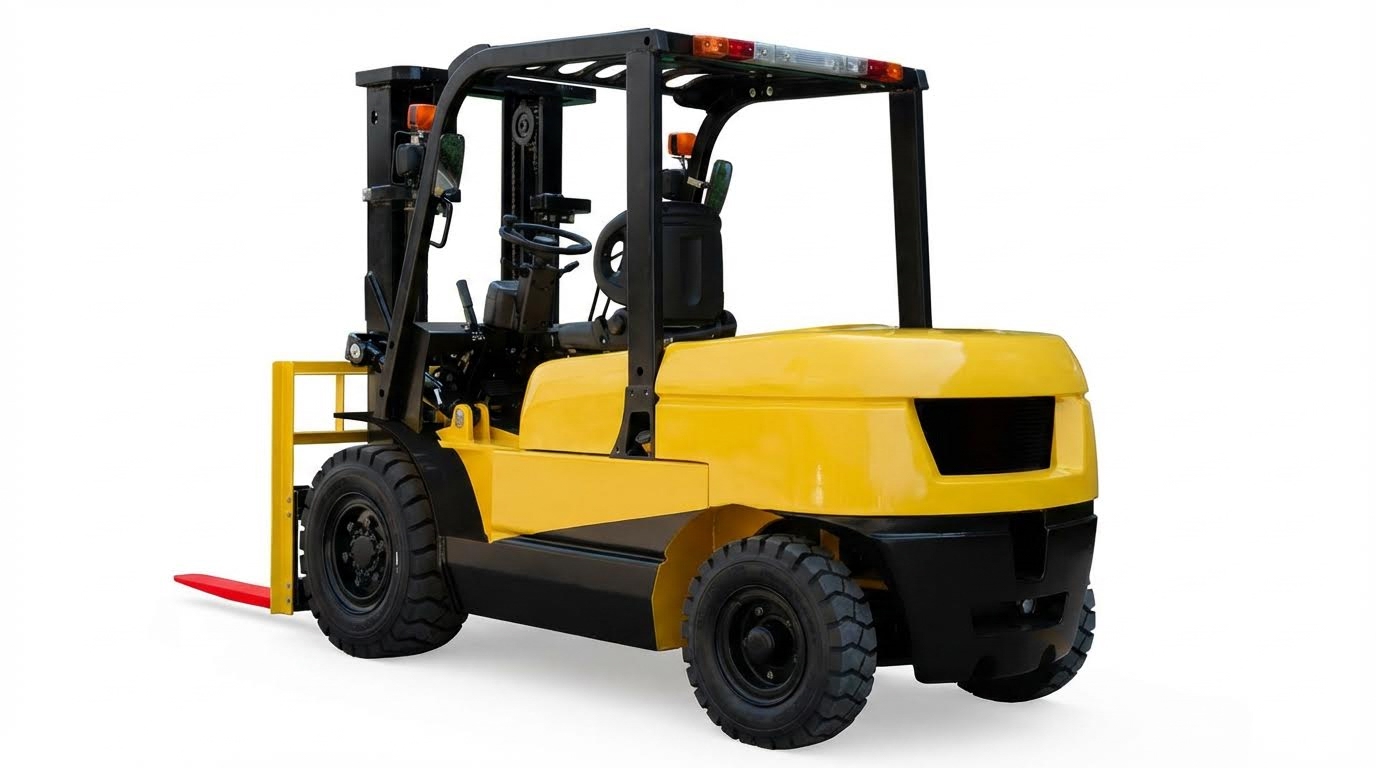
Forklift emergency disconnects and safety devices formed the backbone of engineered risk reduction strategies in industrial environments. Regulatory frameworks such as OSHA rules, IEC 60204-1, ISO 13850, EN ISO 13849-1, and relevant national laws defined mandatory inspection intervals, emergency stop design, and electrical safety architecture. Engineering teams translated these requirements into concrete design choices: clearly visible red emergency stop actuators on a yellow background, main isolators that removed all power, and safety circuits that defaulted to a safe state on any detected fault. Functional safety concepts like Performance Level and Safety Integrity Level guided target architectures using dual-channel NC circuits, monitored safety relays, and safety PLCs to achieve verifiable risk reduction.
From an operational perspective, daily shift-start inspections and structured periodic testing reduced the probability of dangerous failures and prevented approximately 70% of avoidable forklift incidents. Clear failure criteria, immediate tag-out of defective equipment, and disciplined documentation underpinned both legal compliance and traceability after incidents. In parallel, digital inspection tools, connected sensors, and predictive maintenance models started to shorten reaction times, improve diagnostic coverage, and optimize service intervals, especially for fleets operating in harsh or high-duty environments.
Looking ahead, safer forklift systems relied on an integrated approach: robust hardware design, standards-based control architectures, trained and certified operators, and data-driven maintenance. Engineers needed to balance increasing electronic complexity with fail-safe, easily testable designs that avoided software-only emergency stop implementations. Organizations that treated emergency disconnects and safety devices as strategic assets rather than cost items tended to achieve lower accident rates, reduced downtime, and stronger regulatory standing while preparing for future automation and autonomy in material handling. For instance, integrating advanced forklift barrel grabber systems or manual pallet jack solutions can enhance operational efficiency. Additionally, adopting tools like low profile pallet jack options ensures adaptability in diverse material handling scenarios.