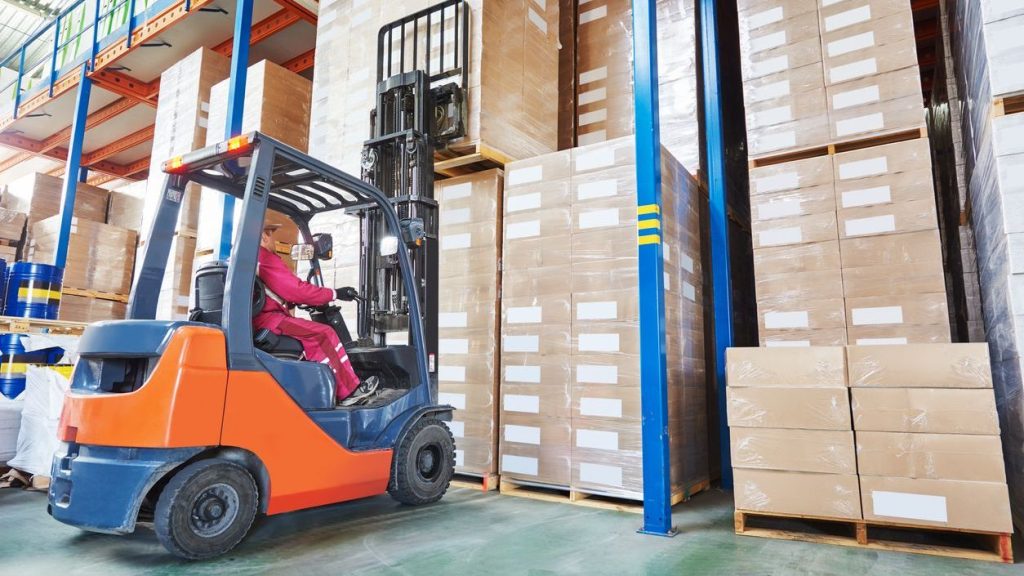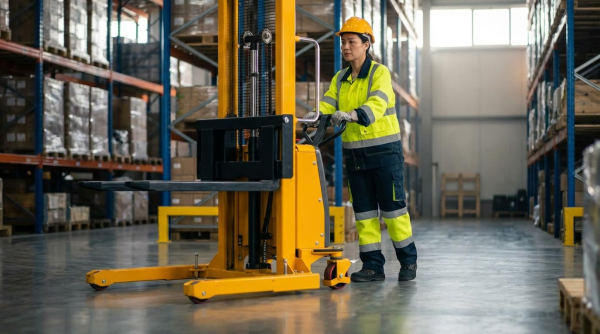
Straddle stackers operated in warehouses and logistics hubs required strict engineering-based safety practices. This article examined their core design and stability principles, contrasted them with pallet jacks, and detailed guarding, visibility, and pedestrian separation strategies. It then addressed safe operating rules, including inspections, load handling, speed control, grade navigation, and operation in trailers, railcars, and hazardous atmospheres. Finally, it covered structured inspection and maintenance programs, troubleshooting, and emerging digital tools before summarizing critical practices that safety managers and engineers could apply in the field.
Core Design Features And Stability Principles
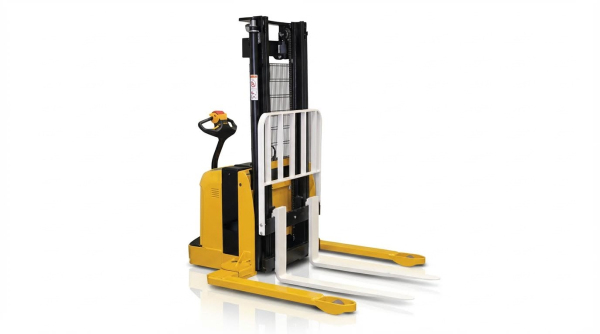
Core design features governed how straddle stackers handled loads, interacted with operators, and behaved dynamically under stress. Stability principles, including the stability triangle and load moment, defined safe operating envelopes and failure modes. Understanding these fundamentals allowed engineers and safety managers to specify suitable equipment and design safer workflows. This section examined those principles and translated them into practical safety guidance for industrial environments.
Straddle Stacker Vs. Pallet Jack: Key Safety Differences
Straddle stackers incorporated outriggers that straddled the pallet, which increased lateral stability compared with typical pallet jacks. They lifted loads to greater heights, so the potential energy and tip-over consequences were higher than for low-lift pallet jacks. Operators usually walked behind or alongside the stacker, using a tiller arm with integrated controls, while pallet jacks often relied on simpler mechanical steering and limited control interfaces. Because straddle stackers operated in narrower aisles and at higher lift heights, hazard exposure to pedestrians, racking, and overhead structures increased. Engineering controls such as rated capacity plates, guarded masts, and defined turning radii were therefore more critical than for basic pallet jacks. These differences required stricter training, speed control, and layout planning when introducing straddle stackers into an existing walkie pallet truck-based facility.
Stability Triangle, Load Moment, And Tip-Over Risks
The stability triangle concept described the relationship between the truck’s center of gravity and its support points, usually the drive wheel and the two outrigger wheels. When the combined center of gravity of truck and load moved outside this triangle, a tip-over occurred. Load moment equaled load weight multiplied by the horizontal distance from the load’s center of gravity to the fulcrum, typically the front axle or outrigger line. As operators raised the load or extended it away from the mast, the load moment increased and reduced the available stability margin. Off-center loads, uneven floors, or turning with an elevated load shifted the center of gravity laterally and significantly raised tip-over risk. Safe practice therefore required keeping loads low during travel, respecting the rated capacity at the specified load center, and avoiding sharp steering inputs when the mast was elevated.
Guarding, Backrests, And Operator Protection Systems
Straddle stackers used overhead guards and load backrests to manage the risk of falling objects and shifting cargo. Overhead guards had to resist impact from typical unit loads and remain securely attached without obstructing the operator’s forward and upward view. Openings in guards were limited so that the smallest unit of cargo could not pass through, which reduced the chance of packages striking the operator. Load backrest extensions prevented stacked goods from rolling or sliding backward into the mast or operator area when the mast tilted. Mast, chain, and sprocket guards enclosed moving parts within reach, reducing entanglement and pinch-point hazards. Additional protection systems included emergency stop circuits, brake interlocks linked to tiller position, and reverse “belly” switches that stopped or reversed travel if the operator became trapped between the truck and an obstacle.
Visibility, Aisle Design, And Pedestrian Separation
Safe straddle stacker operation depended strongly on visibility in all intended directions of travel. Mast profiles, fork carriage design, and load backrests needed to balance structural strength with sight lines so operators could see pedestrians, rack uprights, and intersections. Facilities that used straddle stackers typically adopted narrower aisles than forklift layouts, so engineers specified minimum aisle widths based on truck dimensions, turning radius, and load size. Aisle design often incorporated one-way travel patterns, marked pedestrian walkways, and mirror placement at cross aisles to reduce blind conflicts. Floor markings, physical barriers, and designated crossing points helped separate pedestrians from powered truck paths. Speed limits, horn-use rules at obstructed views, and lighting standards further supported visibility and reaction time, especially in high-rack or mixed-traffic areas.
Safe Operating Practices And Hazard Controls
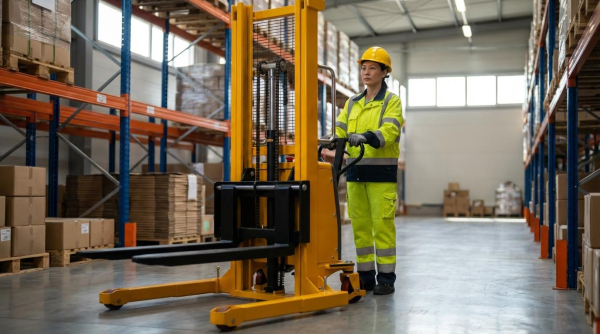
Safe operation of straddle stackers depended on disciplined procedures, engineered safeguards, and trained operators. This section focused on how to translate design limits and regulatory requirements into day‑to‑day operating rules. It linked pre‑shift checks, load control, travel behavior, and site conditions into one coherent hazard control strategy. The goal was to keep the truck within its stability envelope while protecting pedestrians and infrastructure.
Pre-Shift Inspections And Lockout/Tagout Rules
Operators performed a structured pre‑shift inspection before activating any powered functions. They visually checked wheels, forks, mast, lift chains, guards, carriage, warning lights, and the handle assembly for cracks, deformation, leaks, or missing components. They then tested brakes, steering, horn, lift and lower functions, and any safety kickback or emergency stop devices under no‑load conditions. If they found defects affecting safety, they applied lockout/tagout, removed the unit from service, and documented the fault.
Lockout/tagout procedures isolated the energy sources that could cause unexpected motion or electrical shock. For counterbalanced stacker units, this usually meant disconnecting the battery, securing the connector, and attaching a visible tag with fault details. Only designated maintenance personnel were allowed to remove locks or tags after verifying repairs and performing functional tests. This process prevented operators from bypassing safety devices or operating trucks with compromised braking, steering, or structural components.
Load Handling, Travel Speeds, And Grade Navigation
Safe load handling started with respecting the rated capacity marked on the truck’s data plate. Operators positioned forks fully under the pallet, centered the load laterally, and kept the center of gravity as close as possible to the carriage. They lifted the load only high enough to clear the floor and avoided tilting or sudden movements that could shift the load moment outside the stability triangle. Oversized or unstable loads required additional securing, such as strapping or wrapping, before travel.
Travel speed had to match aisle width, surface condition, and pedestrian density. Operators reduced speed when turning, in congested areas, and when visibility was limited by racking or the load itself. On grades, they ascended and descended slowly, maintaining the load upgrade whenever possible to keep weight over the drive unit. They avoided parking on slopes; if unavoidable, they set brakes and blocked wheels to prevent unintended movement. Steering knobs were not used unless the truck had power steering designed for that accessory.
Collision, Run-Over, And Falling-Load Prevention
Collision and run‑over hazards required strict separation between equipment paths and pedestrian walkways. Facilities marked travel lanes, crossing points, and no‑go zones with floor striping, signage, and physical barriers where feasible. Operators sounded the horn at cross aisles, blind corners, and doorways, especially when carrying high loads that limited forward visibility. When the view was obstructed, they traveled in the direction with the best visibility or used a spotter trained in standardized hand signals.
Preventing falling loads depended on correct pallet condition, fork spacing, and load unitization. Operators rejected broken pallets, mis‑stacked goods, or loads that extended beyond the backrest without additional restraint. Load backrest extensions helped prevent product from sliding backward into the mast or operator zone during braking or tilt. Overhead guards protected operators from small falling objects, but they were not a substitute for proper stacking and securement. Personnel were never allowed to ride on forks or loads, and any authorized riding position had to be a designated, protected location.
Operating In Trailers, Railcars, And Hazardous Areas
Operating inside trailers and railcars introduced floor strength, stability, and ventilation risks. Operators confirmed that dock plates or bridge plates were rated for the combined weight of truck and load and that they were properly secured. They avoided entering visibly damaged trailers or railcars where the floor, walls, or supports could not safely carry concentrated wheel loads. Chocks or vehicle restraints held trailers in place to prevent movement during loading and unloading. Adequate lighting and clear communication with dock personnel reduced unexpected motion and impact hazards.
In hazardous atmospheres with flammable gases, vapors, or combustible dusts, only trucks approved and labeled for that classification were acceptable. Facilities assessed zones and selected equipment with appropriate electrical and surface temperature ratings. Ventilation had to control exhaust and battery charging gases, and ignition sources near fuel or charging areas were restricted. Operators followed site‑specific permits and procedures for confined spaces, temperature extremes, and corrosive environments. These controls ensured that lift stacker operation did not introduce ignition or structural failure risks in sensitive areas.
Inspection, Maintenance, And Emerging Technologies
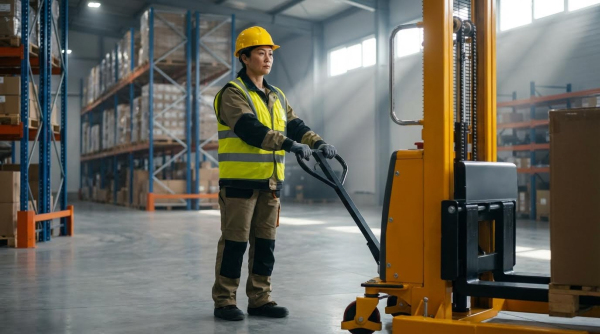
Inspection and maintenance programs determined overall straddle stacker safety performance in warehouses and logistics centers. Structured schedules, clear checklists, and qualified maintenance reduced failure rates and extended service life. Engineers also adopted digital tools and energy monitoring to move from reactive to predictive maintenance strategies. This section examined practical routines, system-specific care, fault diagnosis, and the role of emerging technologies.
Daily, Weekly, And Monthly Inspection Checklists
Daily inspections focused on safety-critical items before operation and typically assumed 8 hours of use per shift, or about 200 hours per month. Operators visually checked hydraulic cylinders and hoses for cracks, leaks, or deformation, and examined the mast assembly, lift chains, rollers, forks, and wheels for damage, corrosion, or excessive wear. They also verified battery condition, cable integrity, and the presence and status of fire extinguishers, as well as rearview mirror cleanliness and alignment. Functional checks covered lift and lower controls, tilt and side shift where fitted, steering response, service and parking brakes, horn, warning devices, and any emergency stop or kickback switches.
Weekly inspections at roughly 50 operating hours added more detailed functional checks without disassembling components. Technicians confirmed correct brake actuation by switching the tiller or control handle between defined positions and listening for the characteristic clicking of the mechanism. They cleaned oil and dust from steering gear components and verified brake clearance, typically maintained between 0.2 millimetres and 0.8 millimetres. Lubrication of exposed pivot points and linkages at this interval reduced wear and helped maintain consistent control response.
Monthly inspections at approximately 200 operating hours required a more comprehensive mechanical and electrical review. Personnel inspected the chassis and structural welds for cracks, frame distortion, and loose fasteners, and checked mast and fork assemblies for deformation or misalignment. They rechecked hydraulic oil levels against lift height, verified the absence of leaks at hoses and cylinders, and confirmed smooth mast movement through the full stroke. Electrical tasks included inspecting electrolyte levels and specific gravity, evaluating contactor faces, micro-switches, fuses, wiring harnesses, and plug connections, and assessing motor brushes and commutators for wear or arcing. Quarterly or 600-hour intervals often repeated these tasks and added component replacement or adjustment based on condition.
Hydraulic, Electrical, And Brake System Maintenance
Hydraulic system maintenance concentrated on fluid quality, correct oil grade, and leak control to preserve lifting performance and safety margins. Technicians checked hydraulic oil levels with forks fully lowered, using reference volumes tied to mast height, such as about 5 litres for 2.5 metres and up to roughly 6 litres for 3.5 metres. They inspected cylinders for rod scoring, seal damage, and external leakage, and examined hoses for abrasion, bulging, or cracked coverings that indicated impending failure. Regular replacement of filters and use of the manufacturer-recommended oil viscosity limited internal wear and reduced the risk of erratic lifting or creeping down under load.
Electrical maintenance addressed both energy delivery and control reliability. Staff inspected traction and lift batteries for case damage, electrolyte levels, corrosion on terminals, and secure connections, and they cleaned and tightened lugs to maintain low-resistance joints. They tested key switches, emergency disconnects, contactors, micro-switches, and controllers for correct operation, replacing components that showed pitting, overheating, or intermittent behaviour. During major electrical repairs, they disconnected batteries and safely discharged residual energy unless live testing was required, in line with lockout and electrical safety procedures.
Brake system maintenance ensured predictable stopping distances and control on grades. Technicians verified that service and parking brakes engaged smoothly and released fully, and they measured brake clearances within the specified 0.2–0.8 millimetre range. They cleaned brake pads and drums or discs to remove dust and contaminants, then inspected lining thickness and surface condition for glazing or cracking. Where steering or drive arrangements integrated braking, they also checked tiller or steering linkages, mechanical joints, and adjustment mechanisms for wear that could degrade braking symmetry or response.
Troubleshooting Common Faults And Failure Modes
Troubleshooting started with clear symptom identification and a structured sequence from simple to complex causes. If a counterbalanced stacker failed to move, technicians first checked fuses, battery state of charge, main power switches, and connector tightness before investigating controllers or motors. Blown fuses, oxidized switch contacts, loose terminals, or defective electric locks frequently explained loss of traction or lift functions and were resolved by replacement, contact cleaning, or tightening. Persistent drive faults led to inspection of wiring harnesses for insulation damage, pinched cables, or corroded connectors.
Lift failures or weak lifting usually indicated issues in the hydraulic circuit or loading practice. Common causes included overload operation beyond the rated capacity, low pressure setting at the overflow or relief valve, internal leakage in the lift cylinder, insufficient hydraulic oil, or low battery voltage on electric units. Corrective actions involved reducing load to within the marked capacity, adjusting relief valve settings to specification, replacing cylinder seals, topping up hydraulic oil, or charging and testing the battery. Uneven or jerky lifting often suggested air in the system, contaminated oil, or mechanical interference in mast stages or chains.
Abnormal noise, vibration, or unstable travel highlighted mechanical wear or alignment problems. Grinding or knocking sounds from the drive end pointed to worn bearings, gear damage, or loose fasteners within the drive unit. Excessive sway or poor tracking signalled damaged or flat-spotted wheels, misaligned caster assemblies, or deformed axles. Operators were instructed to report symptoms immediately and remove the truck from service when safety-critical functions such as braking, steering, or lifting showed degradation, in line with regulatory requirements that prohibited operation of defective powered industrial trucks.
Digital Tools, Predictive Maintenance, And Energy Use
Digital technologies increasingly supported straddle stacker maintenance by turning operational data into actionable insights. Integrated hour meters, event loggers, and telematics modules recorded usage patterns, fault codes, and impacts, allowing maintenance planners to schedule interventions based on actual duty cycles rather than calendar intervals. Condition-monitoring sensors on hydraulic circuits, drive motors, and batteries supplied temperature, current, and pressure data that indicated emerging issues before functional failures occurred. Facilities used these datasets to prioritize high-risk units and optimize spare parts inventories.
Predictive maintenance strategies combined sensor outputs with analytic models to forecast component remaining life. For example, trending lift motor current against load and temperature helped identify insulation deterioration or bearing wear, while monitoring hydraulic pressure profiles revealed valve sticking or pump wear. Battery management systems tracked charge–discharge cycles, depth of discharge, and cell voltage balance to predict when energy storage capacity would fall below operational requirements. These approaches reduced unplanned downtime and extended component life compared with purely reactive repair policies.
Energy-use management also became a key focus, especially for electric straddle stackers operating across multi-shift schedules. Operators and engineers monitored battery state of charge, charging patterns, and idle times to minimize deep discharges and opportunity charging that shortened battery life. Facilities evaluated high-efficiency drive systems, regenerative braking, and optimized acceleration profiles to reduce kilowatt-hour consumption per tonne-metre of handling. By integrating digital monitoring with training and procedural controls, organizations aligned safety, reliability, and energy efficiency within a single maintenance framework.
Summary Of Critical Straddle Stacker Safety Practices
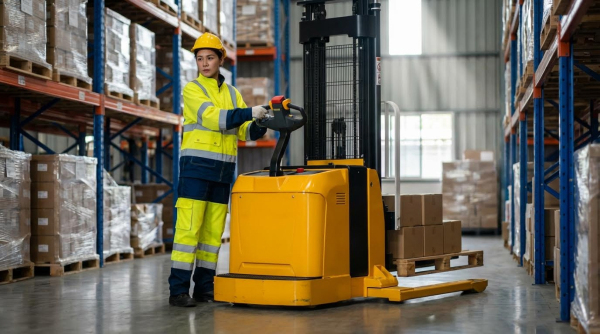
Straddle stacker safety relied on a systems approach that integrated design, operation, and maintenance controls. Engineers and safety managers treated the machine, the operator, and the warehouse layout as one interacting system. The most effective programs combined robust equipment guarding, disciplined operating rules, and structured inspection regimes. Training and supervision then tied these elements together into consistent daily behavior on the floor.
From a technical standpoint, understanding stability principles remained fundamental. Operators needed clear knowledge of the stability triangle, load center distances, and load moment effects to avoid tip-over and falling-load events. Rated capacity markings had to stay visible and enforced, while backrests, overhead guards, and wheel guards provided engineered protection against impact and shifting cargo. Visibility management through mirror placement, aisle design, and pedestrian separation further reduced collision and run-over risk.
Regulatory expectations and industry standards drove rigorous inspection and maintenance routines. Daily pre-use checks, structured 50–200–600 hour service intervals, and strict lockout/tagout for unsafe units prevented mechanical failures in service. Electrical, hydraulic, and brake systems required verification of functional integrity and use of equivalent-performance replacement parts. Digital monitoring, battery management systems, and predictive analytics increasingly supported early fault detection and energy-efficient operation.
Looking ahead, straddle stacker safety practices will continue to evolve with better sensing, interlocks, and connected fleet management. However, engineered features cannot compensate for poor training or weak safety culture. Facilities that define clear operating envelopes, enforce speed and grade limits, and maintain clean, orderly traffic routes will see the greatest risk reduction. A balanced strategy combines conservative design assumptions, disciplined maintenance, and competency-based operator training to keep incident rates low while preserving high material-handling productivity.