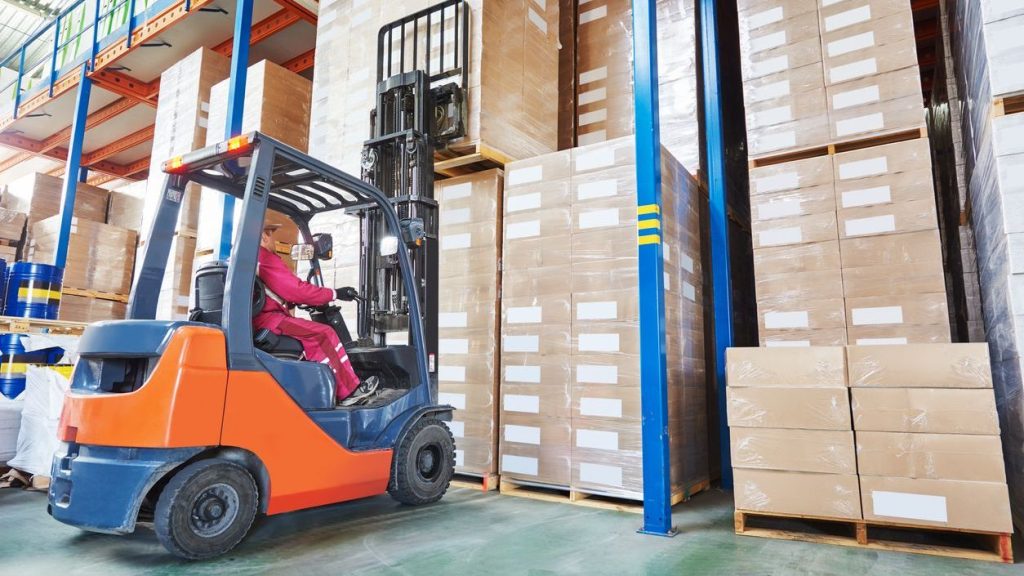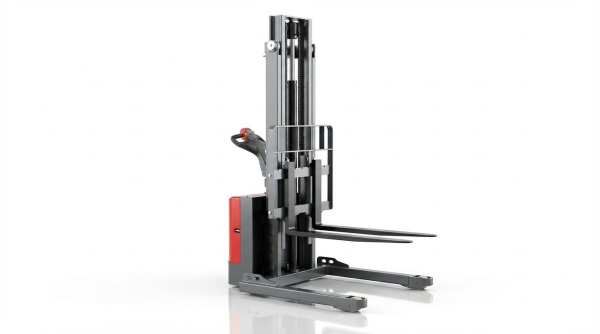
Walkie stackers sit at the intersection of industrial truck engineering, safety regulation, and plant logistics. This guide explains how standards define walkie stackers, how OSHA forklift classes compare with ISO truck types, and where pedestrian stackers fall within ISO 3691-5 and the ISO 22915 stability series. It then connects those classifications to real-world applications, duty cycles, safety functions, and engineering limits for load, height, and stability. Finally, it summarizes truck class, compliance obligations, and best-practice selection for operations asking “what class is a walkie stacker” under both OSHA and ISO frameworks.
Defining Walkie Stackers And Truck Standards
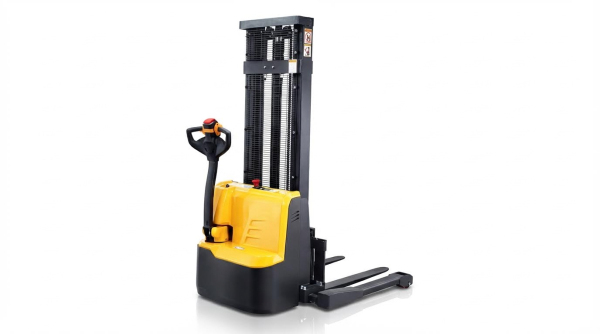
Engineers defined walkie stackers as a subset of powered industrial trucks designed for pedestrian control. Understanding what class is a walkie stacker required mapping these trucks against OSHA forklift classes and ISO industrial truck types. This section explained the engineering definition, the regulatory classification logic, and how standards framed typical plant use cases and duty cycles. It created the foundation for later sections on compliance, design, and selection.
What A Walkie Stacker Is In Engineering Terms
In engineering terms, a walkie stacker was a pedestrian‑controlled powered industrial truck with an integrated mast. The operator walked behind or alongside the chassis and controlled traction and lift through a tiller or handle. Typical rated capacities ranged from 800 kg to about 2,000 kg, with lift heights often between 2 m and 5.5 m. Designers optimized walkie stackers for short‑distance horizontal travel and vertical stacking on smooth, hard industrial floors. The drive unit was usually electric, with battery power supplying traction and hydraulic lift. Compared with ride‑on forklifts, walkie stackers used a compact wheelbase and narrow chassis to operate in tight aisles. These engineering features strongly influenced how regulators answered the question “what class is a walkie stacker” within OSHA and ISO frameworks.
OSHA Forklift Classes Versus ISO Truck Types
OSHA rules in the United States grouped powered industrial trucks into classes based on power source, operating position, and application environment. Walkie stackers historically fell within the broader powered industrial truck categories used for warehousing and manufacturing, often associated with electric motor narrow‑aisle or electric motor hand‑ridden style equipment. ISO standards used a different logic and defined truck “types” by operator position, power, and primary function. Under ISO, walkie stackers aligned with pedestrian‑propelled or pedestrian‑controlled stacker types rather than ride‑on counterbalanced trucks. While OSHA classes focused on regulatory training and workplace safety obligations, ISO truck types focused on design, safety requirements, and verification testing. Engineers and safety managers needed to cross‑reference both systems when determining what class is a walkie stacker for compliance documentation and operator training programs.
Where Walkie Stackers Fit In ISO 3691-5
ISO 3691‑5:2014 covered pedestrian‑propelled and pedestrian‑controlled industrial trucks, including pallet stackers and straddle stackers. Walkie stackers fit directly into this scope when the operator remained on foot and controlled the truck via a tiller. The standard applied to trucks with manual or electric lifting and capacities not exceeding 1,000 kg for typical stackers, although certain low‑lift pallet trucks within the document allowed higher capacities. It also addressed low‑lift pallet trucks up to 300 mm lift height and scissor‑lift pallet trucks up to 1,000 mm lift height under defined capacity limits. ISO 3691‑5 assumed operation on smooth, level, hard surfaces and explicitly excluded severe conditions, public road use, and trucks with very high overturning moments. When engineers evaluated what class is a walkie stacker in an ISO context, they typically referenced ISO 3691‑5 for safety requirements and ISO 22915‑1 with its relevant parts for stability verification.
Typical Plant Applications And Duty Cycles
Walkie stackers served short‑haul material handling in warehouses, assembly plants, packaging lines, and loading areas. Typical applications included pallet stacking in racking, feeding production cells, and handling loads where ride‑on forklifts lacked space. Duty cycles often involved intermittent use with frequent starts, short travel distances under 50 m, and moderate lift frequencies. Engineers sized battery capacity, motor ratings, and hydraulic systems for these stop‑and‑go patterns rather than continuous high‑speed travel. Floors were usually flat, sealed concrete with minimal gradients, because ISO 3691‑5 assumed smooth, level, hard surfaces. Plants selected walkie stackers for areas with high pedestrian density, narrow aisles, and low to medium throughput where compact geometry and precise control outweighed travel speed. Understanding these application profiles helped safety managers justify the chosen truck class when documenting what class is a walkie stacker for a specific facility and process layout.
OSHA And ISO Classification Of Walkie Stackers

Walkie stackers occupy a specific niche in both OSHA powered industrial truck classes and ISO industrial truck types. Correct classification affects design, testing, operator training, and where the truck can legally operate. Engineers and safety managers must align walkie stacker designs with ISO 3691 and ISO 22915 stability rules while also matching OSHA truck classes for use in US plants. Misclassification can lead to non-compliance, unsafe duty cycles, and incorrect expectations about surface, gradient, and environment capability.
OSHA Powered Industrial Truck Class For Walkies
OSHA defined powered industrial truck classes based on power source, construction, and environment suitability. Walkie stackers typically fell under Class II (electric motor narrow aisle trucks) or Class III (electric motor hand trucks and hand/rider trucks). A pedestrian walkie stacker with an electric drive and lift usually aligned with Class III because the operator walked behind or alongside the truck. If the design supported stand-on or ride-on operation in very narrow aisles, it could align more closely with Class II. Engineers should map the walkie stacker’s operating position, aisle width, and power configuration to the OSHA class, then apply the corresponding training, inspection, and environment rules. From an SEO perspective, when users search “what class is a walkie stacker,” they usually want this mapping to OSHA Class III for typical pedestrian electric walkie pallet truck.
ISO 3691-5 Scope For Pedestrian Stackers
ISO 3691-5:2014 specified safety requirements for pedestrian-propelled and pedestrian-controlled industrial trucks. The scope covered pedestrian straddle stackers and pallet stackers with manual or battery-powered lifting and rated capacity not exceeding 1,000 kg for high-lift stackers. It also covered low-lift pallet trucks up to 300 mm lift and 2,300 kg capacity, and scissor-lift pallet trucks up to 1,000 mm lift or 1,000 kg capacity. The standard assumed operation on smooth, level, hard surfaces and normal industrial materials handling duties. For engineering teams, this meant a typical walkie stacker with a tiller arm, pedestrian control, and electric lift fell exactly under ISO 3691-5, not under the ride-on truck standards of ISO 3691-1 or -2. Designers had to implement the safety functions, guards, control logic, and verification tests specified in this part to claim compliance.
Stability Requirements Under ISO 22915 Series
ISO 22915-1:2024 defined generic stability test principles for industrial trucks, including tilt-table methods and test report content. Pedestrian stackers fell under a dedicated part of the series, referenced as ISO 22915-16, which detailed specific test configurations for these trucks. Tests evaluated stability in the least-stable configuration, with rated load, maximum lift height, and worst-case mast and attachment positions. The truck had to resist tipping at defined lateral and longitudinal slopes without loss of stability. Engineers needed to model center-of-gravity movement, mast deflection, and tyre deformation, then validate by tilt-table testing. For walkie stackers, this constrained maximum rated capacity at height, wheelbase, caster layout, and counterweight sizing. When users ask “what class is a walkie stacker,” stability class under ISO 22915 complements the OSHA class answer by defining how safe the truck remains at its rated envelope.
Surface, Gradient, And Environment Limitations
ISO 3691-5 assumed walkie stackers operated on smooth, level, hard industrial floors. The standard explicitly excluded operation on significant gradients, rough surfaces, and public roads, which signaled to engineers that such use required additional risk assessment and possibly different truck types. Typical guidance limited pedestrian stacker operation to very low gradients, often below 5–7°, especially when loaded, to maintain stability and control. OSHA rules required employers to match truck class to environment, including presence of flammable vapors or dust, but most walkie stackers served standard non-classified indoor areas. Designers and plant engineers therefore needed to define surface flatness, maximum ramp angle, and environmental conditions in site risk assessments and operator manuals. Combining OSHA class, ISO 3691-5 scope, and ISO 22915 stability limits gave a complete picture of where a walkie stacker could safely operate and under which duty cycles.
Compliance, Design, And Selection Considerations
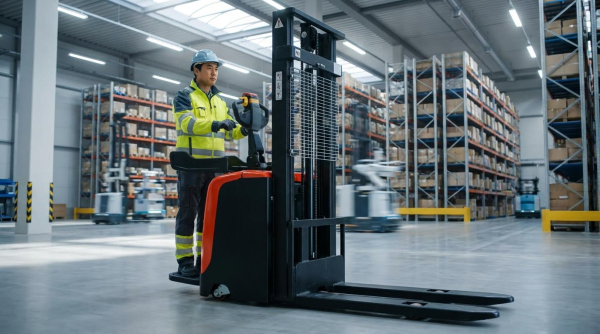
Engineering teams that ask “what class is a walkie stacker” also need to align design, controls, and operating rules with OSHA and ISO requirements. This section links truck class and ISO type to concrete safety functions, structural limits, and lifecycle decisions so selection and specification stay compliant and cost-effective.
Key Safety Functions And Control Architecture
For walkie stackers that fall under pedestrian truck categories in ISO 3691-5, safety functions must address collision, crush, tip, and electrical hazards. Control architecture typically uses a layered approach: primary traction and lift control, safety-related interlocks, and emergency shutdown circuits. Designers implement a dead-man or “belly” switch, key switch, and emergency stop that cut traction and lift power in a predictable, fail-safe manner. Modern controllers integrate speed limiting based on tiller angle, load height, and sometimes steering angle to keep stability margins within ISO 22915 test assumptions. Safety circuits should use redundant channels and monitored contacts for critical functions such as emergency stop, drive-enable, and brake release, following functional safety principles even where not legally mandated. When you specify or compare walkie stackers by class, verify that the safety architecture supports your risk assessment, including operation in congested aisles and around pedestrians.
Load, Height, And Stability Engineering Limits
Regardless of what class a walkie stacker falls into under OSHA rules, ISO 3691-5 and the ISO 22915 series define how engineers must treat load and stability. Rated capacity typically does not exceed 1,000 kg for pedestrian stackers, and stability tests in ISO 22915-1 and ISO 22915-16 verify that the truck does not overturn on specified tilt-table angles. Engineers calculate the combined centre of gravity for truck plus load at maximum lift height, then check it against the stability polygon used in ISO tilt tests. Selection engineers should compare the rated capacity at given load centre distances, not only the headline capacity, because long pallets or offset loads can move the resultant moment outside the tested envelope. For applications involving gradients or uneven floors, you must derate capacity below the nameplate and treat ISO stability performance as valid only for the smooth, level, hard surfaces described in the standards. If your duty cycle includes frequent near-capacity lifts at high height, specify higher safety margins in mast, chain, and carriage design, and verify that the truck’s class and ISO type still cover those conditions.
Operating Rules, Training, And Procedures
Once you know what class a lift stacker is for OSHA purposes, you can align operator training content and site rules with that class and the ISO 3691-5 scope. Operators must receive formal instruction, practical training, and evaluation focused on pedestrian-controlled trucks, including walking position, tiller handling, and body-clearance awareness. Site procedures should enforce pre-use inspections of brakes, horn, forks, hydraulic lines, and battery condition, with defects triggering lockout until repair. Rules must address speed limits, horn use at intersections, minimum fork height while travelling, and prohibition of riders or lifting people. Written procedures should also cover slopes, with clear limits on maximum gradient, direction of travel under load, and bans on turning or braking sharply on inclines. By tying these rules directly to the truck’s class and ISO-defined operating envelope, you reduce misuse that could invalidate the original stability and safety assumptions.
Lifecycle Costs, Maintenance, And New Technologies
Truck class and ISO type influence lifecycle cost because they define inspection depth, maintenance intervals, and allowable environments. Pedestrian stackers designed to ISO 3691-5 typically operate indoors on smooth floors, which reduces structural fatigue but places emphasis on battery health, hydraulic integrity, and control electronics. A planned maintenance regime should include periodic verification of safety functions, brake performance, and mast wear, plus battery service and charger inspection to avoid premature capacity loss. New technologies such as regenerative braking, advanced motor controllers, and onboard diagnostics lower energy consumption and improve controllability, but they also require technicians who understand fault codes and parameter settings. When you compare walkie stackers, consider not just what class the truck is, but also parts availability, diagnostic tooling, and the ease of performing ISO-aligned stability or function checks over the life of the equipment. This approach keeps total cost of ownership predictable while maintaining compliance and safety performance.
Summary: Truck Class, Compliance, And Best Practice
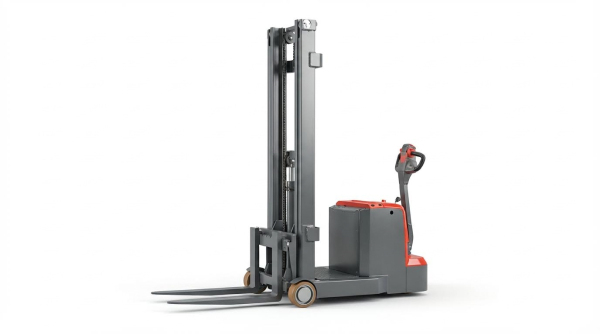
Walkie stackers sat at the intersection of OSHA powered industrial truck classes and ISO pedestrian truck standards. Engineers and safety managers needed a clear mapping to answer queries such as “what class is a walkie stacker” while still respecting plant-specific risks. This section tied together truck classification, design limits, and operational rules into a practical compliance framework.
From a regulatory standpoint, walkie stackers fell under OSHA’s powered industrial truck rules and within the ISO 3691-5 family for pedestrian-propelled and pedestrian-controlled trucks. ISO 3691-5 defined the safety functions, control concepts, and intended operating surface for these trucks, while the ISO 22915 series verified stability by tilt-table and offset-load tests. Together, these standards framed which applications were acceptable: smooth, hard floors, controlled gradients, and defined load ranges. When plants respected those boundaries, engineers could justify truck selection and layout using documented stability margins and test methods.
For best practice, facilities translated this classification knowledge into concrete engineering and procedural controls. They sized lift stackers based on rated capacity, lift height, and gradient limits, then backed that up with training, pre-use inspections, and speed management. Operating rules prohibited overloading, high-lift travel, sharp turns on slopes, and use on rough or steep surfaces beyond the tested envelope. Maintenance programs focused on hydraulics, brakes, tyres, and batteries, because degradation in these subsystems directly eroded the stability and stopping performance assumed in ISO tests.
Looking ahead, tighter integration between electronic control systems and standards would likely refine how “what class is a walkie stacker” was answered in practice. Regenerative braking, advanced traction control, and on-board diagnostics already allowed more precise limitation of speed, acceleration, and lift under marginal conditions. Future revisions of ISO 3691 and 22915 would probably incorporate these technologies, shifting the focus from purely mechanical margins to software-governed safety functions. Plants that treated classification not as a paperwork exercise but as a design and operational constraint would remain better positioned to adopt new technologies without compromising compliance or stability.