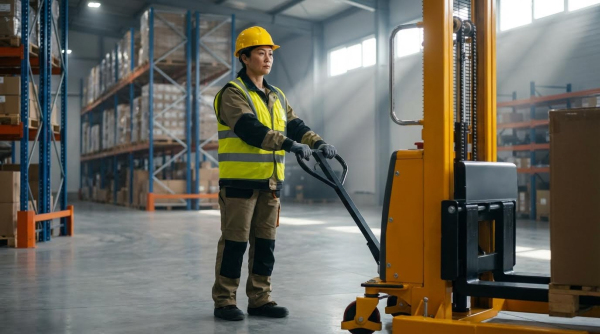
Straddle stacker lifts sit between pallet jacks and forklifts, combining compact size with vertical reach for pallet handling. Engineers who ask how does a straddle stacker lift work need to understand its mechanics, design limits, and integration issues across real warehouses.
This article explains the core mechanics of straddle legs, masts, hydraulic lift circuits, electric drive systems, and safety controls. It then details key design parameters such as capacity, stability, lift height, maneuverability, and energy use, with typical performance ranges for industrial units.
Later sections compare straddle stackers to forklifts and AGVs, show how to match equipment to layout and throughput, and highlight safety, maintenance, and training needs. The final part gives practical takeaways so engineers can specify, justify, and operate straddle stacker lifts with a clear technical and economic basis.
Core Mechanics Of A Straddle Stacker Lift
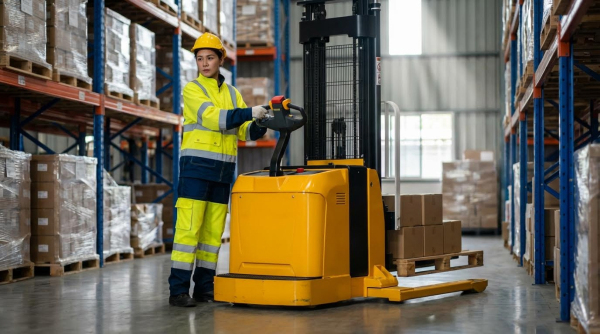
Engineers who ask how does a straddle stacker lift work focus on four core systems. These are the straddle legs, the mast and hydraulic circuit, the drive and brake train, and the control and safety logic. Together they define load paths, efficiency, and operator safety in tight warehouse spaces. The following sections break these systems down into practical engineering terms.
Straddle Leg And Outrigger Load Path
Straddle stackers carry the pallet between two outrigger legs instead of under a counterweight. The load path runs from the forks into the mast channels, then down into the straddle legs and wheels. This creates a wide base and a short overturning moment arm.
| Parameter | Typical effect |
|---|---|
| Straddle width | Defines pallet compatibility and lateral stability |
| Wheelbase | Influences longitudinal stability and turning radius |
| Load wheel offset | Controls front axle reaction and floor pressure |
| Ground clearance | Affects ramp use and pallet entry |
Engineers size the legs to keep the resultant load within the support polygon under all rated conditions. They also check floor bearing pressures, because concentrated loads under the outriggers can exceed typical warehouse floor design if not verified.
Mast, Forks, And Hydraulic Lift Circuit
The mast guides the forks and carries vertical loads into the chassis. Most electric straddle stackers use a single or duplex mast for medium lift heights, and triplex masts where low collapsed height and high reach are both required. Forks slide on the carriage and transfer bending moments from off-centre pallets back into the mast rails.
The hydraulic lift circuit usually includes a reservoir, pump, control valve, lift cylinder, and relief valve. When the operator requests lift, an electric motor drives the pump, which pressurises the fluid and extends the lift cylinder. The cylinder then raises the fork carriage along the mast. To lower the load, the control valve meters flow back to the tank so the forks descend at a controlled speed. Engineers size pump flow for target lift speeds and set relief valves to protect the structure from overload.
Electric Drive, Steering, And Brake Systems
Most powered straddle stackers use an electric drive motor on the tiller end. The drive unit combines the traction motor, gearbox, drive wheel, and often an electromagnetic brake. A separate steering linkage in the tiller head changes the drive wheel angle.
Drive control usually uses a transistor or inverter controller to regulate motor torque. This allows smooth acceleration, creep speed, and regenerative braking in some designs. Braking systems often combine:
- Service braking from the electric motor or electromagnetic brake
- Parking brake that engages when the tiller is upright
- Emergency braking from a belly switch or emergency stop
Engineers check that braking distances stay within safety limits at the rated load and maximum speed. They also consider floor friction, tyre compound, and ramp grades in these calculations.
Control Logic, Sensors, And Safety Interlocks
Control logic coordinates drive, steering, and lift so the stacker stays stable and predictable. The tiller head usually carries a proportional travel control, lift and lower switches, a horn, and sometimes a turtle speed button. The controller reads these inputs and commands the traction and lift motors.
Safety interlocks rely on simple and robust sensors. Typical devices include:
- Tiller angle switches that limit travel when the tiller is too high or too low
- Deadman or presence switches that stop motion when released
- Lift cut-outs that prevent travel above a set fork height
- Overload or pressure switches that stop lift above rated capacity
Some designs add mast tilt or height sensors to adjust speed automatically at higher elevations. Engineers validate these interlocks through fault tree analysis and functional tests. This ensures the stacker fails to a safe state if a sensor, contactor, or controller output does not behave as intended.
Key Design Parameters And Performance Metrics
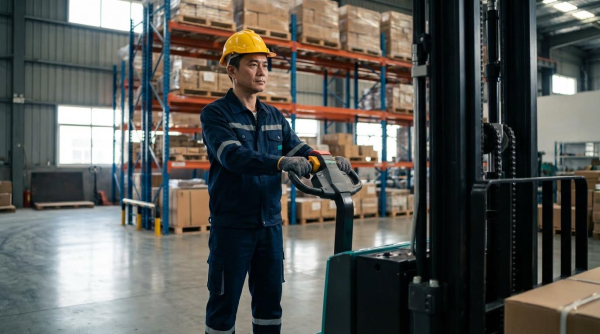
Engineers who ask how does a straddle stacker lift work need clear design rules. This section explains how core parameters drive safety, throughput, and lifetime cost. It links load charts, mast design, aisle geometry, and battery sizing into one consistent view of performance.
Load Capacity, Center Of Gravity, And Stability
Load capacity ratings define the safe working envelope for a straddle stacker lift. Typical electric units handle 1 000–2 000 kg, but the exact value depends on wheelbase, mast section, and hydraulic sizing. Capacity always assumes a rated load center, often 500–600 mm from the fork heel.
Stability depends on the combined center of gravity (CoG) of truck and load. As operators raise the load, the CoG moves forward and upward. This reduces the stability margin against tipping around the front wheels or outriggers. Straddle legs widen the support polygon and shift reaction forces outward, which improves lateral stability when handling pallets off-center or close to racking.
Engineers should review at least three conditions when they evaluate how a straddle stacker lift works under load:
- Rated load at maximum lift height
- Part-load handling with the mast tilted or turned
- Travel with the load lowered but offset on the forks
Manufacturers validate stability using static and dynamic tests that mirror these states. Engineers must keep added attachments, such as clamps or platforms, within the published de‑rating curves.
Lift Height, Mast Types, And Deflection Control
Lift height strongly shapes the overall design of a straddle stacker lift. Common warehouse units reach roughly 3–4.5 m, while higher masts exist for specialized storage. Higher masts increase bending moments at the mast base and at the drive axle. This drives heavier sections and stronger chains.
Three mast concepts are typical:
- Simplex: Single-stage, low cost, low maximum height.
- Duplex: Two stages, free lift possible, suitable for containers and low doors.
- Triplex: Three stages, compact collapsed height with high reach.
Deflection control is critical for safe pallet entry at height. Mast deflection depends on section modulus, steel grade, and chain layout. Excessive forward or lateral deflection can jam pallets, damage racking, and trigger tip‑over in extreme cases.
To keep deflection within acceptable limits, designers use finite element checks and conservative allowable deflection ratios. Typical practice keeps lateral mast tip deflection small enough that the forks remain within pallet opening tolerances at full height. When engineers compare models, they should not only ask how does a straddle stacker lift work but also how stiff the mast remains under rated load.
Maneuverability In Narrow Aisles And Turning Radius
Maneuverability explains why facilities choose straddle stackers instead of sit‑down forklifts. The compact chassis and walk‑behind control reduce the required aisle width and turning radius. This allows higher storage density in narrow aisle warehouses.
Key geometric factors include:
| Parameter | Influence |
|---|---|
| Overall length | Impacts turning radius and staging space |
| Truck width | Sets minimum aisle plus clearance |
| Straddle leg inside width | Defines pallet and load compatibility |
| Steering angle | Controls minimum turning circle |
Walk‑behind electric units often pivot almost about their drive wheel. This can reduce the turning radius to close to the truck length. However, engineers must add safety clearances, typically 200–300 mm each side of the load, when they define rack spacing.
Floor quality also affects real maneuverability. Rough or uneven floors increase rolling resistance and steering effort. They can also amplify mast sway when operators turn with raised loads. Layout engineers should link aisle width, rack height, and operating rules into one documented standard.
Energy Use, Battery Systems, And Duty Cycles
Most modern straddle stacker lifts use electric drive and electric‑hydraulic lifting. Energy use splits between traction, lifting, and auxiliary loads such as steering and control electronics. Typical systems run on 24 V traction batteries, with capacity chosen for one shift or multi‑shift duty.
Engineers should size batteries based on duty cycle rather than nameplate capacity alone. Important factors include:
- Average and peak lift frequency per hour
- Typical load mass and lift height
- Travel distance with and without load
- Number of operating hours per shift
Lead‑acid batteries have lower upfront cost but need charging rooms, watering, and equalization cycles. Lithium‑ion packs offer faster charging, deeper discharge, and better energy efficiency, which suits high‑throughput sites. Regenerative braking and lowering valves can recover part of the potential energy when the load descends or when the truck decelerates.
When engineers ask how does a straddle stacker lift work over a full shift, they should evaluate state‑of‑charge limits, planned charging windows, and battery change procedures. Correct sizing reduces voltage sag, protects motors and pumps, and keeps lifting speed consistent through the day.
Applications, Selection, And Integration Challenges
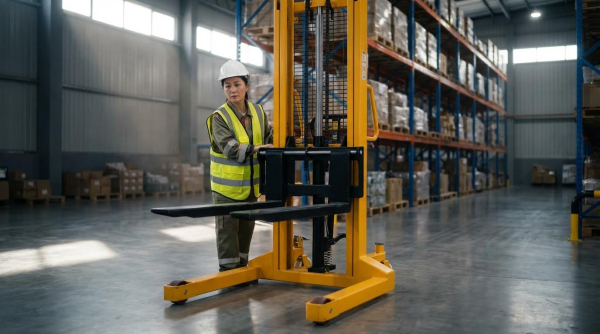
Engineers who ask how does a straddle stacker lift work usually also ask where it fits in a warehouse. This section focuses on real applications, selection trade‑offs, and integration risks. The goal is to link working principles to layout, throughput, and safety constraints. Each subsection builds from basic mechanics to system‑level decisions.
Comparing Straddle Stackers To Forklifts And AGVs
Straddle stackers bridge the gap between manual pallet trucks and ride‑on forklifts. They use walk‑behind electric drive and hydraulic lift, so operators stay close to the load. This supports precise pallet positioning but limits travel distance.
| Aspect | Straddle stacker | Forklift | AGV pallet mover |
|---|---|---|---|
| Typical role | Short‑haul stacking | Longer haul, mixed tasks | Automated pallet transfer |
| Aisle width | Narrow | Medium to wide | Medium |
| Capex | Low to medium | Medium to high | High |
| Operator presence | Walk‑behind | On‑board | Remote / none |
| Best fit | Compact racks, short runs | Yard work, loading docks | Repetitive flows |
Compared with forklifts, straddle stackers offer lower energy use and tighter turning but lower travel speed and capacity. Compared with AGVs, they avoid navigation complexity and software integration but do not remove labor. Plants often deploy a mixed fleet and assign straddle stackers to last‑meter pallet storage and retrieval.
Matching Stackers To Warehouse Layout And Throughput
Layout and flow define whether a straddle stacker is the right choice. Engineers should map travel paths, lift heights, and pallet interfaces before selection. The question how does a straddle stacker lift work matters less than where it cycles and how often.
Key checks include:
- Minimum aisle width versus stacker turning radius and straddle leg width.
- Rack beam heights versus rated lift height and mast deflection limits.
- Floor flatness and slab capacity under concentrated wheel loads.
- Number of pallet moves per hour versus battery size and duty cycle.
Short, repeatable runs with frequent lifting favor walk‑behind electric stackers. Long horizontal moves between buildings or docks still suit ride‑on trucks or tow tractors. In brownfield sites, engineers often reverse the process. They measure existing aisles and racking, then filter stacker models that can physically operate without civil changes.
Safety Compliance, Training, And Maintenance Strategy
Even though straddle stackers are compact, regulators treated them as powered industrial trucks. Compliance required documented training, daily checks, and incident reporting. The stability triangle, rated capacity, and load center had to be part of every training module.
A robust safety and maintenance strategy usually combined:
- Pre‑shift inspections of forks, mast chains, hydraulic leaks, and brakes.
- Battery checks, including electrolyte level and cable condition.
- Rules that banned traveling with elevated loads and sharp turns under load.
- Clear pedestrian zones and one‑way traffic in narrow aisles.
Planned maintenance intervals often followed operating hours. Typical tasks included hydraulic oil changes, lubrication of mast and chains, and inspection of wheels, axles, and contactors. Facilities that tracked faults and near misses in a central system could adjust training and routes before accidents occurred.
Emerging Tech: Telematics, AI, And Digital Twins
Straddle stackers increasingly formed part of connected fleets. Telematics units logged impacts, travel time, lift cycles, and battery state of charge. Engineers used this data to optimize shift patterns, charging windows, and fleet size.
AI‑based analytics supported predictive maintenance. Algorithms looked for changes in lift motor current, hydraulic cycle time, or brake events. They then flagged units that needed service before failure. Digital twins of warehouses allowed planners to simulate new rack layouts, aisle widths, and traffic rules with realistic stacker kinematics.
Vendors also explored tighter integration with warehouse management systems. In these setups, the WMS assigned tasks based on real‑time battery levels, congestion, and operator skills. The core lifting principle stayed the same, but software raised overall system efficiency and reduced unplanned downtime.
Summary And Practical Takeaways For Engineers
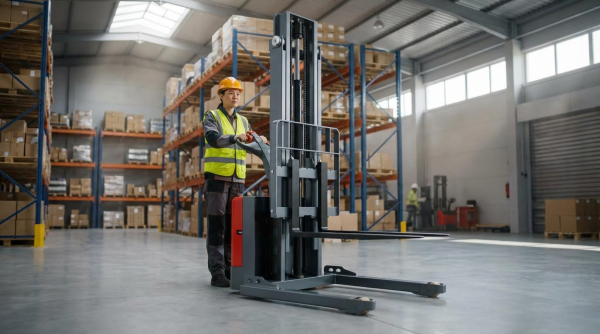
Engineers asking how does a straddle stacker lift work need a clear view of mechanics, controls, and use cases. A straddle stacker routed loads through its legs and mast, lifted them with a hydraulic circuit, and moved them using an electric drive and brake system. Control logic, sensors, and interlocks then coordinated safe motion in narrow warehouse spaces. Design choices around capacity, stability, energy use, and maneuverability determined if a unit matched a given layout and throughput target.
From a technical view, the key findings were simple but strict. Load capacity and rated load center set the safe envelope. Mast type and section stiffness limited lift height and deflection. Steering geometry and wheelbase fixed the turning radius in tight aisles. Battery chemistry, voltage, and duty cycle shaped run time and charging strategy. Engineers had to treat these as a linked system, not isolated options.
In practice, the best results came when teams started with the application, not the catalog. They mapped pallet sizes, rack clearances, gradients, and floor flatness. Then they compared straddle stackers to forklifts and AGVs on stability, speed, and cost per moved pallet. Integration work covered traffic flows, charging zones, and maintenance bays, plus training and inspection routines.
Looking ahead, telematics and digital twins supported data‑driven answers to how does a straddle stacker lift work in this specific plant. Logged drive and lift cycles fed models that predicted failures and optimized charging. Sensor packages improved collision avoidance and speed control. Yet even with these tools, core engineering stayed the same. Respect the load chart. Keep the center of gravity inside the straddle legs. Maintain the hydraulic and brake systems on time. When engineers followed those basics, straddle stackers delivered safe,
Frequently Asked Questions
How does a straddle stacker lift work?
A straddle stacker lifts loads using a hydraulic system that raises and lowers the forks. The forks are positioned on either side of the load, allowing it to lift pallets or other items securely. This design provides stability while handling heavy loads in tight spaces.
What should you do before using a straddle stacker?
Before operating a straddle stacker, perform thorough pre-operation safety checks. Inspect the equipment for any damages, verify fluid levels, and ensure all safety features are functional. Following these steps helps prevent accidents and ensures smooth operation. Straddle Stacker Safety Tips
Are straddle stackers designed for small, tight spaces?
Yes, straddle stackers are specifically designed for compact areas. They are more versatile than traditional forklifts and can maneuver easily in narrow aisles, making them ideal for warehouses with limited space. Straddle Stacker Design