Straddle stackers let facilities move and stack pallets in tight aisles while keeping capital and energy costs under control. This guide explains how to operate a straddle stacker safely and efficiently, from core design limits to real-world operating steps.
You will see how key components, load capacity, lift height, and stability rules shape daily use and layout planning. The article then walks through pre-use checks, load assessment, safe traveling and stacking, and the role of operator training and PPE. Later sections cover maintenance planning, lifecycle costs, and smart upgrades such as sensors and telematics that support safer, data-driven operation. The final summary condenses best practices so engineers, supervisors, and operators can share one clear standard for how to operate a straddle stacker in modern warehouses and plants.
Core Design And Performance Characteristics
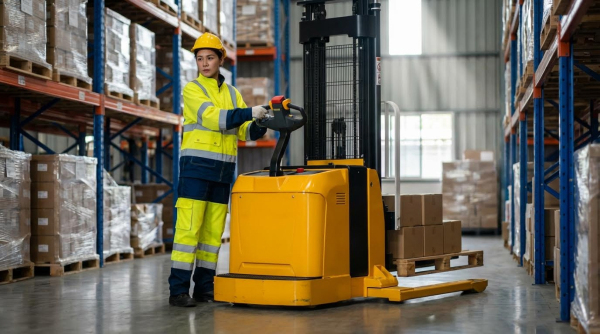
Core design features of a straddle stacker set the limits for safe operation. Operators who understand these limits make better decisions about how to operate a straddle stacker in real warehouses. This section explains the main components, capacity envelope, maneuverability, and power systems that control performance. It links design choices directly to day‑to‑day handling of pallets in narrow aisles and tight spaces.
Key Components And Functional Architecture
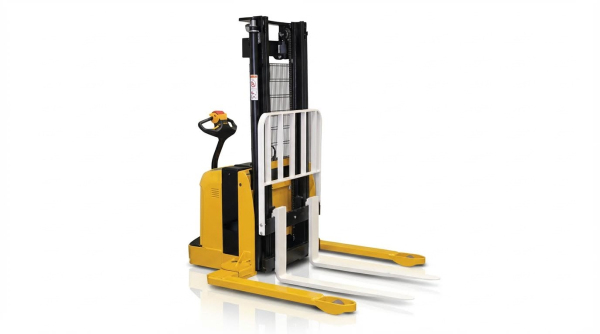
A straddle stacker uses a simple but strict load path. The forks carry the pallet. The mast transfers forces into the chassis. The straddle legs spread the reaction into the floor. This layout lets the machine lift pallets without counterweights like a forklift.
Typical key elements include:
- Mast: fixed or telescopic, with rails, chains, and cylinders that define maximum lift height and deflection.
- Forks: solid steel, often width‑adjustable, to suit different pallet designs and load footprints.
- Straddle legs: fixed or adjustable span that steps around closed pallets and stabilizes the stacker.
- Drive system: electric traction motor, drive wheel, and braking system for controlled travel.
- Hydraulic system: pump, valves, and lift cylinder that set lifting speed and control lowering.
Control architecture usually combines a tiller arm or stand‑on console with proportional lift and travel controls. Safety devices such as emergency stop, dead‑man switch, and flow control valves limit unsafe movements. When operators know how each component works, they can better detect faults during pre‑use checks and avoid unsafe loads.
Load Capacity, Lift Height, And Stability Limits
Every straddle stacker has a rated capacity at a defined load center and lift height. Typical ranges were about 700 kilograms to 1 800 kilograms, with lift heights up to roughly 5 metres for some models. The safe working envelope shrinks as lift height increases because mast deflection and overturning moment grow.
Key stability factors include:
| Parameter | Influence on operation |
|---|---|
| Rated capacity | Maximum load at specified load center and height |
| Load center distance | Further load center reduces allowable mass |
| Lift height | Higher lift reduces effective capacity and stability margin |
| Straddle leg width | Wider base increases lateral stability |
To operate a straddle stacker safely, operators must never exceed the nameplate rating and must keep the load fully against the backrest. Overloading makes steering heavy, increases stopping distance, and raises tip‑over risk during turns or on uneven floors. Loads with a high center of gravity or offset mass need extra margin and slower movements.
Maneuverability In Narrow Aisles And Tight Spaces
Straddle stackers were designed for compact aisles and short turning radii. The drive wheel sits close to the operator, and the straddle legs track the load. This geometry lets the machine work in aisles narrower than those needed for conventional forklifts.
Maneuverability depends on several design aspects:
- Overall length: shorter chassis reduces turning aisle but can increase mast sway at height.
- Straddle width: narrow legs fit tight rack gaps but reduce lateral stability.
- Steering angle: larger angle cuts turning radius but needs precise control at low speed.
- Wheel layout: small load wheels under the legs support high rack density but dislike damaged floors.
When planning how to operate a straddle stacker in a given layout, engineers should verify minimum working aisle. This includes pallet length, fork overhang, and safety clearance for the operator. In practice, safe use in tight spaces means slow travel, early steering, and full awareness of blind spots, posts, and pedestrians. Good floor markings and one‑way traffic patterns further reduce collision risk.
Power Systems, Batteries, And Energy Efficiency
Most modern straddle stackers use electric power with traction batteries. The battery feeds both the drive motor and the hydraulic pump. Correct battery sizing and charging practice directly affect uptime and lifetime cost.
Typical power system features include:
- Lead‑acid or lithium‑ion batteries sized for shift length and duty cycle.
- Built‑in or external chargers matched to battery chemistry and capacity.
- AC drive motors with regenerative braking that recover energy during deceleration and lowering.
- Electronic controllers that limit acceleration and top speed based on load and mast height.
Energy efficiency improves when operators avoid unnecessary travel, combine moves, and keep tyres and wheels in good condition. Under‑charged or poorly maintained batteries reduce lift speed and can trigger fault codes mid‑shift. A structured charging policy, battery inspections, and clean terminals keep voltage drops low and cut unplanned downtime. Designers and fleet managers should match battery type and charger strategy to ambient temperature, shift pattern, and expected peak loads to support safe and predictable operation.
Step-By-Step Operating Procedure And Safety
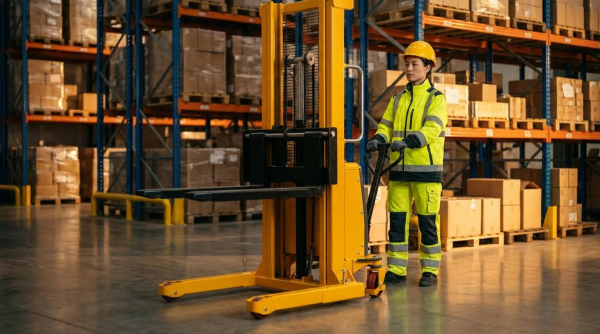
Knowing how to operate a straddle stacker safely starts with a repeatable process. Each step must protect people, loads, and infrastructure. A structured method also reduces damage, downtime, and lifecycle cost. The sections below break the task into inspection, load handling, travel, and training.
Pre-Operation Inspection And Checklists
Operators should follow a fixed checklist before each shift. Visual checks come first. Inspect forks, mast, chains, and welds for cracks, bends, or leaks. Check straddle legs and load wheels for wear or embedded debris.
Next, confirm all safety and control systems. Test horn, emergency stop, and any overload or brake indicators. Verify lift, lower, and travel controls respond smoothly without delay or jerk. Check parking brake or floor lock holds the truck still.
Energy and hydraulics need attention. Confirm battery charge level, cable condition, and connector lock. Look for damaged insulation or hot spots. Check hydraulic fluid level in the sight glass if provided and look for external leaks under the machine.
Finish with environment checks. Confirm floor markings are visible and travel paths are clear. Verify lighting is adequate and any ventilation or fire exits are not blocked. Record findings in a daily inspection log and tag the unit out if you find critical faults.
Load Assessment, Positioning, And Distribution
Safe operation starts with correct load assessment. Read the stacker nameplate and note rated capacity at the specified load centre. Never guess the load mass. Use scales, pallet labels, or system data where possible.
Before lifting, check load integrity. Look for damaged pallets, loose wrapping, or offset centre of gravity. Confirm the load footprint fits between the straddle legs and does not clash with wheels or guards.
Fork positioning is critical. Adjust fork spacing so each blade sits under the main pallet stringers. Insert forks fully until the heel contacts the pallet. Keep the load as low as practical and tilt or mast position set to maintain back-lean if the design allows.
Use this simple sequence for every pick: approach straight, stop, lower forks to entry height, align, insert fully, lift just clear, then check stability. If the load leans, shifts, or deflects the pallet, lower it and correct the issue before moving.
Traveling, Lifting, And Stacking Techniques
When learning how to operate a straddle stacker, travel control is as important as lifting technique. Always travel with the load low, usually just above floor obstacles. This lowers the centre of gravity and reduces tip risk.
Keep speed low in turns and congested areas. Use wider turns to avoid side loading the mast and straddle legs. Avoid sudden acceleration, braking, or direction changes, especially with raised loads. These actions can cause load shift or loss of traction.
For stacking, follow a repeatable pattern: stop square to the rack or stack, align the load, raise to just above target height, move slowly forward, then lower into position. Maintain clearance from beams, overhead structures, and sprinklers. Do not push or drag pallets along beams with the forks.
On descent, control lowering speed to protect pallets and racking. Watch both the load and the path around the machine. Never travel with the load raised to stacking height. If visibility is poor, use a spotter with clear hand signals and agreed communication rules.
Operator Training, PPE, And Communication
Only trained and authorized staff should operate straddle stackers. Training should cover controls, rated capacity, load balance, and emergency procedures. Practical sessions should include real aisle layouts and typical loads from the site.
Personal protective equipment supports safe operation. Typical items include safety shoes with toe protection, high-visibility clothing, and suitable gloves. In noisy areas, hearing protection may be required. Operators should secure loose clothing and avoid items that can snag on controls.
Clear communication reduces collision and pinch risks. Sites should define standard hand signals and radio phrases. Short toolbox talks at shift start help share hazards, congested zones, or unusual loads planned for the day.
Supervisors should audit driving habits and checklist use. They should also review incident reports and near misses. Regular refresher training keeps skills current and reinforces safe habits. A culture that allows operators to stop work for safety concerns without penalty is essential for long-term performance.
Maintenance, Lifecycle Costs, And Smart Upgrades
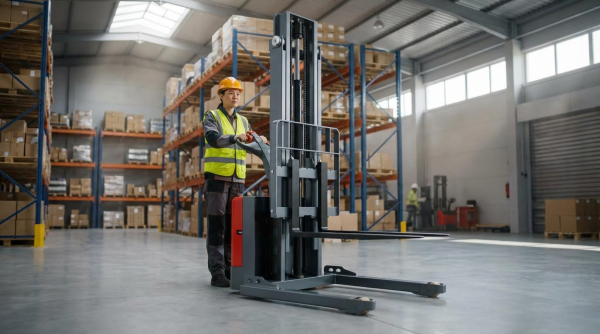
Maintenance has a direct impact on how to operate a straddle stacker safely and efficiently. A structured approach lowers lifecycle cost, reduces downtime, and protects operators. This section explains how planned service, failure analysis, and digital upgrades support safe daily operation and long-term fleet planning.
Preventive Maintenance Schedules And Logs
Preventive maintenance starts with fixed intervals based on hours of use, not calendar time alone. Typical plans group tasks into daily, weekly, monthly, and annual checks. Daily checks focus on safety-critical items such as brakes, steering, horn, emergency stop, and mast condition. Longer intervals cover hydraulic oil changes, chain wear checks, wheel condition, and structural inspection.
A simple but complete log is essential. Each entry should record date, operating hours, work done, parts replaced, and technician name. Digital logs in a fleet system help spot trends such as rising energy use or repeated hose failures. This data feeds decisions on when to overhaul, when to derate a unit, and when to retire or replace it.
To support safe operation, link maintenance schedules with operator checklists. If an operator reports leaks, noise, or fault codes, the unit should move from “in service” to “hold” status until inspection. This discipline prevents minor issues from escalating into mast failure, brake loss, or steering problems during loaded travel.
Common Failure Modes And Troubleshooting
Straddle stackers usually fail in predictable ways when maintenance drifts. Typical mechanical issues include worn lift chains, damaged forks, deformed straddle legs, and flat spots on load wheels. Hydraulic problems often involve leaks at fittings, cylinder seal wear, or clogged filters that slow lift speed. Electric units may show weak batteries, corroded terminals, sensor faults, or contactor and controller failures.
A structured troubleshooting path reduces guesswork. Start with the symptom: no lift, slow travel, warning light, or abnormal noise. Then verify basics in order: power supply, safety interlocks, fluid levels, and visible damage. Only then move to component-level checks such as pressure tests, voltage checks, or encoder calibration. This stepwise approach shortens downtime and avoids unnecessary parts replacement.
Maintenance teams should track repeat failures by model, shift, and task type. If one line frequently overloads units or runs on rough floors, expect higher fork, wheel, and mast wear. In that case, the solution is not only repair but also changes in how to operate a straddle stacker in that area, including speed limits, route changes, or load rules.
Integrating Sensors, Telematics, And AI Analytics
Modern straddle stackers can use sensors and telematics to support safer operation and lower lifecycle cost. Typical sensors measure mast height, fork position, load presence, tilt angle, and impact events. Telematics units transmit run hours, fault codes, travel paths, and battery status to a central platform.
Engineers can then use analytics to change maintenance from reactive to predictive. For example, rising current draw at constant load can signal hydraulic or drive train friction before failure. Frequent overload events in the data show where operators need retraining on how to operate a straddle stacker within limits. Heat maps of travel paths highlight congestion points and blind spots that raise impact risk.
AI tools can rank units by failure risk and suggest optimal service windows. They can also compare fleets across sites to benchmark energy use per pallet moved. When combined with digital work orders and parts inventory, this reduces unplanned downtime and rush shipping of critical components. The result is a tighter link between real operating conditions and the maintenance plan.
Aligning Equipment Use With Design Limits
Design limits define what a straddle stacker can safely do. These include rated load, load center, maximum lift height, duty cycle, and allowed floor conditions. Operating beyond these limits accelerates fatigue in the mast, forks, chassis welds, and axles. It also raises the risk of tip-over, structural crack growth, and sudden component failure during lifts.
Every operating procedure on how to operate a straddle stacker should reference these limits. Operators must know the rated capacity at the specified load center and understand that capacity falls as lift height increases or attachments extend the load. Clear capacity charts on the machine and in training materials support this behavior.
From a lifecycle view, using equipment inside its design window costs less than constant overloading. Overstressed units need more frequent repairs, develop chronic alignment issues, and reach end of life earlier. Engineers should match stacker models and options to real tasks, aisle widths, and pallet types. When tasks change, review whether the current fleet still fits, instead of silently stretching design limits.
Summary Of Best Practices And Key Takeaways
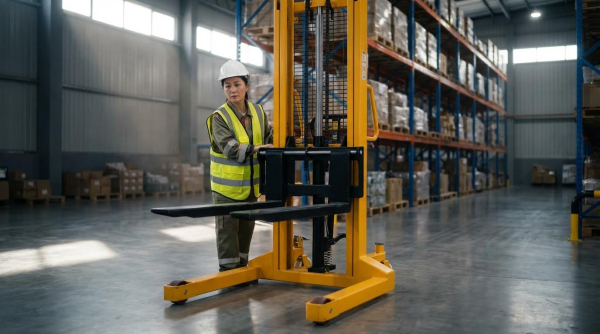
Straddle stacker users who ask how to operate a straddle stacker safely need a complete view of design limits, operating steps, and maintenance. Best practice starts with matching rated capacity, mast height, and straddle width to the pallet mix and aisle layout. Operators should treat the data plate as the main reference for load, lift height, and center of gravity limits. Any task that falls outside these values belongs to different equipment, not to the stacker.
Safe operation depends on a repeatable routine. Operators should complete a pre-use checklist, assess load weight and distribution, and confirm floor and aisle conditions before travel. During travel and lifting, they should keep the load low, speed controlled, and turns gentle, especially in tight aisles. Parking procedures should always include lowering forks, isolating power, and securing brakes.
Maintenance discipline strongly affects lifecycle cost. Facilities should run a documented maintenance log that covers fluids, hydraulics, brakes, batteries, and safety devices. Planned inspections reduce breakdowns and help batteries and drive systems reach their expected service life. Smart add-ons like sensors, telematics, and access control can track impacts, overload attempts, and charging habits, but they do not replace basic training and supervision.
Looking ahead, straddle stackers will likely integrate more automation, data analytics, and energy optimization. Engineers and managers should still anchor decisions on clear design limits, realistic duty cycles, and operator ergonomics. The most reliable answer to how to operate a straddle stacker remains a blend of correct machine selection, structured training, strict respect for ratings, and consistent maintenance.
,
Frequently Asked Questions
How to Operate a Straddle Stacker?
A straddle stacker is used to easily maneuver pallets through tight spaces in warehouses or facilities. To operate it, ensure you understand its controls and functions before use. Always maintain the “Halo Rule,” staying three feet away from other equipment or pedestrians to ensure safety. Straddle Stacker Guide.
- Inspect the equipment for damage or malfunctions before operation.
- Ensure the load capacity aligns with the weight of the pallets being moved.
- Use smooth, controlled movements when lifting or lowering loads.
What Should You Do Before Using a Straddle Stacker?
Before using a straddle stacker, perform a preventive maintenance check to ensure the equipment is in safe working condition. This includes inspecting the forks, wheels, and hydraulic systems. Following a planned preventive maintenance (PPM) checklist can help avoid operational issues. Preventive Maintenance Tips.
- Check fluid levels and tire pressure.
- Test the lifting mechanism for proper functionality.
- Ensure the work area is clear of obstacles.