
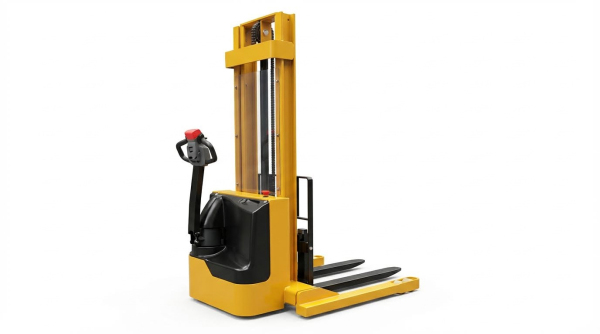
Loading trailers with a walkie stacker sits right on the edge between “possible” and “unsafe,” depending on equipment limits and dock conditions. This guide answers the exact question “can you load a trailer with a walkie stacker” by breaking down design limits, stability, and real-world trailer conditions. You will see where walkie stackers work well, where they become a serious risk, and which engineered alternatives make more sense. The goal is to help safety, operations, and engineering teams choose gear that protects people, product, and uptime—not just the lowest-cost truck on paper.
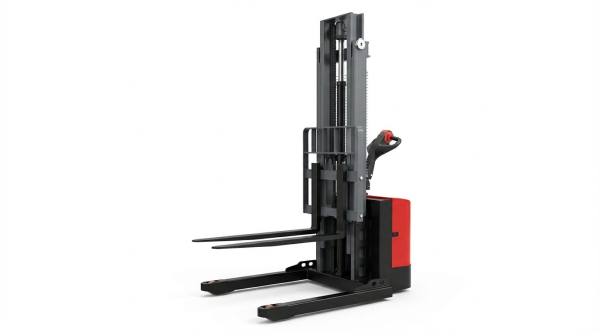
When A Walkie Stacker Can And Cannot Load Trailers
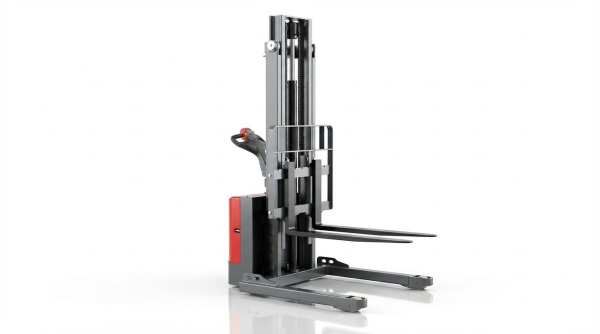
Core design limits of walkie stackers
Before asking “can you load a trailer with a counterbalanced stacker,” you need to understand what the machine was designed to do. Walkie stackers are compact, electric-powered pallet handlers for short, controlled moves on smooth indoor floors, not for long travel over flexible trailer decks or dock gaps. Their geometry, capacity rating, and stability assumptions are all based on warehouse use, not trailer loading.
| Design aspect | Typical walkie stacker value / behavior | Impact on trailer loading |
|---|---|---|
| Rated capacity | About 1,000 kg to 4,000 lb at a 24 in load center capacity and load center data | Capacity drops quickly if the load center shifts forward on dock plates or inside trailers. |
| Load center | Rated at 24 in (600 mm) from the carriage face load center spec | Pallets not fully supported or long loads in trailers effectively increase load center and reduce stability. |
| Travel speed | Roughly up to 3.5 mph loaded speed data | Low speed helps control, but walking beside the truck on a dock edge or plate raises run‑over and crush risks. |
| Operating position | Operator walks behind or stands on a small platform walk‑behind design | Operator stays very close to the truck, with limited escape space inside a trailer. |
| Floor assumptions | Flat, hard, smooth, indoor surfaces typical environments | Wood trailer floors, gaps, and flexing decks are outside the intended design envelope. |
| Power and battery | 24 V system, 180–280 Ah batteries, ~210–280 kg battery mass battery specs | Heavy battery adds to truck weight on trailer floor and dock plates; helps traction but increases floor loading. |
| Mast height | Lowered mast often 71 in or more, max lift up to ~189 in mast height data | Clearance inside trailers and at dock doors can be tight, especially on uneven docks. |
| Wheelbase & footprint | Narrow overall width ~32 in (≈800 mm) width data | Good in aisles, but narrow stance reduces lateral stability on crowned or sloped trailer floors. |
Most walkie stacker safety and control features were sized for warehouse speeds and predictable floor friction. They usually include AC drive motors, regenerative braking, mechanical drum brakes, and direction‑reverse switches in the handle to protect the operator performance and safety features. But these systems assume the truck stays on level ground with good traction.
Key reasons walkie stackers are not trailer loaders by design
Walkie stackers were engineered as low‑speed, short‑distance pallet handlers for confined indoor spaces, such as retail warehouses and manufacturing plants common applications. Trailer loading adds variables like trailer deflection, dock gaps, grades, and limited operator escape paths that fall outside that original design brief.
So, can you load a trailer with a battery-powered stacker in theory? Yes, some operations do it. But from an engineering risk standpoint, the design limits above mean you should treat it as an exception with strict controls, not a default method.
Trailer and dock conditions that change the answer
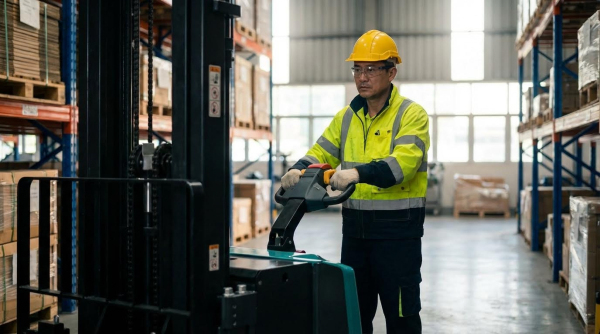
Whether you can load a trailer with a manual pallet jack safely depends far more on your dock and trailer conditions than on the nameplate capacity. Small changes in grade, gaps, or floor condition can turn a “just workable” setup into a high‑risk one.
For B2B operations, it helps to break the decision into specific conditions. That way, supervisors and engineers can document when a walkie stacker is allowed at the dock and when a different truck or method is mandatory.
- Trailer type and condition
- Dry van with sound, flat wood floor vs. damaged or soft decking.
- Reefer units with higher floors and possible interior ramps.
- Drop‑deck or step‑deck trailers with internal transitions.
- Dock interface
- Dock height alignment with typical trailer fleet.
- Dock leveler or plate capacity and lip length.
- Presence of wheel chocks, vehicle restraints, and dock bumpers.
- Surface and grade
- Approach slope from warehouse to dock face.
- Trailer suspension movement during loading.
- Wet, oily, or debris‑covered floors at the dock.
- Space and escape paths
- Clear aisle from dock door to trailer.
- Room beside the stacker for the operator to step clear.
- Pedestrian traffic crossing the dock face.
| Condition | “More acceptable” for walkie stacker use | “Not acceptable / high‑risk” indicators |
|---|---|---|
| Trailer restraint & stability | Trailer locked with a restraint, wheels chocked, landing gear down, and dock bumpers in good condition. | No restraint, no chocks, or visible trailer movement when equipment enters/exits. |
| Dock leveler or plate | Capacity comfortably above combined truck + load weight; plate long enough to maintain proper ramp angle. | Portable plates with unknown rating, excessive flex, or steep approach angle. |
| Floor condition (dock & trailer) | Clean, dry, free of debris, no broken boards or soft spots. | Wet, oily, damaged flooring, or visible deflection under other equipment. |
| Grade and transitions | Near‑level interface, smooth transition from dock to trailer. | Noticeable hump or dip at the lip, internal trailer ramps, or sloped approaches. |
| Clearances | Sufficient headroom for mast and operator, no low crossbars or obstructions. | Low overhead structure that forces the operator to crouch or walk off‑center. |
| Traffic & congestion | Controlled access, marked pedestrian zones, good lighting environment guidance. | Heavy pedestrian traffic, blind corners, or poor visibility at the dock face. |
When conditions are ideal, a walkie stacker may be used under a written procedure and with trained operators. Those procedures should mirror general powered industrial truck safety guidance: pre‑shift inspections, checking brakes, hydraulics, and controls, and keeping loads low and centered during travel inspection and operation practices.
Practical “go / no‑go” checklist for using a walkie stacker at a dock
Before deciding that you can load a trailer with a drum dolly, supervisors should verify at minimum: trailer is restrained and chocked; dock plate/leveler rating exceeds truck + load; trailer floor is inspected and sound; approach and interior are dry and free of debris; there is a clear, marked path with no pedestrian crossings; and the operator is trained on both walkie stacker operation and site‑specific dock hazards inspection checklist reference.
If any of these conditions fail, the engineering‑sound answer to “can you load a trailer with a walkie stacker” is no. At that point, the safer choice is to switch to equipment and dock design that were purpose‑built for trailer loading, which the next sections cover.
Technical Constraints, Safety Risks, And Compliance
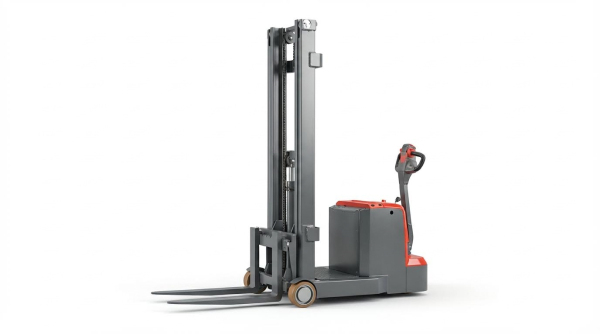
Capacity, load center, and stability in trailers
Inside a trailer, the simple question “can you load a trailer with a walkie stacker” turns into a stability and capacity problem. Rated capacity on the nameplate assumes a flat, solid floor and a standard load center, not a flexing trailer deck. Once you add trailer pitch, dock plates, and uneven pallet weights, the safety margin can disappear fast.
| Key factor | Typical walkie stacker data | Trailer impact | Risk if ignored |
|---|---|---|---|
| Rated capacity | Approx. 2,200–4,000 lb range for many units (1,000–4,000 lb classes) | Dynamic loads from trailer movement can momentarily exceed rating. | Overload, mast or fork damage, loss of control. |
| Load center | Typically rated at 24 in / 600 mm load center (standard spec) | Long pallets, overhanging product, or double-stacked loads shift the center forward. | Effective capacity drops; increased tip‑over risk at the dock plate or inside the trailer. |
| Truck stability | Short wheelbase, narrow overall width (around 32 in / 800 mm) for many models (compact design) | Trailer floors flex between crossmembers; dock plates add another hinge point. | Side‑to‑side rocking, loss of traction, or sudden lateral tip. |
| Mast height | Max lift height up to ~189 in (≈5.5 m) on some units (high‑reach designs) | Low trailer ceilings and dock canopies limit usable height and clearance. | Mast or overhead guard impact with roof, structural damage, operator injury. |
| Travel speed | Approx. 3.5 mph under load; some units ~5–6 km/h loaded/unloaded (typical speeds) | Short stopping distances inside trailers; low friction on dusty or wet floors. | Inability to stop before the dock edge or obstacles. |
From an engineering standpoint, the capacity plate tells you what the truck can handle only at the rated load center on a rigid floor. Inside a trailer, you must derate in your internal procedures to account for longer pallets, uneven stacking, and dynamic forces when the trailer is not fully restrained. For B2B operations, a conservative rule is to keep walkie stacker trailer loads well below nameplate capacity and to avoid any off‑center or unstable pallets.
- Verify the load center: if pallets exceed 48 in depth or product overhangs, treat the load as de‑rated.
- Keep the load as low as possible while traveling; raise only to clear the floor and dock plate.
- Do not side‑shift or “crab” with elevated loads in a trailer; lateral stability is weakest there.
- If you cannot maintain a clear, level path to the nose of the trailer, plan a different loading method.
Floor conditions, grade, and dock/plate requirements
Even if the capacity looks acceptable on paper, floor and grade conditions often decide whether you truly can you load a trailer with a walkie stacker. These trucks are designed for smooth, indoor floors and short grades, not broken pavement, steep docks, or soft trailer decking.
| Element | Walkie stacker design intent | Trailer/dock reality | Engineering concern |
|---|---|---|---|
| Operating surface | Flat, hard, clean warehouse floors (indoor use) | Trailer floors with gaps, patches, and flex; dock plates with lips and transitions. | Shock loads into mast and chassis; wheel hang‑ups at plate lips. |
| Grade / slope | Short, moderate ramps; operators trained to keep load uphill (ramp guidance) | Dock approaches, tilted trailers, or yard slopes changing trailer angle. | Runaway risk, reduced braking, higher overturn moment. |
| Dock plate | Rated for powered industrial trucks; smooth transition, low deflection. | Undersized or worn plates, dockboards with unknown capacity. | Plate failure, sudden drop, or excessive bounce under concentrated wheel loads. |
| Trailer restraint | Assumes truck operates on a fixed, non‑moving surface. | Tractor may move; landing gear may sink; trailer may “drop” as it is loaded. | Gap change at dock plate, load shift, stacker instability. |
Before sending a walkie stacker into any trailer, treat the dock like a small engineering project. Confirm that the dock plate and trailer floor are rated for the combined weight of truck plus maximum load, not just the pallet. Many walkie stacker batteries alone weigh over 200 kg (≈210–280 kg typical), which adds significant axle load at the plate hinge.
- Use only dock plates or levelers with a visible capacity rating for powered trucks, not manual pallet jacks.
- Ensure trailer restraint is engaged and landing gear is supported to minimize trailer drop and bounce.
- Prohibit walkie stacker use on ice, standing water, or loose debris at the dock approach.
- Set and enforce a maximum allowable dock slope or trailer pitch for walkie stacker entry.
Why flexing trailer floors matter more for walkie stackers
Walkie stackers concentrate load on small solid tires and a compact wheelbase. When a trailer floor flexes between crossmembers, one wheel can suddenly lose or gain contact. That rapid change in support point shifts the stability triangle, especially with an elevated or forward‑biased load, and can trigger a side‑tip much faster than on a heavier sit‑down truck with a wider stance.
OSHA/ANSI compliance and operator safety controls
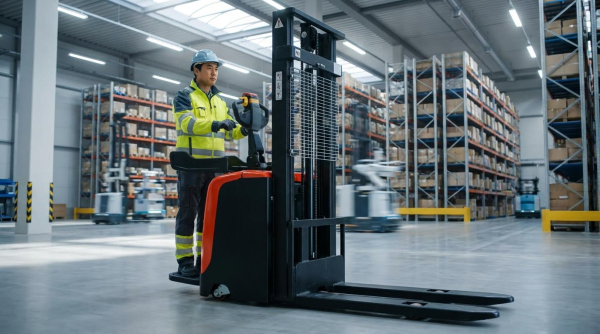
Regulatory compliance adds another layer to “can you load a trailer with a walkie stacker.” OSHA treats walkie stackers as powered industrial trucks, so the same core rules for training, inspection, and safe operation apply inside trailers and on docks.
- OSHA 29 CFR 1910.178 requires formal instruction, practical training, and evaluation for operators of powered industrial trucks, including walkie stackers. Training coverage
- Daily inspections must cover brakes, steering, hydraulic systems, forks, warning devices, and battery condition before use. OSHA checklist
- Workplace conditions (ramps, docks, pedestrian traffic) must be part of the site‑specific training content.
Modern walkie stackers include several built‑in safety controls that help, but do not eliminate, trailer risks. Common features include mechanical drum brakes, direction reverse switches in the control handle, automatic circuit breakers, and power‑on self‑tests (typical safety package). These are designed for controlled warehouse environments, not unstable, moving trailers.
| Safety/control feature | What it does | Limitations in trailer loading |
|---|---|---|
| Emergency reverse (“belly”) button | Reverses travel if the operator is pinned against an object. | Helps at the dock face, but does not prevent tip‑over on a bad dock plate or slope. |
| Regenerative / service braking | Slows the truck when the control handle is returned to neutral (performance feature) | Braking distance still increases on dusty, wet, or sloped trailer floors. |
| Speed control | Low maximum travel speed (around 3–4 mph) to reduce impact energy. | Too fast for short stopping distances near dock edges if operators are complacent. |
| Visibility from walk‑behind position | Operator stands close to the truck with good side visibility. | Forward view into a dark trailer with high loads is still limited; risk of walking off dock edge. |
To stay compliant and reduce liability, B2B operations should codify when walkie stackers are allowed or banned from trailer loading in their written powered industrial truck program. That document should link equipment choice (walkie vs. forklift vs. other) to load weight, trailer condition, dock design, and operator training level. If the environment regularly pushes the limits described above, the compliant answer to “can you load a trailer with a walkie stacker” is usually “no—spec a different truck or redesign the dock.”
Safer Alternatives And Engineering Controls
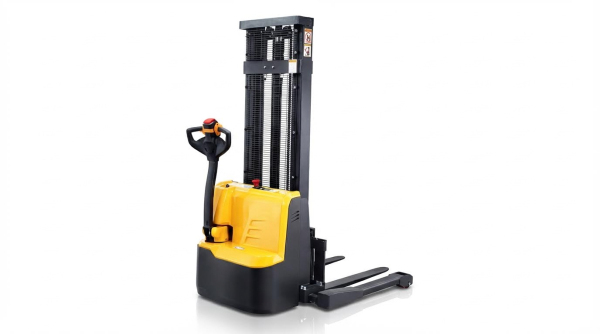
When to specify forklifts, rider stackers, or AGVs
Answering “can you load a trailer with a walkie stacker” starts with choosing the right truck for the job. In many B2B operations, a sit-down forklift, rider stacker, or AGV is the safer engineered solution for dock and trailer work.
Use the matrix below as a quick engineering pre-check before you ever send a walkie stacker into a trailer.
| Scenario / Requirement | Best Primary Equipment | Why This Choice Is Safer / Better |
|---|---|---|
| Daily loading/unloading of floor-loaded or palletized trailers at a dock | Counterbalanced forklift (rider) | Higher capacity, longer wheelbase, better stability on dock plates and trailer floors; designed for frequent trailer entry |
| Medium-throughput dock with short runs between dock and storage | Rider pallet jack or rider stacker | Faster travel than walk-behind, better operator protection, still compact for tight dock areas |
| High-volume, repeat lane loading with standardized pallets | AGV or automated pallet shuttle | Reduces human exposure to trailer pinch points and fall zones; consistent speeds and paths |
| Narrow-aisle racking away from the dock | Walkie stacker / reach stacker | Smaller footprint, lower cost, ideal for smooth indoor floors and short travel distances compared with forklifts |
| Outdoor loading, rough yards, uneven approaches | Outdoor-rated forklift | Larger tires, higher ground clearance, frames engineered for uneven surfaces; walkie stackers are indoor, smooth-floor machines |
| Operations with strict pedestrian / noise limits | Electric forklifts, rider stackers, or AGVs | Quiet, zero point-of-use emissions, strong safety feature sets and predictable travel paths |
Walkie stackers typically offer 1,000–4,000 lb class capacities and modest travel speeds around 3.5 mph under load. They run on compact 24 V systems and are optimized for short, indoor moves on smooth floors. Those design choices are ideal for storage and put-away, not for repeated trailer entry.
By contrast, forklifts are engineered for higher loads, longer wheelbases, and more robust masts, which improves stability on dock plates and flexing trailer floors. They also support higher lift heights and outdoor work, which a walkie stacker cannot safely match in most trailer environments. Forklifts routinely handle 5,000 lb class loads and rougher conditions.
Rule-of-thumb selection logic
Use this simple rule set when someone asks “can you load a trailer with a walkie stacker” during project planning:
- If the truck must fully enter the trailer more than occasionally → specify a forklift or rider pallet truck.
- If the truck only stages pallets at the dock face → walkie stackers and reach trucks are acceptable, assuming the dock equipment is correct.
- If travel distance from dock to storage is long → move from walk-behind to rider equipment or AGVs for productivity and operator fatigue.
- If you need 100% repeatable cycle paths and minimal human exposure → evaluate AGVs or pallet conveyors for those lanes.
Dock design, equipment selection, and battery technology
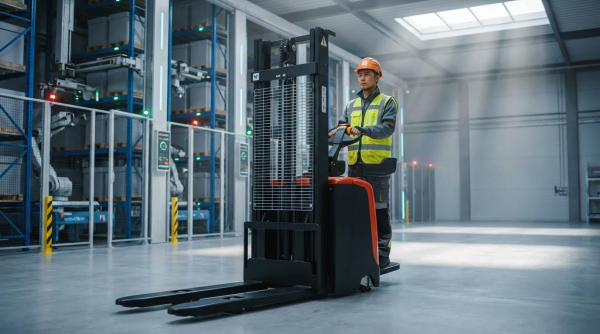
Even if the answer to “can you load a trailer with a walkie stacker” is “we will avoid it,” your dock design and engineering controls still determine overall safety. Poor dock geometry can make the safest truck behave badly.
Use the following checklist to align dock design, truck choice, and power system.
- Dock height and trailer compatibility
- Match dock height to your dominant trailer fleet to minimize ramp angles.
- Use properly rated dock levelers or plates for the heaviest truck you plan to use, not just the walkie stacker.
- Floor and approach conditions
- Specify smooth, non-spalling concrete at docks and in staging areas for walkie and rider equipment.
- Eliminate sudden grade breaks that can shift loads or bottom-out low-clearance stackers.
- Trailer restraint and wheel chocks
- Use mechanical or powered restraints to prevent trailer creep and separation.
- Chock wheels where restraints are not installed or as a secondary control.
| Design / Control Element | Key Engineering Requirement | Impact on Equipment Choice |
|---|---|---|
| Dock leveler or dock plate | Rated for combined weight of truck + max load; limited slope (typically ≤10% for powered industrial trucks) | Steep, under-rated plates are unsafe for walkie stackers; favor forklifts or redesign |
| Trailer floor condition | Sound decking, no rot, no broken boards, adequate crossmember spacing | Marginal floors amplify the risk of small-wheel walkie stackers; forklifts still require strict inspection |
| Aisle width at dock | Clearances for turning and staging without backing blindly | Narrow docks may favor rider pallet jacks or rider stackers over large forklifts |
| Traffic segregation | Marked pedestrian walkways, guardrails, mirrors, and warning devices | Higher truck speeds (forklifts, riders) demand stronger separation than low-speed walkies |
| Charging / battery room | Ventilation, spill containment, eyewash, and clear egress | Supports safe operation of 24 V walkie stackers and higher-capacity electric forklifts |
Most walkie stackers use 24 V batteries with capacities roughly in the 180–280 Ah range and battery weights around 210–280 kg. That mass is part of the counterweight system and must be secured and maintained correctly. Poor battery maintenance reduces runtime, but more critically, it also reduces braking and traction performance during dock work.
- Battery and charging engineering controls
- Provide dedicated, ventilated charging areas away from dock edges and traffic lanes.
- Specify PPE, spill kits, and eyewash for all lead-acid charging operations. Operators should wait at least 10 minutes after charging before putting the truck back into service.
- Use battery restraints and inspection routines so heavy batteries cannot shift during ramp transitions.
- Controls and visibility at docks
- Standardize horns, lights, and alarms across truck types so pedestrians know what to expect.
- Use convex mirrors at dock doors and intersections to reduce blind spots.
- Program walkie and rider units to conservative travel speeds in dock zones, even if they can run faster elsewhere.
Practical design tips for B2B projects
For new or retrofit docks in B2B operations:
- Design the dock and leveler first for the “worst case” truck (usually a loaded forklift), then check whether walkie stackers are appropriate for staging only.
- Keep walkie stackers on the building slab and use forklifts or riders as the “interface equipment” going into trailers.
- Where labor and safety exposure are high, evaluate AGVs or conveyors to move pallets between dock and storage, and keep people off the dock edge as much as possible.
Final Assessment And Recommendations For B2B Operations
Engineering analysis shows that walkie stackers sit at the edge of what is safe for trailer loading. Their capacity, load center, and stability ratings assume flat, rigid floors and short, indoor travel. Trailer decks, dock plates, and grades break those assumptions and can erase safety margins in seconds.
Dock and trailer conditions then amplify the risk. Flexing floors, steep plates, poor restraints, and tight escape paths turn a low-speed truck into a serious crush or tip-over hazard. OSHA and ANSI rules still apply, so any decision to send a walkie stacker into a trailer must stand up to regulatory and legal review, not just convenience.
The practical outcome is clear. Treat trailer loading with walkie stackers as an exception, not a normal method. Use written “go / no-go” criteria, strict derating, and task-specific training if you ever allow it. For routine trailer work, specify forklifts, rider equipment, AGVs, or redesigned docks that match the real loads and geometry.
For B2B projects, the best practice is to keep Atomoving walkie stackers on the building slab for staging and put purpose-built trailer equipment at the dock face. That approach protects people, product, and uptime while staying within sound engineering limits.
Frequently Asked Questions
Can you load a trailer with a walkie stacker?
A walkie stacker, also known as a walk-behind forklift, can be used to load a trailer if the trailer is at ground level or equipped with a ramp. These machines are compact and versatile, making them ideal for warehouse operations. However, ensure the walkie stacker’s weight capacity matches or exceeds the load you intend to move. Forklift Types Guide.
- Ensure the trailer has a ramp if it’s not at ground level.
- Check the walkie stacker’s load capacity before use.
- Walkie stackers work best in small spaces like warehouses.
What class is a walkie stacker?
A walkie stacker falls under Class III of powered industrial trucks. This classification includes electric motor hand trucks or hand/rider trucks, such as electric pallet jacks and walkie stackers. Industrial Truck Classes.