Whether a straddle stacker can counterbalanced stacker run on asphalt safely depends far more on the ground and wheel setup than on the truck itself. This guide walks through surface flatness, slope, friction, and weather, then links them to wheel and tire choices for outdoor and mixed-use yards. You will see practical engineering limits, battery and protection considerations, and a maintenance-focused checklist so your machine works reliably outside, not just on perfect warehouse floors. Use it as a design and operation reference before committing a straddle stacker to asphalt or other paved yard work.
Core Requirements For Running A Straddle Stacker On Asphalt
Before you decide whether a straddle stacker can counterbalanced stacker run on asphalt safely, you must treat the yard like an engineered floor, not just “outside ground.” Asphalt flatness, slope, joint quality, and friction under changing weather all control stability, braking distance, and wheel life. This section gives practical engineering limits and simple field checks so you can decide where asphalt is acceptable, and where you need repairs, speed limits, or a different machine.
Flatness, Slope, And Joint Quality On Paved Yards
Asphalt yards often look “good enough,” but small height errors and slopes amplify once the mast is raised and the load center moves up. Use the indoor floor tolerances as a design benchmark when you evaluate outdoor asphalt for straddle stacker use. The table below summarizes key limits and how they apply when a straddle stacker runs on asphalt.
| Parameter | Typical Engineering Guideline | Why It Matters On Asphalt | Practical Field Check |
|---|---|---|---|
| General surface flatness | ±3–5 mm per 1 m for standard stacking; down to about 1.5 mm per 1 m for lift heights >3 m based on warehouse floor guidance | Ruts and depressions in asphalt cause mast sway and side loading into the straddle legs. | Lay a 2 m straightedge in wheel paths; measure gaps with feeler gauges or shims. |
| Overall yard slope (working area) | <2–3% for indoor stacker operation per typical gradient limits | Higher slopes increase rollback risk, extend stopping distance, and shift load off the drive wheel. | Use a digital level or smartphone inclinometer along main travel lines. |
| Local ramps and transitions | Smooth transitions between levels and ramps; avoid sharp “breaks” per indoor practice | Sharp changes act like speed bumps, causing impact loading on forks, mast, and drive unit. | Drive a slow test with an empty stacker; mark any “jolt” points for repair or speed limits. |
| Joint / patch height differences | <≈2 mm step at construction or expansion joints per floor joint guidance | Raised patches and cold joints in asphalt hammer the small load wheels, accelerating failure. | Check patch edges with a straightedge and ruler; grind or rework if steps are visible. |
| Cracks, potholes, soft spots | Defects should be repaired or isolated before routine traffic per floor defect recommendations | Potholes can catch a straddle leg, twist the chassis, or trigger a tip when loaded high. | Walk the route and spray-paint or cone off all defects until permanently repaired. |
To decide if your particular asphalt area is acceptable for routine stacking (not just occasional crossing), work through a simple checklist.
- Map the exact travel paths (inbound, staging, stacking, outbound) for the straddle stacker.
- Measure slope along and across these paths; keep stacking zones under about 2–3% gradient.
- Check flatness and joint steps in the wheel tracks, not in unused areas of the yard.
- Identify seasonal deformation points where asphalt softens in heat and ruts under wheel loads.
- Downgrade any marginal zones to “travel only, forks low, low speed” and reserve the flattest areas for lifting.
Engineering notes for high-lift work on asphalt
When you lift above roughly 3 m on asphalt, treat the flatness requirement more strictly, similar to the 1.5 mm per meter indoor figure. Small tilts at ground level translate into large lateral offsets at the top pallet position, which increases rack strike and tip risk. If your asphalt cannot economically meet this standard, keep high stacking indoors and use the yard only for low-level transfer.
Friction, Contaminants, And Weather Impacts

Even when the asphalt geometry is acceptable, traction and weather become the next limiting factors. Indoor guidance specifies a static coefficient of friction of about 0.4–0.6 for safe straddle stacker operation to maintain braking and directional control under rated load based on floor friction guidelines. Outdoor asphalt easily drops below this band when wet, dusty, or oily.
| Factor | Effect On Asphalt Friction | Risks For Straddle Stackers | Controls / Mitigations |
|---|---|---|---|
| Dry, clean asphalt | Can reach friction close to desired 0.4–0.6 range, depending on texture per general friction requirements | Generally acceptable for controlled-speed operation with suitable wheels. | Keep routes swept; avoid polishing the surface with constant tight turns in one spot. |
| Water (rain, puddles, melt) | Reduces effective friction; hydroplaning unlikely at low speeds but microfilm acts as lubricant. | Longer stopping distance; drive wheel spin on slopes; difficulty holding position on ramps. | Set wet-weather speed limits; avoid stacking on painted markings; delay operations in heavy rain. |
| Oils, fuels, hydraulic leaks | Drastically lower friction below safe levels, even in small patches aligned with contaminant effects | Sudden loss of traction during turning or braking; uncontrolled yaw with raised loads. | Immediate spill containment and cleanup; absorbent granules; prohibit stacking until area is restored. |
| Dust, sand, fine particulates | Act as rolling layer between wheels and asphalt, reducing grip per contaminant guidance | Side slip in turns; difficulty holding alignment when entering racks or trailers. | Regular mechanical sweeping; localized bunding to stop soil runoff into the operating zone. |
| Ice and packed snow | Friction can fall far below 0.4; brakes may not hold on even mild slopes. | High risk of uncontrolled sliding, especially with elevated loads. | De-ice and clear completely; if bare asphalt cannot be restored, keep straddle stackers indoors. |
A structured contaminant management plan is essential if a straddle stacker will routinely run on asphalt, especially in mixed truck–forklift yards.
- Designate “clean forklift corridors” separated from truck fueling, wash, or maintenance zones.
- Install simple bunds or drainage controls so oils and fines do not wash into stacker routes as recommended for contaminant management.
- Use compatible detergents and mechanical scrubbing to restore microtexture without damaging any surface treatments per cleaning best practice.
- Record weather-related incidents (near misses, wheel spin, slide events) and tighten limits where patterns appear.
- Consider tribometer or skid-resistance testing on critical lanes if stacking heights or loads are high.
How weather ties back into “can straddle stacker run on asphalt?”
From an engineering perspective, the answer is conditional: a straddle stacker can run on asphalt if the surface stays within reasonable flatness and slope limits, friction remains in roughly the 0.4–0.6 band, and contaminants are tightly controlled. In hot climates, monitor asphalt softening and rutting; in cold or wet climates, your practical operating window may shrink to dry periods only. Treat these limits as part of your risk assessment before you approve outdoor or mixed-use operation.
Wheel And Tire Choices For Asphalt And Outdoor Duty
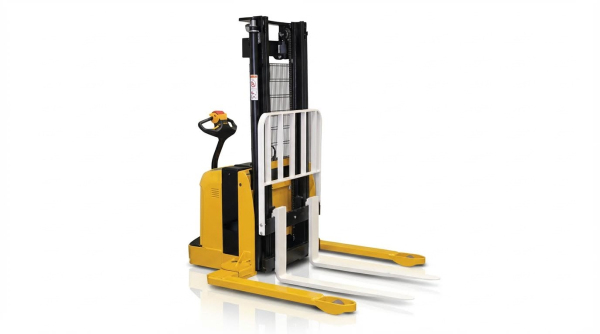
Wheel and tire selection is the main lever you control when deciding if a counterbalanced stacker can straddle stacker run on asphalt safely and efficiently. Asphalt is softer and more variable than warehouse concrete, so you must balance traction, rolling resistance, and shock absorption. The right combination reduces wheel damage, protects the surface, and keeps stability margins high in outdoor and mixed-use yards.
Polyurethane Vs Rubber Wheels On Asphalt
Polyurethane and rubber behave very differently once you leave smooth indoor floors. For any project assessing whether a can straddle stacker run on asphalt, start with these two materials and match them to duty cycle, load, and surface condition.
| Parameter | Polyurethane Wheels | Rubber Wheels | Engineering Comment For Asphalt |
|---|---|---|---|
| Typical indoor application | Sealed concrete, resin floors, composite panels (smooth, stiff substrates) | Smooth but slightly more forgiving floors (higher damping) | Both can work on dense, well-compacted asphalt; rubber copes better with micro‑roughness. |
| Grip / traction | Good grip on dry, smooth surfaces; traction drops faster on dust or wet film. | Higher friction and damping, better traction on slightly uneven or contaminated surfaces | Outdoor asphalt with dust, fines, or moisture usually favors rubber for traction margin. |
| Rolling resistance | Low; efficient travel and lower energy use on smooth, hard surfaces. | Higher; more energy draw and battery usage at the same load. | Polyurethane is better for long, flat runs on high‑quality asphalt; rubber suits short, stop‑start yard work. |
| Shock / vibration | Limited damping; transmits surface defects into mast and chassis. | Good damping; protects structure and load from rough patches. | Rubber reduces fatigue on uneven or cracked asphalt. |
| Surface protection | Protects floor, low abrasion, low noise | Can scuff or mark, especially under high torque. | On hot days, soft asphalt can rut under small, hard polyurethane wheels; wider rubber helps spread load. |
| Chemical / weather resistance | High resistance to oils, greases, many chemicals, and ozone | Can age or crack with UV, oils, and ozone over time. | For outdoor chemical exposure (fuel, oils), polyurethane treads are more durable. |
| Noise level | Low noise on smooth surfaces. | Moderate noise, but less harsh impact noise on rough ground. | Rubber is usually perceived as more comfortable outdoors. |
On good, dense, relatively flat asphalt, polyurethane drive and load wheels can be used if you control speed, limit slopes to around 2–3%, and maintain a friction coefficient in the 0.4–0.6 range through cleaning and drainage . For older, cracked, or patch‑repaired asphalt, rubber is usually the safer choice due to higher damping and better grip on micro‑unevenness.
- Use polyurethane where: asphalt is new, smooth, well‑compacted, and travel distances are long.
- Use rubber where: asphalt has joints, patches, or loose fines, or where braking distances must be minimized.
- Always verify that actual friction stays near 0.4–0.6 with tribometer or field testing in wet and dry conditions .
Quick decision guide: polyurethane vs rubber on asphalt
If your priority is low energy use and you have almost “indoor‑grade” asphalt, polyurethane is acceptable. If your priority is traction robustness and shock protection on a typical yard, specify rubber drive and load wheels.
Vertical Vs Horizontal Drive Wheels Outdoors
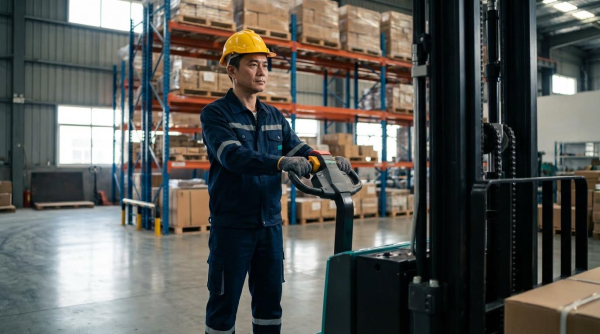
Drive wheel orientation changes how load, traction, and wear behave when a straddle stacker leaves the warehouse. This is critical when you evaluate whether a can straddle stacker run on asphalt without excessive wheel or surface damage.
| Parameter | Vertical Drive Wheel | Horizontal Drive Wheel | Impact On Asphalt / Outdoor Duty |
|---|---|---|---|
| Primary design intent | High maneuverability, tight turning in narrow indoor aisles | High stability and robustness under heavy loads | Vertical is ideal indoors; horizontal is better suited for yards and rougher surfaces. |
| Load distribution | Concentrated contact patch; higher contact pressure. | More even load distribution over a broader footprint. | Horizontal layouts reduce rutting and indentation on softer asphalt. |
| Maneuverability | Excellent; tight turning radius and precise positioning. | Lower than vertical in confined spaces. | In open yards, maneuverability is less critical; stability dominates. |
| Stability with heavy loads | More sensitive to surface defects and slopes. | Better resistance to tipping and lateral instability | Horizontal drive is preferred for outdoor gradients and uneven asphalt. |
| Performance on rough / uneven ground | More susceptible to shock loads into the steering and mast. | More robust against potholes, joints, and patches | Horizontal wheel layouts extend life in outdoor yards. |
| Traction on slippery / wet asphalt | Smaller patch can lose grip faster under torque. | Larger effective patch, better traction on slippery or uneven surfaces | Horizontal drive improves control in rain or on dusty asphalt. |
- Prefer vertical drive wheels for: predominantly indoor use with only very short, smooth outdoor transitions.
- Prefer horizontal drive wheels for: regular yard operation, heavier loads, and mixed‑condition asphalt.
- Regardless of orientation, keep slopes below about 2–3% and avoid sharp transitions that create impact loads on the drive assembly .
When to upgrade from vertical to horizontal drive for asphalt
Consider horizontal drive arrangements if your duty cycle includes frequent outdoor trips, loads near rated capacity, or operation in wet seasons where traction and stability margins are critical.
Solid, Pneumatic, And Non‑Marking Tire Options
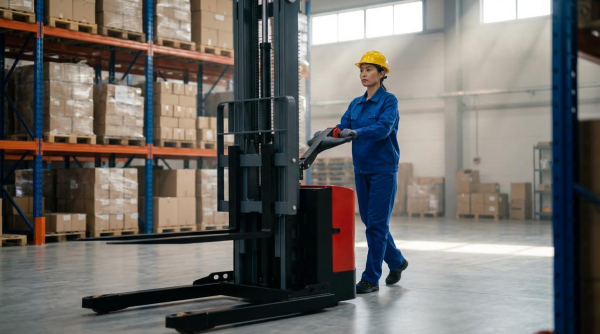
Beyond tread material, tire construction determines how well a straddle stacker tolerates the real outdoor environment: potholes, joints, and debris. These options are particularly important where a can straddle stacker run on asphalt is expected to share space with trucks in logistics yards or loading areas.
| Tire Type | Key Strengths | Key Limitations | Best-Fit Asphalt Use Case |
|---|---|---|---|
| Solid tires | Very high wear and puncture resistance; no blowout risk; long service life and low maintenance | Poor shock absorption; higher rolling resistance; harsher ride | High‑intensity, short‑distance work on relatively even asphalt where uptime and puncture resistance matter more than comfort. |
| Pneumatic tires | Excellent shock absorption and driving comfort; good performance on rough or uneven surfaces; lower initial cost | Risk of blowouts; require regular pressure checks; shorter service life | Yards with uneven or patched asphalt, speed bumps, or embedded rails where shock absorption protects the machine and load. |
| Non‑marking tires | Do not leave black marks; maintain floor cleanliness; reasonable wear resistance | Higher cost; lower load‑bearing capacity than solid tires | Mixed indoor–outdoor routes where appearance and cleanliness at dock doors and warehouse entries are critical. |
- For heavy outdoor duty on asphalt with debris risk, battery-powered stacker or foam‑filled (flat‑proof) tires reduce unplanned stops.
- For rough or poorly maintained asphalt, pneumatic tires reduce impact loading into the chassis and mast, improving fatigue life.
- For operations that cross from asphalt into clean warehouses, non‑marking compounds prevent black transfer while still offering outdoor capability.
Combining tread material and tire construction
In practice, many outdoor‑capable straddle stackers use rubber or polyurethane treads in a solid or foam‑filled construction to balance puncture resistance and acceptable ride quality. Selection should be based on measured surface condition, typical load, travel distance, and the fraction of time spent on asphalt versus indoor floors.
Engineering Guidelines For Outdoor And Mixed-Use Operation
Surface Assessment And Load Rating Checks
Before you decide whether a counterbalanced stacker can straddle stacker run on asphalt safely, you need hard data on the surface, not opinions. Asphalt in yards behaves very differently from indoor concrete, so you must treat it as an engineered support system: geometry, stiffness, and durability.
- Confirm that the asphalt is solid, well-compacted, and not prone to rutting under concentrated wheel loads.
- Check flatness, slope, and joints or cracks along the exact wheel paths and turning zones.
- Verify that the sub-base and pavement structure can carry dynamic wheel loads without excessive deflection.
- Define exclusion or derating rules for weak, cracked, or water-damaged areas.
Key indoor benchmarks you can adapt for asphalt
Indoor reference values help you judge how demanding straddle stackers are on any surface. Typical flatness tolerances are within ±3–5 mm per 1 m for general operation, tightening to about 1.5 mm or less when stacking above 3 m for high-lift work. Slopes should stay below roughly 2–3% to preserve traction and prevent load shift on powered stackers. Height differences at joints or defects should be kept below about 2 mm to limit impact loads and steering shocks and reduce wheel damage and tipping risk.
Use these indoor figures as “gold standards” and then decide where your asphalt yard meets, approaches, or clearly misses them. Where asphalt falls short, you either reduce risk by limiting speed, load, and stacking height, or you invest in local surface upgrades.
| Check Item | Recommended Benchmark | How To Check | Outdoor / Asphalt Adjustment |
|---|---|---|---|
| Flatness along wheel paths | ±3–5 mm per 1 m; ≤1.5 mm for >3 m stacking indoor reference | Straightedge or laser level surveys along typical travel and turning lines | If outside this range, limit stacking height, travel speed, or isolate rough zones. |
| Slope / gradient | <2–3% for normal indoor operation to preserve traction | Digital level or survey over full ramp length | On asphalt ramps, keep heavy handling to one direction, reduce speed, and avoid turning on slopes. |
| Joints, cracks, potholes | Height difference <2 mm at joints to limit impact | Feeler gauges, visual survey, mapping defects | Patch potholes, fill cracks, or mark them as no‑go areas for stackers. |
| Load-carrying capacity | Panels or pavements must support dynamic wheel loads of roughly 9–35 kN for pallet equipment depending on design | Consult pavement design data or have a civil engineer verify structure | Derate truck capacity or restrict routes if pavement is marginal or shows rutting. |
| Friction / grip | Static coefficient of friction ≈0.4–0.6 for safe braking and turning under rated load | Tribometer tests or comparative skid tests | Oil, water, or fine dust on asphalt can drop friction below this; adjust routes and cleaning accordingly. |
- Where asphalt is soft or deforms under wheels, expect accelerated wheel wear and higher tip risk with raised loads.
- On mixed-use sites, define “indoor-grade” asphalt corridors with tighter flatness and maintenance standards.
- Always couple surface checks with load distribution training so operators understand why certain zones are restricted.
Battery Technology, Environment, And Protection
Outdoor and mixed-use operation exposes straddle stackers to moisture, temperature swings, and dust. These factors directly influence battery choice, run time, and failure rates, especially when you run on asphalt yards for long shifts.
Two battery families dominate: sealed lead-acid and lithium-ion. Lithium-ion systems provide faster charging, longer life, and more stable voltage, and they often integrate a battery management system (BMS) that monitors health, temperature, and charge state to prevent overcharge or overheating in continuous outdoor use.
| Design Aspect | Engineering Guideline | Outdoor / Asphalt Relevance |
|---|---|---|
| Battery type selection | Use sealed, maintenance-free lead-acid or lithium-ion for mixed indoor–outdoor duty. Lithium-ion is preferred for high-usage yards due to cycle life and fast charging and integrated protection. | Reduces downtime when travelling longer distances on asphalt between buildings. |
| Environmental window | Keep relative humidity roughly between 40–70% and avoid operation at or below dew point to prevent condensation on electrical parts and corrosion. | Outdoor yards see rapid humidity and temperature swings; use covers and storage rules to protect parked trucks. |
| Ingress protection | Specify enclosures and connectors with adequate sealing against splashing water and dust for yard work. | Asphalt surfaces collect water, mud, and fines that can be thrown up into the chassis. |
| Thermal management | Use battery heaters or insulation in cold climates; provide shading and ventilation in hot climates. | Dark asphalt heats up strongly in sun, raising battery and controller temperatures during long outdoor runs. |
| Charging strategy | Locate chargers in dry, well-ventilated indoor areas; avoid charging on uneven or sloped asphalt. | Prevents roll-away risk and exposure of chargers to rain or standing water in yards. |
- Never park or charge on steep asphalt slopes; small movements can translate into dangerous roll-off with raised forks.
- Use visual inspections for cable damage and connector corrosion after wet-weather yard work.
- Log outdoor hours separately so you can correlate battery degradation with environmental exposure.
Environmental monitoring practices
Simple hygrometers and temperature sensors allowed operators and maintenance teams to track humidity and temperature around electric equipment and avoid condensation. For outdoor and mixed-use fleet planning, extend this thinking to your yard: understand when asphalt is hot, wet, or icy, and align operating rules and battery checks with those conditions.
Maintenance And Safety Practices For Yard Operation
Once you confirm that your can battery-powered stacker run on asphalt from a surface and battery perspective, you still need disciplined maintenance and safety practices. Outdoor duty multiplies wear rates and reduces safety margins, so your processes must reflect that.
- Increase inspection frequency compared with purely indoor units.
- Focus on wheels, brakes, steering, and mast components that see shock loads from asphalt defects.
- Integrate surface condition checks into daily pre-use inspections.
- Train operators specifically on load distribution, speed limits, and route discipline in yards.
| Maintenance / Safety Item | Recommended Practice | Why It Matters On Asphalt |
|---|---|---|
| Daily walk‑around | Check forks, mast, wheels, tires, hydraulic hoses, and safety features such as emergency stop and brakes before operation as part of standard safety protocols. | Detects wheel chunking, loose components, or leaks caused by impact with asphalt defects. |
| Wheel and tire care | Inspect for cuts, flat spots, and embedded stones; verify that wheel material suits the surface and load to match floor stiffness and texture. | Asphalt can trap debris and create sharp edges that rapidly damage wheels. |
| Surface cleaning | Apply contaminant management protocols: contain spills, use bunding, and scrub with compatible detergents and mechanical equipment to restore friction. | Oil, fuel, and fine dust on asphalt quickly reduce friction below safe levels for braking and steering. |
| Load distribution training | Train operators to keep loads within rated capacity, centered, and as low as possible when moving to reduce tipping risk. | Any slope, rut, or pothole in asphalt amplifies the effect of a high or off‑center load. |
| Speed and route control | Define maximum speeds, one‑way systems, and no‑go zones around damaged or steep areas. | Limits dynamic loading on rough asphalt and keeps trucks away from structural weak points. |
| Maintenance logging | Use a structured maintenance log for all checks, repairs, and routine service to track equipment health. | Helps you correlate failures with specific yard areas or conditions and justify surface repairs. |
- Never treat asphalt yards as “low risk” just because they look flat; confirm geometry and friction with measurements.
- Link your yard maintenance budget directly to stacker downtime and wheel replacement data.
- Review incidents and near-misses to update route plans and operating rules regularly.
Operator safety essentials for outdoor use
Core safety measures such as emergency stop buttons, automatic braking, overload protection, and appropriate PPE formed the backbone of safe straddle stacker operation in all environments. In yards, reinforce visibility (high‑vis clothing, lighting), communication with other traffic, and strict adherence to defined travel paths, especially where asphalt conditions vary.
Final Engineering Assessment And Selection Checklist
Straddle stackers can operate on asphalt safely, but only when you treat the yard as an engineered system. Flatness, slope, joint quality, and friction define whether the truck keeps its stability margin, especially at higher lift heights. Poor geometry or low grip turns every defect into a tipping or brake-failure hazard.
Wheel, tire, and drive layout choices then tune how the machine interacts with that surface. Rubber or pneumatic options, and horizontal drive layouts, increase traction and shock absorption on imperfect asphalt. Polyurethane and vertical drive wheels suit short, smooth transitions where energy efficiency and maneuvering matter more.
Battery, protection, and environmental controls decide if performance stays consistent over full shifts outdoors. Moisture, dust, and temperature swings attack both electrics and the pavement, so sealing, storage rules, and charging locations must reflect real yard conditions.
For Atomoving or any other straddle stacker, the best practice is clear. Measure the asphalt, verify load and friction limits, then match wheel and battery specification to that data. Add tight inspection, cleaning, and operator training. If you cannot keep flatness, slope, and friction within the guidance in this article, restrict stacking height or move critical lifts back indoors.
Frequently Asked Questions
Can a straddle stacker run on asphalt?
A straddle stacker can operate on asphalt, provided the surface is designed to support the weight of the equipment and its load. Commercial asphalt surfaces typically handle around 8,000 pounds (3,629 kg) per axle, while heavy-duty industrial lots can support up to 12,000 pounds (5,443 kg) per axle or more. Asphalt Weight Guide.
- Ensure the asphalt thickness is adequate; light-duty commercial lots require about 10 cm (4 inches), while heavy-duty lots need approximately 19 cm (7.5 inches).
- Conduct pre-operation checks to confirm the straddle stacker is in good condition before use. Straddle Stacker Safety Tips.
What is a straddle stacker used for?
A straddle stacker is designed to maneuver pallets through tight spaces in warehouses or facilities. It is ideal for stacking and retrieving loads in narrow aisles where space is limited. Warehouse Solutions.