
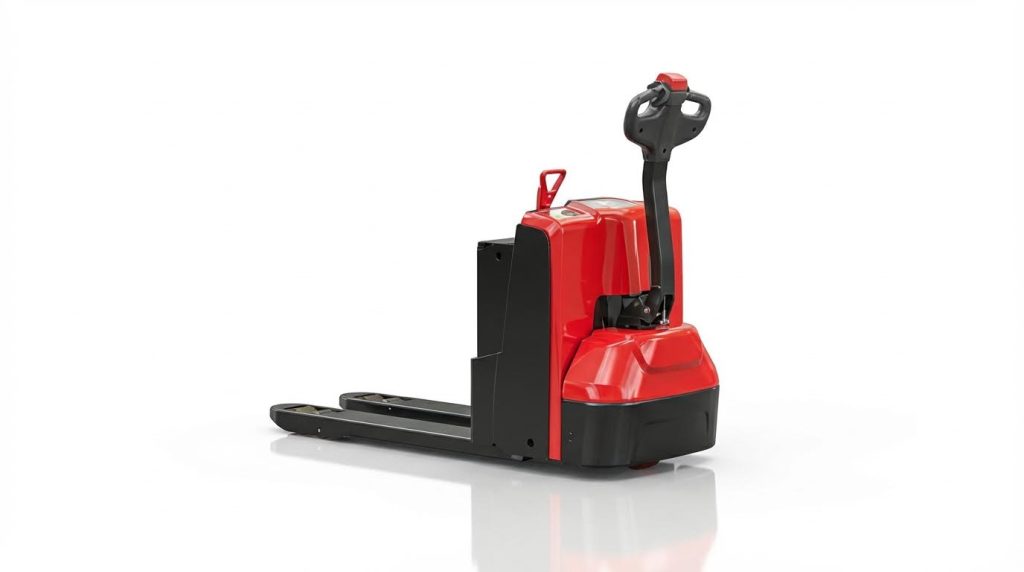
Operations that ask whether a pallet jack will pallet jack lift a specific load need clear engineering rules, not guesswork. This article walks through how to define real load weight, interpret rated capacity, and apply safety margins so the answer is based on numbers, not hope.
You will see how fork height, service range, and elevation limits decide if a low-lift pallet jack is enough or if a stacker or pallet cart is required. The guide also explains how fork length and width must match Euro, US, and specialty pallet standards to avoid damaged pallets and stuck trucks.
Using typical hand pallet truck data, capacity charts, and pallet standards, the full outline builds a simple method: check weight, height, and pallet fit in order. By the end, you can verify in a few steps whether a given pallet jack will pallet jack lift your load safely and efficiently in your plant layout.
Defining Load, Capacity, And Safety Margins
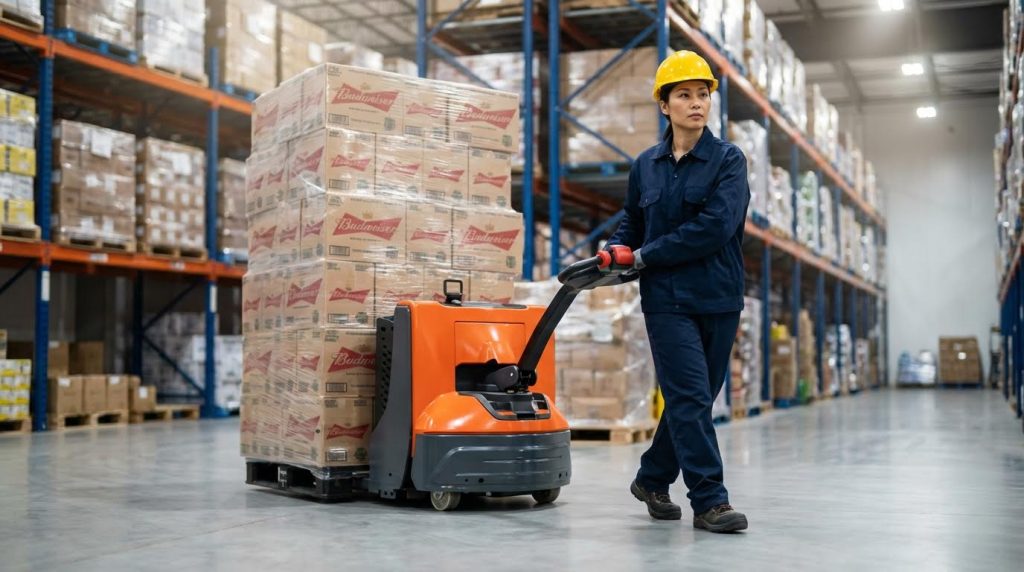
Anyone asking if a hand truck or jack will pallet jack lift a given load must define that load correctly. Engineers look beyond the label weight and consider pallets, packaging, and how the weight sits on the forks. This section explains how rated capacity, load center, and safety margins interact. It also shows how floor and ramp conditions change the real answer to the question “will pallet jack lift this safely?”.
Net Load Vs. Pallet, Packaging, And Accessories
Capacity checks must start with gross load, not just product weight. A typical warehouse pallet jack with 5,500 lb (about 2,500 kg) rating can overload fast if you ignore the pallet and packaging. Timber pallets often add 15–25 kg, and heavy-duty crates or steel stillages add more. Stretch wrap, corner posts, and dunnage also increase mass and shift the center of gravity.
To decide if a unit will pallet jack lift your load, build a simple mass breakdown:
- Product: label or weighed value
- Pallet or skid: catalog or measured mass
- Packaging and restraints: estimated or sample weighed mass
- Any mounted accessories or fixtures
Compare the sum to the rated capacity and leave a margin. For example, a 900 kg product can become 1,000–1,050 kg once you add pallet and packaging. That difference can move a load from safe to borderline on smaller trucks.
Understanding Rated Capacity And Load Center
Rated capacity answers only one part of the will pallet jack lift question. It assumes a defined load center and fork support. For manual pallet jacks, the rating, such as 5,500 lb, normally applies with a standard pallet fully supported along 48 inch forks. The effective load center then sits near the fork heel and between the wheels, where the frame and hydraulic unit are strongest.
When the load center shifts forward or sideways, effective capacity drops. This shift happens if the pallet is too long for the forks, if the load overhangs far in one direction, or if heavy items sit at one end. Industrial truck standards showed that longer load center distances always reduce usable capacity. This follows simple lever physics: more distance creates more overturning moment on the wheels and chassis.
Operators should keep the heaviest part of the load close to the fork heel and evenly spread across both forks. If the load geometry forces a long overhang, treat the nameplate capacity as optimistic and apply extra reduction before deciding the jack will pallet jack lift that configuration.
Applying Practical Safety Factors For Real Loads
Static nameplate ratings do not cover real handling forces. Pulling, pushing, cornering, and braking create dynamic loads well above the static weight. Industry practice used safety margins between 10% and 35% depending on duty. For light pallets under about 700 kg, a 10–15% margin often worked. Medium and heavy pallets, or high-traffic use, justified 25–35% margins.
To apply this in the field, first calculate the maximum realistic gross load, including pallet and packaging. Then add a safety factor:
- Low intensity, short moves: +10–15%
- Mixed duty, frequent moves: +20–25%
- Heavy duty, congested or high-traffic areas: +30–35%
Choose equipment with rated capacity at or above this adjusted value. This approach answers the will pallet jack lift question in a conservative, defendable way. It also reduces frame fatigue, wheel damage, and hydraulic wear over time.
Effects Of Floor, Ramps, And Environment On Capacity
Even if the numbers say yes, conditions on site may say no. Manual pallet jacks with 5,500 lb capacity assume firm, level, smooth floors. Rough concrete, expansion joints, or soft asphalt increase rolling resistance and required pull force. The example unit needs about 75 lb pull when fully loaded on good floor. That force rises sharply on damaged or dirty surfaces, which can make a “within capacity” load impractical or unsafe for one person.
Ramps and dock plates change the will pallet jack lift answer again. On an incline, the operator must overcome gravity along the slope plus rolling resistance. Small steering wheels, around 170–200 mm diameter, and load rollers near 70–90 mm diameter, struggle with steep or broken transitions. In wet, icy, or dusty areas, traction drops and stopping distance grows, so engineers should treat nameplate capacity as an upper limit and apply extra reduction.
Temperature and corrosion also matter. Extreme cold stiffens seals and increases oil viscosity in hydraulic units. High heat and chemicals degrade tires and bushings. In such environments, a further 10% capacity margin is common engineering practice before concluding that a given jack will pallet jack lift a specified pallet safely and repeatedly.
Fork Height, Service Range, And Lift Requirements
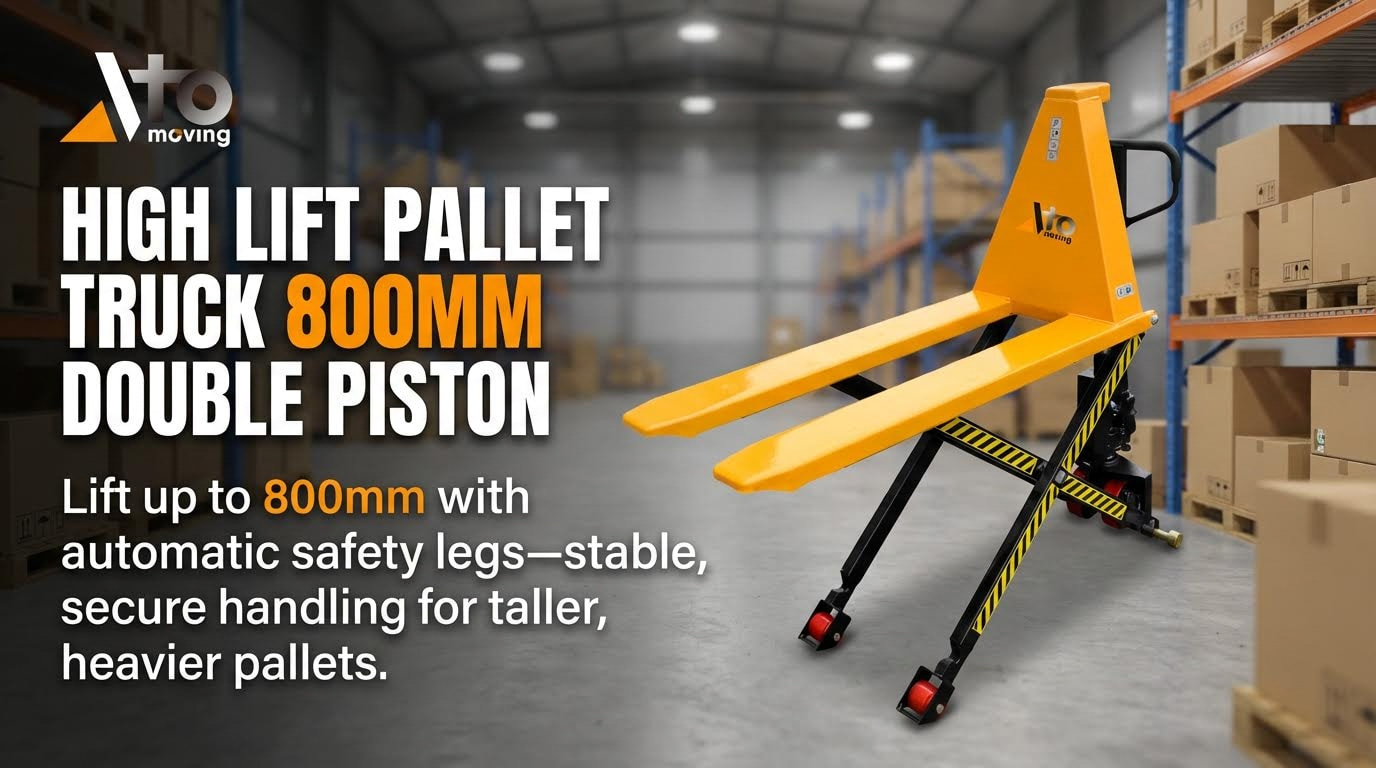
Fork height and service range decide if a pallet jack will pallet jack lift a load safely. Engineers must match minimum and maximum fork heights to pallet design, floor conditions, and required lift tasks. Rated capacity only holds inside this service window. Outside it, stability, effort, and component life all change.
Minimum Fork Height And Pallet Entry Clearance
Minimum fork height controls how easily the forks enter a pallet. A common hand pallet jack offers a service range from about 73 mm to 197 mm. That minimum height must be lower than the pallet’s underside clearance. Standard wooden pallets usually give roughly 90 mm entry height, but damaged boards reduce this.
To check if the pallet jack will pallet jack lift your load without jamming, compare three dimensions:
- Minimum fork height vs. pallet underside opening
- Fork tip thickness vs. lead-in chamfer on the pallet
- Nose wheel diameter vs. pallet ramp profile
Nose wheels at each fork tip help the unit climb into the pallet but also need space. If floors are uneven, add extra clearance margin to avoid striking deck boards. Poor entry increases push force, risks pallet damage, and can shift the center of gravity suddenly.
Maximum Fork Height And Required Lift Range
Maximum fork height defines how far the pallet clears the floor. A typical pallet jack raises from about 73 mm to 197 mm, which suits floor transport and short transfers. This range lifts most pallets 25 mm to 50 mm clear, enough to roll over flat slabs and small joints. It is not meant for stacking.
When you ask if a pallet jack will pallet jack lift a specific task, list the required clearances:
- Floor joints, dock plates, and thresholds
- Truck beds or conveyor infeed levels
- Ramps and localized dips
If required lift exceeds the 197 mm class, a high-lift pallet truck or pallet cart becomes necessary. Over-lifting to “make it work” by tilting or blocking is unsafe and raises tip-over risk. Always confirm that full rated capacity still applies at the top of the jack’s stroke.
Load Center Changes With Elevation Height
Even though a pallet jack only raises a few hundred millimetres, elevation still shifts the effective load center. As the forks rise, the combined center of gravity of truck and load moves upward. This reduces lateral stability, especially on slopes, rough floors, or during sharp turns. The effect is stronger with tall or uneven loads.
For low lift trucks, designers assume a horizontal load center located near mid-fork length. Capacity ratings use this fixed distance. However, real use adds dynamic forces from pushing, pulling, and stopping. To keep the pallet jack will pallet jack lift performance within safe limits, operators should:
- Keep forks at the lowest height that still rolls freely
- Reduce speed with tall or unwrapped loads
- Avoid side pulls or diagonal travel on slopes
These habits limit overturning moments and keep bearings, axles, and the hydraulic unit within design loads.
When A Stacker Or Pallet Cart Is Needed
A hand pallet jack only supports ground-level moves. It does not place loads on shelves, mezzanines, or high truck beds. When the job needs vertical positioning, a stacker or pallet cart becomes the correct tool. The key question is not only “will pallet jack lift this weight” but “will it lift it to the height I need.”
Pallet carts with winch lift offer service ranges from about 32 mm up to over 3,000 mm, depending on fork orientation. They handle lighter loads, typically 160 kg to 225 kg, but give precise placement for office equipment, small skids, or fixtures. Electric or manual stackers cover higher capacities and lift heights from roughly 2,500 mm to 4,500 mm and beyond.
Use a decision path:
- Only floor moves, no stacking: pallet jack
- Light loads, mixed tasks, moderate heights: pallet cart
- Regular racking or truck loading at height: stacker
Choosing the right class of equipment keeps forces within design limits, reduces operator strain, and prevents using a pallet jack in roles it cannot safely fill.
Matching Fork Dimensions To Pallet Standards
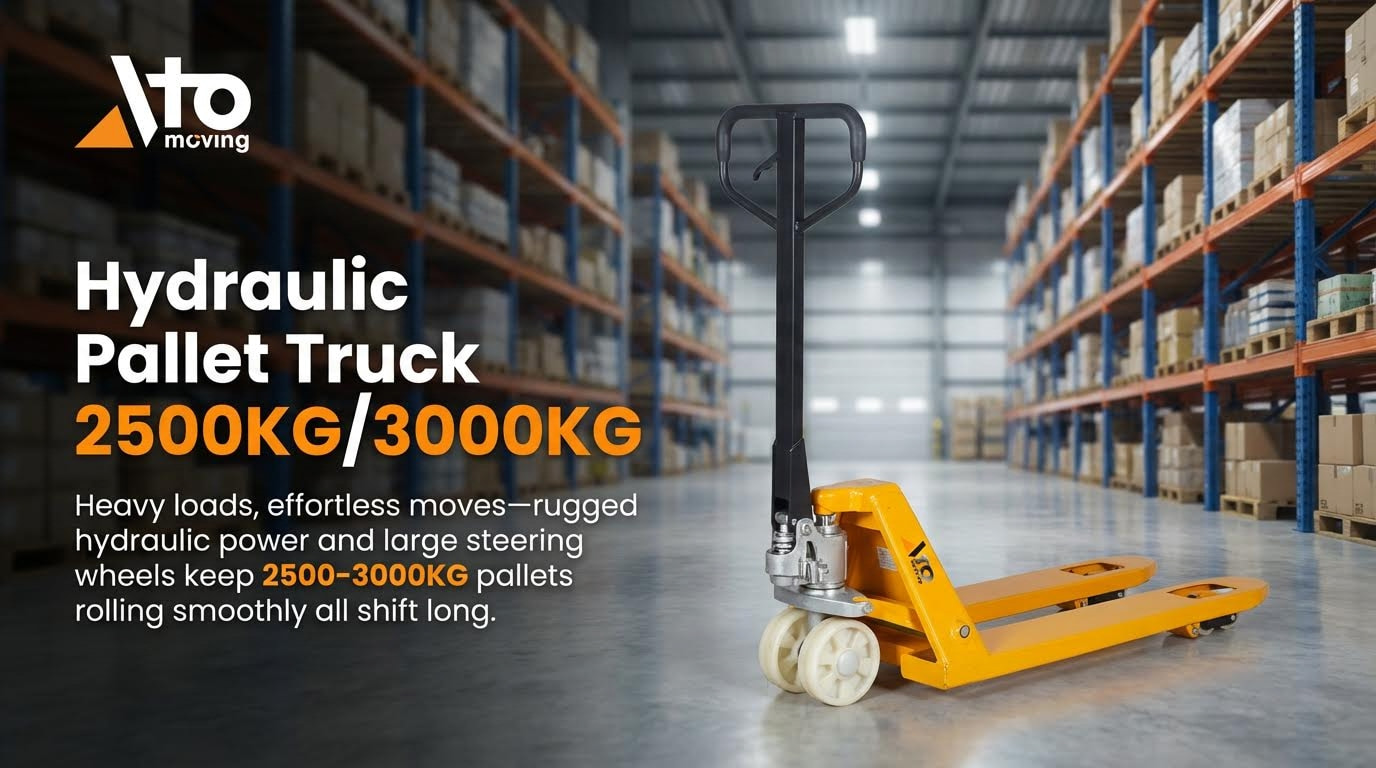
Fork dimensions decide if a pallet jack will pallet jack lift a load safely or not. The key checks are fork length, fork width, and pallet opening layout. When these match, the load stays supported along the full depth and the truck rolls without binding. When they do not, operators see dragging forks, broken deck boards, and unstable loads.
Fork Length Vs. Pallet Depth And Support
Fork length must match pallet depth close enough to support the full stringer span. For most warehouse work, 1,150 mm or 48 inch forks handle standard Euro and US pallets. Shorter forks, such as 915 mm or 36 inch, suit half pallets or tight aisles but reduce support length.
If forks are much shorter than pallet depth, the deck overhangs and can fail under heavy loads. If forks are much longer, tips can punch through stretch wrap or hit racks behind the target pallet. A simple rule helps: keep fork tips within about 25–50 mm of the pallet’s far edge at full entry.
| Pallet depth | Recommended fork length | Typical use |
|---|---|---|
| 800–1,000 mm | 1,000 mm | Euro or UK pallets, side entry |
| 1,200 mm / 48 in | 1,150 mm or 48 in | Full pallets, front entry |
| >1,300 mm | 1,500–1,800 mm | Long or double pallets |
Fork Width Vs. Pallet Stringer And Opening Size
Fork width across the outer edges must suit the pallet’s stringer spacing. Narrow 520 mm (20.5 in) jacks fit Euro pallet openings. Wider 685 mm (27 in) jacks fit GMA and UK GKN pallets but jam in Euro pallets.
To know if a given pallet jack will pallet jack lift your pallet, check three dimensions:
- Overall fork width vs. clear distance between outer stringers.
- Individual fork width vs. opening width under the deck.
- Gap between forks vs. central stringer location.
If forks sit hard against stringers, entry force rises and deck boards crack. Correct width lets the nose wheels run cleanly in the under-deck tunnels without rubbing.
Common Euro, US, And Specialty Pallet Sizes
Standard pallet families give a good starting point when sizing forks. Common patterns include:
- Euro pallet (Eur/EPAL): 1,200 × 800 mm. Typical jack: 520 mm wide, 1,150 mm long.
- UK GKN / Chep: 1,200 × 1,000 mm. Typical jack: 685 mm wide, 1,000 mm long.
- US GMA: 48 × 40 in (≈1,219 × 1,016 mm). Typical jack: 27 in wide, 48 in long.
Specialty pallets for drums, long crates, or two-row picking may need 60 in or 72 in forks. In those cases the longer forks shift the load center forward. That reduces the effective capacity the pallet jack will pallet jack lift, even if the rated capacity seems high enough.
Checking Compatibility With Open And Closed Pallets
Deck style also decides if a pallet jack will pallet jack lift the load. Open-bottom pallets or skids have clear tunnels for nose wheels and load rollers. Closed-bottom or full-perimeter pallets may block the rollers and stop fork entry.
Before deployment, check one pallet of each type in the fleet. Verify that:
- Nose wheels pass the entry chamfer without lifting the pallet.
- Load rollers sit fully under the deck at the parked position.
- Forks clear bottom boards or perimeter runners at full lift height.
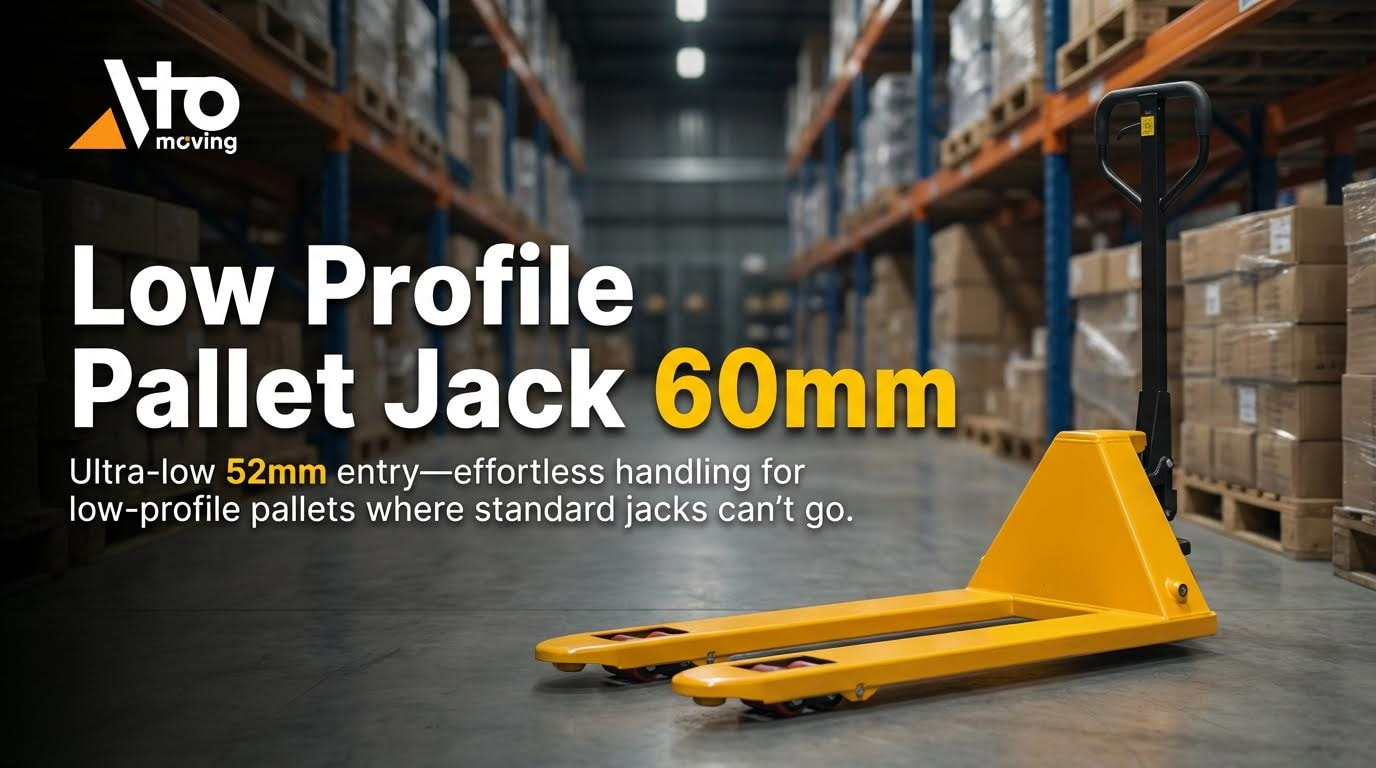
Closed pallets sometimes need low-profile jacks with lower minimum fork height. If the fork tips ride on wood instead of under it, the jack will not pallet jack lift the load safely, even if the weight is within the rated capacity.
Summary: Verifying A Pallet Jack Will Lift Your Load
Answering the question “will pallet jack lift this load” needs more than a quick weight check. You must confirm weight, pallet fit, fork service range, and path conditions as one system. This section pulls together the earlier points into a simple verification method for engineers, supervisors, and buyers.
First confirm total weight. Add product, pallet, packaging, and strapping. Compare this number to the pallet jack rating, such as 2,500 kilograms or 5,500 pounds. Keep a safety margin of at least 10–20% below the rated capacity for real-world conditions, slopes, and floor defects.
Next check fork geometry. Fork length must support the pallet depth, while overall fork width must match the pallet type. For example, a 20.5 inch wide × 48 inch long fork fits Euro-style footprints, while 27 inch wide × 48 inch long forks suit standard GMA pallets. Make sure the minimum fork height is lower than the pallet entry height and the maximum height is enough to clear rack beams, dock plates, or truck beds.
Finally review the route and task. Short, level moves with low stacking needs favor a manual pallet jack. If you must lift higher, work on ramps, or handle tall, offset loads, a pallet cart or stacker may be safer. In every case, the pallet jack will lift the load only when weight, geometry, and environment all stay inside the limits shown on the data plate and in the manual.
,
Frequently Asked Questions
How much weight can a standard pallet jack lift?
A standard pallet jack typically has a lifting capacity ranging from 5,000 to 5,500 pounds (approximately 2,268 to 2,495 kilograms). However, the exact capacity depends on the specific model and manufacturer. For specialized tasks, some heavy-duty pallet jacks can handle up to 10,000 pounds (about 4,536 kilograms). Pallet Jack Weight Guide.
Can a pallet jack lift a car?
No, a pallet jack is not designed to lift a car. While it can handle heavy palletized loads, it lacks the structural strength and stability required for lifting vehicles. Attempting to lift a car with a pallet jack could damage the equipment or cause injury. Pallet Jack Safety Guide.
What are the common problems with pallet jacks?
Common issues include squeaky wheels, stiff steering, difficulty lifting loads, uneven lifting, fork rollover, wheel lockup, hydraulic fluid leaks, and misaligned forks. Regular maintenance and proper use can help prevent these problems. If you notice persistent issues, consult the manufacturer’s guidelines or seek professional repair services.
What should you never do with a pallet jack?
Never exceed the posted load capacity, place hands or feet under the pallet jack, or pull heavy loads instead of pushing them. These actions can lead to accidents, injuries, or equipment damage. Always move loads slowly and ensure the path is clear of obstacles. Pallet Jack Safety Tips.