Safe palletizing of 55-gallon drums is the engineered process of arranging, securing, and handling drums on pallets so they survive transport without shifting, leaking, or violating regulations. When people search for how to palletize 55 gallon drums, they are really trying to avoid tip-overs, crushed pallets, and rejected hazardous shipments. This guide walks through drum and pallet dimensions, drum patterns, dunnage and restraints, floor and racking limits, and the equipment and compliance rules that govern drum palletization. By the end, you will know exactly how many drums fit per pallet and trailer, how to strap and wrap them, and how to keep operators and facilities within OSHA, NFPA, and transport-code limits.
Core Principles Of Palletizing 55-Gallon Drums
Core palletizing principles for 55-gallon drums focus on drum size, pallet fit, and standard load counts so you can control stability, ground pressure, and regulatory limits every time you plan how to palletize 55 gallon drums.
Drum dimensions, pallet sizes, and fit
Drum and pallet fit determines whether a 2×2 drum pattern is stable, free of overhang, and compatible with your floor, racking, and trailer footprint when deciding how to palletize 55 gallon drums safely.
Defines load capacity and resistance to moisture and impact.
Cracked boards or soft wood increase tipping risk and can fail under > 800 kg drum loads.
When you plan how to palletize 55 gallon drums, always confirm the actual outside diameter and chime condition of the drums you receive. Dented or out-of-round drums reduce contact area and create rocking points.
Use sheet goods (plywood, heavy corrugated) if pallet deck gaps exceed 20 mm, or if you’re shipping hazardous liquids where chime damage is unacceptable. This spreads the contact pressure and improves friction between drum and pallet.
How to quickly check drum fit on a pallet (practical method)
Measure the drum diameter across the widest chime with a tape; multiply by 2 and compare to the pallet’s narrow side. If the sum is within 15–25 mm of the pallet width, you’ll have a tight but workable 2×2 fit. Anything looser demands more dunnage and strapping discipline.
💡 Field Engineer’s Note: Always test-fit the first pallet of a new drum batch on your worst pallet. Minor swelling in plastic drums plus a rough deck can suddenly turn a “theoretical fit” into a pallet where operators must hammer drums into place—slowing throughput and increasing damage risk.
Standard drum counts per pallet and trailer
Standard drum counts translate individual drum dimensions into pallet and trailer loading patterns so you can forecast capacity, axle balance, and stacking limits when defining how to palletize 55 gallon drums for real operations.
Load Type
Typical Count / Limit
Key Constraints
Field Impact
Drums per pallet (standard)
4 drums (2×2 layout) on a 1,219 × 1,016 or 1,000 × 1,200 mm pallet 4-drum configuration
Drum diameter vs. pallet width; edge clearance; deck gaps.
Baseline pattern for stability and easy handling with pallet jacks and forklifts.
Mass per fully loaded drum
≈ 270 kg (≈ 600 lbs) for typical liquid-filled plastic drums drum weight
Product density and drum material.
Four drums can exceed 800 kg per pallet; verify pallet and floor ratings.
Higher stacks require engineering verification and documented procedures.
Sprinkler clearance (OSHA / NFPA practice)
≥ 457 mm (18 in) below sprinkler deflectors for top of load sprinkler clearance
Fire code and insurance requirements.
Can limit stacking height even if pallets and drums could carry more weight.
For outbound planning, start with your target trailer count (for example 208 drums for a 53 ft trailer) and work backward to pallets and storage lanes. This keeps warehouse slotting aligned with transport efficiency.
In storage, treat every 4-drum pallet as a concentrated point load of > 800 kg. Check your floor slab and racking documentation; many general-purpose racks are not rated for drum pallets without full-depth support or wire mesh decking.
Quick capacity planning checklist for drum shipments
Confirm drum mass: Use product density to estimate kg per drum, then multiply by 4 for pallet load.
Check pallet rating: Ensure rated capacity exceeds your calculated pallet load with a safety factor.
Validate stacking plan: Verify floor or rack capacity and fire code clearance before deciding 1-high vs 2-high stacks.
Trailer layout: Model pallet rows and axle balance rather than only counting drums.
💡 Field Engineer’s Note: The most common mistake I see is copying a “208 drums per trailer” rule of thumb without checking actual product density. Heavy chemicals can quietly push axle loads over legal limits even when drum counts look fine on paper.
Engineering Drum Patterns, Dunnage, And Restraints
Engineering drum patterns, dunnage, and restraints means designing how four 55‑gallon drums sit on a pallet, what supports them, and how they are tied down so the unit load cannot shift or collapse.
When you think about how to palletize 55 gallon drums safely, this section is where stability is actually engineered into the load. Drum pattern, dunnage, and restraint work together: the pattern controls geometry, dunnage controls contact and load paths, and restraints lock everything into one rigid unit.
💡 Field Engineer’s Note: Most drum failures I see are not from “bad pallets” but from missing dunnage under the chimes or weak banding—loads look fine on the dock and then walk apart after 200 km of vibration.
2×2 drum layouts and stacking configurations
2×2 layouts and stacking configurations define how four drums sit on a pallet and whether you safely add a second layer without exceeding pallet, floor, or stability limits.
A standard 2×2 pattern places four 55‑gallon drums on a square or near‑square pallet, typically 1,219 × 1,016 mm (48 × 40 in) or 1,219 × 1,219 mm (48 × 48 in). Drums with diameters around 572 mm fit tightly in this pattern with minimal edge clearance, which is why four‑drum clusters are the industry default for how to palletize 55 gallon drums. Four 55‑gallon drums are routinely loaded on a 48 × 48 in pallet, forming a stable 2×2 cluster.
Caps maximum pallet stack height regardless of pallet or drum compressive strength.
How to choose between single‑ and double‑layer drum stacking
Single‑layer 2×2 pallets are preferred for mixed handling (forklifts, pallet jacks, conveyors) and long transport routes. Double‑layer patterns are reserved for robust drums, short moves, and where pallet and slab capacities are verified.
Dunnage design: wood, foam, and paper systems
Dunnage design for drums combines wood, foam, and paper elements to bridge pallet gaps, cushion impacts, and lock 55‑gallon drums against rocking or shifting during transport.
Wood dunnage (structural support): Planks or sheets span pallet deck gaps below drum chimes, converting an open‑deck pallet into a near‑solid surface and providing a reliable load path into the pallet blocks or stringers.
Plywood or OSB sheets: Full sheets on top of the pallet deck distribute the concentrated drum loads and standardize friction, especially when pallet boards are worn or mis‑spaced.
Foam pads or rings: High‑density foam around or under chimes damps vibration and minor shocks, protecting plastic and fiber drums in long‑haul or export shipments.
Corrugated pads: Flat corrugated sheets between drums and between tiers reduce steel‑on‑steel contact, protecting chimes and coatings while adding friction to resist sliding.
Honeycomb blocks and cells: Paper honeycomb units fill gaps between drums and between drums and pallet edges, preventing “walking” during vibration.
Overpack slipcovers: 2‑ or 3‑ply corrugated full‑height covers wrap the entire drum cluster and pallet, protecting against dents and abrasions and creating a smooth surface for strapping and wrap.
Top and interlayer sheets: Fiberboard, plywood, or molded plastic trays between drum layers spread contact pressure and prevent chime damage when drums are double‑stacked.
Where dunnage saves money in real operations
Well‑designed dunnage reduces drum rejections from dented chimes, leaking closures, or abrasion damage. It also cuts rework time because pallets arrive intact instead of leaning or broken apart in the trailer.
💡 Field Engineer’s Note: If you hear drums “click” or rock when a pallet truck stops, you have a dunnage problem—either gaps under the chimes or missing gap fillers between drums.
Strapping, banding, stretch wrap, and top caps
Strapping, banding, stretch wrap, and top caps work together to turn four loose drums and a pallet into a single, rigid unit load that can survive forklift handling and road vibration.
Protects against dents/abrasions and provides a flat surface for wrap and labeling.
Stretch wrap type
Machine‑grade or high‑performance hand film with proper pre‑stretch and tension (supplemental)
Adds containment and dust protection but does not replace strapping for heavy drums.
Wrap pattern
Anchor to pallet deck, then spiral upward with ≥50% overlap and 2–3 tight containment bands at mid‑height and near top chime
Creates a continuous membrane that resists lateral drift and keeps drums pressed together.
Top caps
Corrugated, plywood, or high‑density fiberboard sheets on top of drums for load spreading
Distributes vertical loads from stacking or tie‑down straps and protects closures from impact.
Minimum securing standard (example)
At least two unbreakable straps per pallet; vertical banding of slipcover to pallet; full slipcover coverage in some carrier rules
Meets typical carrier and dangerous goods requirements and reduces claims from load shift.
Why stretch wrap alone is not enough for drums
Stretch wrap is designed for friction and light containment, not for stopping 800+ kg of liquid mass under emergency braking. Without straps or bands, drums can shear through the film and leave the pallet entirely.
💡
Facility, Equipment, And Compliance Considerations
Facility, equipment, and compliance considerations define how many drum pallets your floor, racking, and forklifts can safely handle when deciding how to palletize 55 gallon drums without exceeding structural or regulatory limits.
When you plan how to palletize 55 gallon drums, you must treat each pallet as a concentrated point load, not a uniform box. Four filled drums on one pallet often exceed 800 kg (≈1,760 lbs) and create high contact pressure through the drum chimes and pallet stringers, which directly affects slab design, racking beams, and equipment selection. Fire codes and hazardous-material rules then cap how high and how dense you can store those pallets, even when the concrete and steel could theoretically take more.
💡 Field Engineer’s Note: Drum pallets feel “light” to a counterbalance truck, but they are brutal on marginal floors and racking. I always verify slab ratings and beam capacity before approving any multi-tier drum stacking plan.
Floor loads, racking, and stacking limits
Floor loads, racking, and stacking limits control how many drum pallets you can safely store per bay and how high you can stack them before exceeding slab capacity, beam ratings, or fire-code clearance requirements.
Determines point load on the slab and racking; directly affects how many pallets can sit in one bay.
Pallet support requirements in racking
Full-depth support or wire decking recommended under drum pallets
Racking introduces additional limits and often requires full-depth support or decking for drum pallets to prevent deck-board failure
Prevents pallet deck boards from punching through between beams and reduces risk of drum tilt or collapse.
Typical stacking practice
Operations rarely exceed two pallet loads high
Stacking patterns for 55-gallon drums note that facilities “rarely exceed two pallet loads high” because of stability and floor ratings even when drums are robust
Sets a practical maximum stack height in bulk storage and staging areas, especially for liquids.
Fire-sprinkler clearance
Maintain at least 457 mm (18 in) below sprinkler deflectors
Helps planners size outbound loads and balance axle weights for dense, liquid-filled shipments.
From an engineering standpoint, the key is to treat each drum pallet as a concentrated load path: drum chimes → pallet deck boards → stringers/blocks → floor or rack beams. For wood pallets, you consider deck-board thickness, nail patterns, and moisture content, because these factors control how much concentrated drum load the pallet can safely transfer without cracking or excessive deflection. Where slab ratings are marginal, spreading pallets across more bays or using load-distribution panels under racks can keep bearing pressures within design limits.
How to check if your floor can handle drum pallet storage
To validate drum storage against your slab, you compare the pallet footprint (e.g., 1,219 mm × 1,016 mm) and loaded mass (often >800 kg) to the floor’s kN/m² rating. You then factor in dynamic loads from forklifts and add a safety factor consistent with local building codes and occupational regulations.
Handling equipment and automation options
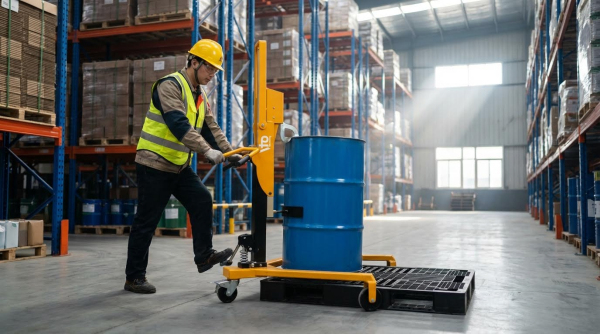
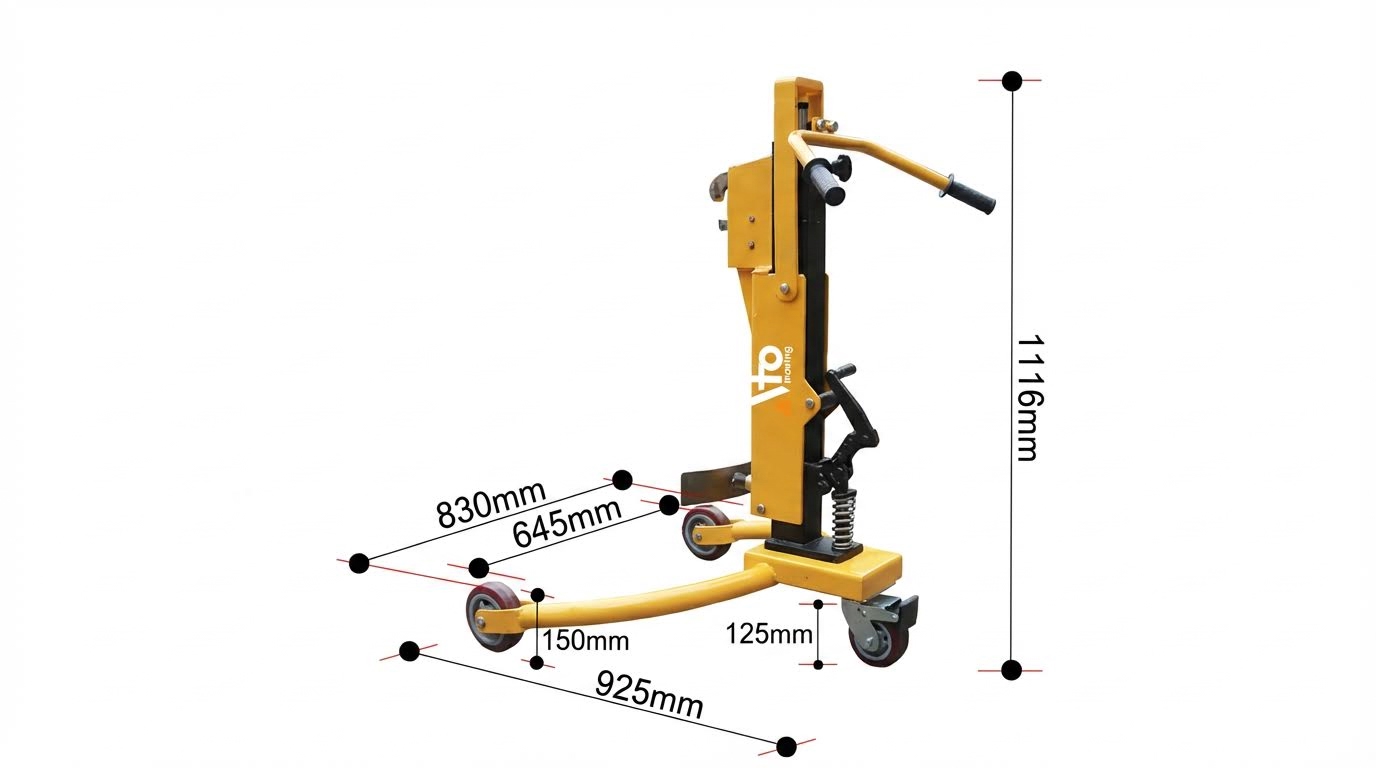
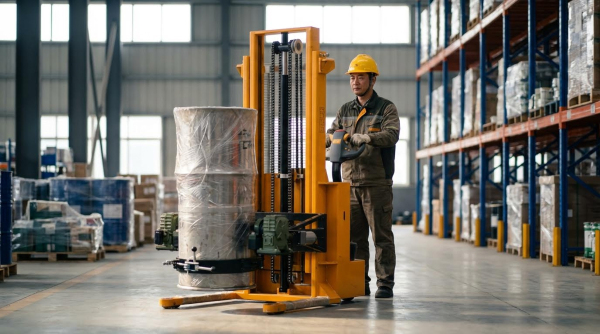
Handling equipment and automation options determine how safely and efficiently operators can move heavy drum pallets, from manual forklifts up to robotic palletizers that can place multiple 55-gallon drums per minute.
Equipment / System
Typical Capability / Characteristic
Source Detail
Field Impact When Palletizing 55-Gallon Drums
Counterbalance forklift with drum pallets
Handles >800 kg pallet loads of four drums
Four-drum pallets frequently exceed 800 kg and must be checked against pallet and equipment ratings before handling
Requires forklifts with adequate rated capacity at the operating load center; under‑sized trucks risk tip-over or mast damage.
Drum-specific attachments (clamps, grippers)
Grip individual drums for picking/placing onto pallets
Drum palletizing guidance emphasizes securing drums and preventing rocking or chime damage with proper support surfaces and restraints during handling
Improves control when building or breaking pallets, reduces impact loads, and cuts cosmetic and structural damage to the drum body.
Enables consistent, high-rate pallet building while keeping operators out of the immediate hazard zone around moving drums.
Safety devices on automated cells
Light curtains, interlocked gates, defined safe zones
Automated drum palletizing systems incorporate light curtains and interlocked access doors to prevent operator injury during operation while maintaining throughput
Supports compliance with machine-safety regulations and reduces reliance on administrative controls alone.
Manual banding and wrapping stations
Use at least two straps and full-height slipcovers where specified
Guidance for palletizing 55-gallon drums calls for a minimum of two metal or unbreakable plastic straps per pallet, plus 2‑ or 3‑ply overpack slipcovers for impact protection
Defines the minimum restraint hardware and materials that banding and wrap equipment must tension and secure reliably.
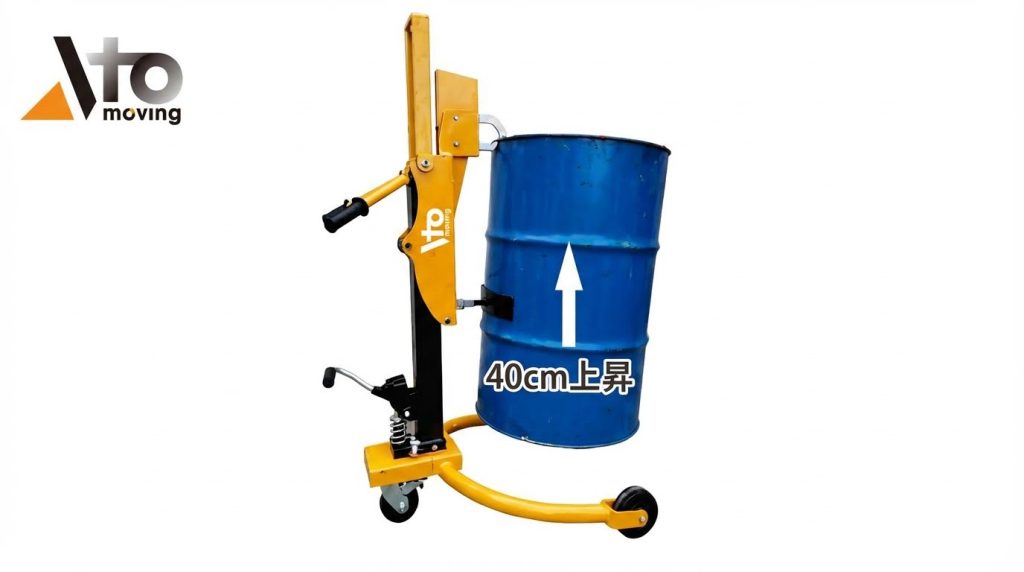
When you decide how to palletize 55 gallon drums in a new or existing facility, match your equipment strategy to both load geometry and regulatory exposure. For lower volumes, standard counterbalance forklifts with drum attachments and well-designed manual banding/wrapping stations may be sufficient, provided operators follow PPE and safe-lifting rules. For higher volumes or hazardous contents, automated gantry palletizers with integrated safety controls can deliver consistent patterns, correct strap placement, and repeatable film application, while keeping people outside the high-risk envelope.
When does drum palletizing justify automation?
Automation becomes attractive when you routinely handle enough drums that manual pallet building constrains throughput or drives ergonomic injuries. If a gantry-style system placing up to five drums per minute can absorb your peak demand and your facility can dedicate floor space for guarding and infeed/outfeed conveyors, the ROI often comes from reduced labor, fewer load failures, and improved compliance documentation.
Final Recommendations For Drum Palletization Safety
Safe drum palletization depends on how geometry, structure, and restraints work together. Drum diameter and pallet size set the 2×2 pattern and edge clearance, which control center of gravity and tipping risk. Dunnage then turns open pallets into continuous bearing surfaces so chime loads flow safely into stringers, racks, and slabs.
Straps and bands do the real containment work. Always band the four‑drum cluster first, then tie the load to the pallet with vertical bands. Use top caps, slipcovers, and stretch wrap as supplements, not substitutes, for structural restraint. Treat every four‑drum pallet as a concentrated load above 800 kg and verify slab ratings, racking support, and sprinkler clearance before stacking.
Match handling equipment and automation to this engineered load. Forklifts, drum attachments, and robotic palletizers must all be rated for the worst‑case mass and load center. For most sites, the safest standard is simple: four drums per pallet, two pallets high at most, full-depth rack support, engineered dunnage, and documented banding and wrap procedures.
Operations and engineering teams should lock these rules into standard work, training, and audits. When in doubt, reduce stack height, add dunnage, upgrade restraints, or consult Atomoving for equipment that enforces safe patterns by design.
Frequently Asked Questions
How many 55 gallon drums can fit on a pallet?
A standard 48×48 inch pallet can hold up to four 55-gallon drums without any overhang. This configuration is widely used in material handling for stability and safety during transport. Palletizing Drums Guide.
Can you stack 55 gallon plastic drums?
Yes, 55-gallon plastic drums can be stacked, but it depends on their design and load-bearing capacity. Always check the manufacturer’s stacking guidelines to ensure safety and prevent damage. Drum Stacking Safety.
What are some tips for safely palletizing 55 gallon drums?
To safely palletize 55-gallon drums, follow these steps:
Ensure the pallet is on a flat, stable surface.
Position drums tightly together to prevent movement.
Use straps or shrink wrap to secure the drums to the pallet.
Avoid overhangs to maintain balance during transport.