
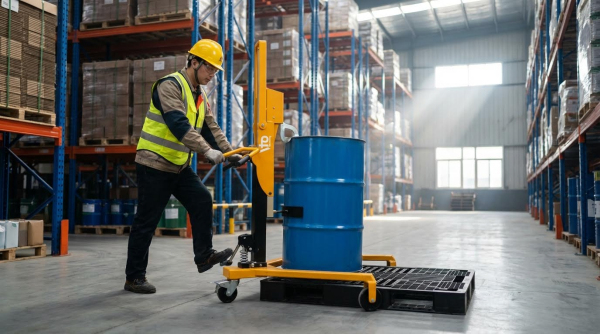
Drum spill pallets are engineered secondary containment platforms that capture leaks and spills from drums and IBCs, preventing hazardous liquids from reaching the floor, drains, or soil. If you’re asking “what are drum spill pallets” in a practical sense, they are your primary compliance tool for meeting secondary containment rules like the 10% / 100% volume requirements and environmental regulations on hazardous liquids. This guide explains what drum spill pallets are and why they matter, how they differ from spill decks and IBC pallets, the key design and material choices, and how to size and lay them out correctly for your facility. By the end, you’ll know how to select systems that are safe, compliant, and efficient to handle in real-world warehouse and plant operations.
What Drum Spill Pallets Are And Why They Matter
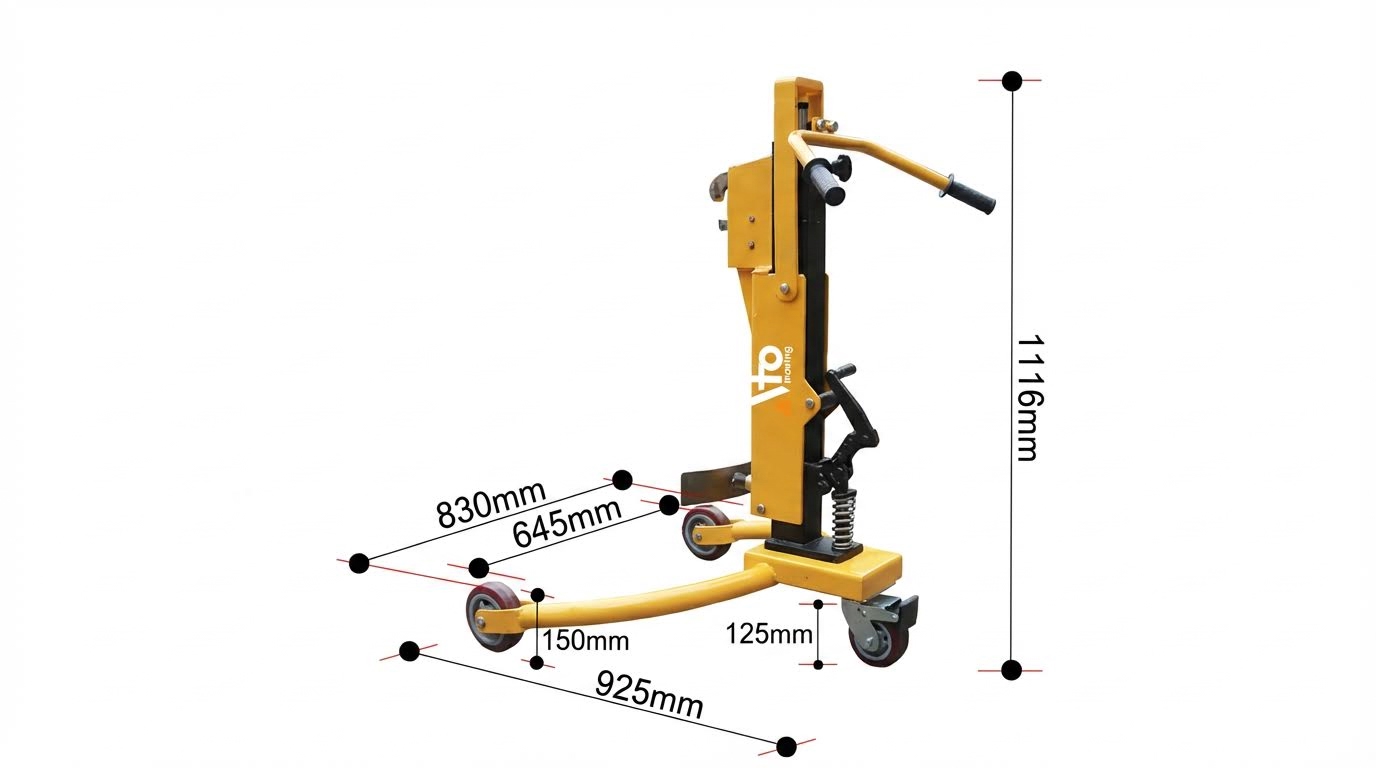
Drum spill pallets are engineered secondary-containment platforms placed under drums and IBCs to catch leaks, drips, or catastrophic failures so hazardous liquids never reach your floor, drains, or soil.
When people ask “what are drum spill pallets,” they are really asking how to keep leaks from becoming environmental incidents or regulatory violations. A spill pallet is a safety device with an integrated sump that contains leaked liquids from drums, IBCs, or smaller containers, preventing contamination of the workplace and environment and supporting compliance with spill-prevention regulations. Spill pallets are explicitly designed as secondary containment for oils, chemicals, and other hazardous liquids, so they sit between your process and a reportable spill.
💡 Field Engineer’s Note: Treat every drum area as if a drum will eventually fail; the only real question is whether the liquid ends up in a controlled sump or in your stormwater system.
Core function and safety role
The core function of a drum spill pallet is to provide a built-in containment sump under drums so any leaks stay inside a controlled volume that meets secondary-containment rules like the 10% / 100% capacity requirement.
A spill pallet is essentially a robust platform with a grated top and a sealed sump underneath that captures leaks and drips from stored drums and containers. The grate keeps drums stable and above the liquid, while the sump holds the spilled volume safely out of traffic areas. This design prevents hazardous liquids from spreading across floors, reaching drains, or soaking into soil, which is critical for both worker safety and environmental protection. Regulators treat these units as secondary containment systems, so they are a front-line control for compliant drum storage.
Secondary-containment rules typically require that the sump volume must hold at least 10% of the total volume stored on the pallet or 100% of the largest single container, whichever is greater. For example, four 55-gallon (≈200 L) drums require a pallet sump of at least 55 gallons (≈200 L), because that equals 100% of the largest drum volume. Similar capacity rules appear in environmental and workplace hazardous-substance regulations, which is why correctly sized spill pallets are a compliance tool, not just “nice-to-have” safety gear.
- Leak and drip capture: Catches slow leaks around bungs, pump connections, and hose couplings that would otherwise spread across floors.
- Catastrophic failure buffer: Provides a containment “bathtub” if a drum is punctured or dropped during handling.
- Regulatory compliance: Helps satisfy secondary-containment requirements for hazardous liquids in many jurisdictions, including 10% / 100% volume rules and similar 25% / 110% rules in some regions. Some guidance specifies 110% of the largest container or 25% of the total volume, whichever is greater.
- Worker safety and housekeeping: Keeps walking and forklift routes dry, reducing slip risk and preventing chemical exposure during routine operations.
- Environmental protection: Prevents uncontrolled discharge of oils and chemicals to stormwater or soil in the event of unnoticed leaks or minor spills.
How spill pallets interact with maintenance and inspections
Because the sump must always have free capacity, regular inspection and emptying are part of the safety function. Weekly visual checks for damage, residue, and sump liquid level, plus periodic cleaning and functional tests, are recommended to keep containment performance reliable. Guidance often calls for weekly inspections and documented periodic testing so the pallet is not just present, but actually ready to contain a spill.
💡 Field Engineer’s Note: The most common failure I see is a “full” sump because rainwater or old spills were never pumped out; in an audit, a full sump is functionally the same as having no containment at all.
Spill pallets vs. spill decks vs. IBC pallets
Spill pallets, spill decks, and IBC pallets are all secondary-containment platforms, but they differ in height, footprint, and load rating so each fits a specific container type and workflow.
When people search “what are drum spill pallets,” they often also encounter spill decks and IBC pallets and assume they are interchangeable. In reality, a drum spill pallet is usually a taller, self-contained unit sized for 200 L (55-gallon) drums, while a spill deck is a low-profile, modular platform that can be linked to create larger containment zones. Spill decks sit closer to the floor and are often used for smaller containers or where drum handling requires ramps. IBC spill pallets, on the other hand, are scaled up for 275–1,000 L IBCs, with much higher load ratings and larger sumps to match the bigger risk profile.
| Containment Type | Typical Use | Physical Characteristics | Containment Capacity Guidance | Field Impact |
|---|---|---|---|---|
| Drum spill pallet | Standard 200 L (55-gallon) drums of oils, chemicals, or other hazardous liquids. | Taller, self-contained unit with grated top and integrated sump; usually holds 2–4 drums. | Sized to meet rules such as 10% of total volume or 100% of largest drum (e.g., ≥55 gallons for four 55-gallon drums). Example: 4-drum pallet ≥55 gallons | Best for compact, compliant storage in drum rooms; easy to see leaks in the sump and to segregate chemicals. |
| Spill deck | Mixed small containers, lab packs, or drums in custom layouts or along production lines. | Low-profile, modular sections that can be linked; often requires ramps for drum loading. | Combined, linked decks must still meet secondary-containment rules (10% / 100% or similar 25% / 110% guidance). Capacity is calculated over the whole connected system | Ideal where push-cart or pallet-jack access is critical; lower height reduces lifting but can spread over more floor area. |
| IBC spill pallet | Intermediate Bulk Containers (IBCs), typically 275–1,000 L of liquid per container. | Larger, heavy-duty platforms with reinforced structure and oversized sump for high volumes and weights. | Must handle the full IBC volume; guidance cites sump capacities ≥275–330 gallons (≈1,000–1,200 L) for typical IBC sizes. Typical IBC pallets match IBC volume | Critical for bulk-transfer and high-risk zones; failure here equals a major spill, so sizing and structural rating are non-negotiable. |
When to choose a spill deck instead of a drum spill pallet
Spill decks are often preferred where height is the limiting factor—such as under low pipe racks or in areas where drums are moved by hand trucks instead of forklifts. Their modular design lets you build long, continuous containment runs under filling lines or racking rows. However, because they are low and can span large areas, you must pay close attention to total connected sump volume to ensure the entire system still meets your secondary-containment rule.
💡 Field Engineer’s Note: For IBCs, never “make do” with a drum spill pallet; the ground pressure, dynamic load, and spill consequence are all higher, so you need a purpose-built IBC pallet with a matched sump and load rating.
Sizing, Layout, And Selection For Your Facility
Spill pallet sizing and layout means matching sump volume, footprint, and load rating to your actual drums/IBCs, so you achieve legal secondary containment without choking your aisles or forklift traffic.
When safety teams ask “what are drum spill pallets” in a practical sense, they are really asking how many units they need, what sump volume is required, and how to lay them out without disrupting operations. This section walks through the maths and the floor-planning logic you actually use on site, based on the 10% / 100% containment rules and typical drum/IBC configurations.
💡 Field Engineer’s Note: Most non-compliance I see is not “wrong pallet type” but “right pallet, wrong quantity or layout” – especially when extra drums are added later without re-checking sump capacity.
Calculating pallet quantity and sump volume
Calculating drum spill pallet quantity is a two-step exercise: first meet the 10% / 100% containment rule, then convert that required sump volume into a practical number of pallets and positions on your floor.
- List all containers by size and liquid type: Record how many drums (e.g. 200 L or 55 gal) and IBCs (e.g. 1,000 L) you have per chemical, because you cannot mix incompatible products in one shared sump.
- Calculate total stored volume per group: Multiply container volume by quantity to get total litres per product line; this drives the “10% of total” part of the rule.
- Identify the largest single container in each group: Note the biggest drum or IBC size, which defines the “100% of largest container” requirement for that group.
- Apply the 10% / 100% rule to get required sump volume: For each group, compute 10% of total volume and compare it to 100% of the largest container; your legal minimum sump is the greater of those two values per secondary containment guidance.
- Check available pallet sump capacities: Compare your required litres to the rated sump capacities of drum or IBC pallets; for example, 200 L drum pallets often exceed 250 L sump, and single-IBC pallets can exceed 1,200 L sump in typical product ranges.
- Convert sumps into pallet quantity: Divide required sump volume by the sump capacity of your chosen pallet model and round up; then check that the pallet also supports the total mass of filled containers (a 200 L drum can exceed 250 kg depending on liquid density per engineering guidance).
- Validate against local regulations and internal standards: Confirm that your calculation meets both environmental/health regulations (such as SPCC-type rules or hazardous substances regulations) and any higher internal corporate standard for secondary containment.
Worked example: 12 drums on 4-drum pallets
Suppose you store 12 × 55 gal (≈ 208 L) drums of the same oil. Total volume is 12 × 55 = 660 gal. Ten percent of total is 66 gal, while 100% of the largest container is 55 gal, so your minimum required sump is 66 gal. One common approach is three 4-drum pallets; each pallet then needs at least 66 ÷ 3 ≈ 22 gal sump, but in practice 4-drum units are sized far larger than this to give a compliance margin per typical selection guidance.
Drum, IBC, and modular system configurations
Drum, IBC, and modular spill pallet configurations determine how you translate containment maths into real floor layouts that maintain forklift access, emergency egress, and future expansion capacity.
| Configuration Type | Typical Use Case | Key Sump / Capacity Characteristics | Layout & Operations Considerations | Field Impact |
|---|---|---|---|---|
| 2-drum spill pallet | Small batches, maintenance shops, test labs | Sized for two 200 L or 55 gal drums; sump typically > 250 L for 200 L drums in common designs | Compact footprint, easy to position near point-of-use; can be placed side-by-side along a wall. | Good for segregating incompatible chemicals while still meeting containment; minimises walking distance for operators. |
| 4-drum spill pallet (square) | Bulk drum storage, decanting areas | Designed for four 200 L / 55 gal drums with sump sized to meet or exceed 10% / 100% rules for typical drum sets per containment guidance | Square footprint suits island layouts or end-of-aisle positions; may require drum handling equipment or ramps. | High drum density per m², but you must maintain at least one clear side for drum access and inspection. |
| 4-drum spill pallet (inline) | Racking fronts, narrow rooms, along walls | Sump volume similar to square 4-drum units, but in a longer, narrower footprint. | Fits in front of pallet racking or along perimeter walls; aligns with forklift aisles without blocking cross-aisles. | Improves traffic flow and keeps drums in a single facing line for faster visual inspection and scanning. |
| Single-IBC spill pallet | Bulk chemical storage, dosing tanks | For 1,000 L IBCs, typical sumps exceed 1,200 L in common models, satisfying 100%+ containment. | Requires clear forklift approach and turning space; often placed in dedicated IBC bays with impact protection. | Handles very high spill volume from one container, reducing environmental risk from a catastrophic IBC failure. |
| Multi-IBC modular system | Large plants with >3 IBCs of similar product | Shared sump sized for multiple 1,000 L IBCs, exceeding 1,200 L per IBC equivalent; all contents must be chemically compatible per modular system guidance. | Interlocking sections create long containment runs; needs planned forklift routes and emergency access points. | Efficient for high-volume storage but demands strict segregation planning and clear labelling to avoid cross-contamination. |
| Low-profile spill deck (modular) | Decanting, small containers, custom work cells | Lower sump height, often used in linked modules to achieve required total containment volume. | Improves ergonomics for manual handling; can be ramp-accessible and configured around machinery. | Ideal where drum lifting is frequent, but outdoor use requires extra protection from rainwater ingress per outdoor guidance. |
When you answer “what are drum spill pallets” for your own site, think of them as modular building blocks: 2-drum and 4-drum units for flexibility, IBC pallets for bulk, and modular systems when you outgrow single units. The right mix gives you compliant secondary containment, clean traffic patterns, and enough headroom for the next 3–5 years of volume growth.
💡 Field Engineer’s Note: Always overlay your spill pallet layout on a scaled floor plan showing forklift turning radii, fire exits, and eyewash stations – a compliant sump that blocks egress will fail a safety audit instantly.

Final Thoughts On Safe, Compliant Containment
Effective drum and IBC containment depends on three linked decisions: correct sump sizing, suitable construction, and disciplined layout. When you size sumps to the 10% / 100% rule, you convert random leaks into controlled events that stay inside engineered volume, not on floors or in drains. When you match pallet type and load rating to drum or IBC weight, you prevent structural collapse and keep platforms stable under real handling forces. Layout then turns these technical choices into safe workflows. Good layouts protect aisles, exits, and emergency equipment while keeping inspection lines short and clear.
Operations and engineering teams should treat spill pallets and decks as core infrastructure, not accessories. Start with an inventory by liquid and container, calculate required sump volume per group, and select drum, IBC, or modular systems that exceed that need with a clear margin. Lock in segregation for incompatible chemicals and plan for future growth so pallets do not get overloaded later. Finally, back the hardware with routine inspections and prompt sump emptying. If you follow this structured approach, your Atomoving containment setup will stay compliant under audit and will protect people, equipment, and the environment when a drum or IBC finally fails.
Frequently Asked Questions
What are drum spill pallets?
Drum spill pallets are specialized platforms designed to store and handle drums containing hazardous materials safely. They prevent leaks or spills from contaminating the environment by capturing any escaping liquid in a built-in sump. These pallets are commonly used in warehouses, manufacturing facilities, and chemical storage areas to ensure compliance with safety regulations.
- They are made of durable materials like polyethylene or steel to resist corrosion.
- Spill pallets often feature a grid or grating surface to keep drums elevated above spilled liquids.
- The sump capacity is designed to hold at least 10% of the total volume of all stored containers or the largest container, whichever is greater.
What are the requirements for a spill pallet?
Spill pallets must meet specific regulatory standards to ensure they provide adequate protection against spills. For example, they should have a robust sump that can contain leaks and be constructed from materials compatible with the chemicals being stored. Regulations such as EPA guidelines or SPCC (Spill Prevention, Control, and Countermeasure) rules dictate these requirements.
- The sump must hold at least 660 liters (174 gallons) for a four-drum pallet under U.S. regulations.
- It should be resistant to UV exposure, rust, and chemical reactions.
- Proper labeling and signage indicating hazardous material storage are essential.
Which is a type of drum hazmat?
Hazardous materials stored in drums include flammable liquids, corrosive substances, toxic chemicals, and reactive compounds. These materials are classified based on their properties and potential risks during storage and transport. Proper handling and containment using spill pallets help mitigate environmental and safety hazards.
- Examples include solvents, acids, oils, and industrial waste products.
- Regulations classify 55-gallon steel drums as bulk packaging for certain hazardous contents Bulk Drum Classification.