Engineers often asked “is a walkie stacker a forklift” needed a standards-based, mechanical answer rather than a marketing one. This article compared how OSHA and ANSI defined powered industrial trucks, what mechanically made a forklift a forklift, and where walkie stackers sat in that taxonomy. It then linked those definitions to application engineering decisions, matching equipment type to load, aisle, and duty-cycle constraints. Finally, it examined technology, safety, and lifecycle cost so specifiers could select the right truck architecture for each material-handling problem.
Defining Walkie Stackers And Forklifts In Standards
Engineers often ask “is a walkie stacker a forklift” when selecting powered industrial trucks. Standards and regulations drew clear boundaries between walkie stackers, rider forklifts, and other truck classes. Understanding those definitions helped engineers size equipment correctly, certify operators, and design compliant warehouses. This section explained how OSHA and ANSI classified trucks, what made a forklift mechanically distinct, where walkie stackers sat in the taxonomy, and the critical design differences in counterweight, mast, and stability.
OSHA And ANSI Classifications Of Powered Trucks
OSHA defined both forklifts and walkie stackers as powered industrial trucks under 29 CFR 1910.178. The regulation referenced ANSI/ITSDF B56 series standards, which provided detailed truck classifications. Counterbalanced rider forklifts generally fell into Classes I, IV, and V, depending on power source and tire type. Walkie stackers usually fell into Class II or Class III as low-lift or high-lift platform and pallet trucks, often described as “pedestrian-controlled” or “walk-behind” units. From a compliance perspective, a walkie stacker was not a forklift class vehicle, but it still required identical core OSHA training, inspections, and written maintenance documentation.
What Makes A Forklift A “Forklift” Mechanically
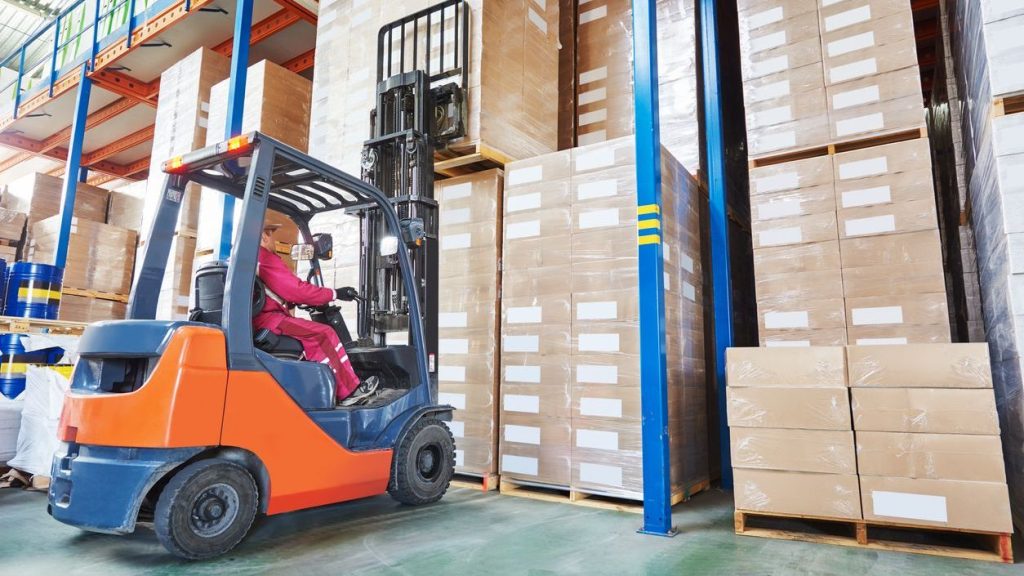
Mechanically, a forklift combined a counterbalanced chassis, a vertical mast, and a carriage with forks that could raise, lower, and tilt under power. The truck supported the load entirely between the drive axle and the fork tips, with a rear counterweight balancing the load moment. The operator rode on or in the truck, using powered steering and traction to move loads over longer distances. This configuration allowed typical rated capacities from 1.5 tonnes to above 8 tonnes and lift heights that exceeded 6 m with appropriate masts. These characteristics distinguished a forklift from pallet jacks, tuggers, and walkie stackers that shared the load between outriggers and drive wheels instead of a pure counterweight system.
Where Walkie Stackers Fit In The Truck Taxonomy
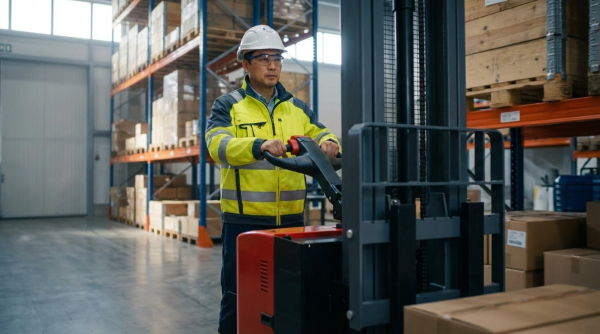
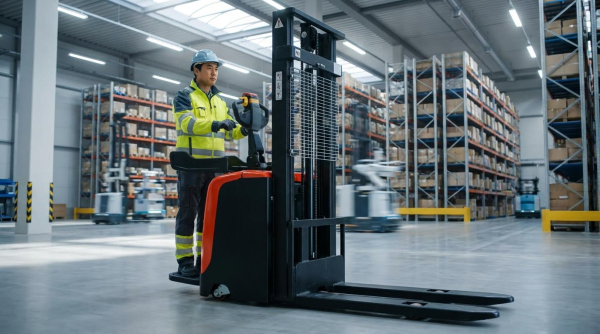
Walkie stackers sat between pallet jacks and rider forklifts in the powered truck hierarchy. Standards treated them as high-lift pedestrian trucks, not as counterbalanced rider forklifts. Operators walked behind or alongside the tiller arm instead of sitting in a cab. The load typically rested on forks supported by outriggers or straddle legs, which transferred part of the load directly to the floor. This geometry limited rated capacities, often to 1.0–2.0 tonnes, and optimized the trucks for short horizontal travel and vertical stacking. In classification tables, engineers would find them under electric walk-behind stackers or pedestrian stacker trucks rather than under counterbalanced forklift categories.
Key Design Differences: Counterweight, Mast, And Stability
The core engineering difference between a walkie stacker and a forklift lay in the stability concept. A counterbalanced forklift relied on a heavy rear counterweight and a stability triangle defined by the front axle and steer axle pivot. The entire load cantilevered in front of the front axle, so mast tilt and load center critically affected overturn risk. Walkie stackers instead used outriggers or straddle legs that extended forward or to the sides, placing wheels closer to the load. This created a shorter load moment arm and reduced the required counterweight mass, but it limited under-clearance and reach into trailers. Mast designs on walkie stackers prioritized compactness and visibility in narrow aisles, while forklift masts supported higher lift heights and more aggressive tilt angles. As a result, walkie stackers suited tight, low to medium height storage, whereas forklifts provided superior stability at higher speeds, greater lift heights, and heavier load centers when properly rated and maintained.
Application Engineering: Matching Equipment To The Task
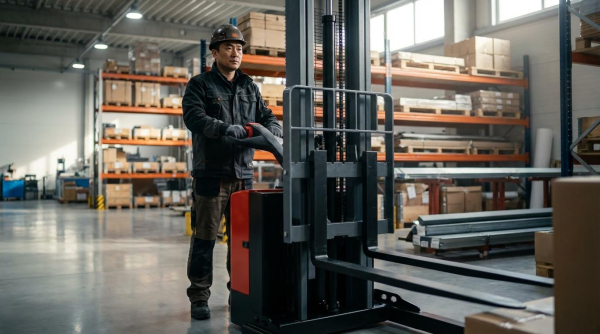
Application engineering evaluated whether a walkie stacker or a forklift delivered better performance, cost, and safety for a given task. Engineers assessed load, lift height, duty cycle, and layout to answer the core question: is a walkie stacker a forklift for this use case, or does it behave as a different tool in practice? The following subsections broke this down into quantifiable criteria so specifiers could select the correct powered industrial truck.
Load, Lift Height, And Duty Cycle Requirements
Engineers first defined rated load, load center, and target lift height. Counterbalanced forklifts typically handled loads from 1.5 t to above 5 t at a 500 mm load center, with masts that reached 6–9 m in standard warehouse applications. Walkie stackers usually operated in the 0.8–2.0 t range with similar or slightly lower lift heights, but their effective capacity derated faster at higher elevations because stability depended on outriggers rather than a large counterweight. Duty cycle also mattered; walkie stackers suited intermittent or medium-intensity cycles with shorter travel distances, while high-intensity, multi-shift operations with frequent pallet movements favored forklifts with higher continuous-duty drive and hydraulic systems. When engineers asked “is a walkie stacker a forklift for this job,” they often found that heavy loads, high lift, and long daily operating hours pushed the specification toward a true forklift platform.
Aisle Width, Floor Conditions, And Travel Distance
Aisle geometry strongly influenced the choice between walkie stackers and forklifts. Walkie stackers offered very small turning radii and operated in aisles near 2.2–2.5 m, depending on pallet length and model, which supported high-density storage. Counterbalanced forklifts generally required wider aisles, often 3.0–3.5 m, to allow right-angle stacking and safe maneuvering with elevated loads. Floor conditions also played a role; walkie stackers performed best on flat, smooth industrial floors because small load wheels and outriggers were sensitive to joints, ramps, and debris. Forklifts, especially pneumatic-tyre variants, tolerated rougher surfaces, minor gradients, and dock transitions better. For travel distance, walk-behind stackers suited short internal moves, typically under 50–80 m per trip, because continuous walking increased operator fatigue. Forklifts, with ride-on seating or stand-on platforms, supported longer internal transport runs and cross-dock movements without excessive strain on operators.
Comparing Throughput, Fatigue, And Safety Risk
Throughput analysis considered pallets moved per hour, average lift height, and travel distance. Forklifts usually delivered higher throughput in medium and large facilities because they traveled faster, accelerated better, and allowed operators to remain seated or standing on-board. Walkie stackers could match or exceed throughput in compact zones with short runs and narrow aisles, where maneuverability and reduced repositioning time offset their lower travel speed. From a fatigue standpoint, walk-behind operation increased step count and physical effort, which limited sustainable cycle rates in large plants; ride-on forklifts reduced musculoskeletal load but introduced different ergonomic concerns such as whole-body vibration. Safety profiles differed as well. Walkie stackers operated at lower speeds and had smaller mass, which reduced kinetic energy in collisions, but close proximity between operator and load increased crush and foot injury risk. Forklifts carried higher tip-over and impact energy risks, which required strict adherence to speed limits, seat belt use, and visibility controls. Engineers balanced throughput gains against fatigue and risk when deciding if a walkie stacker functionally replaced a forklift in a given zone.
When To Specify A Walkie Stacker Versus A Forklift
The specification decision relied on structured criteria rather than a simple label of whether a lift stacker was a forklift. Engineers typically specified walkie stackers when loads stayed below roughly 1.5–2.0 t, aisles were narrow, lift heights were moderate to high but within the stacker’s stability envelope, and travel distances were short. These conditions appeared in back-of-store areas, small warehouses, mezzanine levels, and work-in-process zones around production lines. Forklifts became the preferred choice when operations required frequent truck loading, heavy or oversized pallets, long horizontal runs, or outdoor and mixed-surface travel. They also dominated in cross-docking and high-throughput distribution centers where cycle time per pallet was critical. A hybrid approach was often optimal: walkie stackers handled dense storage and point-of-use replenishment, while forklifts covered bulk receiving, shipping, and long-haul internal moves. This engineering-driven allocation ensured each powered industrial truck type operated where its mechanical design and safety profile aligned best with the task.
Technology, Safety, And Lifecycle Cost Considerations
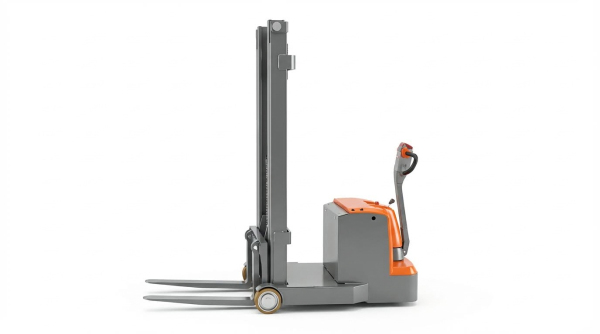
When engineers ask “is a walkie stacker a forklift,” the technology stack, safety architecture, and lifecycle economics provide a precise answer. Both devices fell under the powered industrial truck umbrella, but their drive systems, stability strategies, and maintenance profiles differed. Understanding these differences allowed engineers to specify the right truck for a given throughput, risk level, and budget. This section examined how electric drive, digital monitoring, and safety engineering shaped long-term cost and performance for walkie stackers versus forklifts.
Electric Drive, Hydraulics, And Energy Efficiency
Walkie stackers used compact electric drive units with lower nominal power than ride-on forklifts, which reduced peak current draw and simplified charging infrastructure. Their traction motors drove smaller-diameter drive wheels and shared load support with outriggers, so they did not require the heavy counterweight mass typical of counterbalanced forklifts. Forklifts, especially counterbalanced designs, used higher-power traction motors and larger hydraulic pumps to support greater load capacity and higher lift speeds, which increased instantaneous energy demand but improved cycle times. From an energy-per-pallet-moved perspective, walkie stackers often achieved better efficiency in short-shuttle, low-mass applications, while forklifts became more efficient for heavy loads or long travel distances due to fewer cycles and reduced repositioning. Hydraulic architectures also differed: stackers typically used simpler, lower-flow circuits with smaller cylinders, whereas forklifts required higher-flow valves, larger-bore lift cylinders, and more robust plumbing to withstand higher working pressures and frequent high-lift duty cycles. For engineers evaluating whether a walkie stacker could replace a forklift, comparing kilowatt-hours per shift at the required lift height and load mass provided an objective metric.
Predictive Maintenance, Telematics, And Digital Twins
Telematics and condition monitoring narrowed the technology gap between walkie stackers and forklifts, but deployment density remained higher on ride-on fleets. Forklifts usually integrated CAN-bus sensors for hydraulic pressure, motor current, tilt angle, and impact detection, enabling predictive maintenance models that flagged abnormal trends before failures occurred. Walkie stackers increasingly supported similar sensor suites, though with fewer channels and simpler data sets focused on battery health, controller temperature, and drive-hour accumulation. Digital twin approaches modeled duty cycles, temperature profiles, and hydraulic load spectra to predict component life, such as seal wear in lift cylinders or bearing fatigue in drive units, which was critical where high utilization pushed equipment near design limits. For facilities considering whether a walkie stacker was a forklift-equivalent in reliability, telematics data allowed side-by-side comparisons of mean time between failures, downtime causes, and battery degradation rates. Integration with fleet management systems also supported right-sizing, by showing when walkie stackers operated near their rated capacity too frequently, indicating that a higher-class forklift might reduce overload events and unplanned downtime.
Safety Protocols, Training, And Stability Management
Regulators treated both walkie stackers and forklifts as powered industrial trucks, so operator training and written programs followed similar OSHA and ANSI frameworks. However, risk profiles differed because forklifts carried the operator on the vehicle, while walkie stackers kept the operator on foot within the potential crush and swing envelope. Stability management was central to the question “is a walkie stacker a forklift” from a safety engineering perspective: forklifts relied on the classical stability triangle defined by axle and load center geometry, whereas walkie stackers used outriggers and lower lift heights to reduce overturn risk but introduced new hazards at the outriggers and steering tiller. Training for walkie stackers emphasized pedestrian awareness, safe tiller positioning, and strict control of speed in narrow aisles or on grades greater than approximately 7°. Forklift curricula focused more on seat-belt use, overhead guard limitations, load center calculations at high lift, and visibility when traveling with elevated loads. Both equipment types required pre-shift inspections covering brakes, steering, forks, hydraulics, and battery or engine systems, with immediate lockout if leaks, structural cracks, or critical control faults appeared. Facilities that treated walkie stackers as “less than forklifts” in training often experienced higher incident rates, underscoring that classification differences did not reduce the need for rigorous safety protocols.
Total Cost Of Ownership And Fleet Optimization
Total cost of ownership (TCO) analysis showed why a lift stacker was rarely a one-to-one forklift replacement, even though both lifted pallets. Acquisition costs for walkie stackers were typically lower, and their simpler electric drive and hydraulic systems reduced planned maintenance hours, especially in low-to-medium duty operations. Forklifts, on the other hand, delivered higher throughput per unit in heavy-duty, long-travel, or high-lift applications, which could reduce fleet size and labor cost despite higher unit price and maintenance complexity. Energy costs also diverged: walkie stackers consumed less energy per hour but might require more hours or additional units to meet peak demand, while high-capacity forklifts concentrated energy use into shorter, more productive cycles. A rigorous TCO model included purchase price, financing, preventive maintenance, unplanned repair rates, battery or engine overhaul intervals, operator labor, and downtime risk costs. Engineers optimized fleets by assigning walkie stackers to short-run, narrow-aisle, or light-load zones, and reserving forklifts for dock work, heavy pallets, and long travel corridors. This mixed-fleet strategy answered the practical side of “is a walkie stacker a forklift” by showing that, from a lifecycle cost perspective, each technology occupied a distinct but complementary role in a well-engineered material handling system.
Summary: Choosing The Right Powered Industrial Truck
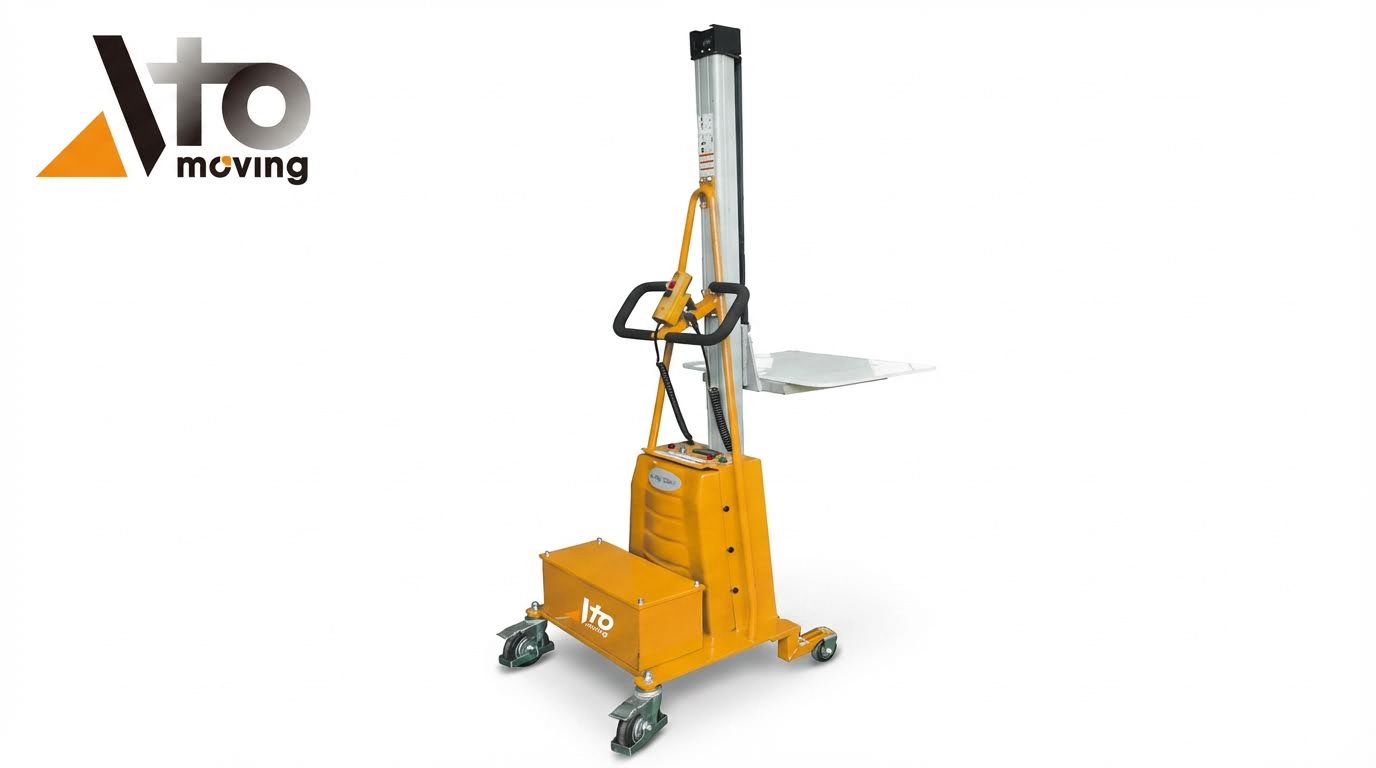
Engineers and safety managers frequently ask whether a walkie stacker is a forklift, because the answer drives both regulatory classification and equipment selection. A walkie stacker is a powered industrial truck, but standards and mechanical design details distinguished it from a conventional counterbalanced forklift. From an application engineering perspective, the choice between these platforms depended on load, lift height, aisle geometry, duty cycle, and acceptable risk level. The optimal specification balanced energy efficiency, stability, training complexity, and lifecycle cost rather than focusing on the purchase price alone.
Technically, the key distinction behind the question “is a walkie stacker a forklift” lay in the counterweight concept and operator position. Counterbalanced forklifts used a mass at the rear to “float” loads without outriggers and supported higher capacities and longer travel distances. Walkie stackers used outriggers and a walk‑behind or stand‑on configuration, which improved maneuverability in narrow aisles but limited capacity and travel speed. Safety engineering therefore emphasized different controls: stability triangle and dynamic load shift for forklifts, versus pedestrian interaction, visibility, and fatigue management for walkie stackers.
Lifecycle cost analyses showed that correctly matching truck type to task reduced unplanned downtime and accident exposure. Electric architectures, telematics, and predictive maintenance platforms supported tighter control of energy use, hydraulic failures, and structural degradation, which historically drove a large share of incidents and repair cost. Future fleets would likely integrate mixed assets: high‑capacity forklifts for heavy, long‑haul moves and agile walkie pallet truck for short‑reach stacking in dense storage. Practitioners should document duty cycles, map travel paths, and model stability margins before deciding whether the right answer for their facility is a counterbalanced stacker, a forklift, or a combination of both.