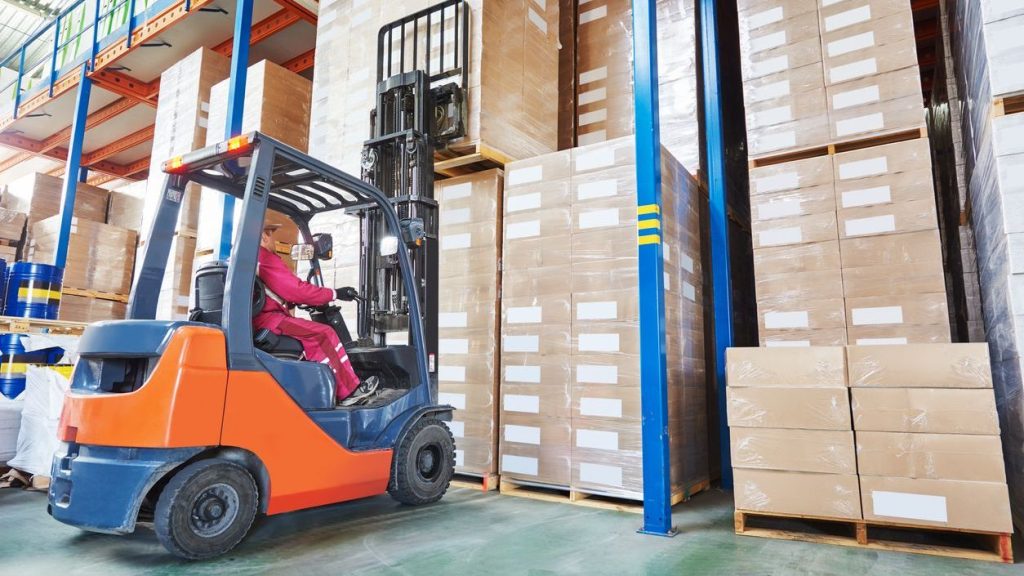
Amazon FBA imposed strict pallet, load, and packaging rules that directly influenced how warehouses specified and operated pallet stackers. To remain compliant, operations had to align equipment capabilities with regional pallet formats, height and weight limits, and export regulations. This article examined Amazon FBA pallet standards, assessed the technical fit of electric pallet stackers, and defined design and selection criteria for FBA-ready equipment. It concluded with a structured approach for determining whether a given counterbalanced stacker configuration could reliably support FBA-compliant, high-density fulfillment workflows.
Amazon FBA Pallet Standards And Constraints
Amazon FBA pallet standards created strict geometric and weight envelopes that directly constrained stacker selection. Operators had to match pallet size, height, and mass limits while maintaining handling efficiency. Stacker specifications therefore needed to align with Euro and UK pallet formats, defined load-building patterns, and export regulations. Trailer and container clearance constraints further influenced mast height, lift range, and maneuverability requirements.
EU And UK FBA Pallet Sizes, Heights, And Weights
In EU FBA operations, Amazon accepted only 800 × 1200 mm Euro or CHEP pallets certified to DIN 15146. In the United Kingdom, the standard was 1000 × 1200 mm four-way access wooden pallets with at least GMA grade B quality. For inbound international flows, pallets required heat treatment to ISPM‑15, even when dimensions matched EU or UK standards. The maximum standard single-pallet height was 1.8 m, including pallet thickness, and gross mass per pallet could not exceed 500 kg. These limits meant stackers needed rated capacities comfortably above 500 kg at the relevant load center, plus fork dimensions compatible with both 800 × 1200 mm and 1000 × 1200 mm footprints where cross-border flows existed.
Load Building Rules That Affect Stacker Selection
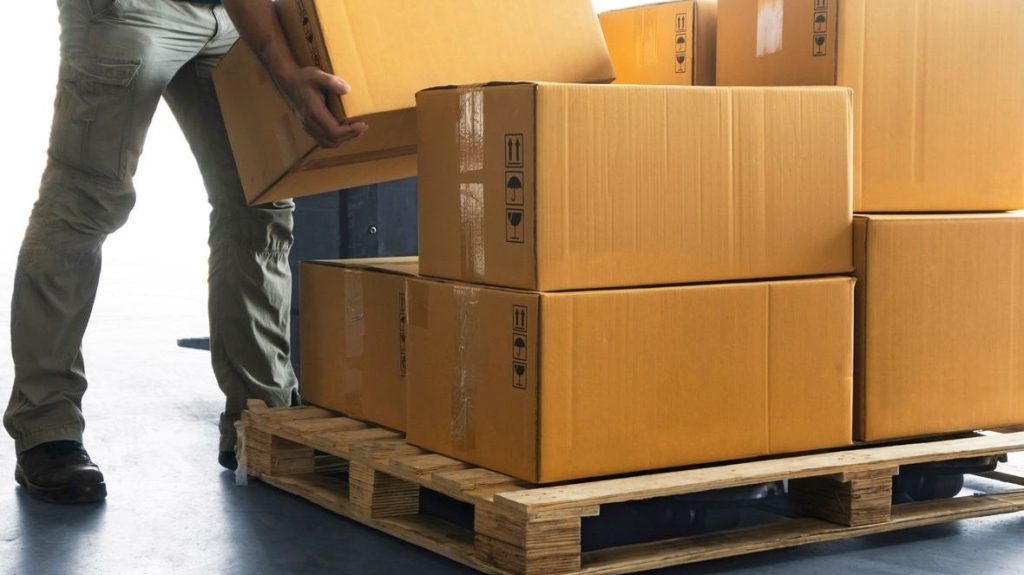
Amazon defined strict load-building rules that impacted stacker specification. Pallets had to respect a typical 72 in (about 1.83 m) height limit in North American-style guidance, with an exception up to 98 in when a single unit exceeded 72 in. In FBA operations, boxes required stacking with heavier cartons at the bottom, stable interlocking patterns, and flush edges on all sides. Single-ASIN pallets needed consistent stacking orientation, while mixed-ASIN pallets had to keep SKUs visually differentiable. Stackers therefore had to position loads precisely, hold forks level under partial or asymmetric loads, and provide fine lift control to avoid deforming cartons or breaking the flush, cube-optimized stack profile.
Compliance With ISPM-15 And Export Requirements
ISPM‑15 compliance was mandatory for pallets crossing international borders into Amazon FBA networks. Pallets required heat treatment and appropriate marking to indicate conformance, which affected procurement policies and sometimes pallet mass. Stackers therefore needed sufficient capacity margin to handle slightly heavier heat-treated pallets without exceeding the 500 kg gross limit. Operators also had to prevent pallet damage, since broken boards could compromise ISPM‑15 markings and lead to non-compliant loads. Selection of stackers with smooth, controllable hydraulic systems and precise fork tip geometry reduced impact loads into pallet stringers and blocks, supporting both regulatory compliance and pallet reuse.
Space, Clearance, And Trailer Loading Constraints
Amazon required that overall pallet height in containers left at least 152 mm of clearance between the top of the stack and the trailer or container roof. This constraint, combined with the 1.8 m and 72 in guidance, defined the maximum working lift height for stackers in staging and loading zones. Double-stacked pallets could reach 2.7 m in Germany and Central and Eastern Europe, and 3.0 m in the United Kingdom, France, Italy, and Spain, which demanded taller masts with adequate residual capacity at height. Narrow dock areas, staging lanes, and trailer interiors constrained turning radius and overall truck length. Consequently, warehouse engineers favored compact electric pallet stackers with short chassis, tight turning circles, and masts designed to operate safely within these vertical and horizontal envelopes while maintaining stability under 500 kg FBA-compliant loads.
Technical Fit Of Electric Pallet Stackers For FBA
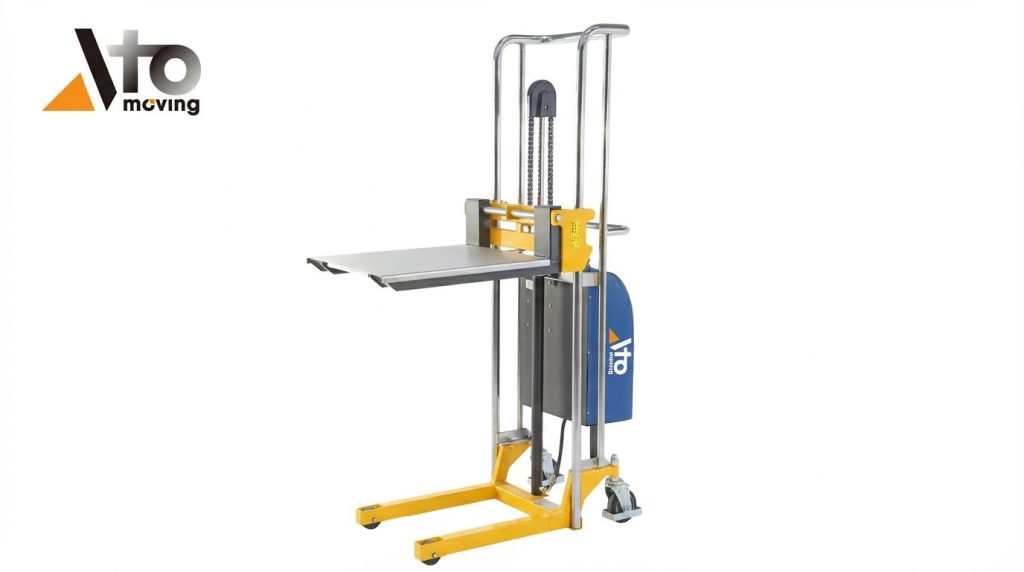
Electric pallet stackers supported high-throughput FBA environments when their specifications aligned with Amazon pallet rules. Engineers had to match capacity, mast geometry, and maneuverability to 500 kg and 1,500 lb constraints. Safety, ergonomics, and training requirements further shaped equipment choice. This section evaluated how electric stackers technically integrated into Amazon-compliant workflows.
Matching Stacker Capacity To 500 kg / 1,500 lb Limits
Amazon FBA constrained pallets to 500 kg gross weight in EU road networks and approximately 1,500 lb in other networks. Stackers therefore required a rated capacity comfortably above these limits, typically 1,000–1,500 kg, to maintain safety factors. Engineers evaluated the residual capacity at the relevant load center, usually 600 mm for Euro and UK pallets. They also verified that the chassis, drive unit, and braking system handled repeated near-limit cycles without overheating. In practice, operations teams often derated internal limits to 80–90% of nameplate capacity to reduce structural fatigue.
Mast Heights, Lift Ranges, And FBA Stack Height Rules
FBA rules limited standard pallet height to about 1.8 m in Europe and 72 in in other regions, including the pallet. Double-stacked heights reached 2.7 m in Germany and Central and Eastern Europe, and 3.0 m in the United Kingdom, France, Italy, and Spain. Stackers therefore needed masts that lifted the fork carriage at least 100–200 mm above the highest target placement height to allow safe clearance. Designers compared free-lift and overall mast height to racking beam levels and trailer door openings. They also checked that visibility through or around the mast remained adequate when handling near-maximum FBA stack heights.
Maneuvering In Narrow Aisles And Staging Lanes
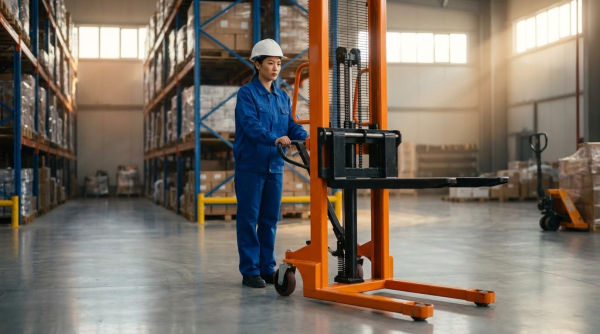
FBA staging lanes and inbound docks often operated with aisle widths only slightly larger than pallet diagonal plus stacker length. Electric pallet stackers with compact chassis and short head lengths improved turning in these constrained zones. Operators relied on precise tiller-arm control and proportional travel speed to pivot around pallet corners without rack or carton damage. Engineering teams calculated the required right-angle stacking aisle based on pallet dimensions of 800 × 1,200 mm or 1,000 × 1,200 mm. Low-lift, walk-behind stackers usually offered better maneuverability at the dock, while straddle or reach designs suited denser buffer storage.
Safety, Training, And PPE In High-Density FBA Zones
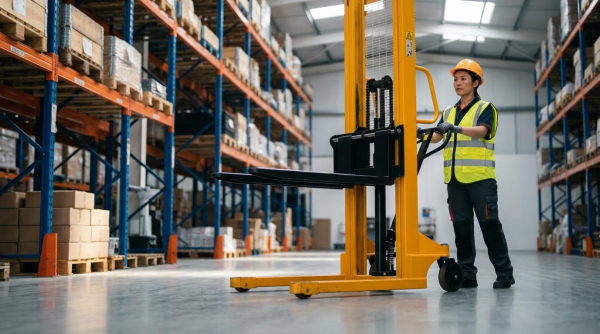
High-volume FBA nodes combined dense pedestrian traffic with frequent pallet movements, so safety engineering was critical. Operators completed structured training on pre-use inspections, load assessment, and adherence to pallet height and weight rules. Programs emphasized correct fork insertion, stable stacking of labeled cartons, and speed control near picking and packing areas. Facilities mandated PPE such as safety footwear and high-visibility garments, and often added local rules for eye or hand protection. Regular refreshers, near-miss reporting, and documented emergency procedures supported continuous improvement of stacker safety performance in these demanding zones.
Design And Selection Criteria For FBA-Ready Stackers
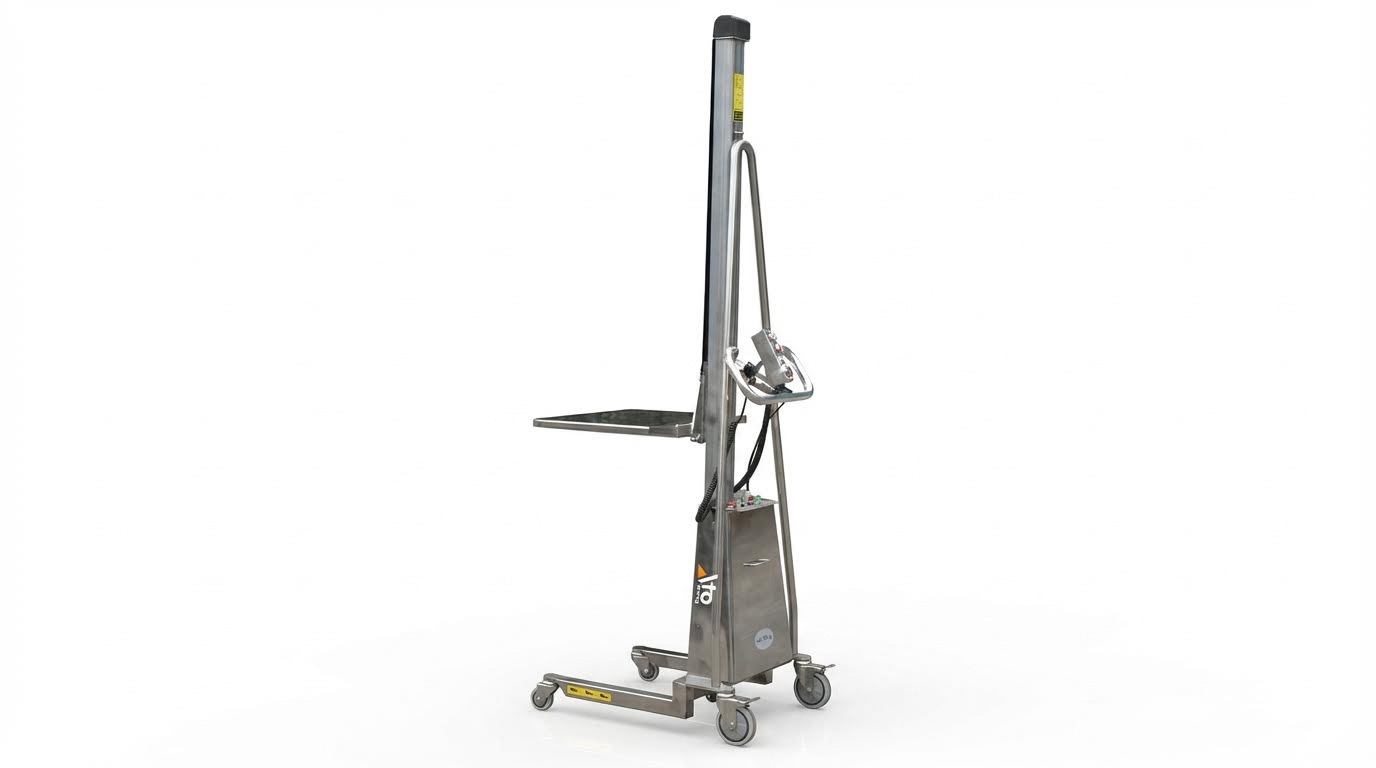
Designing and selecting pallet stackers for FBA-compliant operations requires strict alignment with Amazon’s pallet, weight, and height constraints. Engineers must match fork geometry to Euro and UK pallet footprints, while ensuring stability at 1.8 m and typical double-stack heights. Energy systems, duty cycles, and digital monitoring capabilities must support continuous, high-density flows in FBA-style warehouses. The following criteria focus on geometric compatibility, stability engineering, power management, and data-driven maintenance.
Euro And UK Pallet Interface: Fork Length And Spread
FBA operations in the EU required 800 × 1,200 mm Euro or CHEP pallets, certified to DIN 15146. In the United Kingdom, FBA accepted 1,000 × 1,200 mm four-way wooden pallets meeting at least GMA grade B. Stackers for these environments therefore needed fork lengths that fully supported the 1,200 mm pallet dimension without excessive overhang. Typical fork lengths between 1,150 mm and 1,200 mm provided adequate support for both formats while maintaining maneuverability.
Fork spread had to match entry openings and load bearer spacing on Euro and UK pallets. Adjustable fork widths allowed operators to center loads on 800 mm and 1,000 mm pallet sides without contacting deck boards or stringers. The fork tip profile and thickness influenced entry into four-way pallets at low clearances, especially when film-wrapped. Designers also considered minimum lowered fork height to ensure compatibility with pallet entry heights while maintaining sufficient structural stiffness.
Stability With Double-Stacked FBA Pallet Loads
Amazon limited single-pallet height to 1.8 m, including the pallet, with gross weight capped at 500 kg. Double-stacked pallets could reach 2.7 m in Germany and Central and Eastern Europe, and 3.0 m in the United Kingdom, France, Italy, and Spain. Stackers handling these heights required masts with adequate residual capacity and low deflection at maximum lift. Engineers evaluated the combined center of gravity of two 500 kg pallets when determining counterweight and wheelbase dimensions.
Stability analysis considered the truck’s stability triangle, load center distances, and dynamic effects during braking or turning. Load backrests had to extend high enough to restrain the upper pallet without damaging cartons or labels. Tilt functions, if present, required conservative limits at high lift to reduce tip risk. Operators needed clear guidance on maximum permitted lift height for double-stacked units, especially in trailers or containers where roof clearance and dock gradients affected effective stability.
Battery, Duty Cycle, And Multi-Shift Utilization
FBA-style facilities operated at high throughput, which imposed demanding duty cycles on electric pallet stackers. Battery capacity selection depended on lift frequency, travel distance, and typical load mass, often near the 500 kg pallet limit. Engineers sized traction and lift motors to balance acceleration and energy consumption, aiming to complete full shifts without deep discharges that shortened battery life. Lithium-ion systems offered fast opportunity charging and higher cycle life, which suited multi-shift operations.
Proper charging infrastructure and procedures were critical for consistent availability. Operators needed training on safe connection, charge windows, and temperature limits to avoid premature degradation. Battery management systems monitored state of charge, temperature, and cycle counts, enabling predictive replacement planning. In high-density FBA zones, standardized battery types simplified spares management and reduced downtime during pack swaps or maintenance.
Digital Tools, Telematics, And Predictive Maintenance
Digital tools supported reliable stacker performance in data-driven FBA environments. Telematics modules captured utilization hours, lift counts, travel distances, and impact events. Fleet managers used these data to optimize deployment, identify underused units, and adjust maintenance intervals based on actual duty. Access control via PINs or badges ensured only trained operators used the equipment, improving safety and compliance.
Predictive maintenance relied on condition monitoring of key components such as hydraulic pumps, lift chains, wheels, and batteries. Algorithms flagged abnormal vibration, temperature, or current draw patterns before failures occurred. Integration with warehouse management or maintenance systems allowed automated work orders and parts planning. Over time, digital records of faults, repairs, and usage informed future stacker specifications and replacement strategies tailored to FBA operational profiles.
Summary: Determining Pallet Stacker Suitability For FBA
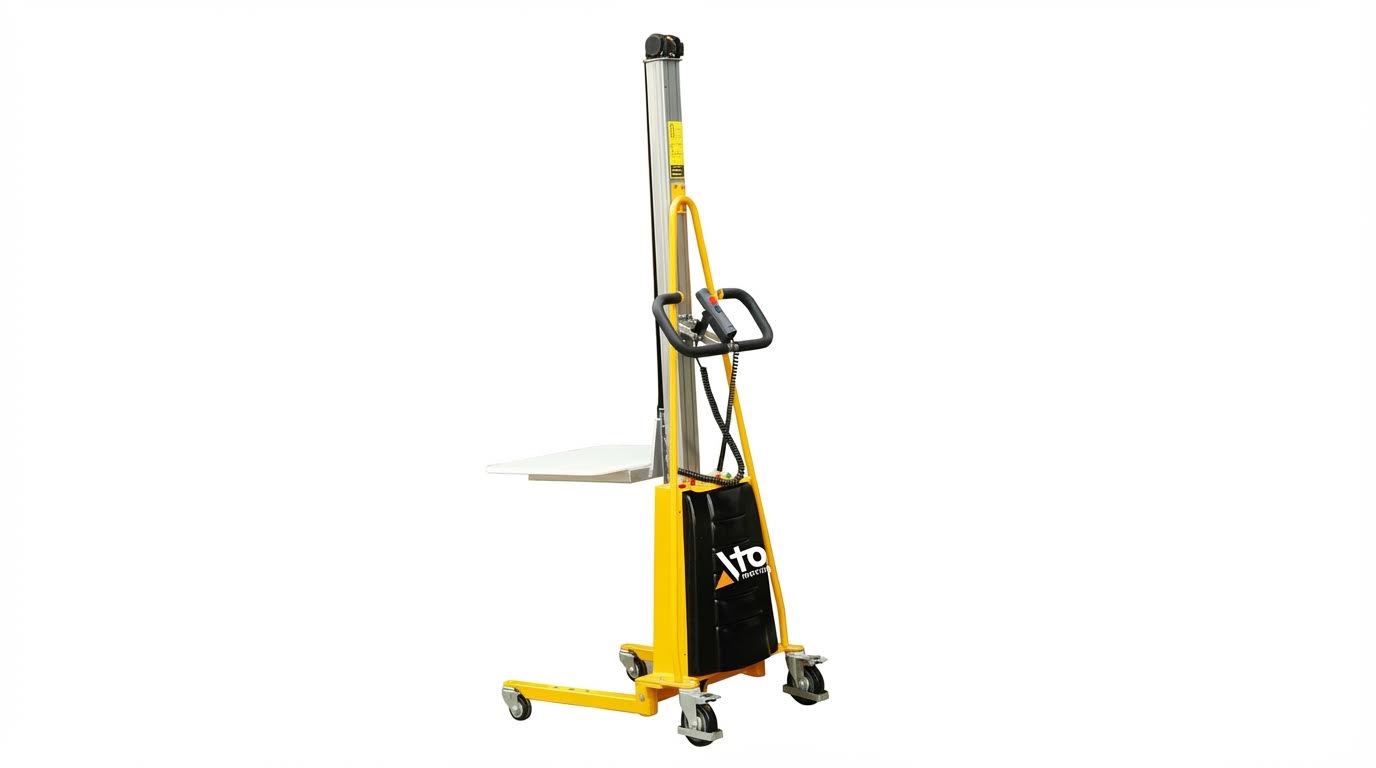
Evaluating pallet stackers for FBA operations required aligning equipment capabilities with strict pallet, load, and packaging rules. Amazon defined pallet footprints, height limits, and gross weight caps, while also enforcing ISPM‑15 heat treatment for international flows and clear stretch‑wrap and labeling standards. Electric and manual stackers had to interface reliably with Euro 800×1200 mm and UK 1000×1200 mm pallets, lift within 1.8 m single‑pallet and regional double‑stack limits, and respect 500 kg and 1,500 lb constraints without compromising stability or maneuverability in dense storage layouts.
These requirements had direct implications for stacker design and selection. Mast profiles, fork dimensions, and residual capacities needed verification against real FBA load cases, including double‑stacking and container clearance. Facilities increasingly adopted higher‑efficiency electric stackers with optimized batteries, telematics, and predictive maintenance to support multi‑shift FBA throughput while limiting downtime. At the same time, safety, PPE, and operator‑training programs remained central, because incident rates in high‑density zones strongly depended on operator behavior and awareness.
In practice, operators and engineers benefited from a structured decision framework. This framework compared candidate stackers against pallet interface geometry, rated capacities at target lift heights, aisle‑width constraints, and regulatory items such as ISPM‑15. A balanced perspective recognized that FBA rules could evolve, pushing toward more automation, denser storage, and tighter data integration. Stackers that combined robust mechanical design with flexible digital monitoring and disciplined maintenance positioned operations to remain compliant, safe, and cost‑effective as FBA logistics continued to develop.