Plants that ask what is a straddle stacker lift usually want a clear engineering view of where this equipment fits between pallet trucks and forklifts. This article explains how straddle stacker lifts work from the ground up, focusing on geometry, load paths, hydraulics, and control systems defined in the full outline.
You will see how core design choices affect stability, capacity, and duty cycles, then how those choices translate into real applications, from narrow-aisle warehouse work to cold storage and dock integration. Later sections connect safety, maintenance, energy management, and lifecycle cost so engineers and operations leaders can specify, operate, and upgrade straddle stackers with confidence.
Core Design and Operating Principles
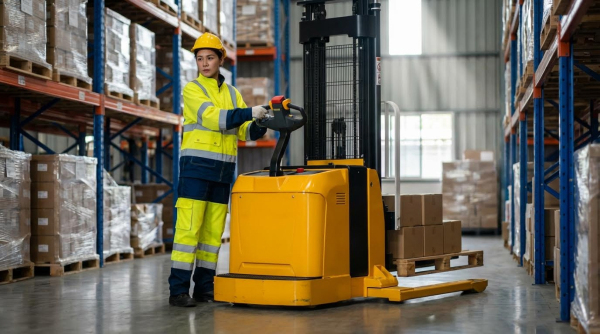
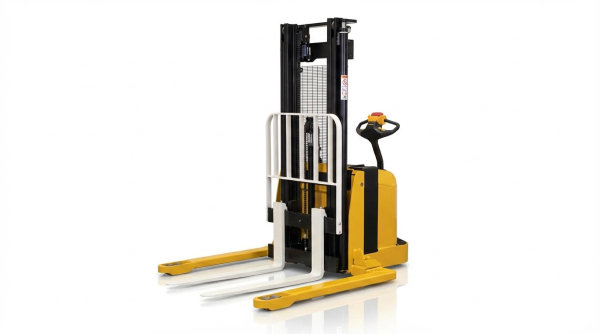
Engineers who ask what is a straddle stacker lift focus first on its core structure and duty profile. A straddle stacker is a pedestrian or ride‑on lift truck that carries the load between two outrigger legs that “straddle” the pallet. This section explains how leg geometry, mast design, powertrain, and key metrics work together to deliver safe, efficient stacking in tight warehouse aisles. It also gives plant engineers a framework to specify stackers against capacity, height, and cycle demands without oversizing or under‑engineering the system.
Straddle Leg Geometry and Stability
Straddle legs support the load from below and from the sides. They bypass closed pallets and provide a wide base. Typical designs use two parallel outriggers with adjustable inside clear width to suit different pallet sizes and load footprints.
Stability depends on three main distances: wheelbase, track width, and load center. A wider straddle width increases lateral stability but also increases required aisle width. A longer wheelbase improves fore‑aft stability but increases turning radius.
Engineers usually treat the truck and load as a combined rigid body. The center of gravity must stay inside the support polygon defined by the wheels and load wheels. When the mast lifts, the combined center of gravity moves up and slightly forward, which reduces stability margin. As lift height rises, operators must reduce travel speed and avoid sharp steering inputs.
Key leg design choices include:
- Fixed vs adjustable leg width for different pallet types.
- Leg height to clear pallet stringers while keeping a low step‑in height.
- Wheel material, often polyurethane or nylon, to balance floor protection and rolling resistance.
Heavy‑duty units may add cross‑bracing or thicker sections in the outriggers. This resists twisting when the operator turns with a raised load near the rated limit.
Mast, Forks, and Load Center Fundamentals
The mast converts hydraulic force into vertical lifting. Common industrial stackers use simplex, duplex, or triplex masts depending on required lift height and collapsed height limits. Typical maximum lift heights range from around 1.6 metres up to about 4.8 metres, depending on model and duty.
Forks carry the pallet and transfer load into the mast carriage. Adjustable forged steel forks allow handling of different pallet widths and non‑palletised skids. Engineers must check fork section modulus and deflection limits at rated load.
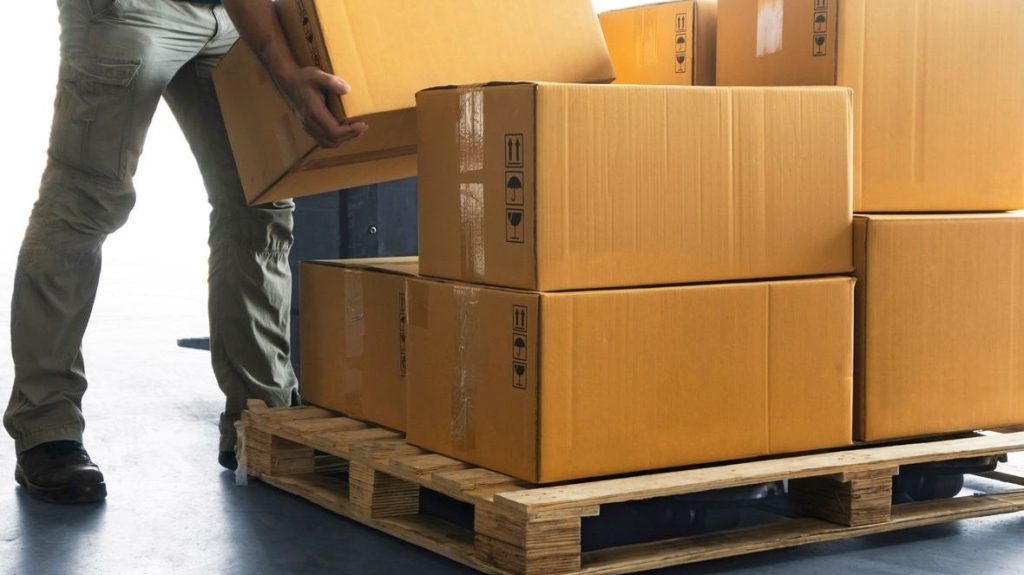
Rated capacity is always tied to a rated load center, often 500 millimetres for pallet work. For example, a stacker might be rated 1,000 kilograms at 500 millimetres load center. If the actual load center increases due to long pallets or offset loads, the safe capacity drops.
Key engineering checks include:
- Verify mast rail and chain design for full rated load at maximum height.
- Check backrest height against load dimensions to prevent product fall‑back.
- Confirm fork tip thickness and taper allow easy pallet entry without floor gouging.
For narrow aisles, clear view masts and slim fork carriages improve visibility. This reduces damage to racks and product, especially at upper levels.
Powertrain, Hydraulics, and Control Systems
Most modern straddle stacker lifts use electric power. Typical systems use 24 volt traction and lift circuits, with battery capacities from about 195 ampere‑hours for light duty to above 300 ampere‑hours for heavier use. Higher capacities, up to around 660 ampere‑hours, support long shifts and intensive cycling.
The powertrain usually combines an AC drive motor, reduction gearbox, and drive wheel. AC motors and programmable controllers allow smooth acceleration, speed limiting, and regenerative braking. Regenerative braking recovers energy during deceleration and extends battery runtime.
The hydraulic system powers lift and lower functions. A compact gear pump, driven by an electric motor, supplies pressure to a lift cylinder in the mast. Typical lift speeds under load are in the order of tens of millimetres per second, with higher speeds when unloaded.
Control systems use a tiller or handle with integrated functions. Common features include:
- Ergonomic handles with dual thumbwheels for travel direction and speed.
- Handle‑mounted lift and lower switches for one‑handed operation.
- Direction reverse or “belly” switches to prevent trapping incidents.
Safety electronics may add automatic resetting circuit breakers, power‑on self‑tests, and reverse polarity protection. Mechanical drum brakes or electromagnetic brakes hold the truck when stopped, even on slight slopes.
Key Performance Metrics and Duty Cycles
When engineers compare options and search what is a straddle stacker lift, they often look at four main metric groups: capacity, height, speed, and maneuverability. Typical rated capacities lie roughly between 900 kilograms and 1,800 kilograms, depending on model and mast. Lift heights range from low‑level 1.6 metres units to high‑reach designs near 4.8 metres.
Travel speeds under load often stay around walking pace, near 5 to 6 kilometres per hour. This speed suits pedestrian control and tight aisle work. Turning radius can be close to 1.3 metres for compact models, which allows operation in narrow aisles that would block standard forklifts.
Duty cycle describes how intensively the equipment runs. A light‑duty profile might mean less than five operating hours per day with frequent breaks. A medium‑duty profile could involve multi‑shift work with frequent lifts but moderate travel distances.
Key sizing factors include:
- Average and peak load mass at the rated load center.
- Number of lift cycles per hour and per shift.
- Share of time spent lifting, travelling, and idling.
Battery and charger selection must match this duty cycle. For electric units, engineers often aim for 20% to 30% residual charge at shift end. This buffer protects battery life. Proper matching of performance metrics to the real duty cycle prevents both under‑specification, which risks overheating, and over‑specification, which ties up capital without clear benefit.
Applications, Selection, and System Integration
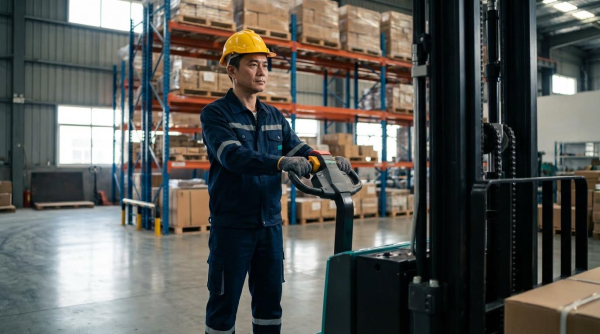
This section explains what is a straddle stacker lift from an application and selection view. Engineers can use these points to decide when a straddle stacker is better than a forklift and how to integrate it into racking, docks, AGVs, and special environments such as cold stores.
Comparing Straddle Stackers and Forklifts
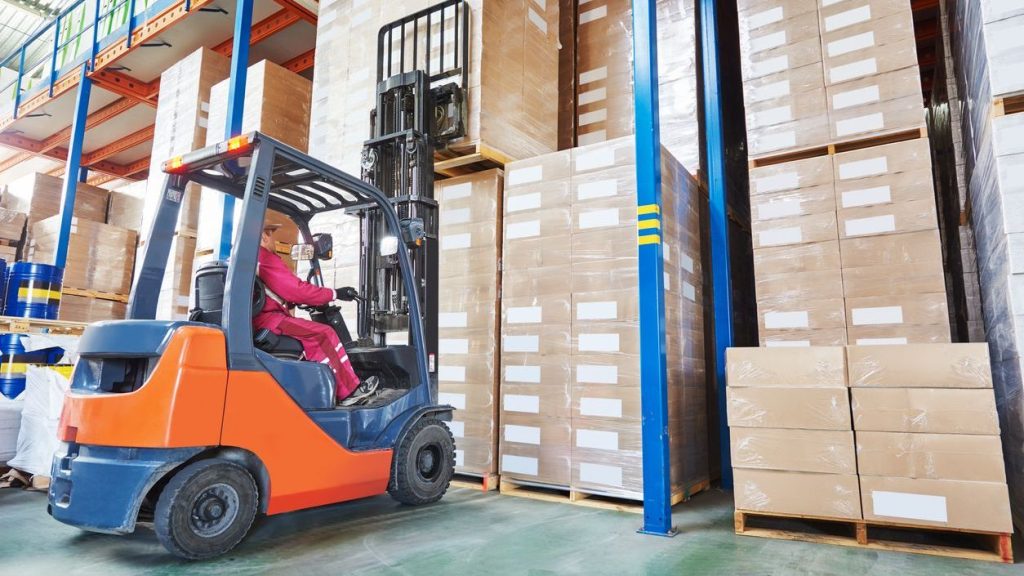
A straddle stacker lift is a walk-behind or ride-on truck with outrigger legs that straddle the pallet. A forklift is a counterbalanced truck that carries the load in front of the wheels. This basic difference drives clear trade‑offs in safety, capacity, and layout.
Typical electric straddle stackers handle light to medium loads. Common capacity ranges sit around 900–1,800 kg or 2,000–4,000 lb. Forklifts often exceed these values and reach higher lift heights, which suits bulk handling and high-bay storage.
Straddle stackers work best indoors on flat floors and in short-shift duty. They move slower than forklifts but offer tight turning and fine positioning. This suits small warehouses, production cells, and dock work where operators handle pallets for less than about five hours per day.
From a risk view, straddle stackers are less aggressive machines. They weigh less and move slower. Forklifts, by contrast, had high accident and fatality counts in past safety reports. Plants often use straddle stackers to reduce risk in light-duty zones and keep forklifts in heavy-duty or yard areas.
Matching Capacity, Height, and Aisle Width
Correct sizing starts with three linked questions: load mass, lift height, and aisle width. These define whether a straddle stacker lift can replace or complement a forklift.
Key selection checks include:
- Rated capacity at the specified load center, often 500 mm.
- Maximum lift height versus top beam of racking or mezzanines.
- Required clear aisle for 90° stacking turns.
Straddle stackers usually serve mid-level racking. Typical lift heights sit around 4–5 m, though some models reach higher. This suits one to three beam levels in small warehouses. Forklifts handle taller bays where lift heights exceed roughly 5–6 m.
Aisle width is a major driver. Compact straddle stackers can work in narrow aisles that would block many counterbalanced forklifts. Plants often choose them when they need to keep aisles around pallet depth plus a modest turning allowance, instead of the wide clearances forklifts demand.
Engineers should map worst-case pallets, including overhang and load shift, then check turning templates from the supplier. This avoids later clashes with columns, guards, or dock edges.
Integration with Racking, Docks, and AGVs
When engineers ask what is a straddle stacker lift in system terms, the answer is simple. It is a link between floor, racking, and upstream or downstream transport. Good integration prevents bottlenecks and damage.
With racking, the leg span and fork length must match pallet style and beam spacing. Straddle legs need free space under or beside pallets. Blocked legs cause impacts and rack damage. Adjustable legs and forks help match mixed pallet sizes but still need clear standards.
At docks, straddle stackers support trailer loading where a full forklift fleet is not justified. They work well for pallet transfer between dock levelers, conveyors, and storage. However, floor flatness and dock plate capacity must suit concentrated wheel loads.
AGV and AMR projects often use straddle stackers as interface equipment. Typical roles include:
- Buffer storage near AGV transfer points.
- Exception handling for damaged pallets.
- Manual backup when AGVs are offline.
Control integration can stay simple. Visual standards, marked handoff zones, and clear traffic rules between AGVs and walk-behind stackers reduce conflicts and idle time.
Indoor, Cold Storage, and Specialized Uses
Straddle stacker lifts are mainly indoor tools. Their electric power, low noise, and zero point-of-use emissions suit production lines, pick modules, and small warehouses. Smooth concrete floors reduce rolling resistance and protect wheels.
Cold storage adds extra constraints. Low temperatures affect batteries, hydraulic oil viscosity, and operator comfort. Cold-store-ready stackers use components and seals that keep performance stable in these conditions. Operators also need gloves-friendly controls and clear mast views in low light and fogging.
Specialized uses often focus on tight spaces and controlled loads. Examples include beverage distribution aisles, retail backrooms, and work-in-process buffers in manufacturing. In these cases, the compact chassis and fine lift control reduce product damage.
Plants sometimes pair straddle stackers with reach or counterbalanced trucks. Stackers handle inner aisles or production zones, while larger trucks work in yard or bulk storage. This mixed fleet approach reduces capital cost and energy use while still meeting peak demand.
Safety, Reliability, and Lifecycle Management
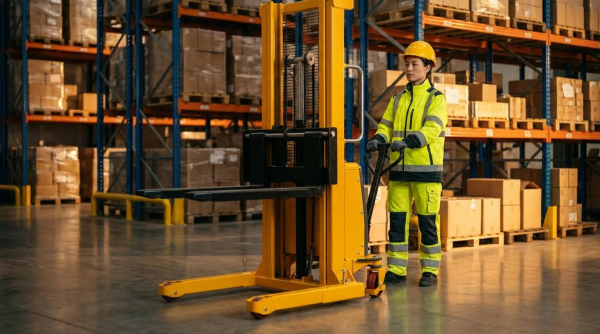
Engineers who ask what is a straddle stacker lift also need to understand how safety and lifecycle controls shape real plant performance. Safety systems, preventive maintenance, batteries, and cost models all interact with core design choices such as load center, mast height, and duty cycle. This section links those factors so plants can specify, operate, and renew straddle stacker fleets with predictable risk and cost.
Operator Safety, Ergonomics, and Compliance
Straddle stacker lifts used in warehouses and plants relied on built-in safety layers rather than raw power. Typical electric units used features such as automatic resetting circuit breakers, reverse polarity protection, and power-on self-tests to prevent unsafe operation after faults. Mechanical drum brakes and safety glass mast guards helped control motion and protect the operator from falling objects or hydraulic failures.
Ergonomics directly influenced incident rates and fatigue. Most powered straddle stackers used control handles with grouped functions, dual thumbwheels, and sometimes twist-grip travel controls. These designs let operators keep both hands in stable positions while they raised loads up to typical heights around 4.5 m to 4.8 m. Tight turning radii, often near 1.3 m, reduced steering effort and allowed precise positioning in narrow aisles.
From a compliance view, plants had to align straddle stacker operation with local occupational safety rules for powered industrial trucks. Key practices included:
- Training and authorizing operators for walk-behind and rider modes.
- Respecting rated capacity at stated load center, often 500 mm.
- Limiting use to flat, smooth floors and indoor or controlled environments.
- Maintaining clear travel paths and racking interfaces.
Incident data for forklifts showed high fatality and injury counts. Plants often used straddle stacker lifts for lighter, shorter moves to cut exposure to higher-risk ride-on trucks.
Preventive Maintenance and Failure Modes
Reliability engineering for straddle stacker lifts focused on a few dominant subsystems. The hydraulic circuit carried the lifting duty and needed regular oil checks, contamination control, and seal inspection. Typical guidance recommended oil replacement between 4 and 12 months depending on hours and environment. Dirty oil increased internal leakage, slowed lift speeds, and raised failure risk for pumps and cylinders.
Mechanical structures such as forks, straddle legs, and wheels defined safe load paths. Engineers monitored forks for bending or cracks near the root, with simple straight-edge checks along the length. Excess deviation or visible cracks required immediate replacement. Wheel and bearing wear affected stability and maneuverability. Worn or cracked wheels, especially on load wheels under the legs, caused uneven loading of pallets and racking beams.
Typical failure modes included:
- Insufficient lifting force due to low hydraulic pressure or air in the system.
- Rapid fork descent from internal leakage or faulty valves.
- Startup failures from battery, contactor, or control wiring faults.
- Abnormal noise from dry bearings, gearboxes, or mast rollers.
Structured maintenance plans used daily, weekly, and annual tasks. Daily checks covered leaks, visible damage, and safety interlocks. Deeper inspections every 1,000–2,000 operating hours aligned with manufacturer recommendations and reduced unplanned downtime.
Battery, Charging, and Energy Management
Electric straddle stacker lifts typically used 24 V battery systems with capacities in the 195–660 Ah range. Lower capacities suited light-duty, under five hours per day. Higher capacities supported multi-shift or higher lift cycles. Battery choice directly affected travel speed, lift speed, and duty cycle between charges.
Lead-acid batteries remained common because of cost and established maintenance practices. Plants had to:
- Avoid deep discharge to prevent plate damage.
- Use matched chargers and respect charge curves.
- Maintain electrolyte levels above plates using distilled water.
- Vent charging areas to handle hydrogen gas.
Lithium-ion options gained use for higher utilization or fast charge needs. These systems required temperature-controlled charging, usually within 0 °C to 40 °C. Battery management systems monitored cell voltages and temperatures, which reduced operator error but added electronic complexity. Energy recovery through regenerative braking on some AC-drive models improved efficiency and extended run time between charges.
Good energy management policies coordinated shift patterns, charging windows, and spare battery pools. Plants tracked battery health and replaced units when capacity fell below about 80% of rated value to avoid surprise runtime losses during peak periods.
Total Cost of Ownership and Upgrade Paths
When engineers compared what is a straddle stacker lift to a forklift, total cost of ownership often favored the straddle stacker for light and medium loads. Purchase prices typically ranged from a few thousand to tens of thousands of US dollars, below comparable reach trucks or counterbalance forklifts. Lower mass and smaller motors reduced energy use, especially for units working less than five hours per day.
TCO models needed to include:
- Acquisition cost and financing.
- Battery replacement cycles and charger infrastructure.
- Planned maintenance parts such as wheels, seals, and hydraulic oil.
- Unplanned repair risk and downtime impact.
- Operator training and certification costs.
Well-m,
Frequently Asked Questions
What is a straddle stacker lift?
A straddle stacker lift, also known as a straddle stacker forklift, is a specialized pallet-handling truck designed with two support legs that extend on either side of the pallet rather than directly beneath it. This design allows for better stability and handling in tight spaces. Straddle Stacker Guide.
Can a straddle stacker lift loads?
Yes, a straddle stacker can lift loads efficiently. For example, a lithium-ion-powered straddle stacker can lift loads as high as 140 inches, making it highly maneuverable and productive in warehouse environments. Raymond Basics.
What is the difference between a stacker and a straddle stacker?
The main difference lies in their design and functionality. A standard stacker typically supports the load from beneath, while a straddle stacker uses two support legs that extend on either side of the pallet. This gives the straddle stacker added stability and makes it suitable for handling wider loads.