If you’re asking how much can a walkie stacker hold, the honest engineering answer is: it depends on more than the sticker rating. Walkie stacker capacity changes with load center, lift height, mast type, battery weight, tires, and floor conditions. This guide breaks down typical walkie stacker load ranges, how data plates and derating really work, and which factors quietly reduce usable capacity in the real world. Use it to size equipment safely, protect operators, and avoid overloading your trucks as your loads, racking, and aisles change over time.
Understanding Walkie Stacker Rated Capacity
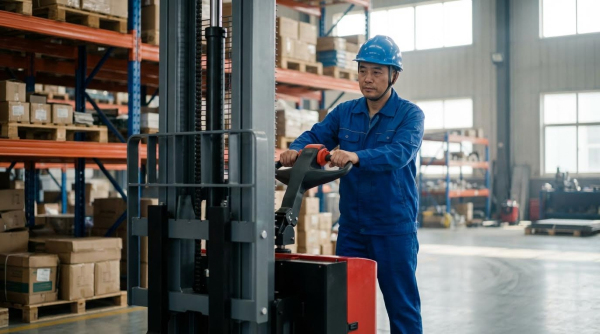
Typical walkie stacker load ranges
When people ask “how much can a walkie stacker hold,” they usually mean the safe rated capacity under ideal conditions. Actual walkie stacker ranges vary by class and design, but most sit in the light to medium‑duty band used in warehouses and production areas. The table below gives realistic capacity bands for common walkie-style machines so you can quickly see where your application fits. These bands assume level, smooth floors and correctly positioned loads.
| Walkie / pedestrian truck type | Typical capacity range (lb) | Typical capacity range (kg) | Typical use case |
|---|---|---|---|
| Walkie stacker (pedestrian-operated) | 1,000 – 4,000 rated capacity band | ≈ 450 – 1,800 | Light-duty stacking in tight spaces |
| Walkie reach stacker | 2,000 – 3,500 typical range | ≈ 900 – 1,600 | Reaching into racking, medium lift |
| Pedestrian straddle stacker | 2,000 – 4,500 typical range | ≈ 900 – 2,000 | Handling pallets with increased stability |
| Pedestrian-propelled stacker (manual / electric lift) | Up to ≈ 2,200 | Not exceeding 1,000 kg by design for some pedestrian stackers per pedestrian-truck standards | Short-distance lifting on smooth, level floors |
From this data, a practical answer to “how much can a walkie stacker hold” is: usually between about 1,000 and 4,000 lb for standard walk-behind units, with reach and straddle variants extending that band slightly upward. Low-lift pallet trucks and scissor-lift pallet trucks sit in similar light to medium ranges but are not true walkie stackers because their main role is transport or ergonomic positioning rather than high stacking.
Related pallet truck capacity ranges (for comparison)
Low-lift pallet trucks are often rated up to about 2,300 kg at lift heights up to 300 mm, while scissor-lift pallet trucks reach around 1,000 mm with capacities up to about 1,000 kg. These values come from industrial truck safety standards that also govern stacker design and testing. Standards overview
Rated capacity, load center and data plates
Knowing how much a walkie stacker can hold safely always starts with its rated capacity at a specified load center. This information lives on the truck’s capacity or data plate, along with key limits for lift height and sometimes derated capacities at different load centers. To use that plate correctly, you need to understand the link between rating, load center and the real load on the forks.
- Rated capacity is the maximum load the manufacturer allows under ideal conditions, at a defined load center distance and lift height. As the load center increases, the safe capacity drops because the load has more leverage on the truck. Rated capacity definition
- Load center distance is the horizontal distance from the fork heel (front face of the forks) to the load’s center of gravity. Many walkie stackers use 24 in (600 mm) as the reference load center, but long or uneven loads push that center outward and reduce usable capacity. Load center explanation
- Lift height also derates capacity. As you raise the load, the combined center of gravity of truck plus load moves, shrinking the stability margin and forcing a lower allowable weight at top-of-mast. Lift height effect
- Data plate (capacity plate) consolidates these limits. It typically displays rated capacity at a base load center and may add a small capacity chart or notes for higher lift heights and longer load centers.
The following table shows how load center alone can change the answer to “how much can a walkie stacker hold,” even when everything else stays constant.
| Example stacker rating | Load center (in) | Approx. safe capacity (kg) | Effect on usable capacity |
|---|---|---|---|
| Rated 1,500 kg @ 24 in | 24 | 1,500 | Full nameplate capacity at standard pallet load center |
| Same unit, longer load | 30 | ≈ 1,200 illustrative derating example | Capacity can drop by roughly 20% as load center increases |
Standards for pedestrian-propelled trucks require that this rated capacity be verified through stability and performance tests that consider load weight, lift height and operating conditions. These tests check that the truck remains stable and controllable at the declared capacity, and they set the foundation for the numbers printed on the data plate. Testing overview
- Never exceed the lowest limit on the data plate (capacity, load center, or lift height).
- Treat the printed rating as a ceiling, not a target. Build in a safety margin when sizing equipment.
- Recheck the plate if you add attachments or change forks, as these can shift the load center and reduce capacity by 10–50%. Attachment impact
In practice, the safest way to answer “how much can a walkie stacker hold” for your exact load is to compare the actual load weight, dimensions and lift height against the numbers on the data plate and any capacity chart supplied with the truck. If any one of those exceeds the stated limit, you must treat the rated capacity as reduced and size the equipment up accordingly.
Engineering Factors That Reduce Usable Capacity
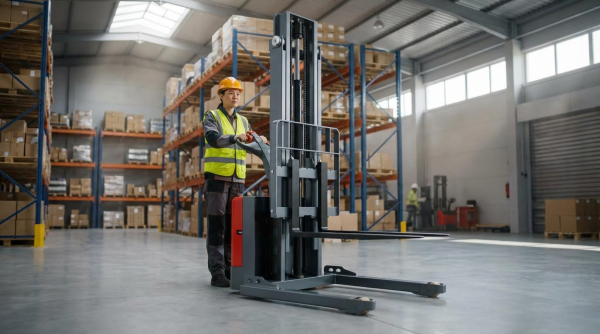
Even when the data plate says one number, real-world conditions often mean your walkie stacker can safely handle less. To understand how much can a walkie stacker hold in your operation, you must account for load center, lift height, battery, tires, and floor conditions, not just the rated capacity.
Load center distance and stability triangle
Load center is the distance from the fork heel to the load’s center of gravity. As this distance grows, the truck loses capacity because the load has more leverage over the drive wheels. This is one of the biggest reasons the answer to “how much can a walkie stacker hold” changes between a tight cube load and a long or uneven one. The stability triangle concept explains why: the combined center of gravity of truck plus load must stay inside a triangle formed by the wheel contact points.
| Factor | Effect on usable capacity | Typical impact / example |
|---|---|---|
| Rated capacity & rated load center | Base capacity under ideal conditions | Capacity stated on data plate at a specific load center distance Rated Capacity definition |
| Increased load center distance | Reduces capacity due to higher overturning moment | Example: 1500 kg at 24 in may drop to about 1200 kg at 30 in load center Load center example |
| Long or uneven loads | Moves center of gravity forward; narrows stability margin | Pipe, long crates, or offset pallets can easily push the combined center of gravity toward the front axle |
| Attachments (fork extensions, clamps) | Extend load center and add weight ahead of the mast | Commonly reduce capacity by roughly 10–50% depending on attachment geometry Attachment derate range |
- As load center increases, effective lifting capacity decreases in a near-linear fashion for small changes.
- Walkie stackers are typically rated around a 600 mm (24 in) load center; pushing beyond this cuts into how much can a walkie stacker hold in practice.
- Always treat the data plate capacity as valid only at the stated load center and mast height.
- Use manufacturer capacity charts to confirm safe weight at your actual load dimensions.
Why the stability triangle matters
The wheels form a triangle of support. The truck’s own center of gravity sits inside this triangle when unloaded. Adding a load shifts the combined center of gravity toward the forks. If you increase load weight or load center too far, the combined center of gravity crosses the front edge of the triangle and the truck tips forward. Turning, braking, ramps, and uneven floors all move this point dynamically, which is why engineers build in safety margins and require derating as geometry changes.
Lift height, mast design and derating curves

Capacity is not a single number; it changes with lift height. As the mast raises, the load sits higher, the center of gravity moves up, and the stacker becomes less stable. Mast design and type control how quickly capacity must be reduced as height increases.
| Parameter | Influence on usable capacity | Engineering reason / notes |
|---|---|---|
| Lift height | Higher lift = lower allowable load | Capacity typically decreases as lift height increases due to reduced stability and mast deflection Lift height impact |
| Mast type (single, duplex, triplex) | Controls max height and derating profile | Triplex masts reach higher but may require more aggressive derating at top heights Mast type effects |
| Mast and chain/hydraulic strength | Sets structural limit at given height | Columns, chains, and cylinders must handle bending and buckling loads at full height Structural factors |
| Derating curves / capacity charts | Show allowable weight vs. height and load center | Used to answer “how much can a walkie stacker hold at a given rack level” safely |
- Never assume the rated capacity applies at top rack; it usually applies at a specific intermediate height.
- High-lift applications (e.g., top beam in tall selective racking) often need a higher nameplate capacity than the actual pallet weight to stay within derated limits.
- Side-shift and reach mechanisms add weight and move the load forward, further derating the capacity curve.
How engineers build derating curves
Engineers test stackers at multiple heights and load centers. They measure mast deflection, wheel load distribution, and stability margins. Using these data, they define the maximum safe load for each height and geometry, then round down to include safety factors and dynamic effects like braking and steering. The result is the capacity chart that should be mounted with or near the data plate.
Battery weight, tire condition and floor quality
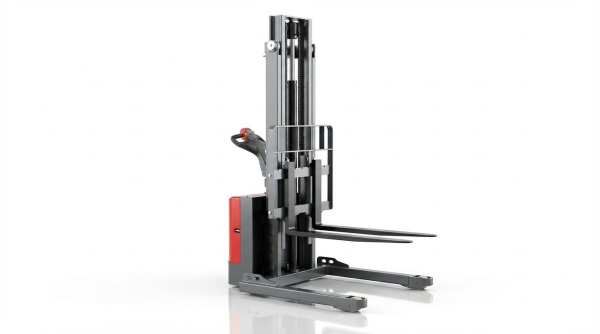
Even if load center and height are correct, support conditions under the truck change how much can a walkie stacker hold in real work. Battery weight, tire condition, and floor quality all influence stability, traction, and braking. These are often overlooked, but they are critical to safe capacity.
| Factor | Effect on capacity & stability | Key details / examples |
|---|---|---|
| Battery weight & condition | Changes counterweight and performance | Battery capacity influences lifting performance and operating time Battery influence. A heavier or lighter battery shifts the truck’s center of gravity and can change effective capacity by a noticeable margin Battery weight impact |
| Tire type and wear | Affects traction and stability | Worn or damaged tires reduce stability and can lower practical lifting capacity Tire condition |
| Floor flatness and friction | Determines how much load the truck can safely move without sliding or rocking | Standards assume smooth, level, hard surfaces for rated capacities Surface requirement. Uneven or slippery floors reduce stability and usable capacity Floor conditions |
- A depleted battery may slow lift speed and can struggle to raise loads near rated capacity.
- Changing from lead-acid to lighter batteries alters counterweight; always confirm the truck’s capacity with the new battery mass.
- Flat spots, chunking, or mismatched tire diameters shift load to one side and reduce the safety margin of the stability triangle.
- Ramps, dock plates, and broken concrete introduce dynamic rocking that effectively derates how much a walkie stacker should carry, even if the nameplate says it is allowed on level ground.
Practical checklist before trusting nameplate capacity
Before loading to the rated capacity, verify that: the correct battery type and weight are installed and secured; tires are in good condition and properly sized; the operating surface is hard, level, and clean; lift height and load center match the capacity chart; and operators understand that real-world usable capacity is often lower than the number printed on the data plate.
Matching Walkie Stacker Capacity To Your Application
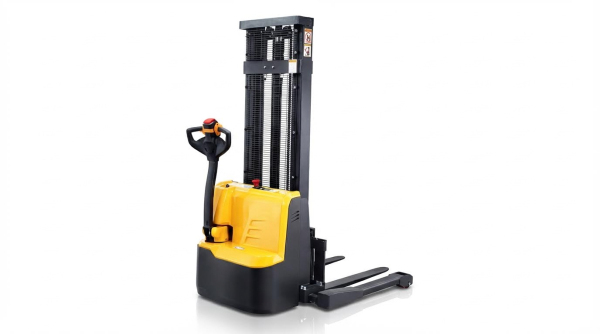
Calculating required capacity and load center
When people ask “how much can a walkie stacker hold”, the correct answer always starts with the load and its geometry, not the truck brochure. You size the truck to the heaviest, worst‑case load and the longest load center you expect in real life, then cross‑check against the data plate and capacity charts. Manufacturers rate stackers at a specific load center and derate as this distance grows. That is why a simple step‑by‑step method works best.
- Define your worst‑case load
- Maximum unit weight (kg or lb) you must handle.
- Maximum load length, width, and height (including overhang, packaging, dunnage).
- Is the load rigid (crate), semi‑rigid (bagged product), or flexible (big bags)?
- Estimate actual load center distance
- For a typical palletized load, load center ≈ half the load length measured from the fork face.
- Example: 48 in pallet → nominal 24 in load center.
- Long loads (doors, lumber, machinery) can easily push the load center to 30–36 in or more.
- Allow extra if loads are not perfectly centered or overhang the forks.
- Apply a capacity “safety factor”
- Target at least 10–20% capacity margin above your heaviest expected load.
- This margin covers uneven loading, wear, and real‑world variations.
- Use manufacturer derating logic
- Understand that capacity falls as load center increases. For example, a stacker rated 1500 kg at 24 in may only handle about 1200 kg at 30 in. This reduction is shown in manufacturer load charts.
- Check the data plate and charts for your required lift height, not just ground level. Capacity also drops at higher mast elevations.
- Translate into a minimum rated capacity
- If you must lift 900 kg loads with a realistic 28–30 in load center to full rack height, you will typically look for a manual pallet stacker with rated capacity ≥1200–1500 kg at a 24 in load center, depending on the exact derating curve.
- Always confirm with the specific truck’s capacity chart, not a generic catalog line.
Quick rule‑of‑thumb for “how much can a walkie stacker hold”
- Typical walkie stackers: about 450–1800 kg (1,000–4,000 lb) rated capacity at standard load centers. This range is common for pedestrian‑operated units.
- Expect lower usable capacity if your load center is longer than standard, or if you lift to the top of the mast.
- Do not select a truck whose rated capacity only just equals your heaviest load; build in margin.
The table below shows how the same nominal truck can have very different usable capacities depending on load and geometry. Numbers are indicative to illustrate the engineering logic.
| Scenario | Heaviest load | Load length | Approx. load center | Required rated capacity band* |
|---|---|---|---|---|
| Standard pallets | 800 kg | 48 in | 24–26 in | 1000–1200 kg at 24 in |
| Long pallets / overhang | 800 kg | 60 in | 30 in | 1200–1500 kg at 24 in |
| Bulky machinery on skids | 1200 kg | 72 in | 36 in | 1600–2000 kg at 24 in |
*Exact band depends on the specific derating curve for that walkie stacker model and mast height.
Narrow aisles, pallet types and racking heights
Even after you know how much can a walkie stacker hold for your load, the building often becomes the real constraint. Aisle width, pallet style, and top beam height all influence whether the truck can safely reach and place the load without hitting limits on capacity or maneuverability. These layout factors should be locked in before you finalize a stacker spec.
- Narrow aisle width and maneuvering
- Measure clear aisle width between rack or obstacles, not just drawing dimensions.
- Allow for truck length, load overhang, and steering arc during turning.
- Very narrow aisles may force you toward shorter chassis or different mast configurations rather than simply higher capacity.
- Pallet and load support type
- Standard closed‑deck or open‑deck pallets usually keep the center of gravity predictable.
- Damaged or undersized pallets can shift the load center forward and reduce stability.
- Non‑palletized loads (crates, drums, machinery) often sit further forward on the forks, effectively increasing the load center and lowering usable capacity.
- Racking heights and mast selection
- Record the highest beam level you must service plus clearance for handling and deflection.
- Choose mast free‑lift and overall height to clear doors, mezzanines, and sprinklers.
- Remember that stacker capacity typically decreases at higher lift heights due to stability limits, so check the capacity chart specifically at your top beam.
Practical layout checklist before choosing capacity
- Smallest aisle where the stacker must turn with a full load.
- Lowest doorway or obstruction vs. mast collapsed height.
- Highest racking level vs. mast extended height and derated capacity at that height.
- Typical pallet size and any non‑standard loads (long, high, or offset center of gravity).
- Floor flatness and condition, since uneven floors further reduce practical capacity. Smooth, level floors are assumed in capacity ratings.
When you combine these layout constraints with load calculations, you get a realistic answer to “how much can a walkie stacker hold” in your facility, not just on paper. The correct truck is the one that meets your worst‑case load and geometry at the highest rack position, within your narrowest aisle, with margin for wear and everyday variation.
Final Engineering Considerations For Safe Sizing
When you answer “how much can a walkie stacker hold”, you must go beyond the big number on the brochure. Final sizing decisions should lock in a safety margin, reflect real load geometry, and respect both standards and site conditions.
Use the points below as a pre‑purchase and pre‑deployment checklist.
- Always size to the worst credible case (heaviest, tallest, most off‑center load).
- Verify that capacity is adequate at your required lift height, not just at ground level. Capacity typically decreases as lift height increases.
- Confirm the actual load center created by pallet size, overhang, and attachments, then check it against the data plate and capacity chart. Rated capacity always assumes a specific load center distance.
- Maintain a conservative engineering safety factor between required capacity and rated capacity (commonly 20–25% for day‑to‑day operation).
Use standards and test logic, not guesswork
International standards for pedestrian‑propelled stacker trucks cap typical capacities and define how stability and braking tests must be done. For example, pedestrian‑propelled stackers with manual or electric lift are often limited to about 1,000 kg and are intended for smooth, level, hard floors. Standards specify capacity ranges and floor conditions. These standards also require stability and performance tests that combine load weight, lift height, and operating conditions to define maximum safe capacity. Test procedures determine the final rated capacity on the data plate. When you evaluate how much can a walkie stacker hold in your plant, align your assumptions with the conditions used in these tests: level floor, correct tires, correct battery, and properly maintained braking and control systems.
From an engineering perspective, “usable capacity” in your building is the rated capacity minus all the reductions caused by real‑world factors.
- Load center growth from larger pallets, overhang, or attachments reduces capacity, sometimes by 10–50%. Longer load centers increase overturning leverage and cut capacity.
- Lift height and mast type (especially high triplex masts) require derating at upper stages. Capacity falls as the center of gravity rises with lift height.
- Battery weight and state of charge influence both stability and hydraulic performance. A non‑standard battery can shift the center of gravity and change how much the truck can safely lift at height. Battery weight changes the truck’s balance and effective capacity.
- Tire type/condition and floor quality (smooth, level, non‑slip) are critical to keep the stability triangle intact under load. Worn tires and uneven floors reduce usable capacity and increase accident risk.
Practical sizing rules you can apply immediately
To close the loop on safe sizing, apply these practical rules before you sign off on a walkie stacker specification:
- Base calculations on the heaviest pallet plus any foreseeable future growth (for example, 10–15% weight increase over the next few years).
- Use the largest pallet length and any planned overhang to compute your worst‑case load center, then read the manufacturer’s capacity chart at that distance and your maximum racking height.
- If you add attachments (fork extensions, clamps, booms), treat the attachment as part of the load center and assume a significant capacity reduction unless the capacity plate explicitly covers that attachment.
- Confirm that your floor condition and gradients match the assumptions in the standards and test procedures; if not, derate further or improve the floor.
- Train operators to read and respect the capacity plate and charts so that day‑to‑day decisions in the aisle match the engineering assumptions you used in sizing.
Handled this way, “how much can a walkie stacker hold” becomes a controlled engineering answer, not a guess based only on the catalog rating.
Final Engineering Considerations For Safe Sizing
Walkie stacker capacity is not a fixed promise; it is an engineered limit that assumes ideal geometry and conditions. Load center, lift height, mast type, battery mass, tires, and floor quality all change the true safety margin. When these shift, usable capacity drops, even if the nameplate number stays the same.
Engineering teams must treat the data plate and capacity chart as boundary conditions, not targets. Start with the heaviest, longest, highest load you expect. Calculate the real load center and required lift height. Then read the capacity chart at that exact point and build in at least a 20% margin. If the chart does not clearly cover your case, step up to a higher‑capacity model or a different mast configuration.
Operations teams must keep conditions aligned with design assumptions. Maintain correct battery type and weight. Replace worn tires. Repair poor floors. Train operators to read and follow the data plate and to reduce loads when geometry or surfaces are worse than “perfect test” conditions.
Used this way, a walkie stacker from Atomoving delivers predictable, safe performance. Capacity becomes a controlled engineering outcome, not a guess based on a single catalog value.
Frequently Asked Questions
What is the weight capacity of a walkie stacker?
The weight capacity of a walkie stacker varies depending on the model and manufacturer. Typically, most walkie stackers can hold between 1,000 kg to 2,000 kg. For precise details, it’s best to consult the equipment specifications provided by the manufacturer. Forklift Types Overview.
How high can a walkie stacker lift?
A walkie stacker is designed for stacking pallets and lifting loads to moderate heights. Most models can lift loads up to 6,100 mm (6.1 meters). This makes them ideal for warehouses with medium-height shelving. Crown Stacker Details.
Does a walkie stacker count as a forklift?
Yes, a walkie stacker is considered a type of forklift. It falls under the category of powered industrial trucks, which are regulated by safety standards like OSHA. Operators need proper certification to use them safely. Walkie Stacker Safety Guide.