If you are asking “what is a walkie lift,” you are really asking how pedestrian-operated pallet movers and stackers differ in design, safety, and performance. This guide breaks down walkie pallet jacks and walkie stackers so you can match equipment to your loads, aisle widths, and lift heights. You will see how factors like load capacity, mast design, and battery technology affect stability, uptime, and total cost of ownership. Use this as a practical engineering playbook to choose the right walkie lift for your warehouse or shop floor.
Defining Walkie Lifts, Pallet Jacks, And Walkie Stackers
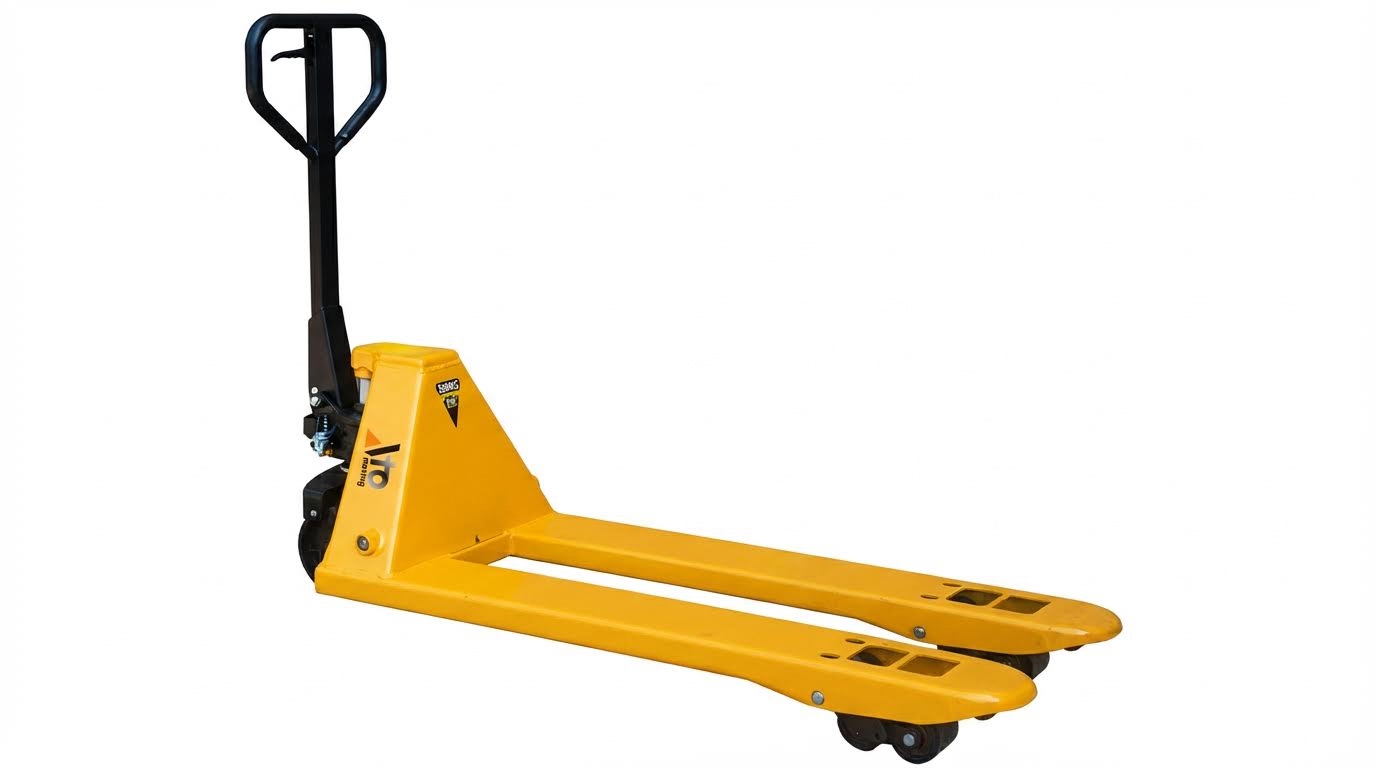
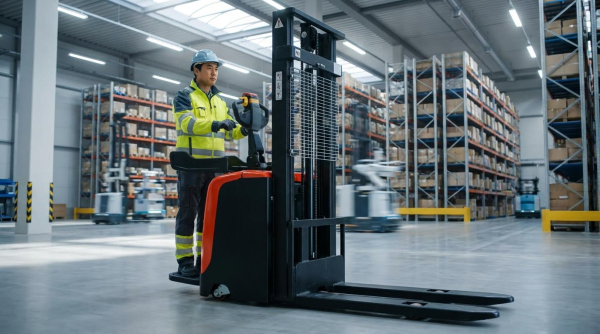
When people ask “what is a walkie lift,” they usually mean a family of compact, pedestrian-operated trucks used to move and lift pallets in tight warehouse spaces. In practice, this family splits into two main tool types: walkie pallet jacks for ground-level moves and walkie stackers for vertical storage. Understanding how “walkie,” “pallet jack,” and “stacker” differ helps you match equipment to load, aisle width, and lift height.
What “Walkie” Means In Material Handling
In material handling, “walkie” describes the operator position and how the truck is controlled. The operator walks with the machine instead of riding on it.
- Pedestrian-operated: The operator walks behind or beside the truck and steers with a tiller or handle, not from a seated cab.
- Low travel speed: Typical walkie stackers are limited to about 4–6 km/h for safety in mixed pedestrian areas (pedestrian speed range).
- Compact chassis: Narrow frames (around 1–1.3 m wide for many walkie stackers) allow operation in tight aisles and docks (typical chassis width).
- Tiller-based controls: A multi-function tiller usually carries travel, steer, lift, and lower controls for both walkie pallet jacks and walkie stackers (dual-control concept).
- Electric assistance: Most “walkie” units in modern warehouses are battery-powered for drive and/or lift, although manual walkie pallet jacks still exist.
Where walkie lifts fit among other equipment
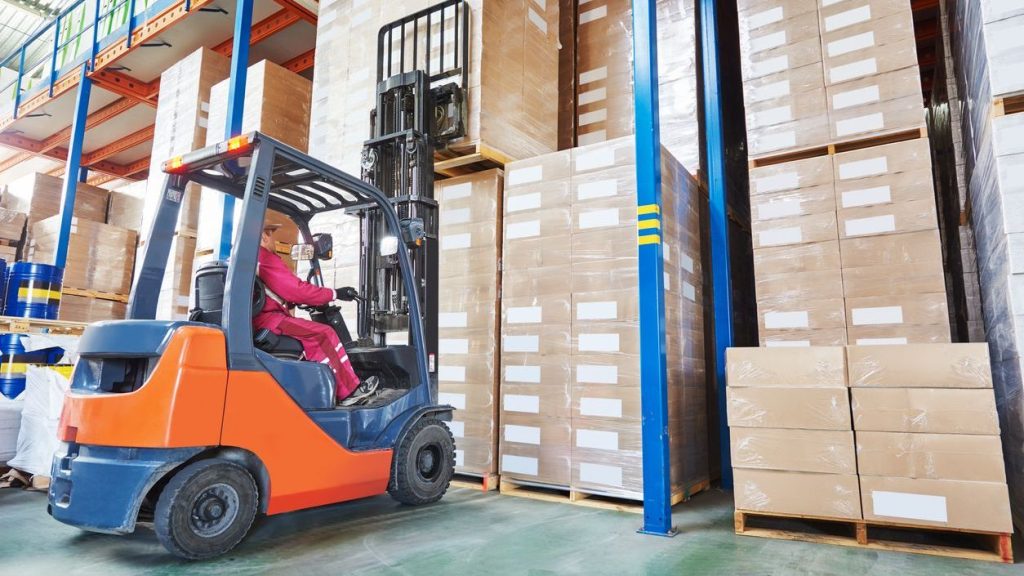
Walkie lifts sit between simple manual pallet jacks and full counterbalance forklifts. They offer more lift height and control than a pallet jack but with lower capacity and speed than a sit-down forklift, and they work best on smooth, level floors rather than rough outdoor yards. Space-efficiency vs. forklifts
Core Design Of Walkie Pallet Jacks
Walkie pallet jacks are the simplest answer to “what is a walkie lift” when the job is horizontal transport at floor level. They are built to pick up a pallet just high enough to roll and then move it short distances.
- Primary function: Horizontal movement of palletized loads over short distances, with only minimal lift height to clear the floor and obstacles (ground-level focus).
- Versions: Manual pallet jacks (pump handle for lift, push/pull to move) and electric pallet jacks (powered travel and often powered lift) (manual vs. electric).
- Lift range: Only enough to raise the pallet slightly off the ground to navigate uneven spots, not for stacking to racking levels.
- Frame and forks: Low-profile forks slide into the pallet openings; a compact chassis keeps turning radius small for narrow aisles.
- Hydraulic unit: A small hydraulic pump and cylinder provide the limited lift; on manual units this pump is actuated by the handle strokes.
| Feature | Manual Walkie Pallet Jack | Electric Walkie Pallet Jack |
|---|---|---|
| Operator position | Walking, pushing/pulling by hand | Walking, using powered drive |
| Lift mechanism | Manual hydraulic pump via handle | Electric or electro-hydraulic lift |
| Typical use | Light–moderate loads, short runs | Higher throughput, frequent moves |
| Lift height | Minimal (just clears floor) | Minimal (still ground-level focus) |
| Cost & maintenance | Low purchase and upkeep; simple maintenance (cost-effectiveness) | Higher cost; needs battery and charger |
Manual walkie pallet jack pros in data terms
Manual walkie pallet jacks stayed popular because they were significantly cheaper than powered stackers and did not need extra batteries or charging infrastructure. Their maintenance focused on simple tasks like hydraulic oil checks, lubrication of wheels/axles, and cleaning to protect wheels from debris, which kept failure rates low and service life long. Cost and maintenance advantages Typical maintenance tasks
Core Design Of Walkie Stackers
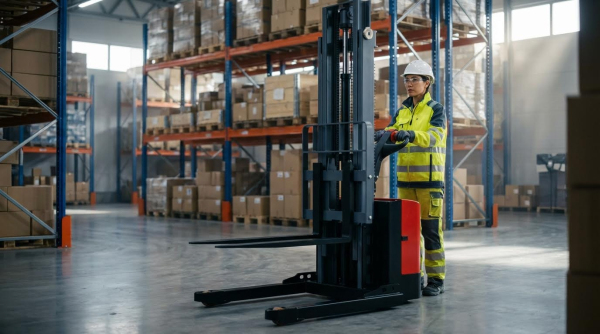
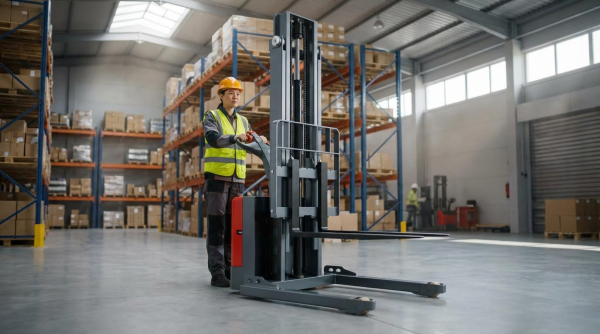
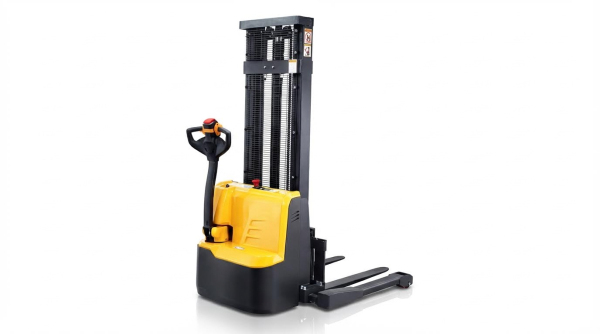
Walkie stackers are the vertical-lift answer to “what is a walkie lift.” They take the walk-behind format of a pallet jack and add a mast so you can stack pallets in racking or feed machinery at height.
- Primary function: Lift and lower palletized loads to storage and picking heights while still allowing horizontal movement (vertical handling role).
- Operator position: Pedestrian, using a tiller with integrated travel and lift/lower controls (dual-control system).
- Power system: Electric drive and lift, commonly using 24 V or 36 V battery packs, with runtimes of several hours per charge depending on capacity and duty cycle (typical battery specs).
- Mast and forks: Single, 2-stage, or 3-stage mast with free lift, plus adjustable forks that raise to multiple storage levels (mast design and free-lift).
- Safety systems: Automatic braking, overload protection, and sensors to prevent unstable lifts, all tuned to the rated capacity and load center (safety features).
| Key Design Aspect | Typical Walkie Stacker Characteristics |
|---|---|
| Rated capacity range | Approx. 1,000–2,500 kg depending on model (common capacity band) |
| Lift height range | Several meters; many designs around 3–4 m for standard warehouse racking (example lift heights) |
| Chassis width | Compact, often around 1–1.3 m for use in tight aisles (space-efficient profile) |
| Battery type | Lead-acid or lithium-ion; lithium-ion can support full shifts with rapid recharge and productivity gains of roughly 30% vs. lead-acid in some cases (battery advancements) |
| Load center sensitivity | Capacity drops if the load center moves beyond the rated value (for example, reductions on the order of 15–30% are possible when loads are carried too far out) (effect of load center) |
Why walkie stackers differ from forklifts
Walkie stackers were engineered to prioritize space efficiency over raw lifting power. They use narrower frames and do not rely on large counterweights like counterbalance forklifts, which keeps overall length and aisle requirements down but limits outdoor and rough-surface use. Charging is simpler as many walkie-type electric units can plug into standard building power, while larger forklifts often need higher-voltage industrial charging stations. Design differences vs. forklifts
Technical Comparison: Walkie Pallet Jacks Vs. Walkie Stackers
This section compares walkie pallet jacks and walkie stackers on hard engineering facts: how much they lift, how high they go, and how long they work. If you are asking what is a walkie lift in practical terms, these three comparisons—capacity, height, and power—show which machine fits your loads, racking, and shift pattern.
Load capacity, load center, And stability
Walkie pallet jacks and walkie stackers handle similar pallets, but they are not equal in capacity, load center tolerance, or stability margins. The table below summarizes typical ranges and what they mean in real warehouses.
| Parameter | Walkie Pallet Jack (manual / electric) | Walkie Stacker | Engineering Notes |
|---|---|---|---|
| Typical rated capacity | 1,000–2,500 kg (light–medium duty) Cited capacity range | 1,000–2,500 kg typical Cited stacker capacities | Similar nameplate capacities, but stackers carry load at height, so stability is more critical. |
| Load center (LC) | Commonly 500–600 mm for standard pallets | ≈600 mm typical LC; capacity drops beyond this Load center effect | Long or unbalanced loads quickly de‑rate stacker capacity at height. |
| Capacity loss beyond rated LC | Usually modest impact because lift height is low | ≈20% capacity loss per extra 100 mm beyond LC; 15–30% total de‑rating is common Cited de‑rating data | Critical selection factor for tall racking or long pallets. |
| Stability at ground level | Very stable; low center of gravity; load travels just off the floor | Stability depends on mast, wheelbase, and floor condition; dual-front-wheel designs improve stability at max load Dual-wheel stability | Stackers are more sensitive to uneven floors, slopes, and off‑center loads. |
| Speed envelope | Walk‑behind models often limited for safety; manual speed governed by operator | Pedestrian design with typical speed 4–6 km/h Cited speed range | Both prioritize pedestrian safety over travel speed. |
For anyone evaluating what is a walkie lift from a stability standpoint, think in terms of “height × offset.” A walkie pallet jack keeps the load low, so the overturning moment is small even when the pallet is a bit long. A walkie stacker moves that same mass upward, so any extra overhang beyond the rated load center multiplies the tipping risk.
- Use pallet jacks when loads stay at floor level and you mainly care about horizontal moves.
- Use walkie stackers when you must place loads into racking but can control pallet length and keep the center of gravity close to the carriage.
- In borderline cases (long loads, poor floors), specify dual-front-wheel stackers and reduce the working capacity below the nameplate for a safety margin.
Practical engineering check for stability
Before committing to a stacker, test worst‑case loads at maximum intended height with reduced capacity (for example, 70–80% of the rating). This reflects real‑world factors like pallet damage, shifting contents, and floor irregularities that are not fully captured in catalog data.
Lift height, mast design, And free-lift systems
Walkie pallet jacks and walkie stackers differ most obviously in vertical reach. That difference drives mast design, free‑lift needs, and how well each machine uses your building’s clear height.
| Parameter | Walkie Pallet Jack | Walkie Stacker | Implication for warehouse design |
|---|---|---|---|
| Primary function | Horizontal transport with minimal lift height Ground‑level focus | Vertical stacking and retrieval plus short horizontal moves Stacking function | Choose jacks for floor‑level staging; stackers for multi‑level racking. |
| Typical lift height | Just enough to clear floor and dock transitions (a few hundred millimeters) Minimal lift | ≈3–4 m common; “several meters” possible depending on model 3–4 m lift range Several‑meter lift | Stackers unlock vertical cube; jacks cannot service upper beam levels. |
| Mast type | No mast; low‑profile forks only | Often 2‑ or 3‑stage masts; 3‑stage common with free‑lift 3‑stage mast mention | More stages give more lift in the same collapsed height but add weight and complexity. |
| Free‑lift capability | Not applicable | Free‑lift allows forks to rise before mast extends, helping under mezzanines and low doors Free‑lift feature | Crucial where there are low overhead obstructions but tall racks deeper in the aisle. |
| Mast strength for high capacities | Not relevant | High‑capacity units need reinforced masts and dual hydraulic cylinders to control deflection under heavy loads Reinforced mast requirement | For heavy loads at height, specify mast stiffness and cylinder configuration, not just capacity. |
- If you only load trucks, feed production lines, or move pallets between zones at floor level, a manual pallet jack is the simpler, more economical choice.
- If you store pallets above the first beam level, a walkie stacker (or similar walkie lift) is usually the minimum viable solution.
- Free‑lift masts matter in buildings with low door headers, sprinklers, or mezzanines; they let you lift the pallet inside the doorway before the mast rises.
How mast design affects safety and productivity
Taller, multi‑stage masts introduce more flex and sway, especially near maximum height. This slows operators because they must pause to stabilize loads before placement. When you ask what is a walkie lift “good for,” remember that a shorter mast with fewer stages is usually safer and faster if your racking does not require extra height.
Power options, batteries, And duty cycles
The last key difference between walkie pallet jacks and walkie stackers is how they are powered and how long they can work between charges. This directly affects shift coverage, charging infrastructure, and total cost of ownership.
| Aspect | Walkie Pallet Jack | Walkie Stacker | Operational impact |
|---|---|---|---|
| Power types | Manual (no battery) and electric versions available Pallet jack power options | Mainly electric; manual and semi‑electric stackers also exist Stacker power options | Manual jacks suit low‑volume work; powered stackers suit repetitive lifting. |
| Battery voltage | Commonly 24 V class for electric jacks | Typically 24 V or 36 V electric systems 24/36 V mention | Higher voltage helps support higher lift and pump power on stackers. |
| Battery capacity and runtime | Smaller packs; duty cycle focused on travel, not high lifting | ≈200–300 Ah lithium packs give about 5–6 hours runtime in typical use Runtime data | Stackers need more amp‑hours because lifting at height draws higher current. |
| Lithium‑ion vs lead‑acid | Lead‑acid common; lithium increasingly available on higher‑end electric jacks | Lithium‑ion can support full 8‑hour shifts with ≈1.5‑hour rapid charge and ~30% productivity gain vs lead‑acid Lithium performance | Lithium reduces downtime and supports opportunity charging during breaks. |
| Charging infrastructure | Manual jacks need none. Electric jacks often charge from standard outlets; low complexity. | Electric stackers typically charge from standard 120 V supply, simpler than many forklifts that need 240 V industrial chargers Charging comparison | Stackers offer powered lifting without the heavy infrastructure of full forklifts. |
| Energy demand per cycle | Low; most energy goes into rolling resistance and minor lifting | Higher; energy goes into pumping oil to raise loads to several meters and powering traction motors | Plan for more frequent charging or larger batteries on high‑throughput stacking applications. |
- For light, intermittent moves in small facilities, manual pallet jacks eliminate battery management and charging completely.
- For high‑throughput operations with frequent lifting, electric walkie stackers with lithium‑ion batteries deliver consistent performance and shorter charge windows.
- When you evaluate what is a walkie lift “worth” versus a sit‑down forklift, remember that walkie stackers often run from simpler 120 V outlets, reducing installation cost.
Duty cycle sizing tip
Estimate your duty cycle in lifts per hour and average lift height. For example, a walkie stacker handling about 1,800 kg and 60 lifts per hour needed at least an 80 Ah battery to sustain performance in one documented case. Stacker duty cycle example Use similar calculations to size batteries conservatively, then verify with field trials.
Practical Applications, Selection Criteria, And TCO
Matching equipment to aisle width And layout
When you ask what is a walkie lift in a real facility, the right answer depends heavily on aisle width, racking height, and travel distance. Walkie pallet jacks favor short, ground-level moves, while walkie stackers shine where you must use vertical space. Use the layout to drive the choice, not the other way around.
| Layout factor | Walkie pallet jack (manual / electric) | Walkie stacker / walkie lift | Typical best use |
|---|---|---|---|
| Aisle width | Works well in very narrow aisles; small turning radius and short overall length. Manual units are especially compact | Chassis typically 1–1.3 m wide, needs more clearance for mast swing and load. Compact but less nimble than basic jacks | Very tight pick aisles → pallet jacks; moderate aisles → stackers |
| Racking / storage height | Ground-level only; minimal lift just to clear floor irregularities. Not a stacking tool | Lift to several meters using mast and forks, often 3–4 m or more. Designed for vertical storage | Low storage → pallet jack; high-bay or mezzanine feeding → stacker |
| Trip length & traffic | Best for short shuttle moves between nearby zones; low speed but quick to deploy. Ideal for staging areas | Good for repeated runs between storage and docks; electric drive reduces fatigue. Speed typically limited to 4–6 km/h for safety. Pedestrian-speed travel | Short, dense pick paths → pallet jacks; repetitive put-away / retrieval → stackers |
| Floor quality & environment | Manual jacks tolerate minor defects but suffer on steep slopes and damaged floors. Best on flat, hard floors | Dual-front-wheel stackers improve stability on uneven floors at rated loads. Still mainly indoor / paved use | Rough floors → evaluate wheel type and path; both are mainly indoor tools |
| Throughput / picks per hour | Manual jacks suit low-volume or occasional moves. Electric versions raise throughput but remain ground-level only. Low capital, lower peak output | Electric stackers and walkie riders handle higher volumes faster, especially in bulk loading / unloading. Higher productivity in busy docks | Low volume → pallet jack; medium–high volume with stacking → walkie lift / stacker |
To decide what is a walkie lift for your site in practical terms, map each aisle: width, turning clearances at the ends, and required lift heights. Then select walkie pallet jacks for low-level handling and walkie stackers where the layout demands vertical storage or frequent put-away.
Quick layout-based selection checklist
- If more than 70% of storage is at ground level → prioritize walkie pallet jacks.
- If you regularly store above 2.5–3 m → you need walkie stackers or similar walkie lifts.
- If aisles are just wide enough for a pallet and operator → manual or compact electric pallet jacks fit best.
- If aisles allow mast swing and safety clearances → walkie stackers give better cube utilization.
- For long, straight runs between dock and storage → consider electric walkie riders for higher productivity. They streamline dock-to-storage moves
Safety, compliance, And maintenance requirements
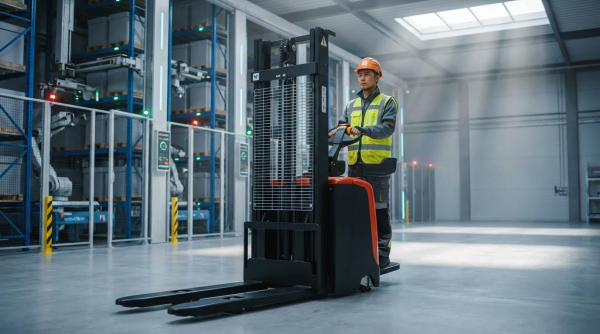
Safety and lifecycle cost often decide which walkie solution is truly “right,” even more than initial price. Any answer to what is a walkie lift must include how you will train operators, maintain the unit, and comply with site rules and regulations.
Key safety and compliance practices for walkie pallet jacks and walkie stackers include:
- Formal operator training on controls, load handling, and hazard recognition, not just “on-the-job” shadowing. Training is essential for both jacks and stackers
- Strict adherence to rated capacity and load center; exceeding load center can cut effective capacity by 15–30% and raise tip-over risk. Capacity falls as load center increases
- Never bypass or override height limit switches or safety interlocks, which protect against over-lifting and mast instability. Overlifting destabilizes the center of gravity
- Use of PPE (safety shoes, high-visibility clothing, and where needed, gloves and eye protection) in all operating zones. Basic PPE reduces injury severity
- Clear rules prohibiting riding on manual pallet jacks and avoiding slopes with loads. These practices prevent common accidents
Maintenance discipline has a direct impact on total cost of ownership (TCO). Manual pallet jacks have low service needs, while electric walkie stackers and riders require structured inspection and battery care but deliver higher output.
| Aspect | Manual walkie pallet jack | Electric walkie pallet jack / rider | Walkie stacker / walkie lift |
|---|---|---|---|
| Baseline maintenance tasks | Check hydraulic oil annually; typical oil ~0.4 L, ISO VG32, with 30 cSt at 40°C. Lower forks, refill to filler-hole bottom | Battery charge checks, connector inspection, control function tests, wheel and brake checks. Daily inspection recommended | Daily inspection of mast, forks, wheels, hydraulics, and electrical components. Look for cracks, leaks, damage |
| Lubrication & wear control | Monthly lubrication of wheels, axles, and grease points; frequent wheel cleaning to prevent debris damage. Extends service life | Grease moving joints per schedule; monitor drive tires and load wheels for flat spots from overloading or impacts. Good wheel care cuts downtime | Lubricate chains, bearings, pivot points; clean to keep switches and sensors reliable. Prevents corrosion and sticking |
| Battery & energy | None (manual); no chargers, no battery replacement cost. Lowest energy-related TCO | Daily charge checks; proper charging extends life and uptime. Some setups support full-day work on one charge. Modern batteries support high-intensity use | Battery size must match lift frequency; e.g., high-lift stackers may need ≥80 Ah to sustain 60 lifts/hour. Undersized batteries raise TCO |
| Inspection & record-keeping | Simple daily visual checks and occasional chain / valve adjustments. Store unloaded and forks lowered | Operator pre-shift inspections plus periodic service by maintenance staff; basic log-keeping recommended. | Structured weekly and periodic technician inspections, with formal maintenance records to support compliance. Records support preventative maintenance |
| Intrinsic safety features | Relies heavily on operator behavior and load discipline; no powered drive or mast to fail. | Emergency stop, horns, lights, and automatic braking are common on powered walkie riders. Helps protect pedestrians | Overload protection, automatic braking, and limit switches protect against mast and load failures. Integral to modern stacker design |
From a TCO perspective, manual pallet jacks win on pure cost but cap your throughput and rely on operator effort. Electric walkie pallet jacks, riders, and walkie stackers cost more to buy and maintain but reduce labor, shorten handling cycles, and improve ergonomics, which often pays back in busy operations. Aligning safety systems, maintenance capability, and workload with your layout is the most reliable way to answer what is a walkie lift you should actually buy.
Final Thoughts On Choosing The Right Walkie Lift
Walkie pallet jacks and walkie stackers solve different problems, but the same engineering rules guide both. Load capacity, load center, mast height, and aisle width all combine to set your real safety envelope, not just catalog ratings. When you raise a load higher or move the center of gravity forward, you increase overturning forces and reduce the stability margin. That is why stackers demand stricter control of pallet length, floor quality, and operator training than low‑lift pallet jacks.
Power choice and battery sizing also shape uptime and lifecycle cost. Manual pallet jacks cut energy and service costs but cap throughput. Electric walkie stackers with well‑sized lithium batteries support longer shifts and faster cycles, which can offset higher purchase price in busy sites.
The best practice is simple. Start with your layout and loads, then work backward. Define aisle width, lift heights, pallet types, and duty cycle in numbers. Select walkie pallet jacks for low‑level, short moves and walkie stackers where vertical storage or high volume justifies power and mast complexity. Finally, lock in formal training, daily inspections, and disciplined maintenance so your chosen Atomoving walkie lift delivers safe, predictable performance over its full service life.
Frequently Asked Questions
What is a Walkie Stacker?
A walkie stacker is a type of material handling equipment designed to lift and transport pallets. It uses legs that sit under the forks to distribute the load weight, allowing it to lift two pallets at one time. This makes them ideal for applications that require transportation and lifting of pallets. They also require minimal space for turning, making them suitable for narrow aisles. Walkie Stacker Guide.
How High Can a Walkie Stacker Lift?
Walkie stackers are ideal for lifting loads to heights up to 6100 mm. They are commonly used in applications where loads need to be stored at elevated positions and minimal travel distances are required. These machines can also serve as mobile work platforms to position work at an ergonomically-friendly height. Stacker Specifications.
What is the Difference Between a Walkie Stacker and a Forklift?
A walkie stacker is a more compact and maneuverable option compared to traditional forklifts. While both can lift and transport loads, walkie stackers are typically used for lighter loads and in tighter spaces. Forklifts, on the other hand, are designed for heavier loads and longer travel distances within a warehouse. Forklift vs Stacker.