“Can you load a trailer with a walkie stacker?” is the wrong first question; the right one is whether you can do it within its design and safety limits. This guide explains where walkie stackers work well, why trailers are high‑risk, and what safer loading options and controls you should consider before approving this task.
What Walkie Stackers Are Designed To Do
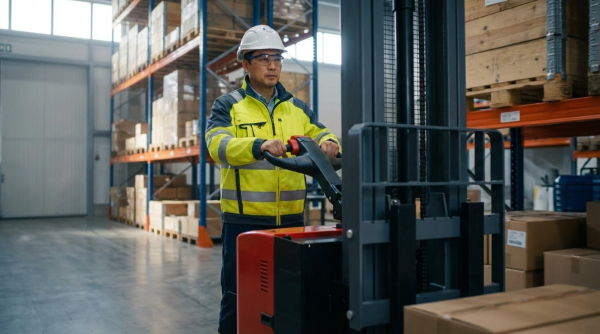
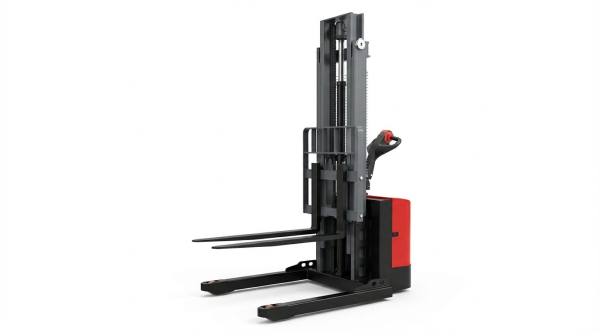
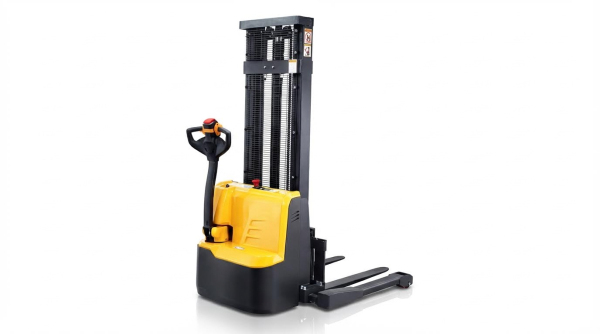
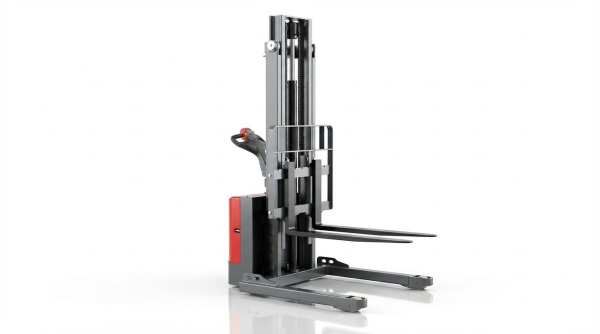
Walkie stackers are compact, pedestrian-operated powered trucks designed for short-distance pallet handling and vertical stacking on flat, smooth floors, not for rough dock transitions or unstable trailer decks. Understanding this design envelope is key before asking whether you can load a trailer with a walkie pallet truck.
Core design and operating envelope
Walkie stackers are engineered as indoor, low-speed, short-reach material handlers with the operator on foot close to the chassis. Their geometry, speed, and weight distribution assume controlled warehouse floors, not the dynamic environment inside most trailers.
- Operator position: Walk-behind or small fold-down platform – Keeps the truck compact but leaves the operator exposed if something shifts.
- Typical travel speed: Around 1.5–2.0 m/s (≈3.5 mph) loaded – Fast enough that a slip or trailer movement can cause loss of control.
- Intended surface: Flat, hard, smooth indoor floors – Not designed for flexing wood floors, gaps, or broken boards in trailers.
- Overall width: Roughly 800 mm – Good for narrow aisles, but narrow track reduces lateral stability on crowned or sloped decks.
- Power system: 24 V battery, roughly 180–280 Ah, truck mass about 210–280 kg – Gives traction but adds point load to dock plates and trailer floors.
Why floor type matters so much
The tyres and suspension of walkie stackers assume a rigid, even floor. On a flexing trailer deck, load shifts change the effective gradient and can unload the drive wheel, reducing braking and steering control right when you need it most.
| Design Feature | Typical Value / Characteristic | Operational Impact |
|---|---|---|
| Operator mode | Pedestrian (walk-behind or small platform) | Limited escape space inside a 2.4–2.6 m wide trailer |
| Intended surface | Flat, hard, smooth warehouse floor | Poor tolerance for gaps, broken boards, or dock lips |
| Truck mass (without load) | ≈210–280 kg | Concentrated load on dock plates and trailer floor |
| Travel speed (loaded) | ≈1.5–2.0 m/s | Requires good traction and predictable gradients |
| Overall width | ≈800 mm | Fits tight aisles but less stable laterally on slopes or crowns |
💡 Field Engineer’s Note: If a walkie stacker feels “twitchy” when you cross a dock plate empty, expect that behaviour to amplify under load on a flexing trailer floor. That’s a design-envelope warning, not just operator “feel.”
Rated capacity, load center, and lift height limits
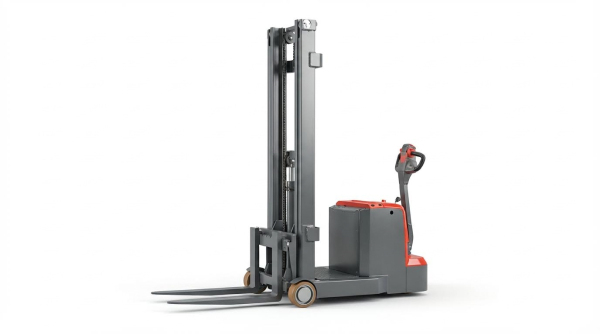
Walkie stackers carry useful loads, but their rated capacity assumes a specific load center and lift height on level ground. Any change in load position, grade, or mast height eats into your safety margin, which is critical when asking can you load a trailer with a manual pallet jack.
- Typical rated capacity: About 1,000–2,000 kg at a 600 mm load center – A full pallet near this limit leaves little room for error at height.
- Load center assumption: Load mass evenly distributed, pallet fully supported, center 600 mm from the carriage – Dock plates and tight trailers often push pallets forward, increasing the effective load center.
- Lift height range: Lowered mast often >1,800 mm; max lift commonly 3,000–4,500 mm – Higher lift reduces residual capacity and increases overturn risk.
- Travel height good practice: Load kept about 300–400 mm above floor during travel – Minimises tipping moment if the trailer floor moves or the truck hits a defect.
| Parameter | Typical Range / Condition | Operational Impact |
|---|---|---|
| Rated capacity | ≈1,000–2,000 kg at 600 mm load center | Overloading or extending load center can cause forward tip |
| Load center | 600 mm from carriage face | Gaps or short pallets shift center forward, reducing capacity |
| Max lift height | ≈3.0–4.5 m | Residual capacity drops as mast extends |
| Recommended travel height | ≈300–400 mm | Lower center of gravity for better stability in trailers |
| High-travel discouraged above | ≈500 mm | Increases overturn risk on uneven or moving floors |
- Capacity curve: Every walkie stacker has a capacity plate showing allowable mass vs. height and load center – Trailer work often pushes you toward the edge of this curve.
- Fork engagement: Forks must fully support the pallet – Partial engagement lengthens the effective load center and can break pallet boards.
How to sanity-check a load before entering a trailer
Confirm the pallet mass is below the truck’s rated capacity at the required lift height, verify full fork insertion, and keep the lift height at or below about 400 mm while moving. If you cannot maintain these conditions inside the trailer, the application is outside a walkie stacker’s safe design envelope.
💡 Field Engineer’s Note: When you move from flat concrete to a dock plate and into a trailer, treat it as adding “virtual height” to the load. The effective tipping moment can look like you just raised the forks another 300–400 mm, even if the mast hasn’t moved.
Why Trailers Are a High-Risk Environment
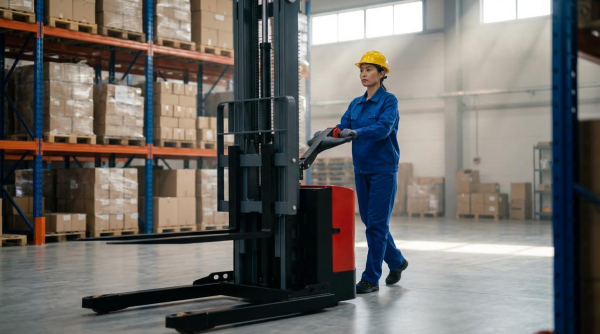
Trailers are a high-risk environment for walkie stackers because flooring, gradients, clearances, and restraint conditions fall outside what these trucks were designed for. This is central to any honest answer to “can you load a trailer with a walkie stacker”.
Walkie stackers assume flat, solid, predictable floors and short travel distances. Trailers add flexing decks, dock transitions, confined space, and the possibility of trailer movement, all of which directly attack stability and escape options.
Dock plates, floor strength, and grade transitions
Dock plates, trailer floors, and grade transitions are high-risk because they change the load geometry and floor loading that walkie stackers rely on to stay stable.
- Dock plate rating: The plate must carry the stacker mass plus load – under‑rated plates can bend or fail under concentrated wheel loads.
- Plate length and angle: Short plates create steep ramps – steep approach angles shift the load centre forward and reduce effective capacity.
- Trailer floor strength: Wood floors, gaps, and soft spots are common – localized failure under a 200–300 kg drive unit can cause sudden drop and tip‑over.
- Floor condition: Wet, oily, or debris‑covered floors – increase slip risk and reduce braking and traction, especially on the single drive wheel.
- Transitions and humps: Lips, crowns, and dock bumps – momentarily unload wheels and can rock the mast, destabilising a raised load.
| Element | Typical Issue | Risk Mechanism | Operational Impact |
|---|---|---|---|
| Dock plate capacity | Unknown or marginal rating | Plastic deformation or sudden failure | Risk of stacker dropping through plate during entry/exit |
| Dock plate length | Short span between dock and trailer | Ramp angle too steep | Forward shift of load centre, increased rollback risk |
| Trailer floor | Old timber, broken boards, flexing | Local collapse under wheel loads | Instant loss of support, potential tip‑over or stuck truck |
| Transition profile | Crowns, dips, lips at threshold | Dynamic rocking, wheel unloading | Load sway, fork impact, loss of traction |
| Surface condition | Water, oil, pallet fragments | Reduced friction, point loading | Longer stopping distances, steering loss, puncture risk |
How grade transitions affect rated capacity
Walkie stacker capacities assume a level surface and a defined horizontal load centre. When you put the truck on a ramp or over a hump, the effective horizontal distance from the drive axle to the load centre increases. Even a small angle change can erode the safety margin built into the nameplate rating, especially with tall or poorly wrapped loads.
💡 Field Engineer’s Note: In real docks, the first failure is often not a spectacular plate collapse but progressive bending. Once a dock plate or trailer floor starts to “dish” under a walkie stacker, retire that interface immediately; the altered geometry quietly eats into your stability margin every cycle.
Stability, escape paths, and operator exposure
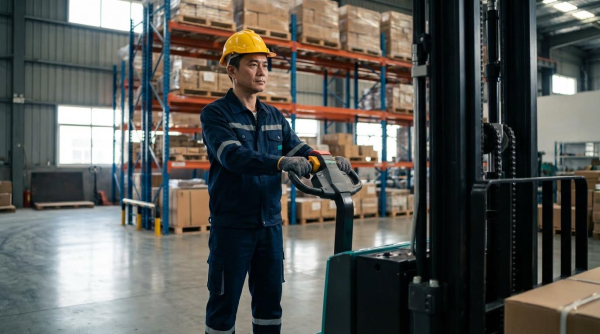
Stability and escape are worse in trailers because the operator is on foot, boxed in by walls and freight, and shares limited space with a tall, narrow vehicle.
- Narrow trailer width: Internal width around 2.4–2.6 m leaves little lateral clearance – small steering errors can trap the operator between truck and wall.
- Confined length: Deep loading forces long reversing runs – operator must walk backwards near stacked freight and trailer edges.
- Reduced lateral stability: Narrow chassis and crowned floors – increase side‑tip risk with high or offset loads.
- Limited escape paths: Only one door, blocked by pallets or the stacker itself – if the load shifts or the trailer moves, the operator has nowhere to go.
- Proximity to load: Walk‑behind position keeps operator close to forks and mast – increases crush and struck‑by risk if the truck surges or slides.
| Scenario | What Changes vs. Open Floor | Primary Risk | Best For… / Impact |
|---|---|---|---|
| Reversing out of a loaded trailer | Operator walking backwards in a 2.4 m corridor | Trip, crush between handle and racking/wall | Needs strict speed limits and spotters to be tolerable |
| Turning inside the trailer | Minimal side clearance for chassis swing | Side impact, pallet collapse, foot run‑over | Better suited to low‑profile pallet jacks than stackers |
| Travelling with raised load | Low roof, cross‑bows, and flexing floor | Mast strike, load shift, tip‑over | Keep forks just 300–400 mm above deck wherever possible |
| Trailer movement at dock | Trailer “drop” or creep from dock | Gap opening under wheels | High need for restraints and visual checks |
Why operator position matters more in trailers
On a walkie stacker the operator is effectively the crumple zone. In an open warehouse, they can step sideways or back from a problem. In a trailer, both sides are hard walls, the rear is the door edge, and the front is the moving truck and load. This geometry turns any loss of control into a potential crush event.
💡 Field Engineer’s Note: When I audit docks, I watch the operator’s feet, not the truck. If there is no place for a clean lateral step at any point in the cycle, the trailer is a poor candidate for walkie stacker work, no matter what the capacity plate says.
Compliance with OSHA/ANSI and internal safety rules
Regulatory and internal rules treat trailers as elevated, unstable work areas, so using walkie stackers there demands controls many sites simply do not meet.
- Securing the trailer: Parking brake set, wheels chocked, landing gear down, and restraints engaged – prevents trailer creep or “dock walk.”
- Rated interface equipment: Dock levellers and plates with known capacities – ensures combined mass of truck plus load stays within rating.
- Pre‑use inspections: Checks for broken boards, soft spots, and fluid spills – reduces the chance of structural or friction failure mid‑operation.
- Written procedures: Standard steps for securing, loading order, and communication – turns ad‑hoc decisions into repeatable safe practice.
- Training and authorization: Only trained operators allowed to enter trailers – supports compliance with powered industrial truck rules and internal policies.
| Control Area | Typical Requirement | Risk Addressed | Operational Impact |
|---|---|---|---|
| Trailer restraint | Chocks and/or mechanical restraint | Trailer roll‑away or creep | Makes repeated entry/exit with walkie stackers more predictable |
| Dock interface rating | Capacity > stacker mass + max load | Structural failure of plate/leveller | Often rules out light, portable plates for powered trucks |
| Floor inspection | Visual check each trailer before entry | Hidden damage or contamination | May slow loading but prevents high‑severity failures |
| Operator training | Formal PIT and dock‑specific training | Misuse, overloading, speed | Defines who may even ask “can you load a trailer with a walkie stacker” on site |
| Internal policy | Approved equipment list per dock | Wrong truck in wrong place | Often bans walkie stackers from trailers entirely |
How internal rules often go beyond regulations
Many facilities adopt stricter rules than national standards because incident investigations repeatedly link trailer accidents to marginal conditions that were technically “legal” but clearly unsafe. Common examples include banning walkie stackers from unsupported semi‑trailers, from trailers without restraints, or from any unit with visibly damaged floors.
💡 Field Engineer’s Note: If your dock relies on “experienced operators” instead of hard rules and physical controls, expect regulators and insurers to push back after the first serious trailer incident. Written, enforced limits on where walkie stackers may operate are your best defence.
Safer Ways To Handle Trailer Loading
Safe trailer loading with a walkie stacker depends on strict limits, disciplined procedures, and knowing when to say “no” and use other equipment instead. This section turns the question “can you load a trailer with a walkie stacker” into a structured, defensible safety decision.
When (and how) a walkie stacker may be conditionally allowed
A walkie stacker should only enter a trailer under tightly controlled, pre-approved conditions defined by engineering and safety teams. The goal is to ensure the dock environment matches the equipment’s design limits, not the other way around.
| Condition Area | Minimum Requirement | Operational Impact |
|---|---|---|
| Trailer securing | Parking brake set, engine off, wheels chocked, landing gear/stabilisers deployed, no visible movement | Reduces risk of trailer roll-away or “trailer creep” while the stacker is inside |
| Dock plate / leveller | Rated capacity comfortably above combined mass of walkie stacker + heaviest load | Prevents plate failure or excessive flex when crossing into the trailer |
| Floor condition | Clean, dry, no broken boards, no obvious soft spots or deflection under other traffic | Maintains wheel traction and prevents local floor collapse under point loads |
| Grade / transitions | Near-level interface with smooth transition; no sharp humps or dips at dock lip | Reduces risk of tipping when the load centre shifts during crossing |
| Load characteristics | Intact pallets, stable stacking, mass within rated capacity at intended lift height | Prevents sudden load shift or collapse inside confined trailer space |
| Traffic density | Controlled access; no mixed pedestrian/vehicle traffic inside trailer | Gives operator space to manoeuvre and retreat if something goes wrong |
- Written authorization: Site management should explicitly list which doors and trailer types allow walkie stacker entry – removes ambiguity at the dock.
- Pre-use checks: Operators complete a short dock-and-trailer checklist before first entry – catches bad plates, damaged floors, or unsecured trailers.
- Load height rules: Keep loads low (around 300–400 mm) when travelling inside trailers – maximizes longitudinal stability and headroom.
- Speed control: Enforce low-speed operation with gradual acceleration and braking – limits inertial forces on the load and mast.
- Escape path: Operators maintain a clear path back to the dock door – allows rapid retreat if the trailer shifts or the load destabilizes.
How to decide “yes” or “no” for a specific dock
Walk the dock with engineering and safety staff. Document trailer types, dock heights, floor construction, and typical loads. For each door, record whether walkie stacker entry is “Allowed,” “Allowed with conditions,” or “Prohibited,” and communicate this visually at the dock.
💡 Field Engineer’s Note: Treat every new trailer like a first-time inspection. Trailer floors age unevenly; a dock that was safe last week can develop a cracked board or soft spot that suddenly cannot carry the concentrated weight of a loaded walkie stacker and pallet.
Engineering controls, training, and maintenance requirements
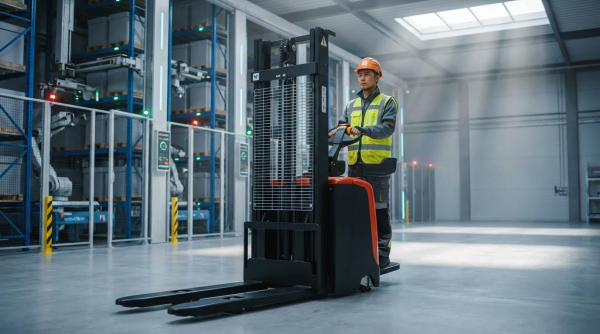
Engineering controls, structured training, and disciplined maintenance turn a borderline use case into a managed risk scenario. Without all three, the answer to “can you load a trailer with a walkie stacker” should default to “no.”
- Engineering controls: Fixed vehicle restraints, rated dock levellers, and clearly marked parking/chock positions – physically prevent common trailer movement failures.
- Traffic management: Marked walkways, one-way travel rules, and restricted access to active loading bays – separates people from moving equipment.
- Slope limits: Site rules that prohibit operation on steep internal ramps or uneven yards – avoid lateral instability and uncontrolled roll-away.
- Load rules: Standard limits on pallet height, wrapping, and overhang – ensure consistent, predictable load behaviour in trailers.
| Control Type | Key Requirement | Best For… |
|---|---|---|
| Engineering | Rated dock levellers, vehicle restraints, bumpers, and dock-edge markings | High-throughput docks with frequent trailer changes |
| Administrative | Written SOPs, checklists, and door-specific permissions for walkie stackers | Standardising behaviour across multiple shifts and contractors |
| Training | Formal instruction on capacities, combined weights, and dock interface risks | New operators and periodic refresher for experienced staff |
| Maintenance | Daily pre-use checks plus scheduled inspections of brakes, steering, mast, and hydraulics | Ensuring the stacker performs as assumed in the risk assessment |
- Operator training: Cover load charts, dock interaction, and trailer-specific hazards – builds judgment, not just button-pushing skills.
- Site-specific induction: Show operators which doors and trailer types are off-limits – prevents “I thought it was okay here” incidents.
- Supervision and audits: Periodic observations and checklist reviews – keeps procedures alive after the initial rollout.
- Preventive maintenance: Daily checks of brakes, steering, horn, forks, and visible leaks – catches faults before they appear on a ramp.
- Fault reporting culture: Simple, non-punitive process to tag unsafe equipment or dock plates – stops “just one more load” with compromised gear.
Practical daily checklist items
For the walkie stacker: brakes, steering response, horn, emergency stop, forks not bent or cracked, mast movement smooth, no visible hydraulic leaks. For the dock: trailer secured, dock plate seated and locked, floor clear and dry, lighting adequate inside the trailer.
💡 Field Engineer’s Note: Most serious dock incidents I have seen did not come from exotic failures; they came from a known small defect (a soft trailer board, a sticky brake, a marginal dock plate) that people kept working around “just for today” until physics finally caught up.
Final Assessment and Recommendations
Walkie stackers can physically enter and load trailers, but the engineering facts show that this is rarely a low-risk task. Their design assumes flat, rigid floors, short runs, and clear escape space. Trailers add flexing decks, steep transitions, confined geometry, and uncertain floor strength. These changes cut into capacity margins and stability far faster than most operators realise.
Engineering and safety teams should treat trailer entry as an exception, not a default use case. Start by mapping each dock and trailer type, then decide where walkie stackers are prohibited, where they are allowed with strict conditions, and where other equipment must take over. Put those decisions into written rules, visible signage, and simple checklists.
When conditions do meet the design envelope, controls must work together: rated dock gear, secured trailers, stable loads, trained operators, and well-maintained trucks. If any element is missing, the safe answer is “no entry.”
The practical recommendation is clear. Use walkie stackers mainly for on-floor storage, staging, and short transfers on good concrete. Use purpose-built dock equipment or alternative Atomoving solutions for routine trailer loading. That approach respects the physics, protects operators, and stands up to regulator and insurer scrutiny.
Frequently Asked Questions
Can you load a trailer with a walkie stacker?
A walkie stacker, also known as a walk-behind forklift, is a compact and versatile piece of equipment commonly used in warehouses. While it is primarily designed for indoor use, such as stacking pallets in selective racking systems or store rooms, it can also be used to load trailers under certain conditions. The key factors to consider include the weight capacity of the walkie stacker, the height of the trailer’s loading dock, and the stability of the load.
- Ensure the walkie stacker’s weight capacity matches or exceeds the load being moved.
- Check that the trailer is securely positioned at an appropriate height for the walkie stacker to access safely.
- Use proper loading techniques to maintain balance and prevent accidents.
For more details on walkie stackers and their applications, refer to this Forklift Types Guide.
What class is a walkie stacker?
A walkie stacker falls under Class III of powered industrial trucks. This classification includes electric motor hand trucks or hand/rider trucks, such as electric pallet jacks and walkie stackers. These machines are typically powered by batteries and are designed for tasks like horizontal transport and low-level stacking.
Learn more about powered industrial truck classifications in this Truck Classifications Guide.