Stand-up forklifts and reach trucks formed the backbone of high-density, narrow-aisle material handling in modern warehouses and plants. These machines enabled tight maneuvering, rapid cycle times, and efficient vertical storage while maintaining strict safety and stability requirements. This article examined their core design and operating principles, the main stand-up forklift families, and the specialized reach truck variants used for deep racking and high lift heights. It concluded with practical selection guidelines to match equipment type to aisle geometry, load profile, duty cycle, and indoor floor conditions.
Core Design And Operating Principles
Stand-up forklifts and reach trucks relied on compact chassis, electric powertrains, and upright operator positions to work efficiently in constrained warehouse layouts. Their design favored rapid on/off access, fine control in narrow aisles, and low local emissions for indoor use. Understanding how designers defined stand-up layouts, contrasted them with sit-down trucks, and arranged key components helped engineers and operators match equipment to plant logistics and maintenance strategies.
What Defines A Stand-Up Forklift
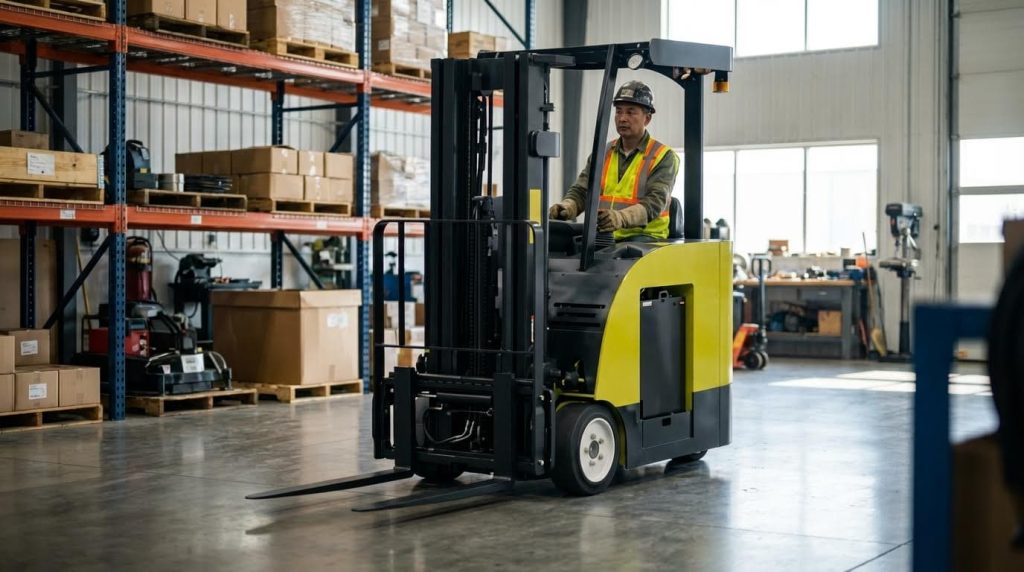
A stand-up forklift positioned the operator on an integrated platform rather than a seated compartment. The operator faced sideways or forward depending on the model and used a tiller arm or multi-function control handle for steering and traction control. Electric drive systems dominated, using industrial traction batteries to power drive motors, lift pumps, and control electronics. Designers optimized the chassis for short overall length and tight steering geometry, which allowed operation in narrow aisles and busy dock areas. Quick step-in and step-out access supported workflows with frequent short moves, order picking, and shuttle operations.
Stand-Up Vs. Sit-Down Forklifts In Plants
Sit-down forklifts typically offered higher capacities and better suitability for mixed indoor and outdoor duty, but required wider aisles and turning radii. Stand-up units traded ultimate capacity and ride comfort over long distances for superior maneuverability and cycle-time efficiency in dense storage. In plants, engineers often specified stand-up forklifts where rack spacing dropped below typical counterbalanced stacker aisle requirements and where operators performed frequent dismounts. Stand-up layouts also supported improved visibility in racking because operators could align their stance with the direction of travel or load engagement. However, they demanded strict operator training on body positioning and stability, since the operator remained closer to the truck’s lateral motion envelope.
Key Components And Powertrain Basics
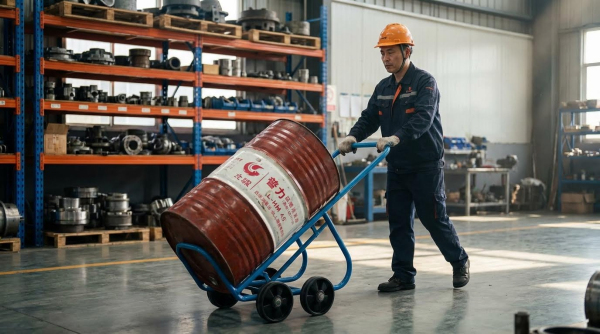
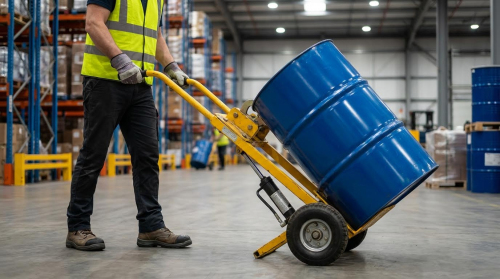
Stand-up forklifts and reach trucks used an electric powertrain centered on a high-capacity traction battery, typically 24-volt or 36-volt systems in warehouse-class machines. One or more AC or DC traction motors drove the load or steer wheels, while a separate hydraulic pump motor supplied pressure to the mast lift cylinders and reach mechanisms. Control electronics governed acceleration, braking response, and lift functions, often integrating regenerative braking to return energy to the battery during deceleration and lowering. The mast assembly, forks, and in reach trucks the extending carriage or pantograph, formed the primary load-handling structure and defined the rated capacity at given lift heights. Chassis components such as load wheels, drive units, and steering linkages required regular inspection for wear and play to maintain stability and precise handling. Additionally, some facilities utilized manual pallet jack solutions for smaller tasks.
Main Types Of Stand-Up Forklifts
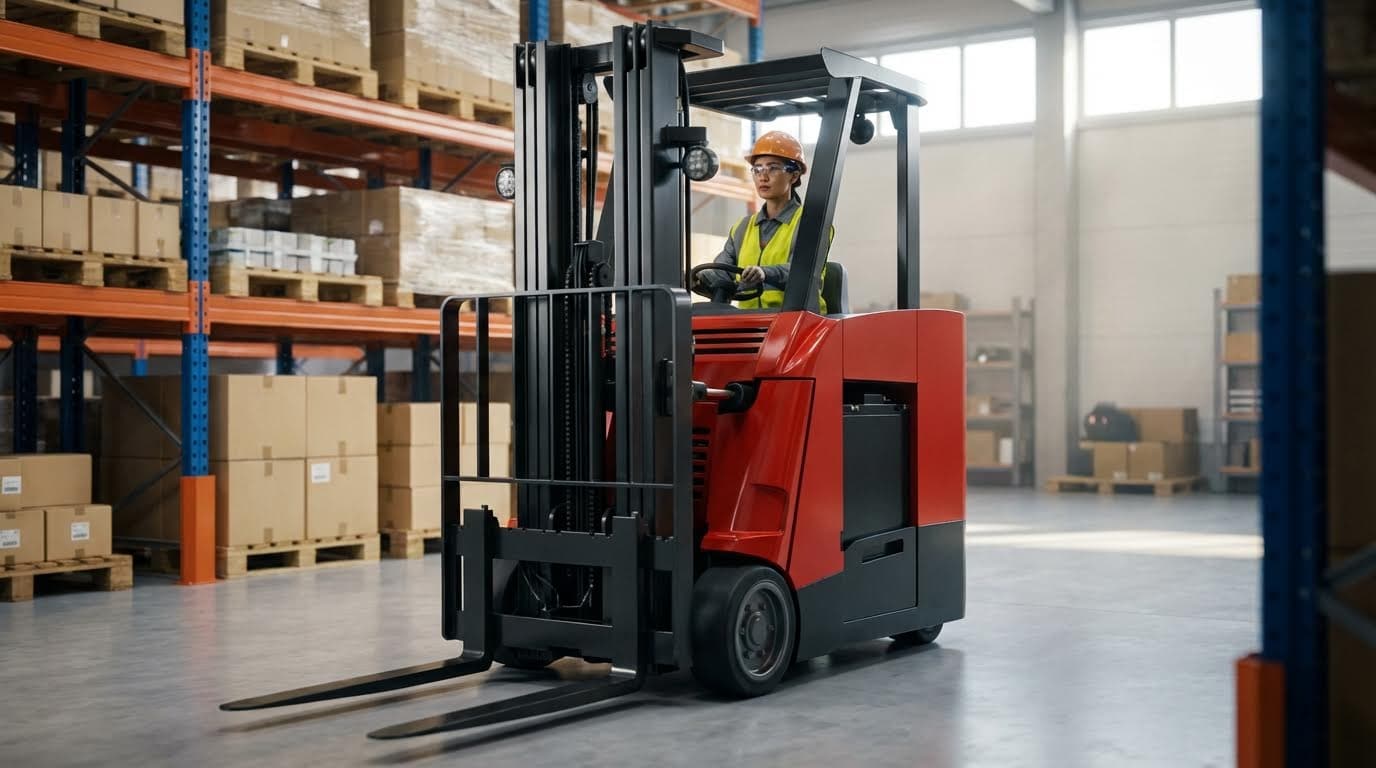
Stand-up forklifts covered a broad family of electric industrial trucks. Engineers and operations teams selected specific types based on aisle width, load profile, and duty cycle. Understanding the main variants helped match equipment to throughput, rack geometry, and floor conditions. The following subtypes represented the core configurations used in warehouses and distribution centers.
Stand-Up Counterbalance Forklifts
Stand-up counterbalance forklifts used a rear counterweight to balance the load on the forks. They operated similarly to sit-down counterbalance trucks but used a standing operator compartment for faster on/off cycles. These trucks worked well at dock doors, in staging areas, and in wider aisles where the truck body needed to enter the rack face. Typical electric stand-up counterbalance models handled loads from 1,500 kilograms to about 4,000 kilograms with lift heights up to roughly 7 meters. Their turning radius exceeded that of reach trucks, so facilities usually reserved them for mixed indoor tasks and loading trailers rather than ultra-narrow aisles.
Narrow-Aisle And Dock Work Stand-Up Units
Narrow-aisle stand-up units prioritized compact chassis length and tight steering geometry. Designers minimized the rear overhang and optimized mast profiles to operate in aisles near 2.6–3.0 meters, depending on load size. These trucks often combined side-stance operator positions with multi-function control handles to reduce body rotation and fatigue. In dock work, stand-up units allowed rapid shuttle movements between trailers and buffer storage, improving cycle times where operators dismounted frequently. Compared to reach trucks, narrow-aisle stand-up counterbalance units traded ultimate storage density for higher versatility across docks, cross-docks, and transfer zones.
Walkie And Rider Pallet-Handling Variants
Walkie pallet trucks used a tiller arm, with the operator walking behind or ahead of the unit, which suited short distances and lighter duty cycles. Rider pallet trucks incorporated a standing platform, enabling higher travel speeds and better productivity over longer runs in larger facilities. Full electric pallet trucks used battery power for both traction and lift, reducing operator exertion compared with hand-hydraulic designs. Engineers typically specified these units for ground-level put-away, order staging, and shuttle work between production lines and storage, while leaving high-bay racking to reach trucks or stand-up counterbalance forklifts.
Reach Truck Variants And Applications
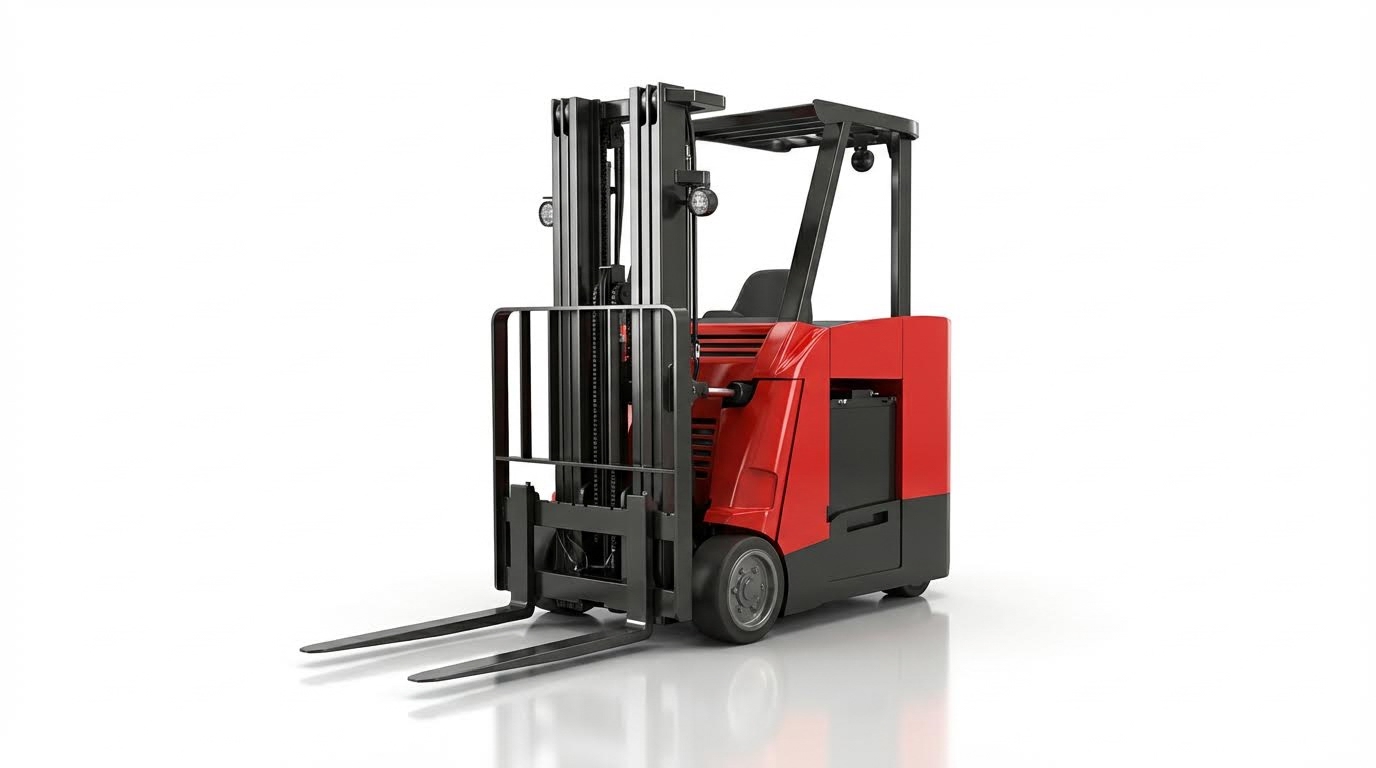
Reach trucks provided high-density storage capability in constrained warehouse footprints. Their extendable mast and compact chassis allowed operators to work efficiently in narrow aisles with elevated racking. Different reach configurations addressed single-deep, double-deep, and mixed-load profiles while balancing stability, capacity, and energy use. Correct variant selection depended on load characteristics, rack geometry, and floor quality.
Standard Stand-Up Reach Trucks
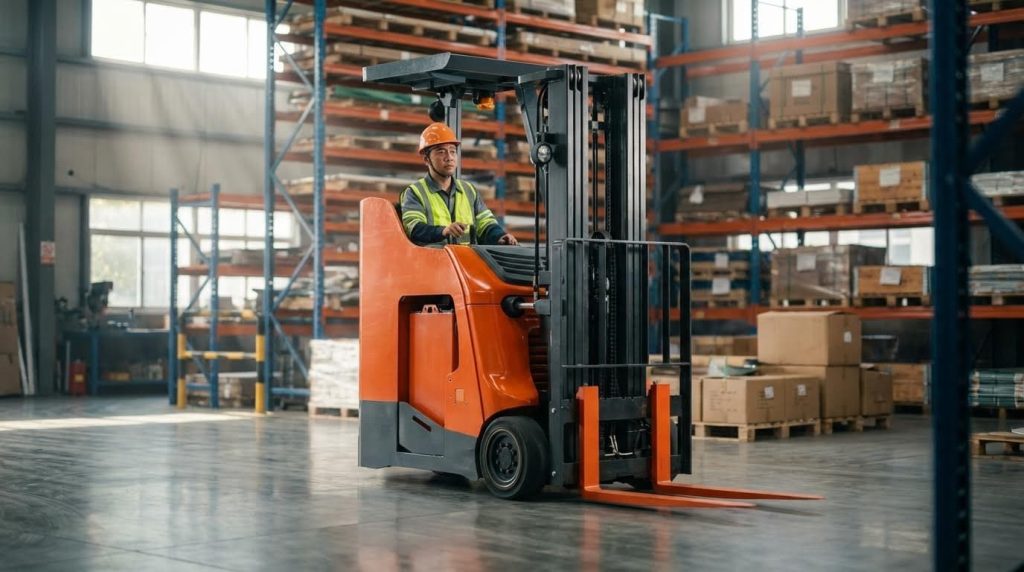
Standard stand-up reach trucks used an extendable mast and pantograph mechanism to project the forks into pallet racking. Operators stood sideways on a protected platform, which improved visibility along the travel path and into the rack face. Typical units lifted loads between roughly 1,100 kg and 2,000 kg to heights from 3 m up to about 10 m, depending on model and mast class. Battery power, usually 24 V or 36 V, supported indoor operation with low noise and zero local emissions. These trucks suited single-deep racking in narrow aisles where rapid shuttle movements and frequent stops dominated the duty cycle.
Straddle And Deep-Reach Truck Configurations
Straddle reach trucks incorporated outrigger legs that straddled the pallet, increasing lateral stability and allowing handling of less uniform or flexing loads. Their gripping or side-support arrangements stabilized the pallet during lift and travel, which benefited multi-pallet picks and heavier or taller loads. Deep-reach trucks extended the concept by using longer forks and an adapted pantograph to access the second pallet position in double-deep racking. This configuration reduced required aisle count and increased storage density but imposed stricter limits on rated capacity at maximum outreach. Facilities often deployed a mix of standard, straddle, and deep-reach units to match different zones and SKU profiles within the same building.
Height, Capacity, And Aisle Width Criteria
Engineers sized reach trucks primarily from three parameters: required lift height, load mass, and aisle width. Modern high-capacity reach models lifted up to roughly 13.7 m with nominal capacities around 1,450 kg at lower heights and reduced capacity at full elevation and reach. Narrow-aisle layouts typically targeted clear aisle widths in the 2.6 m to 3.0 m range, measured pallet to pallet, to permit right-angle stacking with adequate clearance. Designers evaluated the truck load chart to ensure that pallet weight, center-of-gravity distance, and lift height remained within the stability envelope. Battery voltage and ampere-hour rating also entered the selection process, because higher lift heights and intensive duty cycles demanded greater energy reserves and robust thermal management.
Indoor Use Limits And Floor Condition Needs
Reach trucks operated best on smooth, level, and debris-free indoor floors due to their relatively small load wheels and low undercarriage clearance. Uneven joints, potholes, or damaged concrete increased dynamic loading on the mast and chassis and could compromise stability when the mast was elevated or extended. For that reason, operators typically avoided outdoor travel or rough dock aprons, except for short, controlled movements on verified flat surfaces. Facilities specified floor flatness and levelness to relevant warehouse standards to support high-bay operations at heights above roughly 8 m. Routine housekeeping, prompt repair of spalled concrete, and clear marking of expansion joints helped maintain predictable traction and braking performance, reducing tipover and load-shed risk during tight maneuvering.
Summary And Practical Selection Guidelines
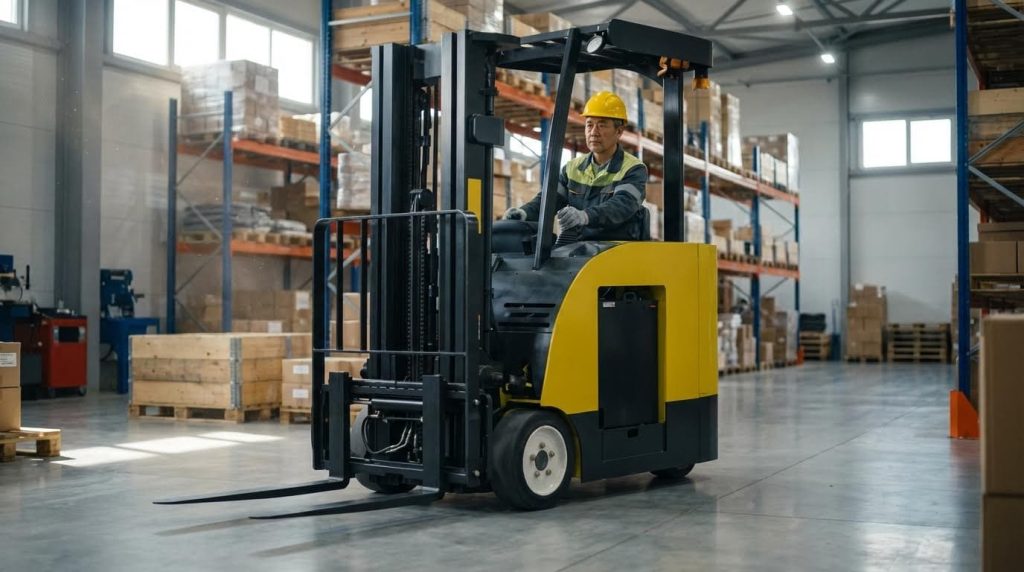
Stand-up forklifts and reach trucks increased storage density and throughput in modern warehouses. Stand-up counterbalance units handled dock work and general material movement, while narrow-aisle stand-up and reach designs optimized racking access in constrained spaces. Reach trucks, including standard, straddle, and deep-reach variants, operated primarily indoors and lifted to heights above 8 m with defined capacity curves. Their battery-electric powertrains, ergonomic controls, and telematics-ready architectures supported efficient, low-emission operation.
When selecting equipment, engineers first defined the storage concept: rack height, pallet depth, and minimum aisle width. They then matched truck class to task: counterbalanced stacker for trailer loading and mixed duties, standard reach for single-deep racking, straddle or deep-reach for high-density multi-deep storage. Key sizing steps included calculating maximum pallet mass, center-of-gravity position, and required lift height, then verifying the rated capacity at that height on the data plate.
Floor quality and environment strongly influenced feasibility. Reach trucks required flat, debris-free, high-strength floors with controlled gradients and minimal surface defects. Stand-up units with small load wheels were sensitive to joints and potholes, which limited outdoor use. Battery strategy also mattered: 24 V or 36 V systems with appropriate ampere-hour capacity and charging infrastructure determined shift length and uptime.
Future developments pointed toward higher energy density batteries, integrated fleet telematics, and operator-assist systems for speed, mast tilt, and stability control. These technologies promised tighter safety envelopes, better diagnostics, and lower lifecycle cost, but required disciplined maintenance and periodic software updates. A balanced approach combined conservative mechanical sizing, adherence to applicable powered industrial truck standards, and pilot trials in representative aisles before full fleet deployment.