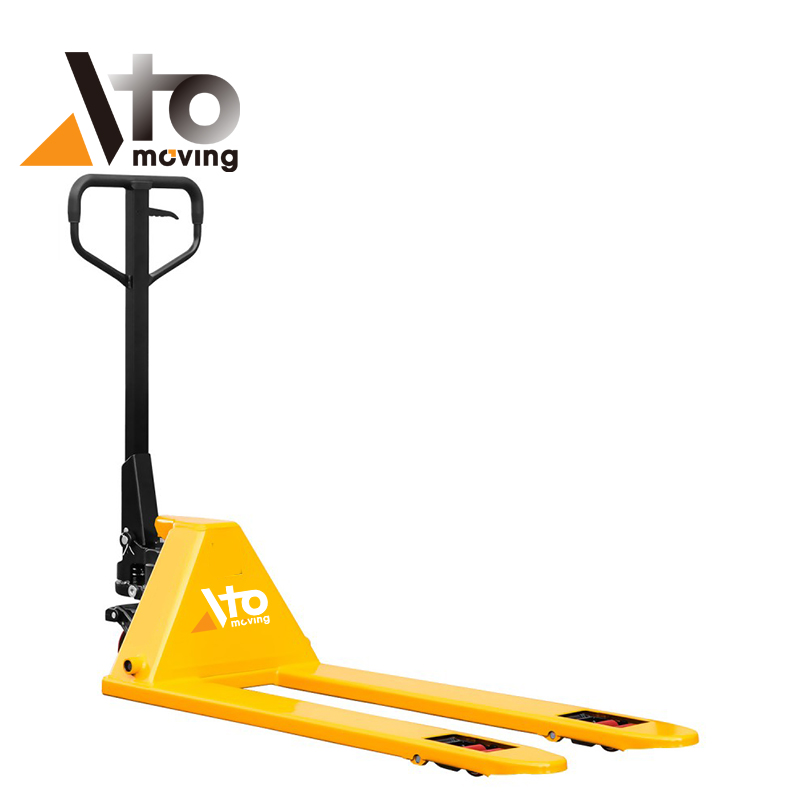
Material handling engineers often hear the question: can a pallet jack lift a car? Answering it correctly requires understanding pallet jack load ratings, typical vehicle weights, and how static capacity differs from real-world stability and floor loading. This article walks through rated capacities, geometric limits, and failure modes, then explains certified alternatives and safety practices. Using this framework, you can evaluate risks objectively and select safer, standards-compliant solutions for moving or positioning vehicles.
Pallet Jack Capacities Versus Vehicle Weights
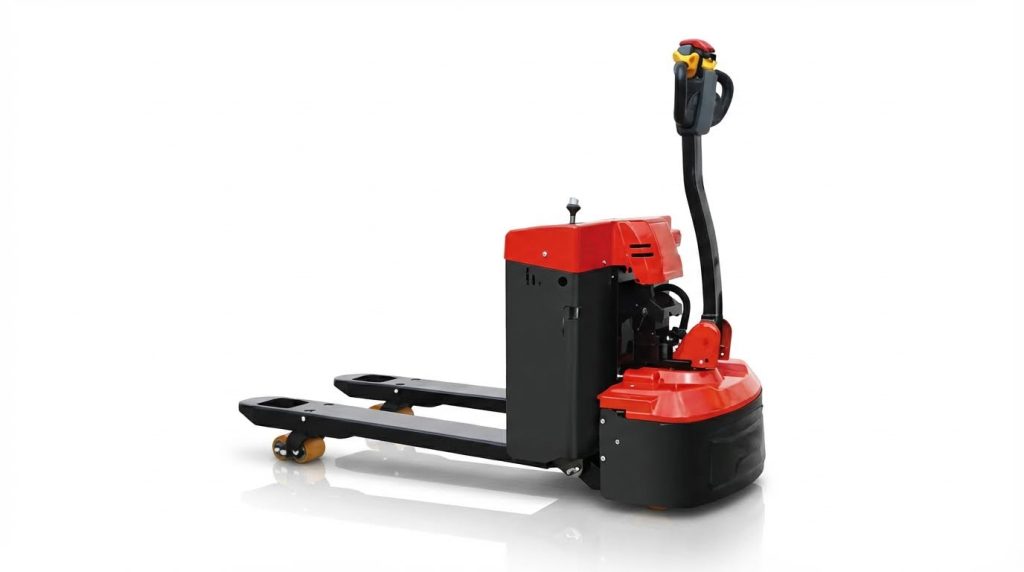
Engineers assessing whether a pallet jack can lift a car must compare rated jack capacity with real vehicle masses and support conditions. This section analyzes typical manual and electric pallet jack ratings, relates them to passenger car weights, and explains why static capacity does not guarantee safe vehicle support. It also shows why total floor loading must include both the pallet jack and the vehicle, especially in warehouse and trailer applications.
Typical Manual And Electric Jack Load Ratings
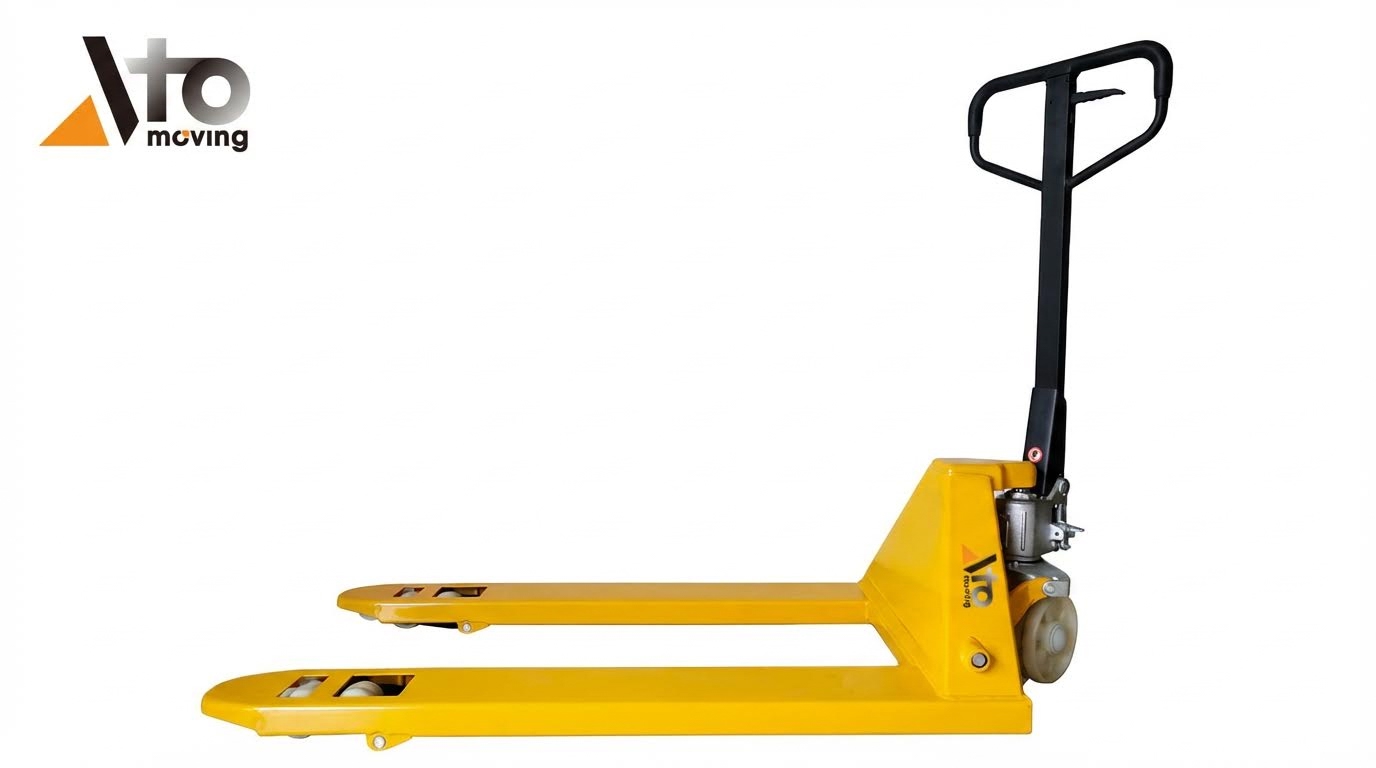
Manual pallet jacks typically carried rated capacities between 2,000 kg and 2,500 kg. Heavy-duty manual units sometimes reached 4,900 kg to 5,000 kg. Electric pallet jacks often matched or exceeded these ratings due to stronger frames and powered drive. However, the truck’s own mass increased significantly, usually between 454 kg and 680 kg, and heavy-duty units sometimes exceeded 1,500 kg. Manufacturers based these ratings on uniformly distributed palletized loads, with the load center located near the fork heel. Factors like fork length, width, wheel configuration, and lift height all affected allowable capacity. Higher lift or added attachments usually reduced the safe working load because of increased bending moments and hydraulic stress.
Comparing Jack Capacity To Passenger Car Weights
To answer “can a pallet jack lift a car,” engineers first compare typical car weights with jack ratings. Compact passenger cars often weighed 1,200 kg to 1,600 kg, while midsize and SUVs commonly ranged from 1,700 kg to 2,300 kg. Electric vehicles and large pickups frequently exceeded 2,500 kg. On paper, a standard 2,500 kg pallet jack appeared capable of carrying at least a small car mass. However, pallet jack ratings assumed a flat pallet footprint, not a point or line contact under a car chassis or pinch weld. A vehicle’s mass also concentrated at discrete points, which created local overloads on forks and wheels. Therefore, even when nominal capacities looked similar, the actual loading condition for a car fell outside the design envelope of the pallet jack.
Why Static Rating ≠ Safe Vehicle Support
Static capacity indicated the maximum load under ideal test conditions, not a blanket guarantee for every geometry. When asking whether a pallet jack can lift a car, engineers must consider contact area, load path, and dynamic effects. A car supported on narrow fork tips produced high local stresses, potential underbody damage, and unstable support points. Any movement, braking, or floor irregularity introduced dynamic loads that exceeded static ratings. The pallet jack’s hydraulic unit, bearings, and wheels were not designed for off-center, high-clearance vehicle lifting. Static labels also did not account for maintenance condition, wear, or prior overload history. As a result, using rated capacity alone to justify lifting a car violated basic engineering safety factors and typical OSHA expectations for safe equipment use.
Including Truck Weight In Floor Load Calculations
When evaluating whether a pallet jack can lift a car inside a warehouse or truck, total floor load became critical. Engineers had to sum the vehicle mass, the pallet jack mass, and any additional tooling or blocking. For example, a 2,000 kg car plus a walkie pallet truck produced a 2,600 kg combined load on the slab or trailer deck. Standards such as ANSI MH16.1 for industrial racks required inclusion of handling equipment weight in load calculations. Concentrated wheel loads from the pallet jack often governed, not just total mass. Overstressed slabs or trailer floors risked cracking, local punching, or deck failure. Including the truck weight also affected mezzanine and dock ramp design, which often had lower rated capacities than ground slabs. Therefore, any scenario where a pallet jack lifts a car must treat the combination as a single load case, which usually exceeded the intended design of both the jack and the supporting structure.
Engineering Limits: Stability, Geometry, And Failure Modes
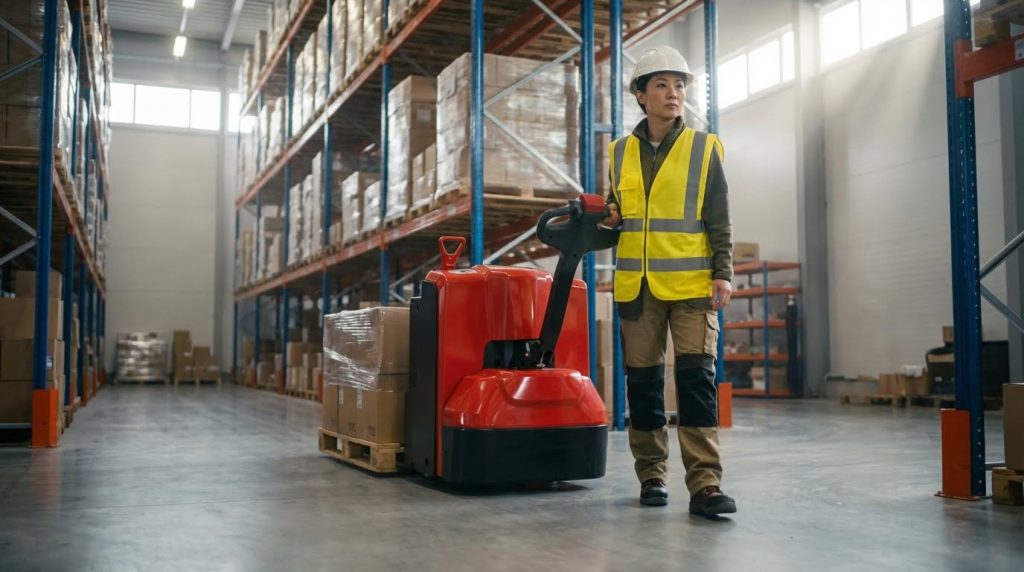
Engineering limits explained in this section show why the answer to “can a pallet jack lift a car” is practically no in real-world conditions. Even when nominal capacity appears close to vehicle weight, geometry, stability, and failure modes make the setup unsafe. Understanding fork dimensions, load center, floor conditions, and regulatory constraints clarifies why manual pallet jacks were never designed as vehicle lifting devices.
Fork Geometry, Load Center, And Car Undercarriage
Fork geometry set the load envelope for palletized loads, not for vehicle frames. Standard pallet jack forks typically measure about 540–685 millimetres wide and 1,000–1,200 millimetres long, with rated capacity at a defined load center, often 600 millimetres from the fork heel. A passenger car undercarriage does not present flat, continuous bearing surfaces aligned with this geometry. Instead, contact points concentrate at pinch welds, subframes, or suspension members, which creates high local stresses and risk of structural damage. Even if capacity suggests a pallet jack can lift a car, mismatched geometry means the forks cannot support the vehicle uniformly or predictably.
Center Of Gravity, Tipping, And Loss Of Stability
Vehicle center of gravity locations differ significantly from those of palletized loads. A pallet load usually sits symmetrically between the forks, keeping the combined center of gravity inside the support polygon formed by wheels and load. A car supported at two or four small points over narrow forks shifts the combined center of gravity higher and often off-center. Small horizontal movements, suspension compression, or operator input can move this center of gravity outside the stability triangle, causing tipping. Once tipping begins, the operator has limited ability to correct it because the hydraulic pallet truck has a short wheelbase and small contact patches.
Overload Effects On Hydraulics, Wheels, And Forks
Manual pallet jacks often carried nominal ratings around 2,000–2,500 kilograms, while heavy-duty units reached about 4,990 kilograms. However, those ratings assumed uniform pallet loads and proper load centers. When users tried to see whether a pallet jack can lift a car, they effectively introduced eccentric loads and shock inputs. Overload or off-center load increased hydraulic pressure beyond design margins, accelerating seal wear or causing sudden leakage and loss of lift. Wheels and axles experienced point loading and could develop flat spots, bearing failures, or fracture. Forks, designed for bending in a specific direction, risked permanent deflection or cracking when loads concentrated at short spans or near the fork tips.
Floor Conditions, Rack Loads, And OSHA Compliance
Floor conditions strongly influenced stability and structural safety when operating any pallet jack. Uneven slabs, expansion joints, oil contamination, or debris reduced friction and created unexpected dynamic loads. When operators pushed a car-laden pallet jack near storage racks or mezzanines, they had to include both the vehicle weight and the pallet truck weight in floor load and rack load calculations, as required by standards such as ANSI MH16.1. Regulatory frameworks such as OSHA 29 CFR 1910.178 required adherence to manufacturer ratings and prohibited using powered industrial trucks in unsafe configurations. Using a pallet jack to lift a car violated these principles because it ignored design intent, compromised stability, and exposed workers to crushing, tip-over, and falling-object hazards, even if the lift appeared momentarily successful.
Safe Alternatives For Lifting And Positioning Vehicles
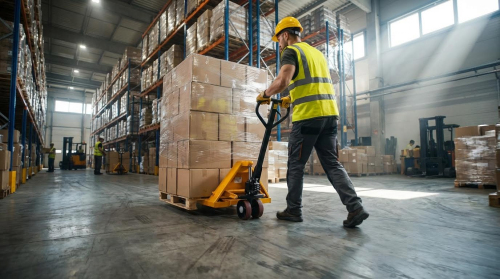
When engineers ask whether a pallet jack can lift a car, the correct response is to redirect the discussion toward purpose‑built vehicle lifting systems. Vehicle service requires equipment with certified load ratings, redundant safety features, and geometry designed for underbody contact points, not pallet loads. This section outlines engineered alternatives that control risk, comply with OSHA requirements, and avoid the overload and instability issues that arise when anyone tries to prove that “can a pallet jack lift a car” in practice.
Using Certified Lifts, Stands, And Hoisting Systems
Certified vehicle lifts and stands use structural members, locking devices, and pads designed for automotive frames and lifting points. Two‑post, four‑post, scissor, and in‑ground lifts carry rated capacities, typically between 3,000 kilograms and 18,000 kilograms, with safety factors defined by standards such as ANSI/ALI ALCTV. Mechanical locks engage automatically as the lift rises, so the vehicle does not rely solely on hydraulic pressure. Jack stands, axle stands, and support stands then provide secondary support under specified points, preventing collapse if a primary system fails. Compared with attempts to see whether a pallet jack can lift a car, these systems distribute loads correctly, maintain stability, and allow safe access under the vehicle.
When To Use Cranes, Hoists, Or Devices Like Uplift Levi-Load
Overhead cranes and hoists become appropriate when the task involves lifting powertrains, battery packs, body shells, or raw materials rather than complete vehicles. Manual, electric, or air hoists with chain or wire rope offer controlled vertical lifting with defined duty cycles and overload protection. Devices such as the Uplift Levi-Load connect to a crane and rotate long stock from horizontal to vertical, enabling a single operator to position material accurately before machining. This type of tooling reduces the temptation to improvise with pallet jacks or forklifts for non‑palletized loads. For full vehicles, engineers should specify rated spreader beams, slings, and attachment points validated by finite element analysis and proof testing, rather than experimenting with whether a pallet jack can lift a car.
Role Of Digital Twins And Predictive Maintenance
Digital twins of lifting systems model structural members, hydraulics, and control logic to predict stresses and deflections under various load cases. Engineers can simulate worst‑case scenarios, such as off‑center vehicle loading, asymmetric axle weights, or degraded components, and verify that safety factors remain acceptable. Coupled sensors on cylinders, motors, and structural nodes feed data into predictive maintenance algorithms that flag anomalies before failure. This approach helps ensure that rated capacities remain valid over the equipment’s life, rather than drifting downward due to wear or corrosion. By contrast, ad‑hoc uses like trying to confirm that a pallet jack can lift a car lack any model‑based validation and therefore introduce unquantified risk.
Ergonomics, Training, And PPE For Material Handling
Safe vehicle lifting depends on human factors as much as mechanical design. Ergonomic planning minimizes manual pushing, pulling, and awkward postures, reducing musculoskeletal disorders that were common when workers relied on brute force or misused pallet jacks. Structured training covers load charts, center‑of‑gravity assessment, lift point identification, and lockout procedures, aligning with OSHA operator‑training requirements for powered industrial equipment. Appropriate personal protective equipment, including safety footwear, gloves, and eye protection, mitigates residual hazards such as dropped components or sharp edges. When teams understand why the question “can a pallet jack lift a car” indicates a mismatch between tool and task, they are more likely to choose certified lifts, stands, and hoists that manage both mechanical and ergonomic risk.
Summary: Why Lifting Cars With Jacks Is A Bad Idea
The core answer to “can a manual pallet jack lift a car” is no in any safe, standards-compliant sense. Rated capacities for manual and electric pallet jacks applied to pallets did not translate into safe support of a concentrated, irregular vehicle load. Passenger vehicles typically exceeded or closely approached jack ratings once dynamic effects, off-center loading, and floor conditions were included. Treating a pallet jack like an automotive lift created a serious risk of tipping, structural failure, and personal injury.
From an engineering standpoint, fork geometry, load center assumptions, and wheel layout were optimized for uniformly supported pallets, not for contact with a car’s undercarriage or pinch welds. Overload or misapplied load could damage hydraulics, bend forks, or fracture wheels, even when the nominal capacity in kilograms appeared higher than the curb weight. Regulations such as OSHA 1910.178 required correct use, inspections, and defect removal from service, which explicitly conflicted with improvised vehicle lifting. Floor loading rules also required including the pallet jack mass in total rack or slab load, further eroding any apparent safety margin.
Industry practice favored purpose-built vehicle lifts, stands, hoists, and engineered devices for rotating or positioning heavy components. These systems incorporated redundancy, mechanical locking, and certification against automotive standards, unlike pallet jacks. Future trends such as digital twins and predictive maintenance strengthened this direction, enabling better modeling of stresses and earlier detection of fatigue in lifting equipment. In practical terms, facilities that needed to move or support vehicles safely invested in certified lifting systems and operator training, while reserving pallet jacks for their intended role: low-height transport of stable palletized loads.