Engineers who ask what is hydraulic pallet truck need a clear view of its hydraulic circuit, mechanical layout, and safe operating envelope. This article follows the full life of a truck, from basic working principle and component geometry through design choices in forks, wheels, frames, and hydraulic assemblies.
You will see how capacity, fork size, wheel material, and duty cycle interact when selecting between manual, electric, and specialized pallet trucks. The later sections connect safety, ergonomics, regulations, maintenance, and lifecycle cost into practical engineering guidelines that support robust, low-failure material handling systems in warehouses, plants, and logistics hubs.
Hydraulic Pallet Truck Fundamentals
Engineers who ask what is hydraulic pallet truck usually want a clear view of how it works and where it fits. This fundamentals section explains the hydraulic circuit, key mechanical parts, and geometry that define performance. It also compares manual and electric operation and links these choices to typical capacities and dimensions. The goal is to give a practical engineering baseline for later design, selection, and lifecycle decisions.
Basic Working Principle of the Hydraulic Circuit
A hydraulic pallet truck uses fluid pressure to lift palletized loads. The operator pumps the handle. The pump forces hydraulic oil into a cylinder. Pressure in the cylinder drives a piston that moves the lift linkage and forks upward. A check valve holds pressure when the operator stops pumping. A release valve opens during lowering. The valve lets oil flow back to the reservoir and the forks descend in a controlled way.
Key design points include:
- Typical working pressure in compact hand pumps reaches several megapascals.
- Seals must hold pressure without leakage under static load.
- Valve orifices must balance smooth lowering with acceptable cycle time.
Engineers size the hydraulic components so the handle force stays reasonable at rated load. They also limit maximum pressure to protect the frame and forks.
Key Mechanical Components and Geometry
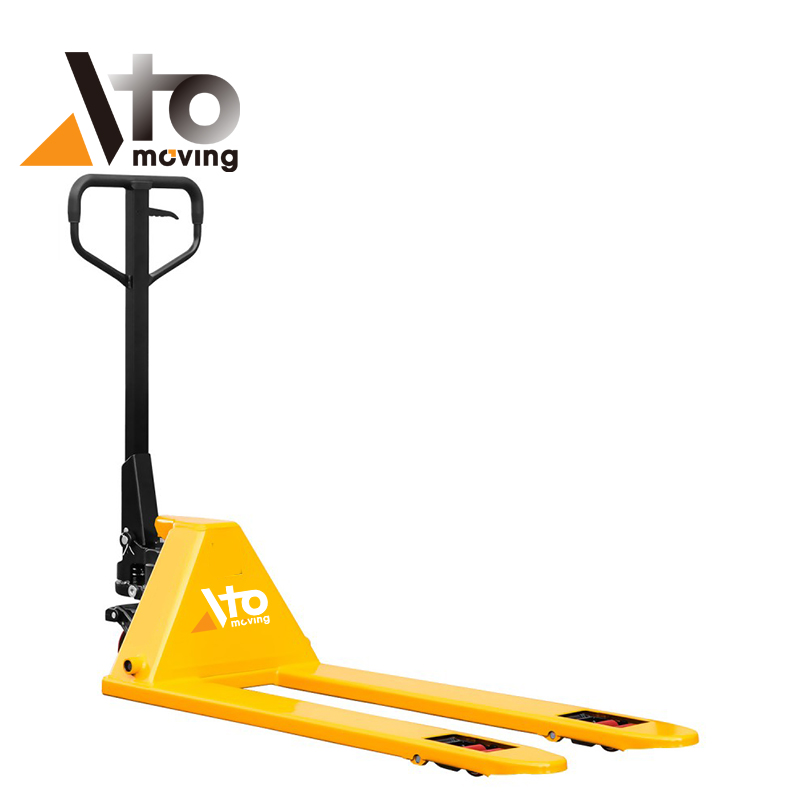
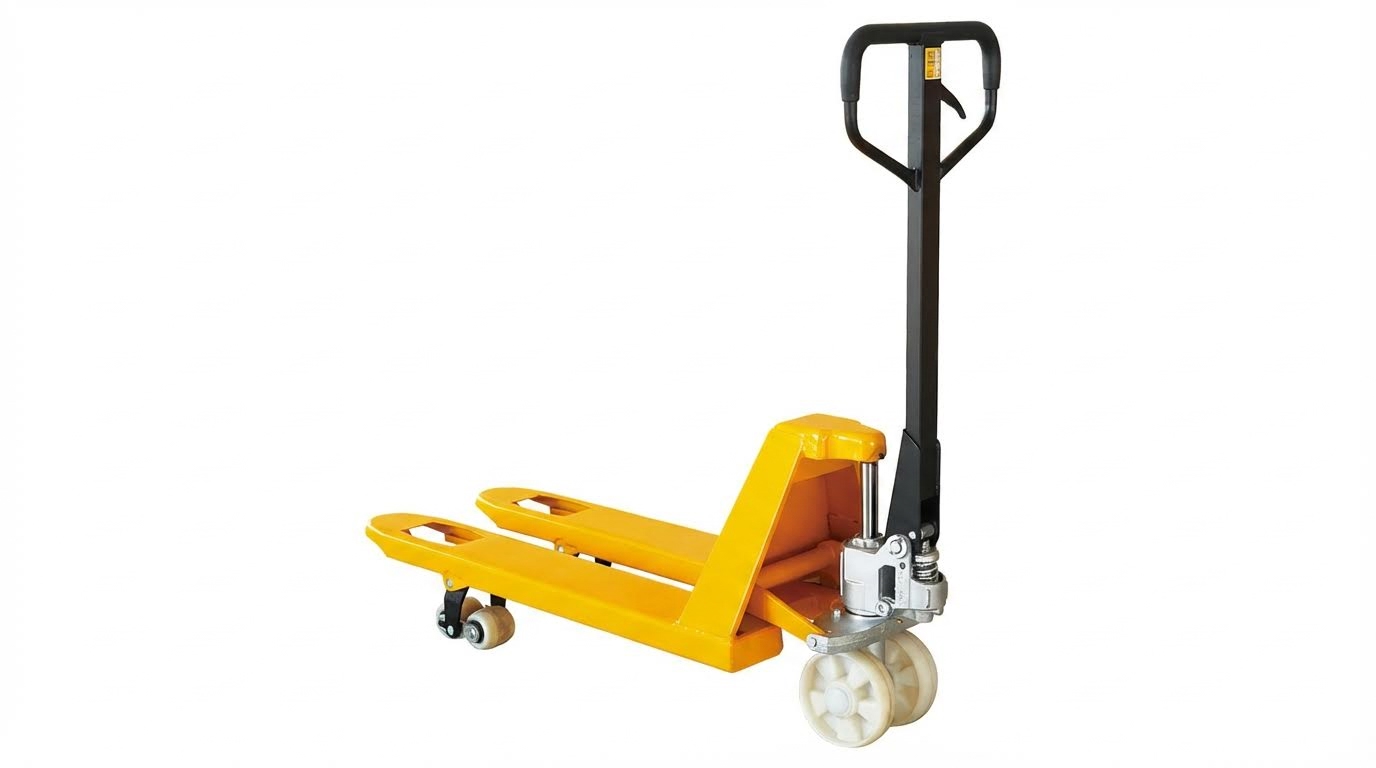
The main mechanical parts are the forks, chassis, steering handle, wheels, and linkage. Forks slide under the pallet deck and transfer load into the frame. A typical fork length is about 1150 millimetres. Common outside fork widths are around 520 to 550 millimetres for standard pallets.
Geometry strongly affects stability and push force. The load wheels under the fork tips carry most of the weight when the pallet is raised. The steering wheels carry more weight during insertion and turning. The distance between steering axle and load wheels sets the lever arm. Longer wheelbase reduces required hydraulic pressure for a given handle stroke but increases turning radius.
The tiller handle gives the operator enough leverage for steering and for pumping. Designers choose handle length and steering angle so the truck can turn inside typical aisle widths in warehouses.
Manual vs. Electric Pallet Truck Operation
Manual hydraulic pallet trucks rely on human power for both lifting and travel. The operator pumps the handle to lift and pushes or pulls to move the load. This suits short distances, moderate duty cycles, and flat floors. It keeps purchase cost and maintenance low but increases physical strain at high throughput.
Electric pallet trucks keep the same basic hydraulic lift principle. However, an electric motor drives travel and often supports powered lifting. Batteries supply energy for long shifts. These trucks handle higher movement frequency, longer routes, and ramps with less fatigue. They also improve speed consistency and reduce cycle time.
Choice between manual and electric versions depends on load weight, daily pallet moves, and route length. Engineers also consider floor gradients and required acceleration. Manual units fit tight spaces and low budgets. Electric units fit intensive logistics flows.
Typical Capacities, Dimensions, and Ratings
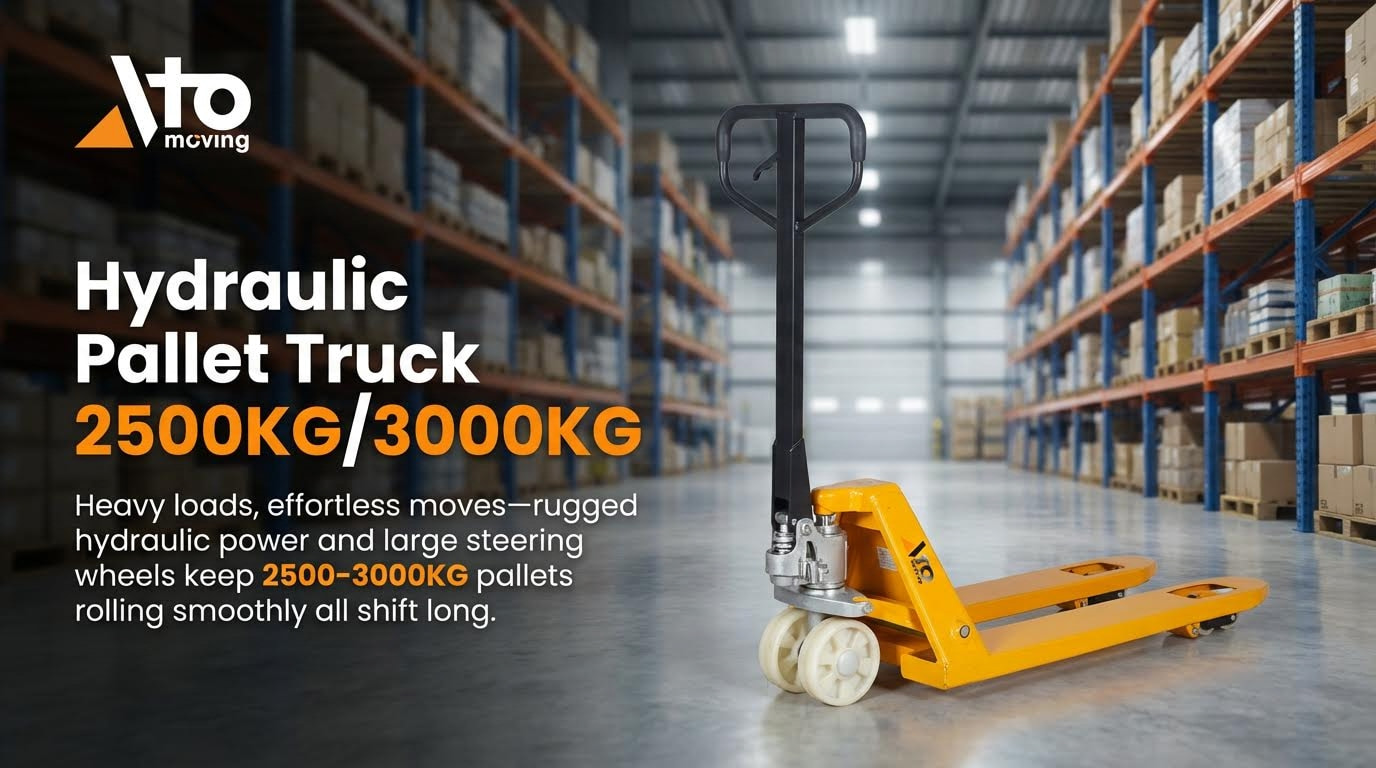
When people search what is hydraulic pallet truck, they often want typical size and rating data. Manual hydraulic pallet trucks commonly carry between 2000 kilograms and 3000 kilograms. Some heavy duty designs reach around 5000 kilograms. Fork length is often about 1150 millimetres for EUR and ISO pallets. Standard fork height in the lowered state is roughly 80 to 90 millimetres. Maximum lift height is usually near 190 to 200 millimetres, which is enough to clear floor irregularities.
| Parameter | Typical value |
|---|---|
| Rated capacity | 2000–3000 kg |
| Fork length | ≈1150 mm |
| Overall fork width | ≈520–550 mm |
| Lowered fork height | ≈80–90 mm |
| Raised fork height | ≈190–200 mm |
| Truck weight | ≈60–85 kg |
Manufacturers rate trucks for uniform loads with the centre of gravity near the fork centre. Overloading or shifted loads reduce stability and stress the hydraulic system. Engineers should always keep a safety margin above the heaviest expected pallet weight.
Design, Components, and Engineering Choices
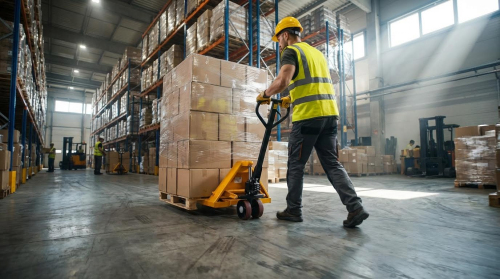
Design choices in a hydraulic pallet truck define safety, effort, and service life. Engineers who ask what is hydraulic pallet truck in a design context must link every component to load paths, floor contact, and hygiene or noise limits. This section explains how forks, wheels, hydraulics, and frames work together. It focuses on practical trade-offs for industrial layouts and regulated environments.
Fork Design, Strength, and Pallet Interface
Forks carry the full pallet load and transfer it to the wheels. Typical fork length is about 1 150 mm to suit EUR and ISO pallets. Width between forks often ranges from 520 mm to 685 mm, which matches common pallet opening patterns. Engineers size fork plate thickness and section height from bending and deflection checks.
Fork tips need a low entry height, often near 85 mm. This low profile lets the truck enter damaged or low-clearance pallets. Tapered and rounded tips reduce snagging and impact on deck boards. For higher capacities, designers increase fork thickness and add underside stiffeners instead of only raising material grade.
Key interface choices include:
- Fork length 5–10 % longer than pallet length for full support.
- Outer fork width aligned with pallet stringers for stable bearing.
- Load center close to 600 mm for standard 1 200 mm pallets.
These rules keep bending stress within steel yield limits and reduce local crushing of pallet boards.
Wheel Materials, Floor Conditions, and Noise
Wheel choice strongly affects rolling effort, floor wear, and noise. A typical hydraulic pallet truck uses two steering wheels at the handle and two or four load wheels under the forks. Engineers match wheel material to floor hardness, surface damage risk, and acoustic limits.
| Material | Typical Use | Key Features |
|---|---|---|
| Polyurethane | Indoor, smooth floors | Low noise, good floor protection |
| Nylon | Heavy loads, flat concrete | Low rolling resistance, harder on floors |
| Rubber | Uneven or outdoor areas | High grip, better on rough surfaces |
Polyurethane wheels reduce noise and limit floor marking, so they suit retail and distribution centers. Nylon wheels support high point loads and roll easily but generate more noise and stress on brittle surfaces. Rubber wheels absorb shock on expansion joints and rough yards but need more push force.
Engineers also select wheel diameter and width. Larger diameters climb small obstacles more easily and reduce bearing loads. Wider wheels spread load and reduce floor pressure but increase scrub in tight turns. Tandem load wheels under each fork tip share impact loads from broken boards and dock plates.
Hydraulic Pump, Seals, and Pressure Control
The hydraulic group converts handle work into lifting force. A compact pump feeds one or more cylinders mounted in the fork frame. When the operator pumps the handle, the pump raises pressure in the oil circuit. This pressure acts on the cylinder piston and lifts the forks.
Typical working pressures sit around 10–12 megapascals for 2–3 tonne trucks. Designers set bore diameter to achieve the target capacity at that pressure. They also add an overload valve that opens when pressure exceeds a safe limit. This valve protects the frame and forks from overload misuse.
Seal design is critical for reliability. The system uses wiper seals to keep dirt out and rod seals to keep oil in. Material selection depends on temperature range and fluid type. For cold stores, low-temperature elastomers keep flexibility. For hot or chemically aggressive sites, higher grade seal materials resist swelling and hardening.
Engineers keep the circuit simple to reduce leak paths. Common choices include:
- Single-piece cast pump body to cut joint failures.
- Hardened and ground pump pistons to reduce wear.
- Cartridge-type valves for fast service replacement.
These choices lower life-cycle cost and reduce downtime in high-throughput docks.
Frame Materials, Coatings, and Hygiene Needs
The frame holds all loads and defines durability. Standard hydraulic pallet trucks use welded high-tensile steel for the chassis and handle base. Plate thickness often ranges from about 5 mm to 8 mm in high-stress zones. Designers place welds away from peak bending regions and use smooth transitions to avoid stress risers.
Surface protection depends on the environment. For general warehouses, a powder-coated finish gives good corrosion resistance and impact toughness. In coastal or wet areas, zinc-rich primers and thicker top coats delay rust. For strict hygiene sectors, stainless steel frames and axles resist corrosion from washdown and cleaning chemicals.
Hygienic designs avoid horizontal ledges where dirt or liquid can accumulate. Engineers specify continuous welds, rounded corners, and open sections that drain easily. In food or pharmaceutical plants, trucks often use stainless or coated fasteners and closed hydraulic systems that resist fluid leaks.
When asking what is hydraulic pallet truck for a cleanroom or cold store, the answer includes material and coating changes, not only capacity. Stainless frames, sealed bearings, and low-temperature hydraulic oil keep the truck functional and compliant. These engineering choices let one basic mechanism serve very different industries with minimal redesign.
Selection, Applications, and Lifecycle Performance
Engineers who ask what is hydraulic pallet truck also need to know how to select and apply it correctly. Selection affects safety, throughput, and lifecycle cost more than the catalog rating alone. This section links capacity, fork geometry, drive type, safety, and maintenance to real operating profiles in warehouses, plants, and logistics centers.
Matching Capacity, Fork Size, and Duty Cycle
Capacity selection should start from the heaviest real pallet weight, not average load. Good practice keeps a 10–30% safety buffer between rated capacity and maximum expected load. For example, a 3 000 kg truck suits a 2 000–2 500 kg pallet stream.
Fork size must match pallet design and aisle layout. Typical forks are 1 150 mm long and 520–550 mm wide, which fits standard EUR pallets. A simple checklist helps:
- Fork length 50–100 mm longer than pallet for full support.
- Lowered height below pallet entry height, usually about 85 mm.
- Width aligned with pallet openings and stringer spacing.
Duty cycle defines whether a manual or powered solution is viable. Short, occasional moves with moderate loads suit manual trucks. Long pushes, ramps, or continuous multi-shift use push designs toward electric or semi-electric units to limit operator fatigue and musculoskeletal risk.
Manual, Electric, and Specialized Truck Types
Manual hydraulic pallet trucks answer what is hydraulic pallet truck in its simplest form. The operator pumps the handle to lift and pushes to move. They fit low-to-medium volume work, short runs, and tight spaces, with low purchase cost and simple upkeep.
Electric pallet trucks add traction and often powered lift. They reduce pull forces and cycle time in larger warehouses and cross-dock sites. They suit high-frequency flows, long travel distances, and slopes where manual effort would exceed ergonomic limits.
Specialized types solve niche problems that standard models cannot handle:
- Short-fork versions for small pallets and cramped production cells.
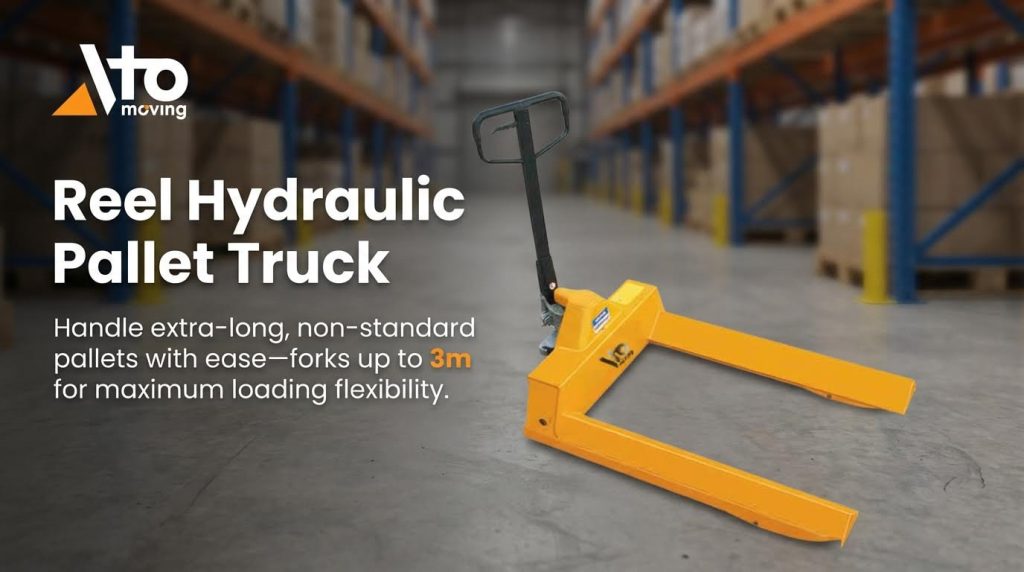
- Long-fork versions for extra-long pallets or two pallets in one trip.
- Four-way units for side entry where front access is blocked.
- Weigh-scale trucks for on-the-move inventory control.
- High-lift and scissor types for ergonomic picking and light stacking.
- Stainless or cold-store designs for food, pharma, and freezer zones.
Correct type selection improves flow, reduces damage, and avoids later retrofits.
Safety, Ergonomics, and Regulatory Compliance
Safe use starts with correct load rating, intact forks, and sound hydraulics. Overloading beyond the plate rating risks seal failure, frame bending, and loss of control. Operators should center the load on the forks and avoid point loading at fork tips.
Ergonomics is central when people ask what is hydraulic pallet truck good for in daily work. Manual models should keep starting and rolling forces low on flat floors. Ergonomic handles, neutral position control, and smooth steering reduce wrist and shoulder strain. Pushing is usually safer than pulling because it loads stronger muscle groups and improves visibility.
Compliance requirements vary by region but follow similar themes:
- Pre-use checks of wheels, forks, and hydraulic leaks.
- Training on correct lifting, travel speed, and cornering.
- Use on suitable floors without large gaps or steps.
- Clear walkways and controlled slopes.
Hygienic or hazardous areas often demand stainless frames, sealed bearings, or spark control. Engineers must align truck design with local safety rules and site risk assessments.
Maintenance, TCO, and Predictive Monitoring
Total cost of ownership (TCO) for a hydraulic pallet truck combines purchase price, downtime, repairs, and labor impact. Manual trucks cost less to buy but can raise labor cost if operators walk long distances or handle very heavy pallets. Electric units cost more up front yet lower per-pallet handling cost in high-volume sites.
Planned maintenance keeps performance stable over the truck’s life. Key tasks include:
- Lubricate pivot points and axles at defined intervals.
- Inspect forks for bending, cracks, or tip damage.
- Check hydraulic oil level and condition, then replace on schedule.
- Verify wheel wear, flat spots, and free rotation.
- For electric units, maintain batteries, chargers, and cables.
Simple logs already support trend analysis. Rising handle effort, uneven fork lift height, or recurring oil films all signal emerging faults. Larger fleets now add basic sensors or digital checklists to track usage hours and repair history. This light predictive approach helps schedule seal replacements, wheel changes, and oil service before failures stop the flow.
Summary and Practical Engineering Guidelines
Engineers asking what is hydraulic pallet truck should link theory with field practice. A hydraulic pallet truck used the pump, cylinder, and forks to lift palletized loads for short moves. Typical manual units carried 2 000 kilograms to 3 000 kilograms with fork lengths around 1 150 millimetres. Correct sizing, wheel choice, and maintenance turned this simple device into a reliable part of a handling system.
From a design view, the truck acted as a short-span lifting beam on small wheel supports. Safe use started with capacity. Rated capacity needed a 10–20% margin above the heaviest pallet. Fork length and width had to match pallet openings so both fork blades supported stringers or blocks. For indoor floors, polyurethane wheels reduced noise and floor wear. Nylon or rubber wheels suited rougher or outdoor surfaces.
Lifecycle performance depended on routine checks. Operators should inspect forks, welds, wheels, and the hydraulic circuit before each shift. Maintenance teams should replace hydraulic oil on a fixed schedule and grease pivot points and axles. Electric versions added battery care and charger management.
Future practice moved toward electric and semi-electric trucks, onboard weighing, and basic telematics. These features cut strain and improved traceability but did not replace core engineering rules. Correct capacity, matched forks, suitable wheels, and disciplined maintenance still defined safe and efficient hydraulic pallet truck operation.
Frequently Asked Questions
What is a hydraulic pallet truck?
A hydraulic pallet truck, also known as a pallet jack, is a tool used to lift and move palletized goods within warehouses, retail stores, and distribution centers. It operates using a hydraulic lifting system that allows the forks to raise and lower loads efficiently. Hydraulic Pallet Truck Guide.
Do pallet trucks use hydraulic power?
Yes, most pallet trucks use hydraulic power to lift loads. The hydraulic system is activated by a handle that pumps hydraulic oil into the lifting cylinder, raising the forks. This mechanism makes it easier to lift heavy pallets compared to manual lifting methods. Pallet Jack Types.
What are the hazards associated with hydraulic pallet trucks?
Hydraulic pallet trucks can pose several hazards. Hot hydraulic fluid can cause burns, and if it comes into contact with an ignition source, it may result in fires. Mechanical hazards include strong forces like torque and crushing. Detached hoses can whip around and cause injuries. Proper training and safety measures are essential to mitigate these risks.
How does a hydraulic pallet truck differ from a forklift?
A hydraulic pallet truck is typically lighter and more compact than a forklift. Pallet trucks usually weigh between 100 to 2,000 pounds (45 to 907 kilograms), while forklifts average around 9,000 pounds (4,082 kilograms). Forklifts generally have higher load capacities and are used for heavier tasks. Pallet Jack vs Forklift.