Shippers who ask how many pallets fit in a 53 truck need a clear engineering answer, not a guess. This article walks through the full math for 53-foot trailers, from internal dimensions to pallet footprints and stacking height limits.
You will see how different pallet sizes, loading patterns, and stacking choices change real pallet counts, both floor-loaded and palletized. The article then compares floor-loaded versus palletized strategies, explains double-stacking constraints, and closes with a practical framework for designing the most efficient, compliant trailer loads.
Core Dimensions And Pallet Math For 53-Foot Trailers
Operations teams who ask how many pallets fit in a 53 truck need a clear link between trailer dimensions and pallet math. This section explains typical 53-foot trailer internal sizes, common pallet footprints, and how these drive pallet counts per load. It also shows how to use simple formulas to predict pallet capacity for single-layer and stacked loads. Finally, it compares space limits versus weight limits so planners know when a 53-foot trailer will cube out or weigh out first.
Standard Trailer And Pallet Dimensions
A typical dry 53-foot trailer had internal dimensions close to 16.15 metres long, 2.59 metres wide, and about 2.79 metres high. Usable length was usually about 13,500–13,600 millimetres due to front wall and door clearances. Usable width between scuff boards was around 2,450–2,500 millimetres.
Standard pallet footprints drove the first step in answering how many pallets fit in a 53 truck. Common sizes included:
- 1,219 × 1,016 millimetres (48 × 40 inches, North American standard)
- 1,067 × 1,067 millimetres (42 × 42 inches, common in food and chemicals)
- 1,219 × 1,219 millimetres (48 × 48 inches, drums and bulk)
- 1,200 × 800 millimetres (Euro pallet)
- 914 × 914 millimetres (36 × 36 inches, beverage and dairy)
With 48 × 40 pallets and straight loading, a 53-foot trailer usually held 2 pallets across the width and 13 rows in length, for 26 pallets per layer. Other footprints changed the row count and cross-trailer count, so engineers always started with internal dimensions and true pallet size, including any overhang from stretch wrap or cartons.
Calculating Pallets Per Trailer: Key Formulas
To move from rules of thumb to repeatable answers for how many pallets fit in a 53 truck, planners used simple dimensional formulas. For a single layer on the floor, the base formula was:
(Trailer internal length ÷ pallet length) × (Trailer internal width ÷ pallet width) = pallets per layer.
For example, with a 13,500 millimetre internal length and 1,219 × 1,016 millimetre pallets in straight loading:
- Rows lengthwise = floor(13,500 ÷ 1,219) ≈ 11 in strict form, 13 in practice when using door and nose clearance tightly.
- Pallets across = floor(2,450 ÷ 1,016) = 2.
- Result ≈ 22–26 pallets, with industry practice settling on 26 for optimized straight loading.
For stacked loads, engineers multiplied the floor count by the number of safe vertical layers:
Pallets per trailer = pallets per layer × floor(trailer internal height ÷ palletized load height).
With 26 pallets on the floor and two safe layers, a 53-foot trailer carried up to 52 pallets. However, teams still checked axle loads, gross vehicle weight, and box crush strength before using the theoretical maximum.
Space Utilization: Cubing Out vs Weighing Out
Knowing how many pallets fit in a 53 truck in theory did not guarantee that count in practice. Two different limits applied. A load could cube out when volume filled first, or weigh out when mass reached legal limits first.
High-density freight such as metals or liquids often weighed out before the trailer reached the 26–30 pallet geometric capacity. In those cases, planners reduced pallet count to stay within gross vehicle weight and axle limits. Low-density freight such as tissue or snack foods usually cubed out first. Teams then pushed toward 26–30 pallets in one layer or 52 pallets stacked, while still staying under the trailer roof.
Engineers also watched three practical factors that cut real capacity below the math:
- Pallet overhang or out-of-square pallets, which could block the last row from fitting.
- Uneven carton heights that reduced safe double-stacking options.
- Required gaps for airflow, load bars, or dunnage, which reduced effective floor area.
By combining dimensional formulas with weight checks and these real-world adjustments, logistics teams set reliable planning numbers for 53-foot trailer pallet capacity across different product families.
Floor-Loaded vs Palletized: Capacity And Tradeoffs
Operations teams who ask how many pallets fit in a 53 truck must also decide between floor-loaded and palletized loading. Both methods change real trailer capacity, labor cost, and product damage risk. The right choice depends on cube utilization targets, labor market limits, and product fragility. This section compares capacity and tradeoffs using typical 53-foot dry van data.
Floor-Loaded 53-Foot Trailers: When It Makes Sense
Floor-loading used the full trailer cube and minimized wasted air. With cartons stacked directly on the floor, a 53-foot trailer often moved the same freight that would need about 20% more palletized loads. This mattered when shippers tried to approach 100% volume use instead of the 80% typical with palletized freight.
Floor-loading made sense when:
- Products were strong cartons, bags, or bales with good stacking strength.
- Shipments ran full truckload lanes with repeatable SKUs and stable demand.
- Freight rates were high, and saving one load in five justified extra labor.
However, floor-loading needed more dock labor and longer load and unload times. Facilities often used gravity or powered conveyors to reduce manual lifting, improve ergonomics, and keep trailer turns acceptable.
Palletized Loading Patterns: Straight, Turned, Pinwheel
Palletized loading simplified handling and counting when planning how many pallets fit in a 53 truck. For standard 1 219 millimetre by 1 016 millimetre pallets, three main patterns existed. Each pattern traded capacity against simplicity and stability.
| Pattern | Typical pallet count | Key feature |
|---|---|---|
| Straight | 26 pallets | Easy to plan and load |
| Pinwheel | About 28 pallets | Better use of gaps |
| Turned | 30 pallets | Highest single-layer count |
Straight loading placed pallets with the 1 219 millimetre side along trailer length. Two pallets fit across the width and thirteen rows fit along the length. Turned loading rotated pallets so the 1 016 millimetre side ran along the length, which allowed about fifteen rows. Pinwheel patterns mixed both orientations to fill pockets but needed more skilled operators and tighter quality checks.
Load Stability, Damage Risk, And Labor Requirements
Floor-loaded freight usually gained better cube use but increased handling risk. Workers touched each case at least twice, which raised scuff, crush, and mis-pick chances. Palletized freight reduced touches and used stretch wrap, straps, and slip sheets to stabilize loads.
From an engineering view, palletized patterns made load paths more predictable. Vertical forces travelled through box columns into deck boards and then into trailer floor crossmembers. This reduced point loads and box edge crush. Floor-loaded stacks depended more on box compression ratings and stacking patterns such as column or interlock stacks.
Labor demand also differed:
- Floor-loaded trailers needed more people per door and longer dwell times.
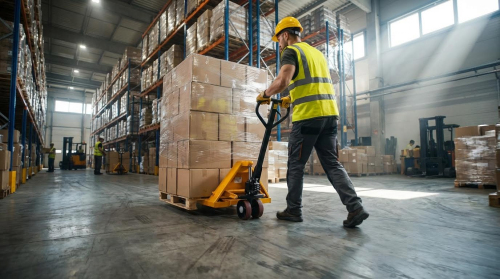
- Palletized trailers used lift trucks, pallet jacks, and dock equipment to cut manual work.
- High-turn facilities often chose palletized loading even with slightly lower cube use.
Ergonomics, Safety, And Trailer Turn Time
Ergonomics strongly influenced the real cost of how many pallets fit in a 53 truck. Floor-loading forced workers to bend, reach, and twist inside the trailer. This increased fatigue and injury risk, especially with heavy cartons. Palletized loading moved most work to dock level where lift trucks handled mass and workers only managed wrap and labels.
Safety also improved with palletized methods. Stable unit loads reduced collapse risk when doors opened or during hard braking. Forklift operators could load from outside the trailer or with limited entry time, which cut fall and impact hazards.
Trailer turn time stayed critical at busy docks. A palletized 53-foot trailer could often load or unload in minutes, especially with standardized patterns like 26 straight pallets. Floor-loaded trailers sometimes tied up a door for an hour or more. Facilities with tight yard capacity or high detention risk usually accepted lower cube use in exchange for faster turns and safer work.
Double-Stacking Strategies And Engineering Constraints
Double-stacking in a 53-foot trailer can nearly double pallet count, but it adds structural and regulatory limits. Engineers must balance the headline question how many pallets fit in a 53 truck with box crush strength, pallet ratings, and legal weight. The aim is to reach the theoretical 52-pallet target without overload, damage, or unstable stacks. This section explains how double-stacking changes capacity math and what constraints control real-world limits.
How Many Pallets Fit When Double-Stacked
A 53-foot trailer with standard 48 × 40 pallets typically held 26 to 30 pallets in one layer. Straight loading gave 26 pallets, pinwheel patterns reached about 28, and turned loading could reach 30. When double-stacked, the simple geometric ceiling was 52 to 60 pallets, but most operations treated 52 pallets as the practical limit.
Capacity depended on three main factors.
- Trailer internal height, usually about 2.79 m to 2.79 m usable.
- Unit load height per pallet, often 1.2 m to 1.5 m including pallet.
- Weight per pallet and legal gross vehicle weight.
In practice, shippers often double-stacked only lighter SKUs. Heavy pallets caused the load to weigh out before it cubed out, so the full 52 positions were not always used. Mixed strategies were common, such as single-stacking dense products over the axles and double-stacking lighter freight at the nose or tail to keep axle loads within limits.
Pallet Strength, Box Stacking Patterns, And Load Limits
Double-stacking worked only when the lower pallet and its packaging carried the full weight of the pallet above plus dynamic forces in transit. Typical wooden pallets handled static loads up to around 2 500 kg, but dynamic and racking ratings were lower. Plastic pallets, especially recycled ones, often had reduced dynamic capacity and were poor choices for heavy double-stacked loads.
Box stacking pattern strongly affected column strength.
- Column stacking maximized vertical strength and was preferred for tall double-stacked loads with uniform cartons.
- Interlocked patterns improved lateral stability but reduced vertical compression strength slightly.
- Chimney or pinwheel box patterns increased compression strength for heavy, dense goods but demanded tight quality control.
Engineers checked box edge crush test (ECT), pallet deck deflection, and contact area between pallets. Layer pads, slip sheets, and corner posts spread load and reduced point pressure on lower cartons. Loads with overhang were poor candidates for double-stacking because overhang shifted compression to carton walls and increased crush risk.
Trailer Height, Axle Loads, And Regulatory Compliance
Even when pallet math allowed 52 pallets, trailer height and weight rules set hard limits. Internal trailer height and door height had to clear the total double-stack height with safe tolerance for floor deflection and road bounce. A common rule of thumb kept total stack height at least 75 mm below measured internal height.
Weight rules were stricter. North American regulations limited gross vehicle weight and axle group loads, so planners had to distribute pallets along the 53-foot length. Typical checks included:
- Verifying total freight mass plus tractor and trailer stayed within legal gross weight.
- Balancing pallet rows so steer, drive, and tandem axles each stayed under their group limits.
- Keeping center of gravity low and near the trailer center to reduce rollover and sway risk.
Compliance also covered load restraint. Straps, load bars, and sometimes dunnage prevented double-stacked pallets from shifting. Regional standards, such as EN 12195 in Europe, defined minimum securing forces and methods, which influenced how high and how tight double-stacked loads could be built.
Role Of Automation, AI, And Digital Twins In Planning
Automation and AI tools turned the question “how many pallets fit in a 53 truck” into a constrained optimization problem. Modern load-planning software modeled trailer geometry, pallet sizes, stack heights, and legal weights together. Algorithms searched thousands of patterns to find layouts that hit 52 double-stacked positions when possible while keeping axle loads legal.
Digital twins extended this approach. Planners built a virtual 53-foot trailer and simulated different SKUs, pallet heights, and stacking rules. The model checked clearances, door interference, and center-of-gravity shifts during braking or cornering. Results fed back into warehouse rules, such as maximum pallet height by SKU for double-stacked lanes.
Automation inside trailers also changed feasible strategies. Powered pallet jacks, guided forklifts, and telescopic conveyors reduced impact loads on lower pallets and made precise placement easier. Atomoving and other automation suppliers integrated WMS, TMS, and load-planning engines so dock teams received exact row-by-row loading plans. This coordination helped operations reach near-theoretical pallet counts while maintaining safety margins and compliance.
Summary: Engineering The Most Efficient Trailer Loads
Logistics teams that ask how many pallets fit in a 53 truck need a clear engineering answer, not a guess. A 53-foot trailer with standard 48 × 40 pallets usually carried 26 to 30 pallets in one layer, and up to 52 pallets when double-stacked within height and weight limits. The exact count depended on loading pattern, pallet size, box height, and legal axle loads. Efficient loading treated the trailer as a constrained 3D volume and a beam under distributed load, not just an empty box.
From a technical view, the best loads balanced three goals. First, they maximized pallet count using straight, turned, or pinwheel patterns based on pallet footprint. Second, they stayed compliant with gross weight and axle limits, while controlling center of gravity and roof clearance. Third, they protected product through correct box stacking patterns, stable wrapping, and verified pallet strength.
Future practice increasingly used automation, AI, and digital twins to simulate how many pallets fit in a 53 truck for each SKU mix. These tools tested floor-loaded and palletized options, checked axle loads, and output safe patterns in seconds. The most effective operations combined this software with trained operators, consistent pallet standards, and fit-for-purpose handling equipment from suppliers such as Atomoving. This balanced approach delivered higher trailer utilization, lower transport cost per unit, and better safety performance over time.
,
Frequently Asked Questions
How many pallets can fit on a 53-foot truck?
A standard 53-foot dry van trailer can hold 26 pallets in a single layer if loaded side by side. If double-stacked, it can accommodate up to 52 pallets. Trailer Capacity Guide.
- Single-stacked: 26 pallets.
- Double-stacked: Up to 52 pallets.
What is the optimal pallet configuration for a 53-foot trailer?
The number of pallets that fit depends on their dimensions. A 53-foot trailer can typically fit 26 standard 48″ x 40″ pallets in a single layer. Skilled loading can fit 30 pallets of 40″ x 48″ by turning them. FreightRun Loading Tips.
- Standard pallets (48″ x 40″): 26 units.
- Optimized pallets (40″ x 48″): 30 units.