Standard pallet jack lift height is the vertical travel of the forks, typically from about 75–85 mm minimum to 185–210 mm maximum, and it directly controls how safely and efficiently you can move pallets. This guide explains how high does a pallet jack lift in real-world terms, why engineering limits keep most models in the 50–200 mm range, and how much clearance you actually need under a pallet to roll without damage. You will see the physics behind fork geometry and hydraulics, the safety envelopes defined by industrial truck standards, and how to choose between standard, high‑lift, and electric options. By the end, you can match lift height to your pallets, floors, and ramps while staying inside safe raising limits and minimizing tip risk, floor damage, and maintenance costs.
What “Lift Height” Really Means On A Pallet Jack
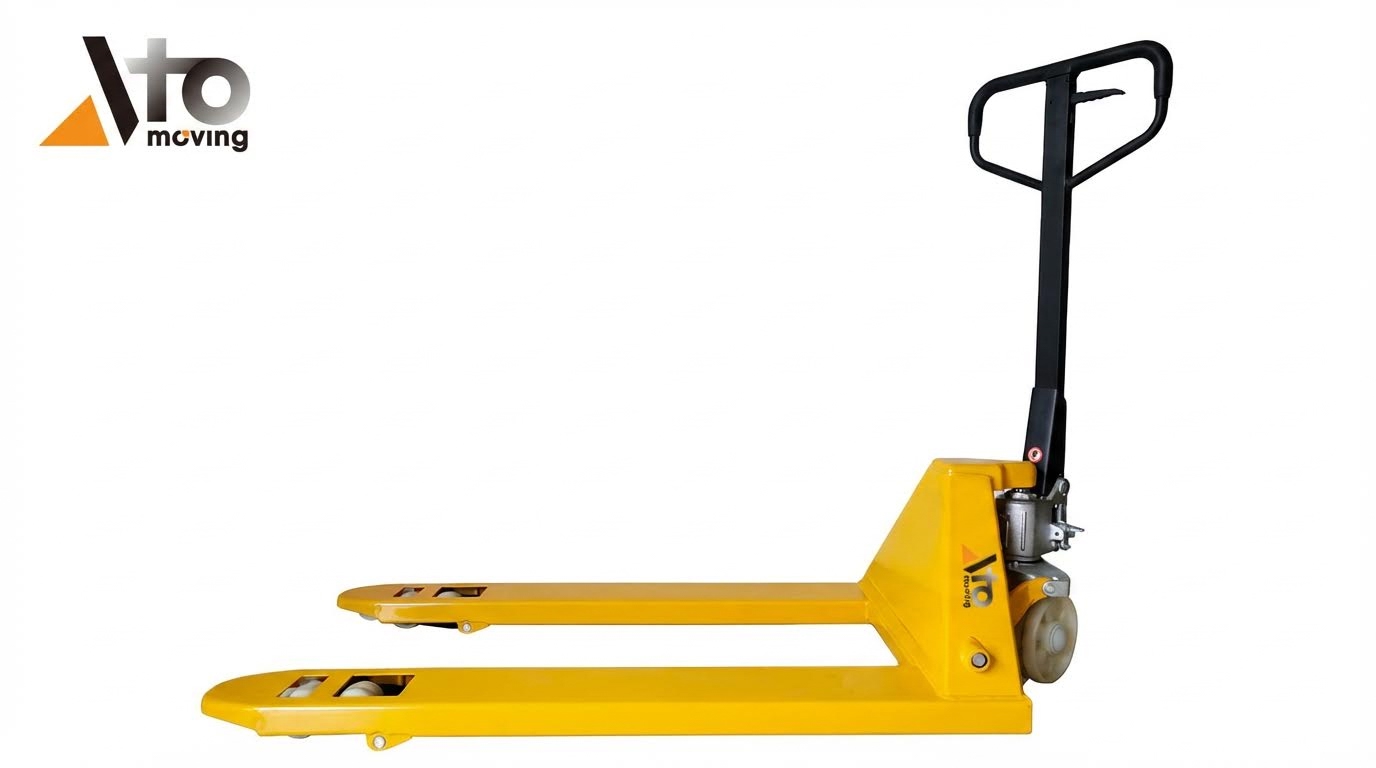
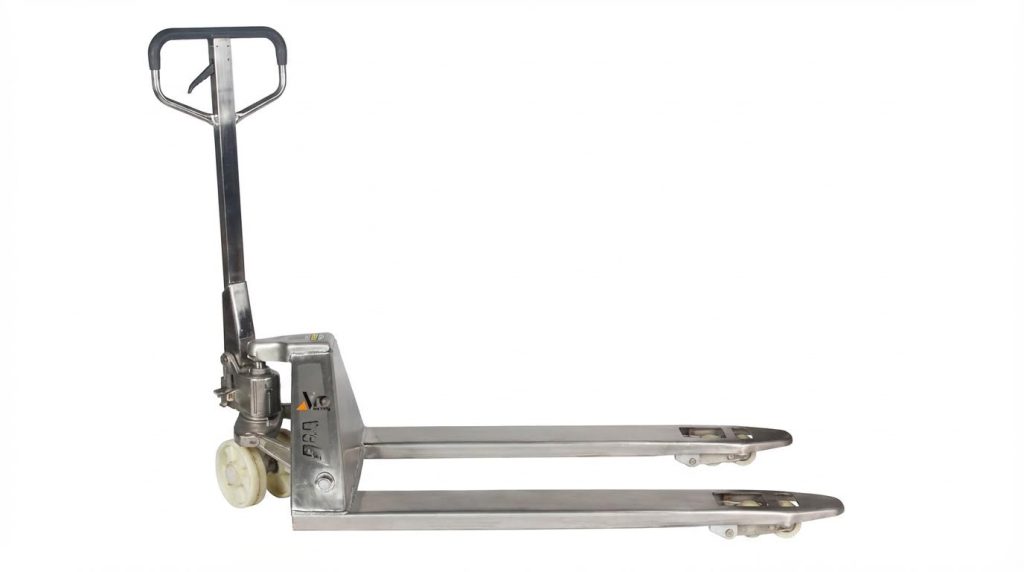
Lift height on a pallet jack is the vertical travel of the forks from their lowest to highest position, which directly answers how high does a pallet jack lift and how much under‑pallet clearance you actually get.
In practice, “lift height” is not how high you can stack, but how far you raise a pallet just enough to roll safely. Standard manual pallet jacks typically move the forks from about 75–85 mm minimum height up to roughly 180–210 mm maximum height, giving around 100–120 mm of usable lift range for transport in normal warehouse use. That small vertical window is engineered to clear pallet bottom boards while keeping the load’s center of gravity low for stability and OSHA/ISO-compliant operation.
💡 Field Engineer’s Note: When operators ask “how high does a pallet jack lift,” what they really need is 25–40 mm of clean clearance under the pallet; anything higher just increases tipping leverage and floor damage risk without adding value.
Minimum fork height and pallet compatibility
Minimum fork height is the lowest position of the forks above the floor, and it dictates which pallet styles you can enter without jamming or damaging boards.
Typical manual pallet jacks list minimum fork heights of 75 mm or 85 mm, tuned to standard wooden pallets that have bottom deck clearances around 90 mm on most warehouse floors. That 5–15 mm margin is just enough for smooth entry without scraping. Lower‑profile designs go below 75 mm to engage low or damaged pallets, but they become harder to design because wheel diameters, fork thickness, and linkage geometry all have to shrink together without sacrificing strength.
| Parameter | Typical Value / Range | What It Controls | Field Impact |
|---|---|---|---|
| Minimum fork height (standard manual jack) | 75–85 mm | Lowest point forks can reach | Determines if you can enter standard pallets without lifting or dragging them. |
| Typical pallet underside clearance | ≈ 90 mm | Gap between floor and bottom deck boards | Needs to exceed minimum fork height, or forks will hit the pallet instead of sliding under. |
| Low‑profile jack minimum height | < 75 mm | Access to special or damaged pallets | Improves compatibility with thin or sagging pallets but may roll worse on rough floors. |
| Load wheel diameter | ≈ 80 mm | How low the fork tips can sit | Larger wheels roll easier over joints but force a higher minimum fork height. |
| Fork thickness (at tips) | Engineered to fit in pallet entry | How easily forks nose into the pallet | Thinner tips enter easier but must still carry 1,360–3,000 kg safely. |
From an operations perspective, the “wrong” minimum fork height shows up as operators ramming pallets to get in, splintered bottom boards, and higher push forces. Matching minimum height to your most fragile pallet type is often more important than chasing maximum lift height.
How to quickly check minimum fork height in the field
Slide a rigid ruler or gauge block under the fork tip with the jack fully lowered. If you cannot insert at least 75–85 mm under a standard jack, the hydraulic unit may not be fully bleeding down, or the frame may be bent, reducing pallet compatibility.
Standard lift range and under‑pallet clearance
Standard lift range is the difference between maximum and minimum fork height, and it directly sets your under‑pallet clearance during travel, which is what really answers how high does a pallet jack lift in day‑to‑day work.
Most manual pallet jacks deliver lifting heights of roughly 100–120 mm from fully lowered to fully raised, with maximum fork heights around 185–210 mm for common warehouse models. Because pallets start with about 90 mm of underside clearance, that translates to only about 25–40 mm of floor‑to‑pallet gap when traveling, which is exactly what you want: just enough to roll without dragging, but not so high that the load becomes unstable or harder to stop.
| Height Concept | Typical Value / Range | How It’s Used | Field Impact |
|---|---|---|---|
| Minimum fork height | 75–85 mm | Starting point before lifting | Must be below pallet underside to even get under the load. |
| Maximum fork height (standard manual) | ≈ 185–210 mm | Highest fork position | Defines total lift range and the theoretical answer to “how high does a pallet jack lift.” |
| Usable lift range | ≈ 100–120 mm | Max minus min fork height | Sets how far you can raise the pallet off the floor for transport. |
| Recommended travel clearance | 20–50 mm under pallet | Forks not fully raised | Balances smooth rolling with low center of gravity for stability on imperfect floors. |
| Ground clearance under raised pallet | ≈ 25–40 mm | At typical travel height | Enough to clear joints and minor damage without “high‑centering” the pallet. |
Standards and best practices advise moving with forks just 20–50 mm above the floor, not at full height, to keep overturning moments low and maintain control on ramps and imperfect surfaces during normal operation. In other words, the practical answer to how high does a pallet jack lift is: high enough to give a few centimeters of safe rolling clearance—if you need more than about 200 mm, you’re in high‑lift or stacker territory, not standard pallet jacks.
💡 Field Engineer’s Note: If you regularly scrape thresholds even with 25–40 mm of clearance, the problem is usually floor condition or ramp angle, not “insufficient lift height.” Fixing those gives a bigger safety and productivity gain than chasing a taller jack.
Engineering Limits Behind Pallet Jack Lift Heights
Engineering limits on pallet jack lift height come from fork geometry, wheel size, linkage design, hydraulic stroke, frame stiffness, and stability rules that together cap how high a pallet jack lifts to roughly 185–210 mm in standard models. When you ask how high does a pallet jack lift, you are really asking how these mechanical and safety constraints define a narrow, safe operating envelope rather than an arbitrary number.
💡 Field Engineer’s Note: If a jack that “used to clear everything” now scrapes on the same dock plates, assume geometry hasn’t changed—the hydraulic stroke or fork deflection has. Measure actual min/max fork heights before blaming the floor.
Fork geometry, wheel size, and linkage constraints
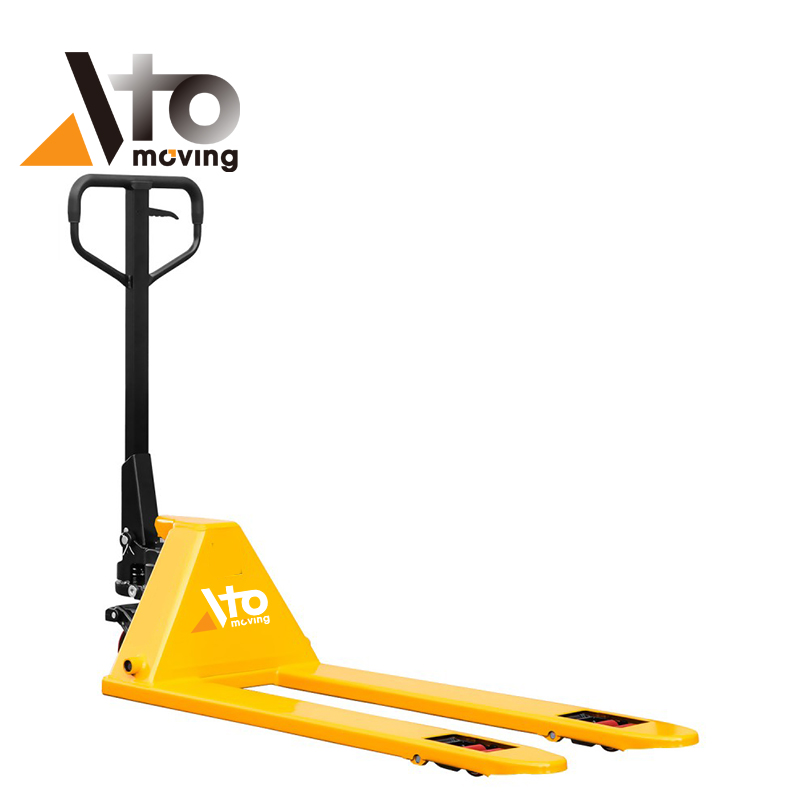
Fork geometry and wheel size mechanically fix both the minimum and maximum fork heights, so they are the first hard limit on how high does a pallet jack lift in real-world use. Standard manual pallet trucks use fork profiles that deliver minimum fork heights of about 75–85 mm and maximum fork heights around 185–210 mm, giving a usable lift of roughly 100–120 mm for clearing pallets and floor imperfections under typical warehouse conditions.
| Design Element | Typical Range / Effect | Engineering Role | Field Impact |
|---|---|---|---|
| Minimum fork height | 75–85 mm | Set by fork profile, load wheel diameter, and linkage pivot geometry in standard designs | Determines whether you can enter low or damaged pallets without jamming. |
| Maximum fork height | 185–210 mm | Limited by linkage rotation angle and hydraulic stroke working together | Controls under‑pallet clearance (typically 25–50 mm) and answers “how high does a pallet jack lift” in most facilities. |
| Load wheel diameter | ≈80 mm | Larger wheels roll better but force a higher minimum fork height by simple geometry | Improves crossing expansion joints but may block entry into low‑profile pallets. |
| Steer wheel diameter | ≈180 mm | Sets chassis height and the arc the linkage can travel without interference under the frame | Affects turning effort and whether the jack bottoms out on ramps and dock plates. |
| Lift linkage geometry | Optimized for ≈100–120 mm lift | Converts small cylinder stroke into fork lift while keeping frame compact and stable | Too much linkage travel would raise the load higher, but also raise the center of gravity and tipping risk. |
| Fork section thickness | ≈3.75–6 mm | Balances stiffness with a low profile under the pallet bottom deck to control deflection | Thicker forks are stronger but need higher pallet openings; thinner forks flex more and can reduce real lift under load. |
From a physics standpoint, the fork tips move in an arc around the load wheel pivot. That arc is constrained by how far the linkage can rotate before it hits the frame or runs out of cylinder stroke, which is why standard lift ranges cluster tightly around 50–200 mm rather than varying wildly across models.
Why not just use bigger wheels to get more clearance?
Bigger load wheels do not increase maximum fork height; they simply raise the entire fork assembly relative to the floor. That lifts the minimum fork height and can make it impossible to enter standard 90 mm‑clearance pallets, so engineers keep wheel diameters around 80 mm for indoor trucks to stay compatible with ISO/EUR pallets used in most warehouses.
Hydraulic stroke, frame stiffness, and load deflection
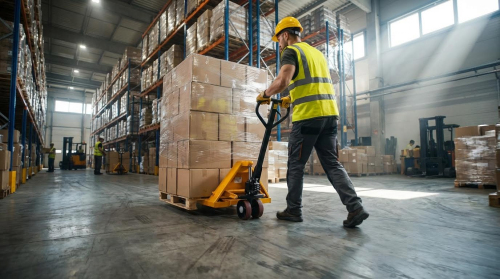
Hydraulic stroke and frame stiffness cap the usable lift height because the cylinder can only travel so far before the frame, forks, and seals reach stress limits or allow too much elastic deflection. Manual pallet jacks that lift about 110–120 mm use compact single‑acting cylinders sized for maximum fork heights around 185–210 mm, beyond which cylinder length, rod bending, and frame weight all increase disproportionately for marginal benefit.
| Hydraulic / Structural Factor | Typical Design Choice | How It Limits Lift Height | Field Impact |
|---|---|---|---|
| Cylinder stroke | ≈110–120 mm lift | Stroke length plus linkage ratio sets maximum fork height, usually ≈185–210 mm on standard units | Defines how many pump strokes are needed and the highest safe travel position. |
| Hydraulic pressure & seals | Single‑stage, chrome rod, high‑quality seals | Designed to sustain load without drift up to roughly 200 mm under rated capacity | Worn seals reduce achievable height, so the jack may no longer clear dock plates or thresholds. |
| Frame stiffness | Reinforced fork and chassis sections | Controls elastic bending so forks stay within the designed lift envelope under load | Less deflection keeps pallet level and maintains real ground clearance on rough floors. |
| Fork deflection under load | Managed via 3.75–6 mm steel thickness | Excessive deflection effectively reduces clearance, even if the gauge says full height is reached | Heavy loads may still scrape on rough concrete despite the jack being “fully pumped.” |
| High‑lift designs | Up to ≈800 mm lift with reinforced frames | Require longer or multi‑stage cylinders and much stiffer structures to control deformation at height | Often derated in capacity; used more as work positioners than for long‑distance transport. |
In practice, engineers size the cylinder so that full pump travel gives just enough fork lift to achieve 25–50 mm of ground clearance under a loaded pallet—no more. Extra height would not move more product; it would only amplify overturning moments and wear on the hydraulic circuit, raising lifecycle cost and maintenance frequency over years of use.
How to spot hydraulic stroke or stiffness issues in the field
Monthly checks should record minimum and maximum fork heights both empty and under a representative load. A drop in maximum height under load, or growing left‑right height differences, usually indicates either internal leakage in the cylinder or permanent frame/fork deformation, long before the jack actually fails to lift in daily operations.
💡 Field Engineer’s Note: If operators complain “this jack doesn’t lift as high as the others,” measure fork tip height at full pump, both sides, under a standard pallet. A 5–10 mm loss often traces back to bent forks from overloading or impact, not the hydraulics.
Stability, safety standards, and operating envelopes
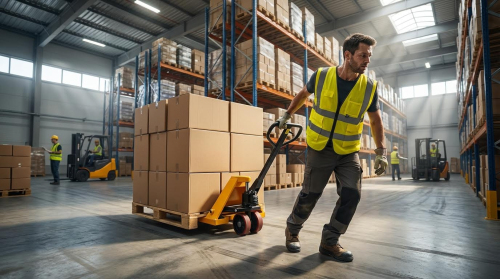
Stability and safety standards ultimately define the safe operating envelope, so they are the reason most answers to how high does a pallet jack lift cluster around the same modest numbers. Industrial truck standards require that rated capacity, stability, and braking performance be verified at maximum lift height, so designers keep that height low to maintain generous tip resistance margins during turning, stopping, and ramp work under test conditions.
- Low center of gravity: Keeping maximum fork height near 185–210 mm maintains a low combined center of gravity, reducing overturning moments during abrupt steering or braking with loads up to 3,000 kg in typical jacks.
- Travel height guidelines: Safety guidance recommends traveling with forks only 20–50 mm above the floor, even though the jack can lift higher, to maintain stability on irregular surfaces and reduce the risk of tipping when crossing joints or slopes in daily operation.
- Stability on ramps and rough floors: On ramps, the effective vertical distance between the load center and downhill wheel increases, shrinking the stability triangle and making high lift settings more hazardous, especially on damaged or uneven concrete found in older warehouses.
- High‑lift stabilizers: Units that lift to around 800 mm add outriggers or stabilizer legs specifically to widen the support base and control tipping moments, often trading off rated capacity to keep within safe stability envelopes Choosing The Right Lift Height For Your Operation
Choosing the right pallet jack lift height means matching how high does a pallet jack lift to your pallets, floor quality, ramps, and ergonomics so you get safe clearance without wasting money on unnecessary lift range.
💡 Field Engineer’s Note: When in doubt, design around your worst pallet and worst floor, not your best ones; 10–15 mm too little clearance shows up every single shift as dragging, jamming, and pallet damage.
Matching lift range to pallets, floors, and ramps
Matching lift range to your environment</b means checking pallet opening height, floor damage, and ramp gradients, then ensuring your jack’s minimum and maximum fork heights provide 20–50 mm of real-world rolling clearance.
Selection Factor Typical Values / Guidance Why It Matters Field Impact Typical standard jack lift range Approx. 75–85 mm minimum, 185–210 mm maximum fork height documented for manual jacks Defines how high does a pallet jack lift in normal warehouse use. Covers most EUR/ISO pallets without needing special equipment. Required travel clearance under pallet 20–50 mm recommended above floor during transport for stability Too low and forks drag; too high and center of gravity rises. Directly affects push force, noise, and tip-over margin on bad floors. Pallet underside clearance Standard wood pallets ≈ 90 mm opening height aligned to 75–85 mm min fork height Must exceed minimum fork height or forks will not enter. Drives whether a standard jack can handle your lowest pallets. Floor condition allowance Allow extra 10–20 mm for worn, cracked, or bumpy concrete beyond ideal 25–40 mm clearance Damaged floors “eat” your theoretical clearance. Reduces stuck loads and wheel impact shocks for operators. Ramps and dock plates Avoid steep ramps; keep forks just high enough to clear transitions to preserve stability On slopes, the downhill wheel sits lower, effectively raising the load height. Too much lift on ramps increases tipping moment and operator strain. Minimum fork height need 75–85 mm for standard pallets; lower only if you have special low-profile pallets noted in specs Controls compatibility with damaged or non-standard pallets. Lower minimum height helps rescue crushed pallets but may cost more. In practical terms, how high does a pallet jack lift for most sites is “just enough” to get 25–40 mm real clearance under the lowest pallet on the worst floor, not the glossy showroom slab.
Quick method to size your lift range
- Measure pallet opening: Measure from floor to underside of the top deck on your thinnest or most damaged pallet.
- Measure floor defects: Check typical crack depths, spalls, and dock plate steps; note the largest height difference.
- Add safety margin: Add 20–40 mm to cover bumps plus 20–30 mm rolling clearance target.
- Compare to jack specs: Confirm the jack’s maximum fork height exceeds this total; if not, consider higher-lift or floor repair.
Comparing standard, high‑lift, and electric options
Comparing pallet jack types by lift height</b shows that standard manual units lift to about 185–210 mm, while high-lift and some electric designs reach up to roughly 800 mm, trading height for reduced capacity and higher cost.
Jack Type Typical Lift Height Range Typical Capacity Range Best Use Case Field Impact on Operations Standard manual pallet jack Min 75–85 mm; max 185–210 mm (≈ 2–8 inches) for general warehouse use ≈ 1,360–3,000 kg, up to 5,000 kg for heavy-duty models in typical specs Floor-to-floor moves, docks, staging, truck loading. Lowest cost per pallet moved; how high does a pallet jack lift here is enough for 99% of ground moves. High-lift / scissor pallet jack Up to ≈ 800 mm service height with reinforced frames Reduced vs standard jacks; capacity derated as height increases to control deflection Work-positioning at waist height, light assembly, packing benches. Improves ergonomics and pick rates but not suited for long-distance travel when raised. Electric pallet truck (low-lift) Similar to manual: max ≈ 195–210 mm for transport Often 2,000–3,000 kg and above, depending on model. Medium–high volume moves, longer runs, dock-to-rack transfers. Same lift height as manual but far lower operator fatigue and higher throughput. Electric high-lift / extended-lift Some models up to ≈ 800 mm for work positioning with stabilizers Capacity reduced vs low-lift electrics at max height. Ergonomic workstations where loads must be frequently raised and lowered. Combines powered travel with ergonomic height, but higher purchase and maintenance cost. High-reach pallet trucks (specialty) Up to ≈ 800 mm (≈ 31.5 inches) in some designs for elevated stacking Varies; often lower than standard jacks at full height. Occasional elevated stacking where a full forklift is not justified. Bridges the gap between pallet jack and small stacker but with tighter stability limits. When you compare how high does a pallet jack lift across these types, remember that more lift is not automatically better; every extra millimetre raises the center of gravity and mechanical stress.
- If you only move pallets on the floor: A standard manual or low-lift electric jack with ≈ 185–210 mm max height is usually optimal and safest.
- If operators bend a lot at pallets: High-lift or electric high-lift units up to ≈ 800 mm can cut fatigue and musculoskeletal injuries, at the cost of capacity and price.
- If you need vertical storage: Consider whether you actually need a walkie stacker or forklift instead of pushing pallet jack lift heights to their limits.
“”
Final Thoughts On Safe Pallet Jack Lift Heights
Safe pallet jack lift height is not about reaching the highest possible number. It is about getting just enough clearance for clean rolling while keeping the load low and stable. Fork geometry, wheel size, and linkage design fix a narrow lift window, typically around 75–85 mm minimum and 185–210 mm maximum. Hydraulics and frame stiffness then ensure the jack can reach that window under real loads without bending or drifting.
Safety standards tie everything together. They assume you travel with only 20–50 mm clearance under the pallet, not at full stroke. That small gap protects stability on ramps, rough floors, and during sharp steering. Pushing lift height higher without changing the chassis and stabilizers quickly eats into your tip margin.
For most operations, the best practice is clear. Choose a standard or low‑lift electric jack that gives 25–40 mm real clearance under your worst pallet on your worst floor. Use high‑lift or extended‑lift units only as work positioners, not as long‑haul transport tools. Finally, measure fork heights in the field and maintain your jacks. That simple discipline keeps Atomoving pallet trucks operating inside their engineered envelope and protects operators, pallets, and floors shift after shift.
Frequently Asked Questions
How high can a pallet jack lift?
A standard manual pallet jack typically lifts up to 8 inches off the ground. However, high-lift pallet jacks can raise loads as high as 32 inches. Specialized electric models may also reach heights over 20 inches due to their advanced lifting mechanisms. For more details, check this Pallet Jack Lift Guide.
What is the maximum safe height for stacking pallets?
For safe stacking, pallets should not exceed 60 inches in height. Always place heavier boxes at the bottom and lighter ones on top to ensure stability and safety during shipping or storage. Refer to this Pallet Shipping Guide for additional insights.