
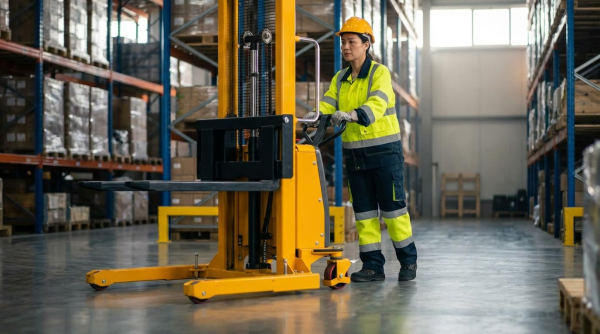
Straddle stackers answer a frequent search question in warehouse design: what is a straddle stacker and when is it better than a forklift or reach truck. This guide explains how these compact trucks work, how their structures carry load, and how hydraulic and electric subsystems define performance and duty life.
Across the full outline, you will see how engineers match capacity, lift height, and aisle width to pallet types, mast designs, power options, and racking layouts. Later sections cover safety, preventive maintenance, batteries, and data-driven lifecycle management so operations teams can select, operate, and renew straddle stackers with confidence.
Core Design And Operating Principles
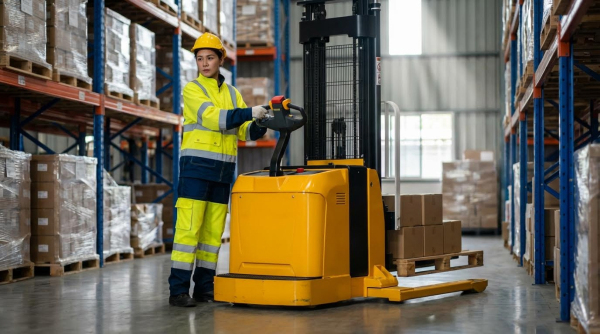
Engineers who ask what is a straddle stacker usually want more than a simple definition. They need to know how it differs from forklifts and reach trucks, how the structure carries load, and how hydraulic and electric subsystems set real-world performance. This section explains those core design and operating principles so warehouse, maintenance, and safety teams can specify, compare, and operate straddle stackers with confidence in modern storage layouts.
Straddle Stacker Versus Forklift And Reach Truck
A straddle stacker is a walk-behind or rider truck with outrigger legs that straddle the pallet. It lifts on fixed or adjustable forks and works in narrower aisles than most counterbalance forklifts. Typical electric warehouse straddle stackers handle about 1,100–1,800 kg and lift up to roughly 3.5 m. They suit short to medium travel distances and medium duty cycles.
Compared with a counterbalance forklift, the straddle design removes the heavy rear counterweight. Stability comes from the base legs around the load. This reduces truck mass, turning radius, and floor loading. Compared with a reach truck, a straddle stacker usually has simpler mast and carriage hardware and lower travel speed. Reach trucks need wider, flatter aisles but work at higher racking levels and longer horizontal runs.
In practice, engineers select straddle stackers when:
- Aisle width is tight and pallet access is mostly at ground and mid-level.
- Throughput is moderate and long-haul moves are done by other trucks or conveyors.
- Floor bearing capacity is limited and lighter trucks reduce slab stress.
Key Structural Elements And Load Path
The main structural elements are chassis, base legs, mast, carriage, and forks. The base legs carry vertical and lateral loads into the floor. They also keep the center of gravity inside the support polygon during lift. The mast guides the carriage and resists bending from off-center or high loads.
The load path runs from pallet into forks, then through the carriage, mast rails, and mast heel into the chassis and legs. Engineers check this path for:
- Bending in forks and mast sections.
- Shear at fork heels and pin joints.
- Deflection that could reduce clearance or cause mast sway.
Straddle legs usually use box or C-section steel. Wheel mounts at the leg tips handle concentrated wheel loads and impact from floor joints. The chassis ties mast and legs together and resists torsion during tight turns or uneven floor contact.
Designers verify stability with loaded and unloaded tilt tests and by comparing overturning moments with restoring moments from the leg footprint. The result is a rated capacity curve that often drops as lift height increases or as load center moves out.
Hydraulic, Electric, And Control Subsystems
The hydraulic system powers lift and sometimes tilt or side-shift. It normally includes:
- Electric motor and gear or vane pump.
- Control valves and relief valves to cap pressure.
- Lift cylinder(s), hoses, and hard lines.
- Tank, filters, and flow control for smooth lowering.
Typical lift speeds are in the range of 0–0.3 m/s for light warehouse units. Designers balance speed against motor size, current draw, and heat. Lowering often uses flow control valves for smooth, predictable descent even with partial loads.
Electric subsystems use traction and pump motors, usually AC for higher efficiency and low maintenance. Lead-acid batteries remain common, while lithium-ion packs appear more in high-uptime operations. Controls use tiller heads or stand-on consoles with proportional lift and travel commands.
Modern control features can include:
- Programmable performance profiles for different operators or zones.
- Regenerative braking to return energy during deceleration and lowering.
- Self-diagnostics and power-on checks to detect faults before operation.
Safety circuits integrate emergency stop, neutral braking, and protective belly buttons on walk-behind units. These systems must fail safe and meet relevant industrial truck standards.
Typical Performance Ranges And Duty Profiles
When people search “what is a straddle stacker,” they usually also want performance ranges. Typical warehouse units offer:
| Parameter | Typical range |
|---|---|
| Rated capacity | 1,100–1,800 kg |
| Lift height | 2,500–3,600 mm |
| Travel speed (loaded) | Up to about 6 km/h |
| Free lift (if fitted) | Up to about 1,800 mm |
These values vary by model, but they show the design focus. Straddle stackers favor vertical storage use and precise handling over high travel speed. They fit light to medium duty profiles such as dock-to-stock moves, in-aisle stacking, and order consolidation.
Duty profile engineering considers:
- Average and peak load mass and lift height.
- Cycle time, including travel, lift, and idle periods.
- Number of shifts and available charging windows.
For low to medium intensity operations, lead-acid batteries with built-in chargers often suffice. Higher intensity sites may use opportunity charging or lithium-ion packs to avoid battery swaps. Matching truck class, battery, and charger to the real duty profile prevents voltage sag, heat issues, and premature component wear.
Correctly sized straddle stackers deliver stable handling, predictable energy use, and long component life. Poorly matched units suffer from slow cycles, frequent thermal cutbacks, and higher maintenance cost over the life of the truck.
Application Engineering And Equipment Selection
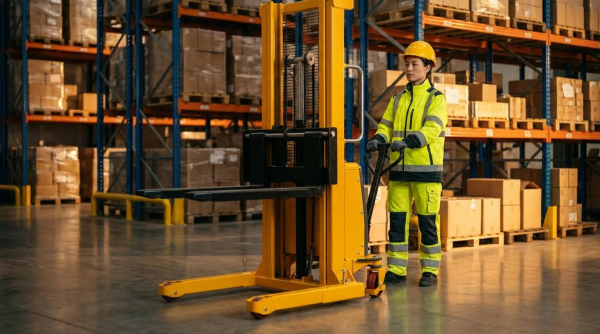
Application engineering links the basic answer to what is a straddle stacker with real warehouse constraints. Engineers must balance capacity, lift height, aisle width, pallet style, and power strategy to avoid overspecifying or undersizing equipment. This section explains how to translate load cases, storage profiles, and site geometry into a fit-for-purpose straddle stacker specification. It also shows how to integrate stackers with racking, docks, and automated flows without creating bottlenecks.
Matching Capacity, Lift, And Aisle Width To The Task
Every selection starts with rated capacity at the required load centre. Typical warehouse straddle stackers handle about 1,100 kg to 1,800 kg at a 600 mm load centre. Engineers should define three numbers before shortlisting models: maximum unit load, highest lift height, and narrowest working aisle.
Lift heights for walkie and rider stackers often reach 3,000 mm to 3,600 mm. At these heights, residual capacity drops as the mast extends, so spec sheets must be checked at the actual lift, not just at ground level. Aisle width depends on truck type and operating mode.
- Walk-behind units can work in aisles close to 2,400 mm if loads are short.
- Platform or rider versions need extra clearance for steering angle and operator stance.
- Cross-aisle transfer zones near docks usually need added width for turning.
For short shuttle work and light stacking, lower-capacity models with modest lift reduce purchase price and energy use. For high-bay or multi-shift work, higher-capacity masts with better residual ratings and stronger chassis are more economical over the life of the asset.
Pallet, Load Geometry, And Mast Configuration
Straddle stackers answer what is a straddle stacker in practical terms by how they interact with pallets. Base legs straddle the pallet, so pallet and load geometry drive feasibility. Closed-deck and CHEP-style pallets suit straddle stackers because the forks enter between deck boards while legs run outside the stringers.
Engineers should review:
| Parameter | Engineering check |
|---|---|
| Pallet width | Must fit between outer faces of base legs with clearance |
| Load overhang | Must not clash with legs or mast when turning |
| Load height | Must clear mast cross-members and overhead services |
Mast type also matters. Single-stage masts suit low-level transfer and dock work because they are rigid and cheaper. Two- or three-stage masts support higher storage while keeping the collapsed height low enough for doorways or mezzanine beams.
Free-lift masts allow forks to rise without increasing overall mast height. This feature helps in low doorways and inside trailers. For mixed pallet sizes, adjustable forks and, where available, adjustable leg width increase flexibility but add mechanical complexity and cost. Engineers should favour the simplest configuration that covers 95% of use cases and handle exceptions with procedures.
Power Options, Charging, And Energy Efficiency
Most warehouse straddle stackers use electric power. When teams ask what is a straddle stacker in terms of energy, the answer is usually a compact electric truck with integrated battery and charger. Common options include flooded lead-acid, maintenance-free lead-acid, and lithium-ion packs.
Lead-acid batteries remain cost-effective for single-shift or low-hour sites. They need planned charging windows and periodic water checks. Lithium packs offer faster opportunity charging, higher usable depth of discharge, and stable voltage. They suit multi-shift or high-uptime operations where charging during breaks replaces battery swaps.
Selection should consider:
- Daily operating hours and peak periods.
- Available charging windows and electrical supply.
- Ambient temperature, especially in cold stores.
- Required travel speed and acceleration for cycle time targets.
AC drive motors and regenerative braking improve efficiency and reduce wear. Regeneration during deceleration and lowering can extend runtime between charges, especially in intensive stacking with frequent lift cycles. Engineers should request energy consumption data or duty-cycle studies where available instead of assuming catalogue runtimes.
Integration With Racking, Docks, And AGVs
Application engineering does not stop at the truck. The answer to what is a straddle stacker also includes how it fits into the overall material flow. Racking geometry, dock layout, and any automated systems must align with stacker dimensions and performance.
For racking, key checks include:
| Aspect | Design consideration |
|---|---|
| Beam height | Must sit at least 150 mm below maximum fork height |
| Bay width | Must allow fork entry without leg or mast interference |
| Aisle type | Standard, narrow, or very narrow based on truck turning radius |
At docks, stackers often unload from trailers and feed pallet conveyors or staging lanes. Dock leveller gradients, trailer bed heights, and floor transitions must match wheel size and ground clearance to avoid impacts. For AGV or AMR integration, straddle stackers usually serve as manual or semi-manual interfaces at the edges of automated zones.
Clear rules help prevent conflicts. Examples include fixed transfer points, marked buffer zones, and one-way traffic patterns. Where future automation is planned, choosing mast heights, aisle widths, and pallet standards that match typical AGV capabilities reduces later retrofit costs. This systems view turns a straddle stacker from a standalone truck into a stable part of a scalable warehouse design.
Safety, Maintenance, And Lifecycle Management
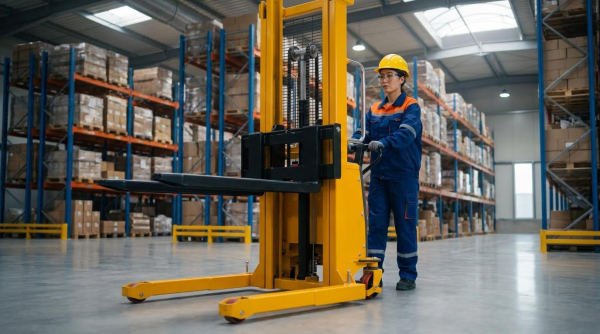
Engineers who ask what is a straddle stacker usually care about safe uptime, not just basic function. This section explains how operator safety, maintenance discipline, and data-driven monitoring extend the useful life of warehouse straddle stackers. It links daily checks to long-term lifecycle cost so EHS, maintenance, and operations teams can align on one coherent standard.
Operator Safety, Stability, And Compliance Factors
Safe operation starts with respecting the rated capacity and load center on the nameplate. Overloading or off-center loads shift the combined center of gravity and reduce the stability margin of the stacker. Operators must keep loads low while traveling, use smooth acceleration, and avoid sharp turns on ramps or uneven floors.
Before each shift, operators should perform a short walk-around check. They verify brakes, horn, emergency stop, tiller arm safety button, and any reverse or “belly” switch. They also check forks for damage, mast chains for visible defects, and look for hydraulic leaks under the truck. Any fault requires tagging the unit out until repair.
To meet typical safety and compliance expectations, sites should at minimum:
- Define speed limits and marked travel lanes in shared areas.
- Separate pedestrian walkways with barriers where possible.
- Set clear stacking height limits per rack level and floor condition.
- Provide PPE rules, especially safety shoes and high-visibility clothing.
Training programs should include load assessment, pallet type limits, ramp use, and emergency procedures. Refresher training after incidents or near misses keeps risk perception high. Good lighting, clear floor markings, and tidy housekeeping further reduce collision and tip-over risks.
Preventive Maintenance For Mechanical And Hydraulic Parts
Preventive maintenance keeps the structural load path and lifting system reliable over the full lifecycle. Mechanical checks focus on forks, mast, chassis, wheels, and fasteners. Forks should be measured for heel thickness loss and checked for cracks or bends; worn forks reduce safety margins even when the hydraulic system still lifts the load.
Mast rails and chains need regular inspection and controlled lubrication. Excessive chain stretch, corrosion, or missing retainers can lead to uneven lifting or sudden failure. Load wheels and steer wheels wear faster on abrasive floors or when operators pivot under load. Flat spots, chunking, or cracked hubs signal the need for replacement to avoid shock loads into the mast.
Hydraulic maintenance usually follows a time or hours-based plan:
| Item | Typical practice |
|---|---|
| Hydraulic oil level | Check monthly or per service schedule |
| Oil quality | Inspect for discoloration or contamination |
| Hoses and fittings | Check for leaks, abrasion, aging |
| Cylinders | Inspect rods and seals for scoring or weeping |
Keeping the hydraulic circuit clean and sealed reduces valve wear and maintains smooth lift and lower speeds. A structured maintenance log with date, hours, findings, and actions supports root-cause analysis when failures occur.
Battery, Electrical, And Control System Care
Electric straddle stackers rely on healthy batteries and clean electrical connections to deliver rated travel and lift performance. Lead-acid batteries should not be routinely discharged below about 20% state of charge. Deep discharge shortens life and can cause plate damage or overheating. Lithium packs tolerate deeper discharge but still benefit from avoiding full depletion.
Good battery practice includes correct charging windows, clean terminals, and proper cable strain relief. Operators should check connectors for heat marks or looseness and report any smell of burnt insulation. Ventilation around charging areas must match the battery chemistry and charger type.
Control systems require quick functional tests before each shift. Operators should verify travel direction, lift and lower, horn, and emergency stop. Maintenance teams should periodically inspect wiring harnesses, contactors, fuses, and protective covers. Dust removal with dry air and tight routing away from pinch points reduces short-circuit and signal fault risks.
Modern stackers often use programmable controllers and AC drive motors. Parameter changes, such as acceleration ramps or speed limits, should follow a documented change process. This avoids unsafe behavior after software updates or component replacement.
Data, Telematics, And Predictive Maintenance Trends
Data collection has changed how facilities manage the lifecycle of straddle stackers. Telematics modules can record key metrics such as driving hours, lift hours, impacts, battery status, and error codes. Engineers then use these data to align maintenance intervals with real duty cycles instead of fixed calendar dates.
Common uses of telematics include:
- Access control through operator logins and license checks.
- Automatic impact logging with time and location stamps.
- Battery state-of-charge tracking and charge event history.
- Utilization reports to right-size fleet counts.
Frequently Asked Questions
What is a straddle stacker?
A straddle stacker, also known as a straddle stacker forklift, is a specialized pallet-handling truck designed with two support legs that extend on either side of the pallet. This design allows it to lift and move pallets in tight spaces more efficiently than traditional forklifts. Straddle Stacker Guide.
What is a straddle stacker used for?
A straddle stacker is used to easily maneuver pallets through tight and cramped floor spaces in warehouses or facilities. It’s particularly useful for handling multiple pallets in narrow aisles where space is limited. Warehouse Solutions.
Can a straddle stacker lift loads?
Yes, a straddle stacker can lift loads, often as high as 140 inches, depending on the model and its specifications. These machines are highly maneuverable and productive, making them ideal for various warehouse tasks. Raymond Basics.