
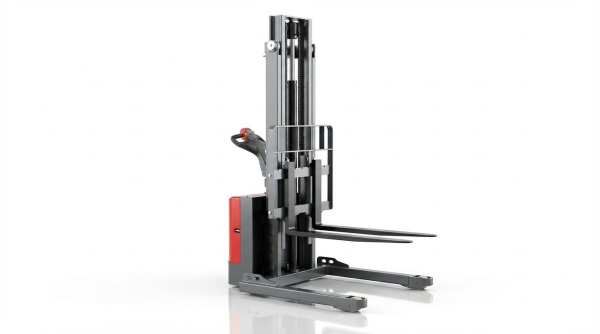
If you have ever wondered what is a walkie stacker and when it makes more sense than a forklift, this guide is for you. We walk through core definitions, components, and key specs so you can match equipment to your loads, aisles, and shifts. You will see how design choices affect safety, stability, and productivity, plus how to select and maintain the right unit for your warehouse. Use this as a practical reference for operator training, equipment comparison, and day‑to‑day decision making on the floor.
What A Walkie Stacker Is And How It Works
Core definition and key use cases
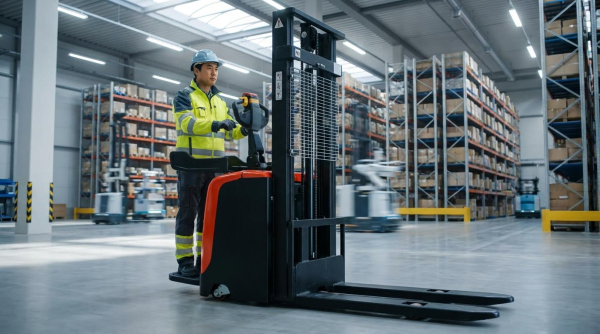
When warehouse teams ask “what is a walkie stacker,” they usually mean a compact, electric-powered pedestrian forklift used for lifting and moving palletized loads in tight indoor spaces. A counterbalanced stacker is controlled by an operator walking behind or alongside the truck, and in some variants standing on a small platform, which gives it much better maneuverability than a sit-down forklift in narrow aisles in confined spaces on smooth indoor floors. Typical lifting capacities range from about 1,400 kg to around 4,000 lb, making them suitable for light to medium-duty pallet handling rather than very heavy industrial loads in everyday warehouse operations. They are commonly used for pallet put-away, order picking support, feeding production lines, and truck or rack loading where lift heights up to roughly 3,600–5,400 mm are sufficient in racking and storage applications.
Key use cases include:
- Short-distance pallet transport between staging areas, docks, and racking.
- Vertical stacking of pallets in narrow aisles where larger forklifts cannot turn.
- Feeding and clearing workstations in manufacturing and kitting zones.
- Retail and self-storage environments that need quiet, low-emission material handling indoors such as retail warehouses and specialty storage.
Because they are classed as powered industrial trucks, operators must complete formal training and evaluation under OSHA 29 CFR 1910.178 before using them in a U.S. workplace to meet certification requirements. This combination of compact size, adequate capacity, and relatively simple operation is why many facilities choose a battery-powered stacker as the first step up from manual pallet jacks.
Main components and operating principles
A lift stacker combines a compact chassis, an electric powertrain, and a vertical mast to lift loads safely. The main structural elements are the chassis with drive and load wheels, the mast and carriage, and the forks sized for standard pallets, often around 55–65 mm thick, 185 mm wide, and about 1,195 mm long with matching fork dimensions and compact overall width near 790 mm. Many models use straddle legs that pass around the pallet to increase lateral stability, while counterbalanced versions rely on rear counterweight when straddling is not possible such as counter-balance and straddle designs. Typical service weight, including the battery, is around 950–1,000 kg, which helps keep the center of gravity low and improves stability under load in relation to the turning radius of about 1,490 mm.
The operating principle is straightforward:
- A 24 V battery pack powers an AC electric drive motor and an electric-hydraulic pump for lift functions using a 24‑volt electrical system with AC control.
- The operator uses an ergonomic tiller handle with thumbwheels to command travel, lift, and lower functions, with an AC impulse controller managing smooth acceleration and braking for both drive and lift.
- Hydraulic cylinders raise the mast or forks at typical loaded lift speeds around 0.13 m/s and lower them at controlled rates near 0.49 m/s to protect the load and structure under both loaded and unloaded conditions.
Travel speeds are usually limited to about 3.5 mph (5.5 km/h) under load to balance productivity and safety in shared aisles with standardized full-load travel speeds. Electromagnetic service brakes, emergency stop buttons, and “turtle” or creep mode help the operator keep precise control in tight spaces and during fine positioning of pallets including reduced-speed operation and emergency stops. From an engineering standpoint, all these components are sized so that the stacker stays within a safe stability envelope across its rated capacity and lift height, provided operators respect the nameplate limits and follow training on what is a walkie stacker and how it must be used.
Key Specifications, Design, And Performance
Capacity, lift height, and stability envelope
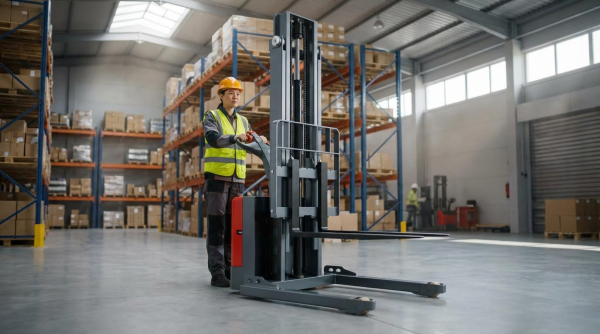
When people ask what is a walkie stacker, capacity and lift height are usually the first specs they compare. Typical rated capacities range from about 1,400 kg to 4,000 lb, depending on mast design and wheelbase. Common walkie stacker lifting capacity values fall in this band. Maximum lift heights usually fall between roughly 3,650 mm and 5,400 mm for standard models, which covers most racking in light‑duty warehouses. Many electric stackers are specified in this height range.
Safe use depends on understanding the stability envelope, not just the nameplate capacity. Key stability factors include:
- Load center distance (typically 600 mm for standard pallets).
- Lift height (capacity decreases as the mast extends).
- Wheelbase and support leg design on straddle or counterbalance types.
Every operator who wants to move beyond the basic question of what is a walkie stacker should know that side loading, off‑center pallets, or operating on slopes quickly reduce the real, usable capacity. Straddle legs or counterweights extend the stability triangle, but the truck still must operate on flat, smooth floors for predictable handling.
Powertrain, batteries, and control systems
Walkie stackers use an electric drive motor and an electro‑hydraulic power unit for lifting. Most models run on a 24 V DC system, which balances energy storage, component size, and safety for pedestrian equipment. Many walkie stacker spec sheets list 24‑volt batteries as standard and similar values appear on other pedestrian stackers. Comparable 24 V systems are also common on 1.4–1.6 t pedestrian units.
Modern units typically use AC impulse or similar transistorized control for both traction and lift. This gives smooth speed modulation, regenerative braking, and good low‑speed torque for precise pallet positioning. AC impulse control systems are widely used for drive and lift functions. From a maintenance standpoint, battery management is critical: keeping charge between roughly 20–80%, avoiding deep discharges, and charging in a ventilated area all extend battery and truck life. Industry guidance recommends this charge window and proper charging conditions.
Travel, lift speeds, and gradeability limits
In performance terms, walkie stackers are optimized for controlled movement in tight aisles, not for high speed. Typical travel speed with a rated load is about 3.5 mph (5.5 km/h), which supports efficient cycle times while remaining manageable for a walking operator. Several electric stacker models specify loaded travel speeds around 3.5 mph and similar values appear on other pedestrian stackers. Comparable travel speeds are listed for 1.4–1.6 t units.
Lift and lower speeds are set to balance productivity with load control. Typical loaded lift speed is around 0.13 m/s, increasing to about 0.20 m/s unloaded, while lowering speeds are often higher to reduce cycle time, for example about 0.49 m/s loaded and 0.23 m/s unloaded. Representative stacker data shows lift and lowering speeds in this range. Gradeability is intentionally limited; many units handle only about 6–7% slopes under full load, rising to roughly 12% when unloaded, which is why this equipment is specified mainly for level, indoor floors. manual pallet jack and drum dolly are examples of tools used in conjunction with walkie stackers. Understanding these speed and slope limits is essential for anyone moving from asking what is a walkie stacker to actually specifying one for a real warehouse layout.
Types, Applications, And Selection Criteria
Comparing walkie stackers to other forklifts
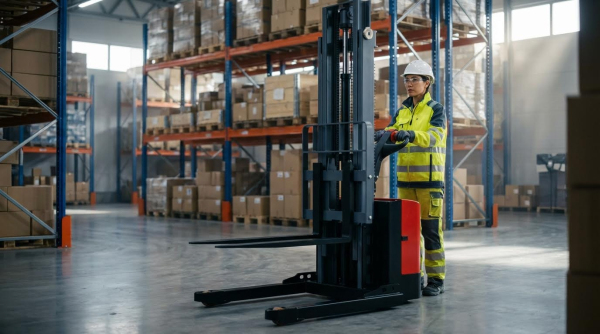
When people ask what is a walkie stacker, they often compare it to a sit-down or reach forklift. Walkie stackers are electric pedestrian trucks designed for tight, indoor spaces and smooth floors. They have a smaller footprint and lower operating cost than conventional forklifts, but they also handle lower capacities and lift heights. Typical walkie stackers work well in narrow aisles where a full-size truck cannot turn safely.
Compared with traditional forklifts, walkie stackers offer easier handling and better maneuverability in confined areas, thanks to their short overall length and tight turning radius. They suit applications such as pallet put-away, light stacking, and short horizontal moves, while larger forklifts are better for outdoor yards, heavy loads, and high-bay racking. Common walkie types include standard, straddle, reach, ride-on, and counterbalance designs, each tuned to a specific use case. Understanding these differences helps operators decide when a walkie stacker can replace a larger truck and when it should complement it. Walkie stacker forklifts are electric-powered devices designed to lift and transport loads in confined spaces and offer advantages such as a smaller footprint, easier handling, and lower operating costs compared with traditional forklifts.
Matching stacker types to warehouse layouts
To answer what is a walkie stacker in practical terms, you need to match the variant to your building geometry and load profile. In very narrow aisles with standard pallets, walkie straddle stackers work well because their outriggers straddle the pallet and improve stability without increasing the turning circle too much. Where pallets sit directly on the floor or you must reach into deep racks or trucks, a walkie reach stacker with an extending mast gives better access. For longer travel distances across a large facility, a ride-on walkie stacker reduces operator fatigue and increases throughput. Types of walkie stackers include walkie straddle, walkie reach, ride-on walkie, counter-balance, and standard walkie stackers, each suited to different warehouse layouts and handling tasks. Counterbalance walkie stackers are useful where you cannot straddle the load, such as around machinery bases or special pallets. Standard walkie stackers are a cost-effective upgrade from manual pallet jacks for light stacking in low to medium-height racking in compact storage areas. By mapping aisle width, rack depth, lift height, and travel distance to these types, you can select a walkie stacker that moves safely and efficiently through your specific warehouse layout.
Summary And Implementation Takeaways
Walkie stackers fill the gap between manual pallet jacks and full forklifts by pairing compact geometry with controlled electric power. Their design links chassis dimensions, mast height, and wheelbase to a defined stability envelope, so capacity always depends on load center, lift height, and floor conditions. When engineers and supervisors respect these limits, they reduce tip‑over risk and product damage.
Electric powertrains, 24 V batteries, and AC controls give smooth, predictable motion that suits shared aisles and dense racking. Travel, lift, and lowering speeds are tuned for safe pedestrian pacing rather than maximum throughput. Grade limits and the need for flat, smooth floors must feed directly into warehouse layout and route planning.
For practical implementation, start with your heaviest pallet, highest rack beam, narrowest aisle, and steepest slope. Use those four values to choose between straddle, reach, ride‑on, and counterbalance walkie stackers, including specialized options from Atomoving. Then lock in safe use by enforcing OSHA-compliant operator training, battery care routines, and pre‑shift inspections. When you treat capacity charts, stability rules, and speed limits as hard design inputs, walkie stackers deliver safe, low‑cost, and reliable material handling in modern warehouses.
Frequently Asked Questions
What is a Walkie Stacker?
A walkie stacker, also known as a walk-behind forklift or pallet stacker, is a type of material handling equipment designed to move and lift palletized goods without requiring the operator to ride on the machine. These machines are compact, maneuverable, and commonly used in warehouses and distribution centers. Walkie Stacker Guide.
What Class is a Walkie Stacker?
Walkie stackers fall under Class III of powered industrial trucks, which includes electric motor hand trucks or hand/rider trucks. They are specifically categorized under Lift Code 2: Low Lift Walkie Pallet. OSHA Forklift Classes.
Do You Have to Be Certified to Use a Walkie Stacker?
Yes, operators typically need certification to use a walkie stacker, as it falls under powered industrial truck regulations. Certification ensures that operators understand safety protocols and operational standards. Walkie Stacker Safety.
Is a Walkie Stacker Considered a Forklift?
Yes, a walkie stacker is considered a type of forklift. It is a compact and versatile option commonly used in warehouses and storage facilities for lifting and transporting pallets over short distances. Forklift Types Explained.