
Manual Pallet Truck
Galvanzied Pallet Truck
Home >> Products >> Manual Pallet Truck
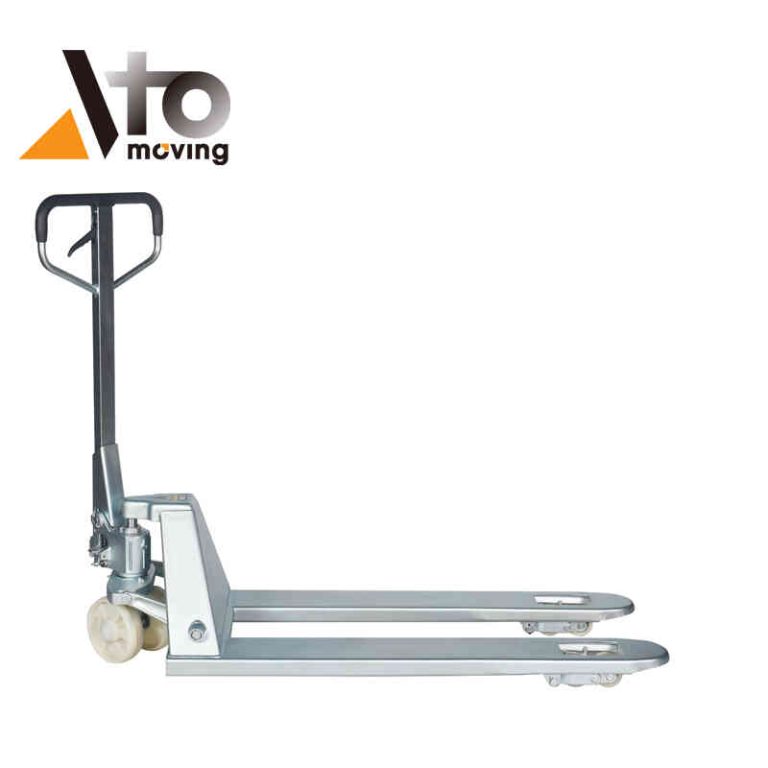
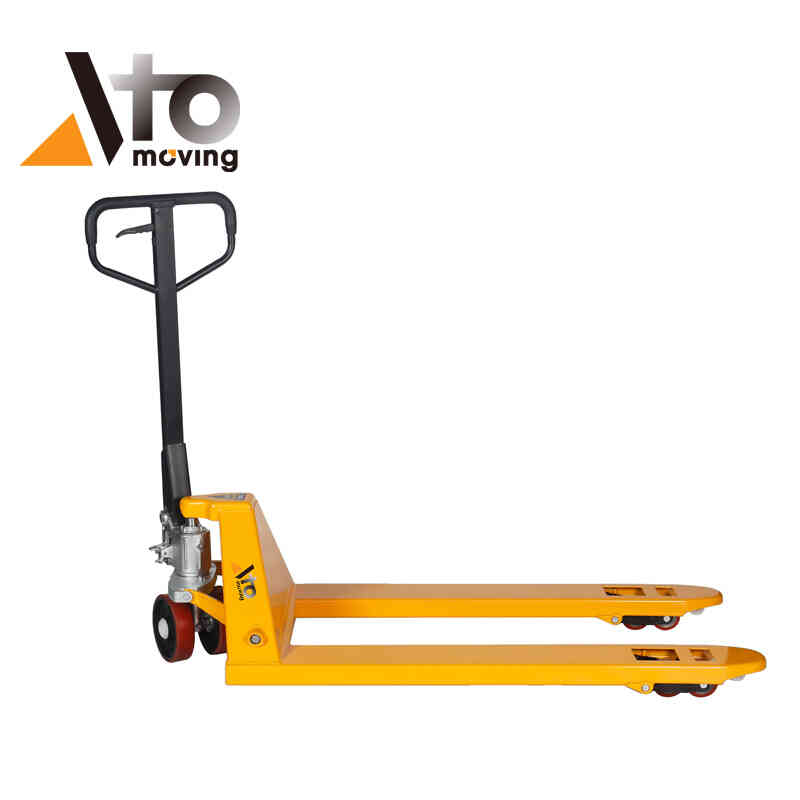
Galvanzied Pallet Truck
- Corrosion Protection: Fully galvanized chassis with zinc-coated components resists degradation in chemical and wash-down environments.
- High-Density Payload: HPG30 model supports loads up to 3000kg (6600 lbs) while maintaining a structural net weight of just 70kg (154 lbs).
- Optimized Geometry: Features a 1249mm (49.2 in) turning radius on the 1150mm (45.3 in) fork model for precision navigation in confined spaces.
- Chemical-Resistant Mobility: Standard Φ180mm (7.1 in) Nylon steering wheels eliminate wheel corrosion and degradation on wet floors.
Model for Manual Pallet Lifter
| Model | HPG25 | HPG30 | |
|---|---|---|---|
|
Loading Capacity |
kg |
2,500 |
3,000 |
|
Lifting Height |
mm |
200/190 |
200/190 |
|
Lowered Height |
mm |
85/75 |
85/75 |
|
Overall Fork Width |
mm |
520/550/685 |
520/550/685 |
|
Overall Fork Length |
mm |
1,150/1,220 |
1,150/1,220 |
|
Steering Wheel |
mm |
Φ180×50 |
Φ180×50 |
|
Double Fork Wheel |
mm |
Φ80×93/Φ74×93 |
Φ80×93/Φ74×93 |
|
Single Fork Wheel |
mm |
Φ80×70/Φ74×70 |
Φ80×70/Φ74×70 |
|
Turning Radius |
mm |
1,249/1,319 |
1,249/1,319 |
|
Ground Clearance |
mm |
32 |
32 |
|
Net Weight |
kg |
65 |
70 |

Request an Equipment Quote
More Material Handling Equipment
Performance
Cost-Efficient Environmental Resistance
For procurement managers analyzing Total Cost of Ownership (TCO) in corrosive environments, the HPG Series bridges the gap between disposable standard trucks and expensive stainless steel models. By utilizing a full galvanization process on the chassis and zinc coating on critical stress points, this manual pallet lifter prevents structural oxidation caused by brine, acids, or frequent wash-downs. This material treatment ensures structural integrity is maintained without the premium price point of 304/316 stainless steel, making it the mathematically superior choice for operations requiring strict hygiene compliance without ISO Class 5 cleanroom requirements.
Heavy-Duty Structural Dynamics
The HPG30 is designed with a high strength-to-weight ratio. Despite a relatively low net weight of 70kg (154 lbs), the reinforced chassis geometry supports a Static Working Load Limit (WLL) of 3000kg (6600 lbs). This 42:1 load-to-weight ratio is achieved through precision welding and high-tensile steel selection before the galvanization process. The hydraulic pump system is calibrated to lift these loads from a lowered height of 85mm (3.3 in) to 200mm (7.9 in) efficiently, ensuring that seal integrity holds under maximum pressure even when subjected to temperature fluctuations common in cold storage logistics.
Precision Maneuverability & Component Specification
Operational efficiency in narrow racking aisles is dictated by the truck’s geometry. The HPG Series features a tight turning radius of 1249mm (49.2 in) for the 1150mm (45.3 in) fork length model, allowing for right-angle stacking in aisles narrower than 2 meters (6.5 ft). Furthermore, the specific selection of Φ180 ×× 50mm (7.1 ×× 2.0 in) Nylon steering wheels and Φ80 ×× 93mm (3.1 ×× 3.7 in) double fork wheels is intentional; unlike polyurethane or rubber, Nylon is non-hydroscopic and resists swelling or cracking when exposed to aggressive cleaning solvents or constant moisture.
Frequently Asked Questions
What is a manual pallet lifter?
A manual pallet lifter, also known as a hand pallet truck or pallet jack, is a versatile material handling tool used to lift, move, and transport pallets in warehouses, retail stores, and manufacturing facilities. It operates using a hydraulic pumping system that is activated by a hand lever, requiring no external power source. The operator lifts the forks by pumping the handle, then rolls the unit to move the load to its desired location. Its compact design makes it ideal for maneuvering in tight spaces and short-distance material handling.
Do you need training to use a manual pallet truck?
Yes, formal training is highly recommended for operating a manual pallet truck, even though it is manually powered. While it is not classified as a powered industrial truck under OSHA’s strict standards, improper operation can still lead to serious injuries, property damage, or accidents. Training should cover proper lifting techniques, load capacity limits, steering and braking controls, safe maneuvering in crowded areas, and how to prevent collisions. Following best practices ensures operator safety and protects the integrity of the load and equipment.
Reference
[1] Jungheinrich UK. “Hand Pallet Trucks”. Jungheinrich UK, Accessed February 22, 2026. https://www.jungheinrich.co.uk/products/new-forklifts/pallet-trucks/hand-pallet-trucks.
[2] Nationwide Handling. “Do You Need a Licence to Use a Pallet Truck? Training & Safety Explained”. Nationwide Handling, Accessed February 22, 2026. https://www.nationwidehandling.co.uk/post/do-you-need-a-licence-to-use-a-pallet-truck-training-safety-explained.
[3] Monroe Engineering. “5 Common Types of Pallet Jacks”. Monroe Engineering, Accessed February 22, 2026. https://monroeengineering.com/blog/5-common-types-of-pallet-jacks/.
[4] BHS. “Stacking Pallets: OSHA Regulations”. BHS, Accessed February 22, 2026. https://na.bhs1.com/blog/post/stacking-pallets-osha-regulations.