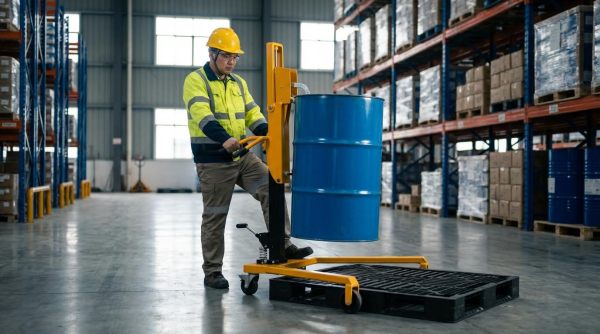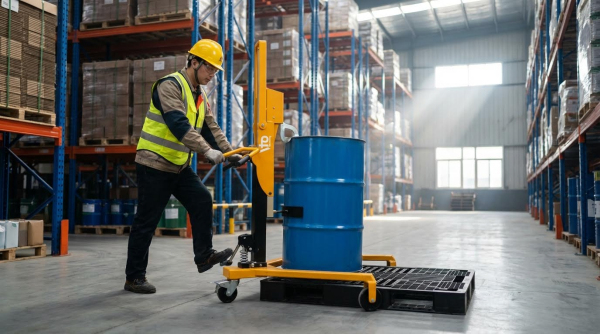
If you want to know how to move 4 drums at once safely, you need the right combination of engineered equipment, route planning, and certification. This guide explains how palletizers, forklift drum attachments, and train dollies work together to move four 200L–220L drums efficiently while controlling center of gravity, floor loading, and operator risk. You will see how load ratings, hydraulics, and environment (ATEX, cleanroom, tight aisles) drive equipment choice so you can design a multi-drum handling strategy that actually fits your plant, not just the catalog page.
Core Methods For Moving Four Drums At Once
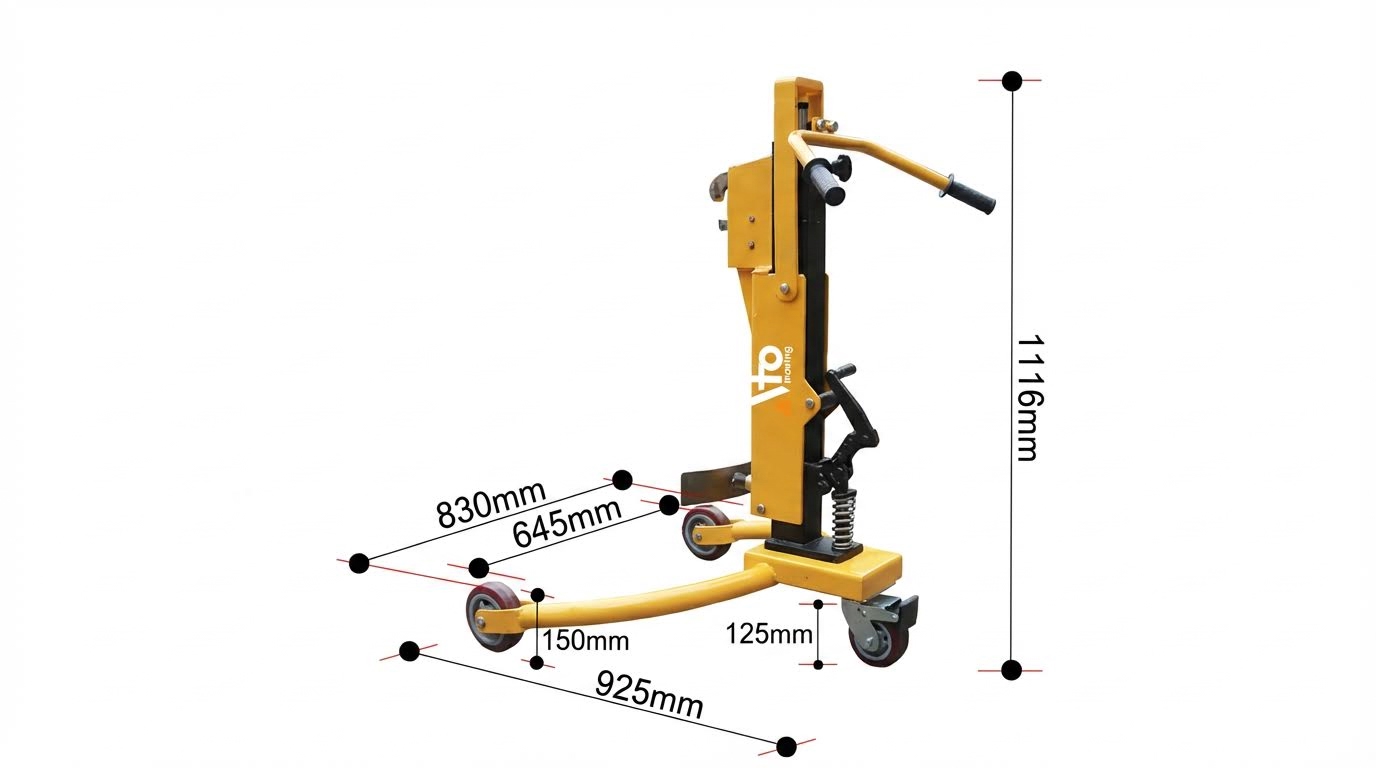
Core methods for how to move 4 drums at once safely are drum palletizers with four-drum pallets and forklift drum attachments designed for clustered drums. The right choice depends on route length, floor quality, and available power equipment.
- Drum palletizers: Purpose-built frames that hold four drums together – optimize stability and manual or powered transport.
- Four-drum pallets: Standardized pallet footprints for four 200L drums – compatible with forklifts and pallet trucks.
- Forklift drum attachments: Clamp or grip multiple drums in one lift – best for higher throughput and longer travel distances.
- Train dollies (overview): Linked single-drum dollies – flexible layouts where turning space is tight.
💡 Field Engineer’s Note: Before standardizing on any “4-drum” method, walk the actual route with a tape measure. Many systems fail not on capacity, but at tight 90° turns, uneven joints, or 2–3% ramps that were never documented.
Drum palletizers and four-drum pallets
Drum palletizers and four-drum pallets move four drums at once by locking them into a rigid footprint that can be lifted, pushed, or towed as a single stable unit. This reduces handling cycles and keeps centers of gravity predictable.
- Defined footprint: Four 200L (55-gallon) drums arranged 2×2 – fits typical 1,000 mm–1,200 mm wide pallet spaces.
- Rigid containment: Rings, pockets, or frames around each drum – prevents rolling and reduces center-of-gravity shifts.
- Single pick point: Fork pockets or tow eyes – allows one truck or tug to move all four drums together.
- Mechanical advantage: Integrated hydraulic or lever systems – reduces manual force and back strain.
Typical four-drum palletizer concept
A typical four-drum palletizer uses a low frame with four drum recesses and fork pockets. Drums are loaded individually using a drum lifter with a hydraulic ram and universal drum catch sized for approximately 50–220 L drums and heights of 380–1,000 mm. The lifter’s hydraulic pump raises each drum under control, and a hand-operated lowering valve gives precise descent for accurate placement into the pallet pockets. Rear wheel steering with polyurethane tires improves maneuverability in narrow aisles when positioning drums into the pallet frame.
| Feature | Typical Engineering Detail | Operational Impact |
|---|---|---|
| Drum size range | Approx. 50–220 L, 380–1,000 mm drum height handled by universal catch universal drum catch data | Allows mixed batch loading of small and standard 200 L drums onto the same four-drum pallet. |
| Hydraulic lift system | Hand pump with hydraulic ram and lowering valve hydraulic system description | Enables controlled vertical placement into pallet pockets without impact loads on drum chimes. |
| SWL of lifter used to load pallet | Approx. 250–350 kg safe working load (SWL) per drum position SWL figures | Covers most 200 L liquid drums, which often weigh 180–360 kg, with a safety margin when correctly specified. |
| Lift stroke | Approx. 740–1,260 mm lift stroke on tall lifters lift stroke data | Allows loading drums from floor level up into four-drum pallets on racks or into process infeed positions. |
| Construction options | Painted carbon steel or 304 stainless steel with corrosion-resistant hydraulics stainless variant | Enables use of four-drum pallets in cleanrooms, food, and pharmaceutical areas without contamination risk. |
| Hazardous area variants | ATEX ‘Ex’ versions for zones 1, 2, 21, 22 with conductive components ATEX information | Makes four-drum handling viable in flammable atmospheres where static and sparking must be controlled. |
- Hydraulic control: Use a lifter with a clean hydraulic circuit and tested components – reduces risk of sudden drops when placing drums into pallets.
- Wheel selection: Polyurethane wheels on the lifter and pallet – run quietly and protect coated floors.
- Integrated weighing: Load-cell lifters with ±0.1 kg accuracy weighing system spec – verify drum mass before committing four-drum loads to a route.
How to move 4 drums at once with a palletizer – basic sequence
- Step 1: Inspect drums and pallet frame – ensures shells, chimes, and pallet pockets are intact to avoid instability.
- Step 2: Use a certified drum lifter to pick each drum – keeps the center of gravity close to the mast and within SWL.
- Step 3: Lower each drum fully into its pocket – prevents rolling and limits liquid slosh during transport.
- Step 4: Strap or clamp all four drums together – creates a single rigid mass with predictable handling.
- Step 5: Move the loaded pallet using a pallet truck, tug, or forklift – consolidates handling into one controlled move.
Forklift drum attachments for clustered drums
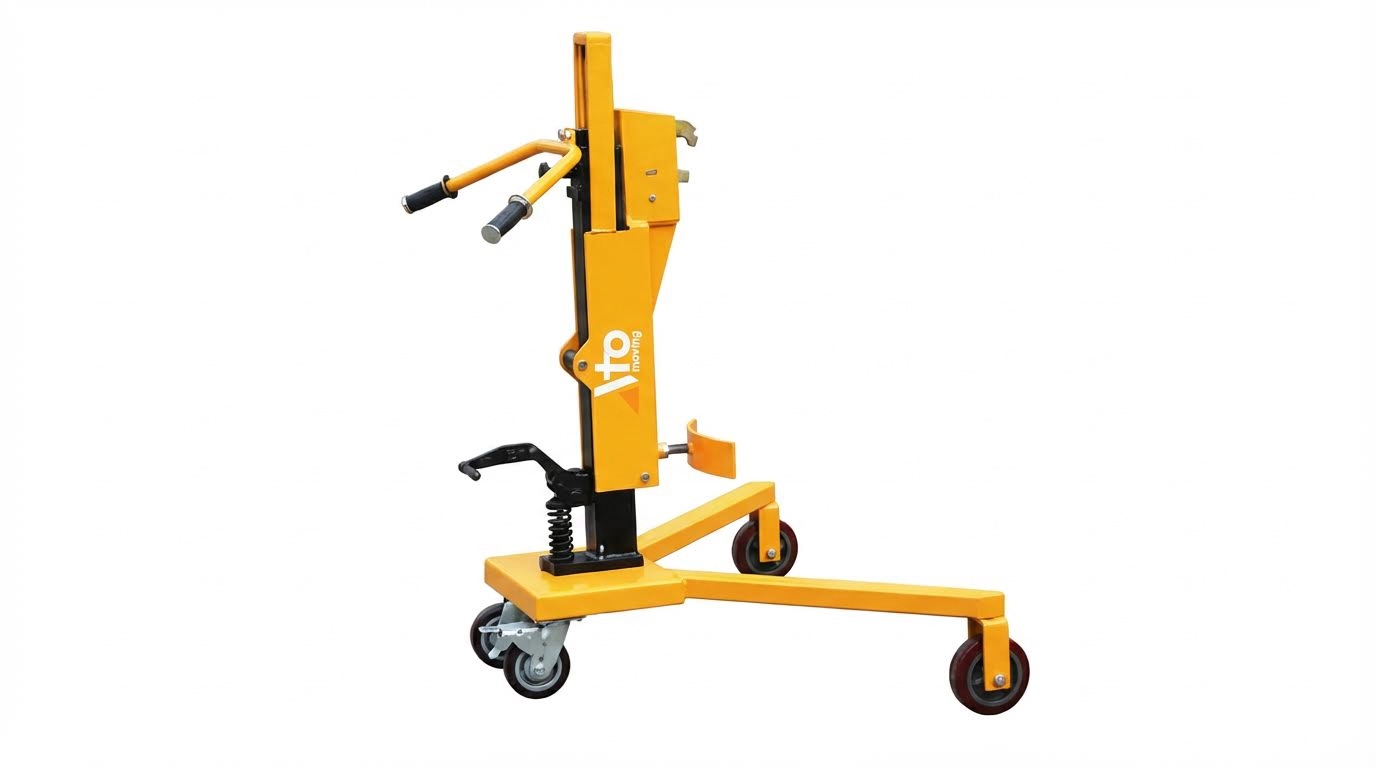
Forklift drum attachments move four drums at once by gripping individual drums with certified clamps mounted on the truck’s carriage or forks, turning the forklift into a multi-drum transporter. This method suits higher-throughput operations and longer routes.
- Attachment design: Frame with multiple drum grippers – allows 2, 3, or 4-drum configurations depending on spacing.
- Grip mechanism: Waist, rim, or over-chime clamps – chosen to match steel or plastic drum designs.
- Compliance: Attachments require SWL certification, proof load testing, and CE marking for safe use safety and standards overview.
| Safety / Design Aspect | Key Requirement | Operational Impact When Moving 4 Drums |
|---|---|---|
| SWL certification | Attachment must have a rated safe working load validated for lifting and moving drums SWL certification | Ensures the combined mass of four drums stays within a proven safety envelope. |
| Proof load testing | Attachment is proof load tested to withstand specified overloads without permanent deformation proof load testing | Reduces failure risk when dynamic forces act on four liquid-filled drums. |
| Inspection frequency | Inspections every 6–12 months by a competent person under lifting regulations inspection guidance | Keeps multi-drum attachments in safe condition despite repeated clamping cycles. |
| Equipment suitability | Attachment must match forklift capacity and drum type (steel, plastic, etc.) suitability requirements | Prevents under-rated trucks or mismatched grips from causing tip-over or drum drop incidents. |
| Quality management | Manufacture under ISO 9001:2015 quality systems ISO 9001 reference | Improves consistency of welds, pins, and clamps critical for multi-drum loads. |
| CE marking | Attachment supplied with CE marking and EC Declaration of Conformity CE marking | Confirms compliance with European safety, health, and environmental requirements. |
- Daily pre-use checks: Operators must verify secure fit to the forks or carriage and look for damage before use daily check guidance – reduces the chance of an attachment detaching under a four-drum load.
- Route planning: Longer runs suit forklifts, but turning radius and overhead clearances must be checked – four drums extend the effective load width and length.
- Training: Drivers need specific instruction on drum grip behavior and liquid surge – stops harsh braking that can overload clamps.
How to move 4 drums at once with a forklift attachment – step-by-step
- Step 1: Confirm forklift and attachment capacities – ensures the rated load, including attachment mass, exceeds four full drums with margin.
- Step 2: Perform attachment pre-use checks – identifies worn clamps or loose fixings before loading.
- Step 3: Approach drums square and at low mast height – aligns grips evenly and keeps center of gravity low.
- Step 4: Clamp each drum fully and verify engagement – prevents partial grip that can slip on rough floors.
- Step 5: Lift only to the minimum travel height and drive slowly – reduces overturning moments from liquid slosh and uneven surfaces.
- Step 6: Set down drums gently and release clamps in sequence – avoids shock loading of drum shells and chimes.
💡 Field Engineer’s Note: When you use a forklift attachment for clustered drums, derate the truck more aggressively than the data plate suggests if you have ramps or rough yards. Four liquid-filled drums act like one big sloshing mass; a small pothole can generate dynamic loads far above the static SWL if you travel too fast.
Technical Design, Safety, And Performance Factors
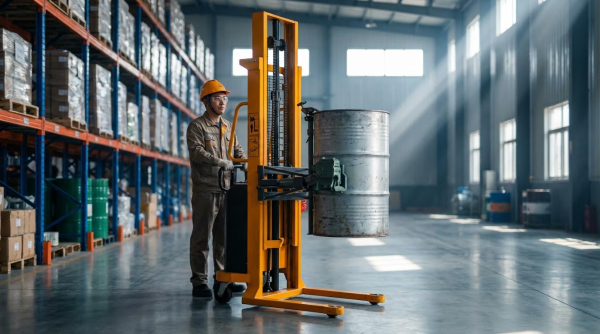
Technical design, safety, and performance factors determine whether equipment can move 4 drums at once without overload, loss of grip, or instability, especially when liquids slosh and floors, routes, and duty cycles are demanding.
When you plan how to move 4 drums at once, three design pillars matter most: certified load ratings and testing, how the equipment grips and controls drum center of gravity, and the hydraulic or electric systems that lift and hold the load.
Load ratings, SWL, and proof load testing
Load ratings, SWL, and proof load testing define the real safe limit of your four-drum system and prove it will not deform or fail under worst-case loading.
- Safe Working Load (SWL): The SWL is the maximum mass the attachment or palletizer may lift and move in normal use – prevents overload when handling 4 full drums.
- Rated capacity vs. actual drum mass: A 200L drum often weighs 180–360 kg – 4 drums can easily exceed 700–1,400 kg if you mis-estimate contents.
- Certification: SWL is validated through formal certification and documentation – supports legal compliance and safe planning for clustered drum moves.
- Proof load testing: Attachments undergo overload tests without permanent deformation – confirms structural integrity when a cluster of drums shifts or sloshes.
- Inspection frequency: Under lifting regulations, competent inspections every 6–12 months assess wear and fitness – catches fatigue before a multi-drum failure.
| Design Factor | Typical Value / Practice | Operational Impact When Moving 4 Drums |
|---|---|---|
| Individual drum mass (200L) | ≈180–360 kg per drum | 4 drums can total 720–1,440 kg; select SWL with margin above worst case. |
| Standard SWL band (example drum lifter) | 250–350 kg per drum or position | Confirms whether a 4-drum pallet or 4-clamp attachment is within safe limits. |
| Upgraded SWL via counterweight | Up to 350 kg per drum position by extending counterweight 250 mm documented example | Allows heavier drums or denser products without altering operating method. |
| Proof load test factor | Typically above SWL (exact factor per standard) | Verifies structure survives shock loads from potholes, ramps, and sudden stops. |
| Inspection interval | 6–12 months by a competent person per guidance | Keeps lifting points, welds, and clamps safe for daily 4-drum operations. |
- Daily pre-use checks: Operators should verify secure attachment, look for damage, and confirm intended use – stops a mis-matched attachment before it carries 4 drums.
- Documentation and CE/EC compliance: CE marking and an EC Declaration of Conformity show the design meets core safety requirements – supports audits and risk assessments for multi-drum routes.
- Quality management (ISO 9001): Certified processes indicate consistent manufacturing and testing – reduces variability in structural performance batch-to-batch.
💡 Field Engineer’s Note: When planning how to move 4 drums at once, I always assume the heaviest plausible fill (high-density liquid, worst-case temperature) and then apply a safety margin on top of the SWL. Real-world overfills and product changes are far more common than the paperwork suggests.
How to verify SWL for a 4‑drum setup
Check the plate on each component: truck, attachment, and pallet or frame. The limiting SWL is the lowest of the three, and you must subtract the attachment’s own weight from the truck’s rated capacity at the working load center.
Drum grip types and center-of-gravity control
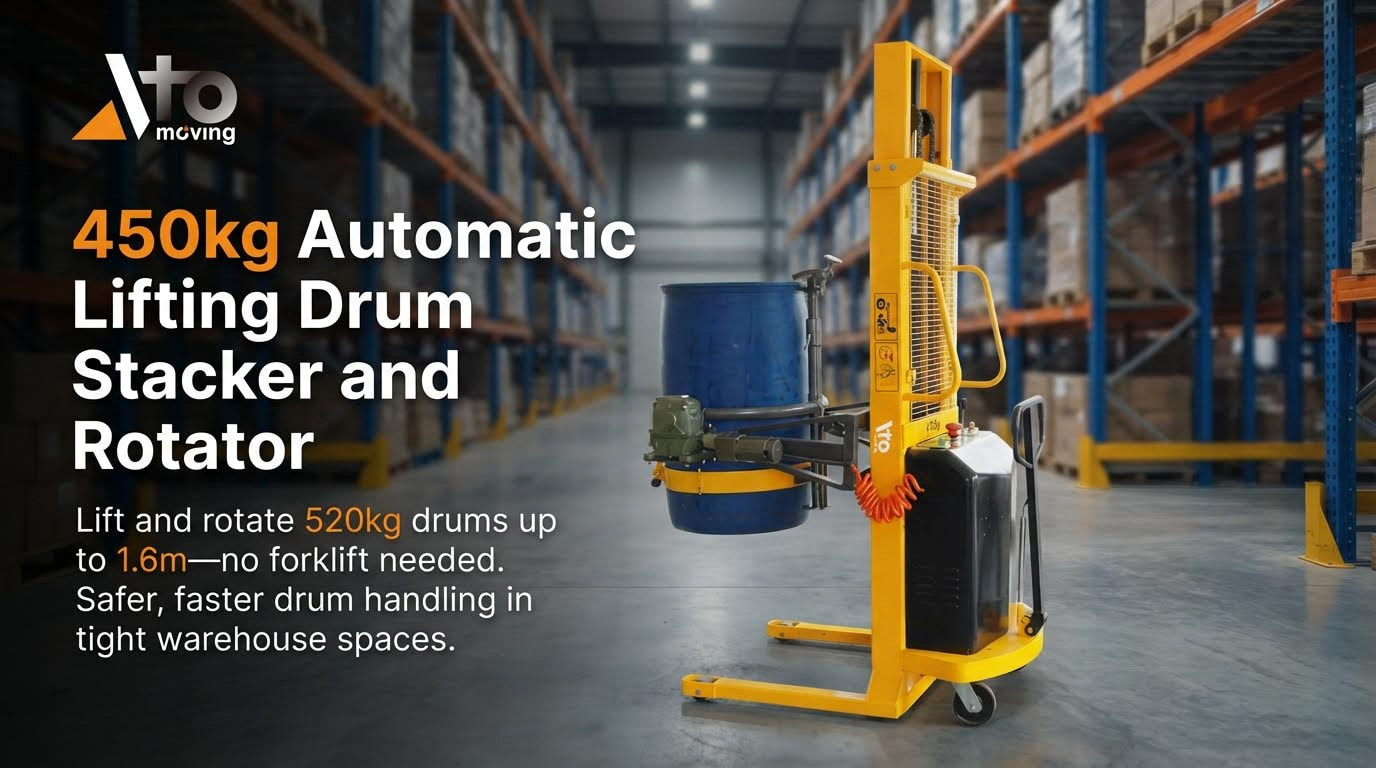
Drum grip type and center-of-gravity (CoG) control decide whether 4 drums stay locked and stable when you brake, turn, or cross uneven floors.
With four drums, any slip or tilt in one position can start a chain reaction. The design of the catch, clamp, or cradle, and how it positions the drum mass relative to the axle and mast, is as important as raw SWL.
- Universal drum catches: Height-adjustable stainless catches can handle 50–220 L drums, 380–1,000 mm tall per spec – lets one frame handle mixed drum sizes in a 4-drum cluster.
- Rim / chime grips: Clamp on the top rim; good for steel drums in vertical lift – fast engagement but needs sound chimes and controlled slosh.
- Waist / band grippers: Clamp around the drum body – better when rims are damaged or when plastic drums deform under load.
- Base cradles and rings: Support under the drum and restrain sideways movement – ideal for train dollies or four-drum pallets over rougher floors.
- Custom attachments: Special heads for screw-top or bespoke plastic drums are available – prevents crushing lids or distorting thin walls when clustered.
| Grip / Support Type | Best For | Operational Impact With 4 Drums |
|---|---|---|
| Rim / chime clamp | Sound steel drums with consistent rim geometry | Fast loading but sensitive to dented rims; inspect each drum before lifting 4 at once. |
| Waist / band grip | Mixed steel/plastic drums, light deformation | More forgiving when drums are not perfect; improves stability in clustered handling. |
| Under-base cradle + straps | Rough floors, ramps, train dollies | Keeps CoG low; better for long routes where slosh and bumps are expected. |
| Universal adjustable catch | 50–220 L drums, heights 380–1,000 mm | One attachment can secure different heights in a 2×2 pallet layout. |
- CoG relative to axle: Keep the heaviest drums closest to the axle or mast – reduces tipping moment when braking or turning.
- Cluster symmetry: Arrange 4 drums symmetrically on pallets or dollies – prevents side-loading wheels and bearings.
- Securing devices: Use straps, chains, or positive latches for each drum – stops one drum walking out of the cluster on ramps.
- Drum condition checks: Inspect chimes, shells, and bungs for dents or corrosion – weak shells can collapse under clamp pressure when grouped.
💡 Field Engineer’s Note: For four-drum moves, I treat every drum as if it is partially filled, even when declared “full” or “empty.” Liquid slosh and trapped residues shift the CoG unpredictably, so I favor low cradles and waist grips over pure rim clamps on marginal drums.
Simple CoG check for a 4‑drum pallet
Visualize a rectangle joining the drum centers. The combined CoG should sit well inside the wheelbase or fork footprint, not near an edge. If two drums are much heavier, place them diagonally opposite or closest to the mast.
Hydraulics, electric lift, and automation options
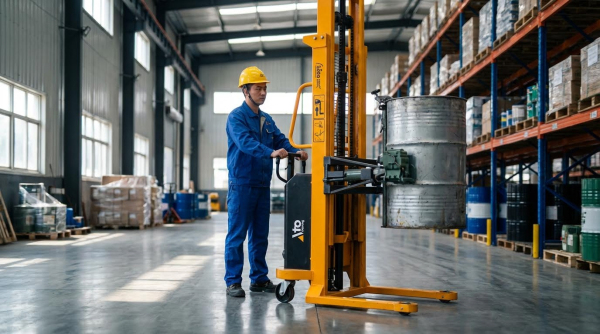
Hydraulic, electric, and automation options determine how consistently and ergonomically you can raise, lower, and position 4 drums, especially in high-frequency operations.
When you scale up from moving one drum to planning how to move 4 drums at once all day, the limiting factor becomes operator fatigue, control precision, and how the hydraulic system behaves under repeated cycles and varying temperatures.
- Hydraulic pump system: A hydraulic pump feeds a lifting ram; the operator controls lift with a handle and a hand-operated lowering valve per design – smooth, controllable vertical motion for stacked or elevated placements.
- Circuit cleanliness: Flushed hydraulic circuits prevent debris ingress – reduces jerky motion that can rock a 4-drum cluster.
- Manual vs. electric-hydraulic: Battery-powered electric-hydraulic lift with push-button control cuts physical effort in high-frequency use as documented – ideal when you lift multiple 4-drum loads every shift.
- Lift stroke: Standard strokes around 740–1,260 mm allow loading to raised platforms or machines per example – check stroke vs. your highest pallet rack or mixer inlet.
- Integrated weighing: Load-cell systems with ≈0.1 kg accuracy can weigh during lift per spec – confirms actual mass of all 4 drums without using floor scales.
| Hydraulic / Electric Feature | Typical Spec | Operational Impact With 4 Drums |
|---|---|---|
| Manual hydraulic lift | Hand pump + manual lowering valve | Good for low-volume moves; operator effort rises with repeated 4-drum cycles. |
| Electric-hydraulic lift | Battery-powered, push-button control | Reduces fatigue and improves consistency in multi-shift, multi-drum operations. |
| Standard lift stroke | ≈740 mm | Sufficient for loading drums on single-height pallets or low platforms. |
| Extended lift stroke | ≈1,260 mm | Allows feeding elevated process equipment or higher racking with 4-drum clusters. |
| Integrated weighing | ±0.1 kg accuracy | Validates combined mass of 4 drums, preventing accidental overloads. |
- Steering and wheel sets: Fixed front wheels with rear steering and polyurethane tires improve maneuverability and rolling resistance per design – important when turning 4 drums within narrow aisles.
- Material construction: 304 stainless frames with plated rams resist corrosion and suit clean environments per spec – essential for food or pharma lines handling multiple drums.
- Hazardous area options: ATEX-rated versions with anti-static and conductive parts support zones 1, 2, 21, and 22 per documentation – enables 4-drum moves in flammable atmospheres.
- Guarding and compliance: Shatterproof polycarbonate guarding and compliance with Machinery Directive 2006/42/EC are common – protects operators from moving parts during clustered handling.
💡 Field Engineer’s Note: In cold rooms or outdoor yards, hydraulic oil thickens and lift speed drops. When you are lifting 4 drums at once, that sluggish response tempts operators to over-pump or “ride” the lowering valve, which can cause sudden drops. Specify oil and seals rated for your coldest conditions, or choose electric-hydraulic units tuned for low temperatures.
When to upgrade to electric-hydraulic for 4‑drum moves
If operators are lifting more than 20–30 four-drum loads per shift, or if you need precise stopping at multiple heights (mixers, scales, racks), electric-hydraulic lift usually repays its cost quickly through reduced strain injuries and faster cycle times.
Selecting Equipment For Routes, Environments, And Drums
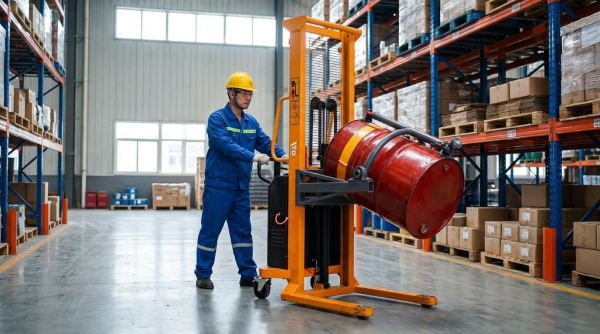
Choosing how to move 4 drums at once safely depends on route distance, floor and slope conditions, environment (hazardous or hygienic), and drum type. The right match prevents tipping, overloading, and non-compliance.
Matching solutions to floor, slope, and aisle width
For planning how to move 4 drums at once, you must match equipment geometry, wheel type, and drive method to the floor, gradients, and available aisle width.
- Floor flatness and defects: Assess joints, potholes, and ramps – Prevents shock loads that can unseat drums or crack welds.
- Route length and frequency: Measure typical travel distance per move – Indicates when to upgrade from manual to powered equipment.
- Aisle and doorway width: Check clear width in mm at the tightest point – Ensures multi-drum frames and forklifts can turn without striking racks.
- Traffic pattern: Map pedestrians, forklifts, and doors – Helps choose slower, more controllable systems in busy zones.
- Drum mass and fill level: Estimate total load for 4 drums – Determines if the route is realistic for manual push forces and for rated SWL.
| Route / Floor Scenario | Typical Equipment Choice | Key Technical Features | Operational Impact |
|---|---|---|---|
| Short, smooth, flat floor, wide aisles (>2.5 m) | Four-drum pallet on pallet truck or forklift | Low-profile pallet, 4 x 200 L drums, truck SWL > total mass | Fast loading/unloading; ideal for repetitive transfers between process and storage. |
| Moderate distance, some joints, aisles 1.8–2.2 m | Drum palletizer or train dollies | Multi-drum frame, large wheels, articulated links | Improves stability over joints; still maneuverable in medium aisles. |
| Long routes, mixed floor, slopes up to ~2% | Powered tug with drum dollies or forklift with drum clamps | Powered traction, certified drum clamps, SWL based on 4-drum load | Reduces operator strain; maintains control on gentle slopes. |
| Narrow aisles (<1.6 m) with tight turns | Compact drum lifter or single-file drum train | Rear steering with polyurethane wheels rear wheel steering | Allows turning within constrained spaces, but may reduce throughput per trip. |
| Uneven or sloped ramps >2% | Forklift with drum pallet or powered handler only | Rated gradeability, braking, and SWL certification SWL certification | Prevents runaway loads; manual trucks are generally unsuitable here. |
How to check if a route is suitable for manual 4-drum moves
Keep total mass realistic for one operator, including equipment. A typical 200 L drum can weigh 180–360 kg when full. Four drums can easily exceed 1,000 kg, which is near or beyond what one person should control manually over any distance. If the route includes slopes, tight turns, or rough floors, prioritise powered solutions or forklifts rather than manual trains.
- Wheel and tire material: Use polyurethane wheels on smooth industrial floors rear wheel steering and polyurethane tires – Reduces rolling resistance and noise.
- Steering geometry: Rear-steer designs pivot tightly – Useful when moving 4 drums into congested bays or around machinery.
- Under-drum clearance: Check minimum 150–200 mm under drum for floor obstacles – Prevents drums from snagging on ramps or dock plates.
- Lift stroke vs. obstacles: If crossing dock plates or lips, ensure lift stroke can raise drums clear – Protects drum chimes and avoids shock loads.
💡 Field Engineer’s Note: For routes with any slope, test the worst-case section with a single loaded drum first. If one drum feels marginal to control, a 4-drum configuration is not acceptable there without powered traction or a forklift, regardless of what the paperwork says.
Hazardous zones, cleanrooms, and compliance needs
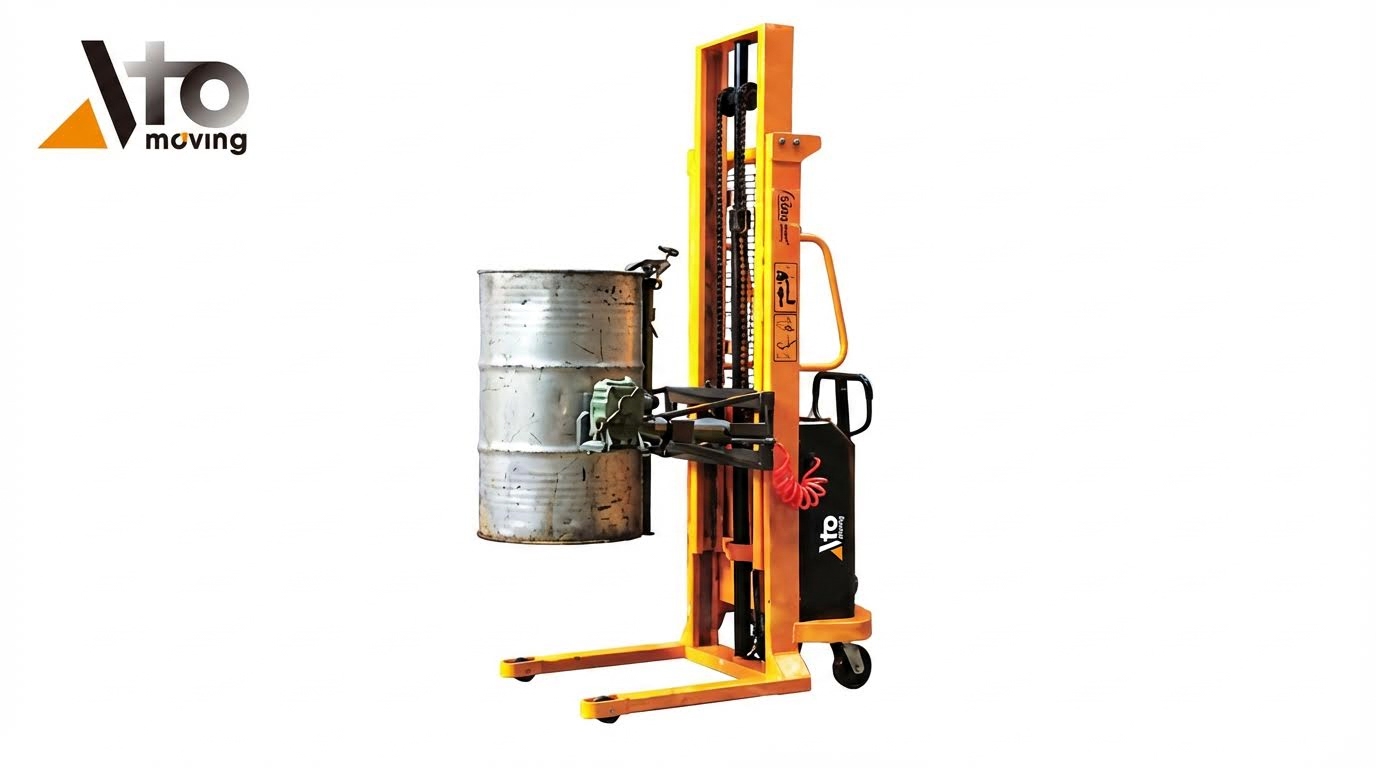
When deciding how to move 4 drums at once in hazardous or hygienic areas, you must prioritise explosion protection, corrosion resistance, and formal certification over pure throughput.
- Hazardous area classification: Confirm if the route passes through zones 1, 2, 21, or 22 – Determines if Ex-rated equipment is mandatory.
- Cleanliness level: Identify if the area is food-grade, pharmaceutical, or general industrial – Drives choice of stainless steel vs painted carbon steel.
- Product and vapour hazards: Use SDS data (flash point, toxicity) – Influences open vs closed handling and spill control.
- Regulatory framework: Check for CE marking and EC Declaration of Conformity on new attachments CE marking and EC Declaration – Supports legal compliance.
- Quality system: Prefer suppliers operating under ISO 9001:2015 ISO 9001 certification – Improves consistency and documentation.
| Environment / Zone | Recommended Construction | Key Design Features | Best For… |
|---|---|---|---|
| Zone 1, 2, 21, 22 (flammable / explosive) | Ex-rated drum lifter or attachment | Anti-static and conductive components for hazardous zones 1, 2, 21, 22 ATEX certification | Moving 4 solvent or powder drums where ignition sources must be controlled. |
| Food and pharma cleanrooms | 304 stainless steel frames and hardware | Nickel/chrome-plated hydraulic rams and stainless encased pump for corrosion resistance stainless steel construction | Frequent washdown and strict hygiene with minimal particle shedding. |
| General warehouse (non-hazardous) | Painted steel, standard hydraulics | Certified SWL and proof load tested attachments proof load testing | Cost-effective bulk moves of 4 drums on pallets or with clamps. |
| Weigh-fill and batching areas | Stainless or coated steel with integrated scale | Integrated load-cell weighing system with ±0.1 kg accuracy integrated weighing | Simultaneous moving and weighing of drums without separate floor scales. |
Why SWL, proof load, and inspections matter for 4-drum moves
Each attachment or lifter must have a Safe Working Load (SWL) that covers the combined mass of 4 drums plus any pallet or frame. SWL certification and proof load testing verify that the design withstands loads without permanent deformation SWL and proof load testing. Under regulations such as LOLER, competent inspections every 6–12 months confirm continued fitness for service and identify wear, cracks, or hydraulic issues before failure.
- Hydraulic system protection: In clean or hazardous zones, enclosed and corrosion-resistant hydraulic pumps and rams minimise leak and contamination risks stainless encased hydraulic pump – Essential for GMP and ATEX compliance.
- Lift method: Use electric-hydraulic lift for frequent 4-drum cycles – Reduces operator fatigue and improves repeatability electric-hydraulic lift option.
- Guarding and visibility: Shatterproof guarding protects operators while maintaining sightlines around clustered drums polycarbonate guarding – Important in crowded process areas.
- Drum compatibility: Use universal or custom catches that handle 50–220 L drums and special screw-top designs universal drum catch and special attachments – Prevents slippage when moving mixed drum types together.
- Documentation and warranty: Keep EC Declarations, inspection reports, and warranty extension records organised inspection frequency and warranty policy – Demonstrates due diligence after any incident.
💡 Field Engineer’s Note: In ATEX or high-hygiene zones, avoid improvising with standard pallets and generic forklift forks for 4-drum moves. Even if the lift “feels” stable, lack of Ex rating, stainless construction, and formal certification can create major compliance and insurance problems after a spill or ignition event.

Final Considerations For Multi-Drum Handling Strategy
Safe four-drum handling depends on more than buying a heavy-duty attachment. You must treat the drums, route, and equipment as one engineered system. Load ratings, proof testing, and inspections define the safe envelope. Grip design and center-of-gravity control keep four drums stable when floors, ramps, and liquid slosh try to upset them. Hydraulics, electric lift, and wheel sets decide whether operators can repeat those moves all day without strain or loss of control.
The best strategy starts with a route survey and realistic drum mass assumptions, then works backward to the right palletizer, forklift attachment, or train dolly. In hazardous or hygienic zones, you then filter options by ATEX, stainless construction, and certification. Finally, you lock in safe practice with operator training, pre-use checks, and documented inspections.
Operations and engineering teams should standardize on a small set of proven methods, like Atomoving palletizers and certified drum clamps, matched to clear use cases. Avoid improvised four-drum lifts, even for “short” moves. When in doubt, derate capacity, slow travel speeds, and favor lower CoG solutions. That approach delivers higher throughput, fewer injuries, and compliance that holds up under audit and after incidents.
Frequently Asked Questions
How can I move 4 drums at once in a warehouse setting?
Moving 4 drums at once requires the right material handling equipment. A drum handler attachment on a forklift is commonly used for this task. Ensure the drums are securely gripped before lifting.
- Use a forklift with a drum handler attachment rated for the weight of 4 drums.
- Securely position the drums within the attachment to prevent slippage.
- Follow OSHA guidelines for safe forklift operation during transport.
What safety precautions should be taken when moving multiple drums?
Safety is critical when handling heavy loads like drums. Always inspect the drum handler and forklift before use. Ensure the load does not exceed the equipment’s capacity, and maintain clear visibility while operating. OSHA Forklift Safety.
- Inspect equipment for wear or damage before use.
- Ensure drums are balanced and evenly distributed.
- Avoid sharp turns or sudden movements during transport.