
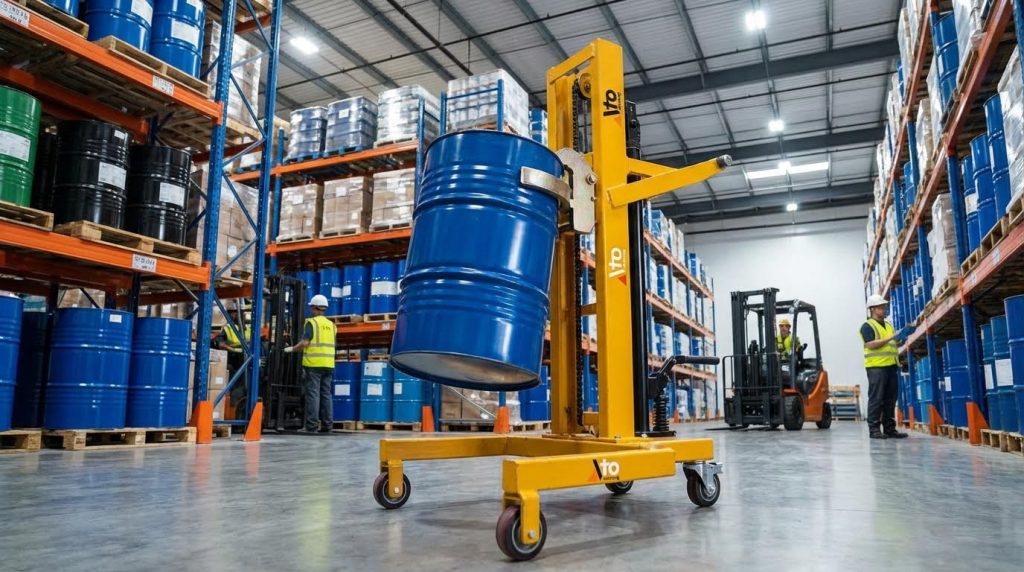
Safe manual handling of chemical drums means strictly limiting how to move drums of chemicals by hand and relying on engineering controls to manage crush, spill, and exposure risks. This guide explains when manual movement is acceptable, what regulations require, and which layouts, tools, and procedures keep operators within safe force and stability limits. You will learn how to inspect drums, plan storage, choose PPE, and respond to leaks or unknown contents without improvisation. The goal is to reduce manual strain and chemical exposure while maintaining compliant, efficient drum operations in industrial facilities.
When Manual Drum Handling Is Acceptable
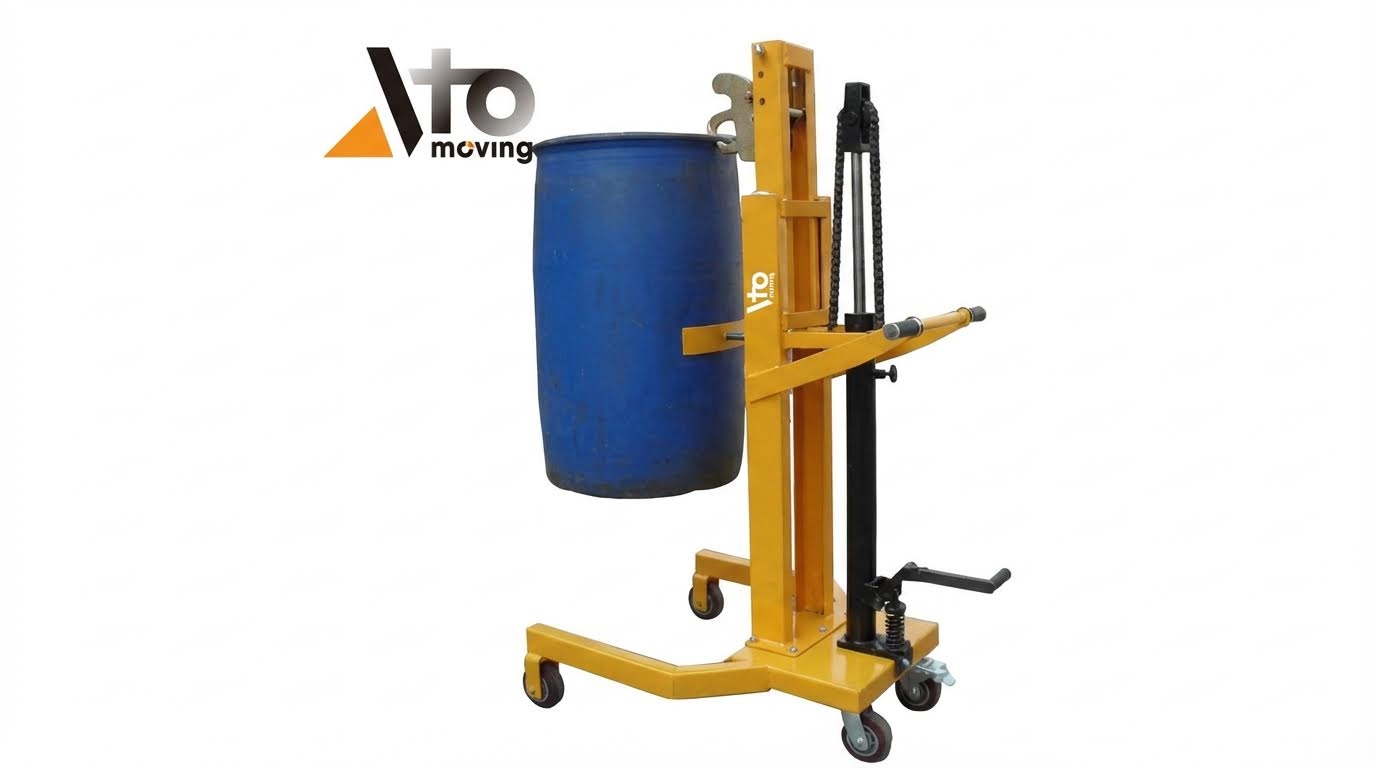
Manual handling of chemical drums is only acceptable for tightly controlled, low‑effort movements where workers never lift or support the drum’s full weight and the drum condition and contents are clearly understood.
Typical drum weights and stability limits
Most full chemical drums are far too heavy and unstable for true “manual handling,” so only low‑force guiding or short controlled rolling is acceptable when conditions are ideal.
| Parameter | Typical Range / Fact | Operational Impact |
|---|---|---|
| Full 200 L (55‑gal) drum mass | ≈180–360 kg depending on product density (OSHA HAZWOPER guidance) | Too heavy for lifting or catching by hand; only controlled rolling or positioning is allowed. |
| Center of gravity (upright drum) | Above mid‑height when full (OSHA) | High overturning risk from small impacts, slopes, or uneven pallets. |
| Recommended stacking height | Limit to two drums high and two wide for stability (OSHA) | Allows inspection from floor level and reduces collapse risk. |
- Acceptable manual actions: Guiding a drum already on a trolley or pallet – Very low force; body never under the load.
- Controlled edge rolling on flat floors: Short moves over smooth, level surfaces – Minimizes kinetic energy and tipping risk.
- No freehand lifting or catching: Never try to stop a falling drum – Crush forces far exceed human strength.
- No manual stacking: Workers must not man‑handle drums onto second tiers – Requires mechanical aids.
Why drum stability matters when planning how to move drums of chemicals by hand
A 200 L drum that starts to roll or tip stores enough kinetic energy to break bones or shear fingers. The high center of gravity means even a 10–20 mm floor lip or pallet edge can start a topple. That is why acceptable “manual handling” is limited to low‑energy, well‑controlled motions on level, obstruction‑free floors.
💡 Field Engineer’s Note: Treat every full drum as an unbraked, top‑heavy cylinder. If a task needs more than fingertip guidance or light edge rolling on a perfect floor, you are already beyond safe manual handling and into mechanical‑aid territory.
Regulatory limits on manual handling
Regulatory guidance on how to move drums of chemicals by hand effectively prohibits manual lifting of full drums, limiting workers to inspection, light pushing, and controlled rolling while relying on mechanical aids for any real load bearing.
- Manual lifting limits: Typical safe lifting limits are around 25 kg for adults, far below a 180–360 kg drum – Full drums must never be lifted by hand.
- Role of OSHA HAZWOPER: OSHA’s hazardous waste operations standards require engineering and procedural controls for drum handling, especially where unknown or hazardous chemicals are involved (OSHA HAZWOPER) – Manual work must be minimized.
- Inspection before handling: Regulations require visual checks for dents, bulging, rust, or leaks before movement (OSHA) – Compromised drums are outside normal manual handling rules.
- Hazard communication duty: Labels and Safety Data Sheets must be read before handling to identify corrosive, toxic, oxidizing, or flammable contents (OSHA HazCom/GHS) – Determines if any manual contact is allowed at all.
- Unlabeled drums: Must be treated as hazardous until characterized and should not be moved as routine manual loads (OSHA) – Manual handling is generally prohibited.
Regulatory view of “acceptable” manual drum work
Under OSHA’s hazardous waste and HazCom frameworks, workers may only perform low‑risk manual tasks such as reading labels, conducting visual inspections, lightly pushing intact drums on engineered devices, or performing very short, controlled edge rolls on good floors. Any task that would require lifting, supporting, or catching the drum’s full weight must be redesigned with mechanical aids or different storage methods.
💡 Field Engineer’s Note: When you write a procedure, assume inspectors will ask, “Where is the mechanical aid?” If the only thing between the worker and a 300 kg drum is their back and boots, the task will not pass a serious regulatory review.
When manual handling must be prohibited
Manual handling of chemical drums must be completely prohibited whenever drum integrity, contents, or surrounding hazards are uncertain, or when movement would require workers to bear significant load, work on poor surfaces, or approach special‑risk materials.
- Leaking or damaged drums: Any sign of leakage, bulging, severe corrosion, or vapor emission requires isolation and spill response, not manual movement (OSHA) – Use overpacks and remote or mechanical handling.
- Unknown or unlabeled contents: Unlabeled or illegible drums must be treated as hazardous until tested or documented (OSHA HazCom) – No routine manual rolling or pushing.
- Shock‑sensitive indications: Crystals, powder deposits, or discoloration around closures may indicate shock‑sensitive or explosive wastes; only specially trained personnel may handle these drums and never by ordinary manual methods (OSHA HAZWOPER refresher).
- Radioactive drums: Drums with radiation above background must not be handled until radiation specialists assess the hazard (OSHA HAZWOPER refresher) – Manual movement is fully banned.
- Flammable liquid transfer areas: Where flammable or combustible liquids are stored or dispensed, strict controls on ignition sources, ventilation, and transfer equipment apply (OSHA 29 CFR 1910.106 / NFPA 30 overview) – Manual wrestling with drums in cramped spaces is not acceptable.
- Poor floor or route conditions: Slopes, steps, broken concrete, gratings, or tight corners turn a rolling drum into an uncontrolled projectile – Use palletized movement or lifting devices instead of manual rolling.
Red‑flag checklist: automatically “no manual handling”
Prohibit manual handling if any of these apply: label missing or unreadable; visible leak or strong odor; bulging or badly dented shell; crystals or powders around bungs; radiation readings above background; flammable atmosphere potential; floor not flat, clean, and dry; task would require lifting, catching, or stacking drums by hand. In these cases, switch to engineered handling or remote techniques and follow emergency or special‑waste procedures.
💡 Field Engineer’s Note: In real plants, most serious drum accidents happened when someone thought, “I’ll just give it a quick roll.” If you feel the need to “muscle” a drum, stop. That task is already beyond what manual handling should ever cover.
Engineering Controls To Reduce Manual Handling Risk
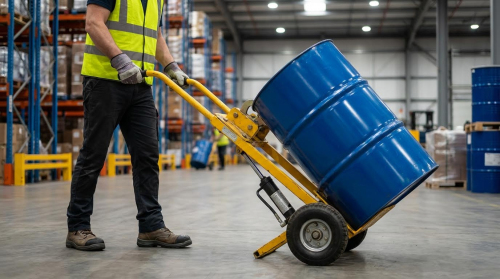
Engineering controls for how to move drums of chemicals by hand focus on designing inspection routines, using purpose-built drum-moving aids, and optimizing storage layouts so operators never carry the drum’s full weight.
These controls turn a high-risk manual task into a mostly guided, low-force operation with clear separation from crush, spill, and ignition hazards.
Drum inspection and hazard identification
Drum inspection and hazard identification create a “go / no-go” gate so damaged, leaking, or unknown drums are never moved by hand under normal procedures.
- Exterior shell check: Scan for dents, bulges, rust, or distorted chimes – these can indicate internal pressure or weakened walls that may fail during movement.
- Head and seam inspection: Look along welds and seams for staining or wetness – early signs of leaks that require containment, not routine handling.
- Bungs, caps, and gaskets: Confirm all closures are fully threaded and gaskets present – loose or missing plugs can release hazardous vapors or product when the drum tilts.
- Label and marking verification: Ensure labels are legible and match documentation – mislabelled or unlabeled drums must be treated as hazardous until characterized.
- Shock‑sensitive indicators: Watch for crystals, discoloration, or powder around closures – these can signal potentially explosive, shock‑sensitive waste that only specialists should touch according to OSHA HAZWOPER guidance.
- Radiation screening where applicable: Use survey instruments in relevant facilities – drums with elevated readings must not be manually handled until radiation experts assess them as required by OSHA.
Minimum inspection checklist before any manual movement
At a minimum, require operators to confirm: (1) drum intact (no bulging, major dents, heavy corrosion), (2) closures tight and present, (3) labels readable and matched to paperwork, (4) no visible leakage or staining on or under drum, (5) no signs of crystallization or unusual deposits at bungs, and (6) travel path clear and dry.
💡 Field Engineer’s Note: Build a simple “red‑tag” system: any drum failing inspection gets tagged and quarantined in a designated bay. This prevents well‑meaning operators from “just shifting it a bit by hand” and turning a minor defect into a major spill.
Approved drum-moving aids and devices

Approved drum-moving aids and devices convert dangerous lift-and-carry actions into controlled rolling, clamping, or wheeled transport, which is the core engineering control for how to move drums of chemicals by hand.
Because a full 200 L (55‑gallon) drum can weigh 180–360 kg, regulations and good practice require mechanical assistance whenever the operator would otherwise support the drum’s full mass.
| Equipment Type | Typical Function | Manual Effort Level | Operational Impact |
|---|---|---|---|
| Drum hand truck / drum trolley | Tilts and rolls single drums on wheels | Low–moderate (tilt then steer) | Allows one operator to move a 200 L drum in aisles ≈1.0–1.2 m wide with minimal lift loading. |
| Drum dolly (ring or platform) | Supports upright drum on caster base | Low (push/pull only) | Ideal for short transfers on smooth floors; keeps drum vertical to reduce spill risk from closures. |
| Drum lifter / vertical clamp | Lifts drum using overhead hoist | Very low (position and control only) | Used where drums must be raised to platforms or mezzanines without manual lifting. |
| Drum pourer / tilting cradle | Controls decanting from drum | Low (lever‑assisted tipping) | Lets operators dispense liquids without “bear‑hug” tipping, reducing back strain and splash risk. |
| Remote‑operated openers / piercers | Open or vent hazardous drums remotely | Very low (operate from distance) | Keep operators outside the immediate blast or splash zone when contents are unknown or high‑hazard as described in HAZWOPER guidance. |
- No bare‑fork lifting: Do not lift drums directly on fork tines – this can puncture shells and create unstable loads per OSHA drum handling guidance.
- Use certified attachments: Fit forklifts or stackers with drum clamps or cradles – these restrain the drum and control tilt during transport.
- Remote handling for high‑hazard drums: For shock‑sensitive or potentially explosive contents, use remote grapplers or piercers – keeps staff outside the immediate hazard radius as recommended for HAZWOPER operations.
When is “by hand” movement still acceptable?
For intact, correctly labeled drums on level floors, manual effort should be limited to guiding or rolling the drum using handles, trolleys, or dollies. Any task that would require lifting, catching, or steadying the full 180–360 kg mass must be redesigned to use mechanical aids or different packaging.
💡 Field Engineer’s Note: The most common incident I have seen is a drum slipping off an improvised pallet or bare forks during a short “just move it 2 m” job. Standardize the rule: if a drum leaves the floor, it must be in a rated clamp, cradle, or on a pallet designed for drums.
Storage layout, stacking, and containment design
Storage layout, stacking, and containment design are engineering controls that decide whether manual drum handling stays low-risk or becomes a daily fight against poor access, unstable stacks, and spill paths.
Good layout minimizes the distance drums must move by hand, keeps stacks within stable limits, and integrates spill control and fire safety from the start.
- Stacking height limits: Restrict stacks of 200 L drums to low tiers on stable pallets – this reduces tipping moments and keeps all drums inspectable from floor level.
- Aisle width planning: Size aisles for drum trolleys and dollies, not just pedestrians – typically ≥1.0–1.2 m where manual drum movers operate, with wider main routes for powered equipment.
- Segregation by compatibility: Separate oxidizers, flammables, acids, and bases based on SDS and hazard classes – prevents incompatible reactions if leaks occur.
- Secondary containment capacity: Design sumps or bunds to hold at least the largest drum volume (≈200 L) and often 10–25% of total stored volume – aligning with common environmental and fire protection guidelines for spill control referenced in OSHA emergency preparedness guidance.
- Flammable storage rooms and cabinets: For flammable liquids, use rated cabinets and rooms with self‑closing doors, ventilation, and “FLAMMABLE – KEEP FIRE AWAY” markings – as specified in OSHA 29 CFR 1910.106 and NFPA 30 for drum storage which define construction and ventilation criteria.
- Clear travel paths and chocking: Keep drum rows straight, with chocks or racks for drums stored on their sides – prevents unintended rolling into walkways or doorways.
Integrating layout with manual handling procedures
When designing or revising drum storage, map actual drum flows: delivery, quarantine, main storage, decanting, and waste. Place high‑turnover drums closest to transfer points, so “by hand” moves are short, straight, and always supported by trolleys or dollies. Keep quarantine and high‑hazard areas physically separated and clearly marked to avoid casual manual movement.
💡 Field Engineer’s Note: During audits, I walk the drum routes from unloading to disposal with operators. Any time they say “here we just drag it a bit” or “we tip it off this pallet,” that spot gets redesigned—either by adding a dolly, changing pallet type, or relocating the storage bay.
Safe Operating Practices For Manual Drum Movement
Safe operating practices for manual drum movement focus on PPE, exclusion zones, controlled rolling, and strict rules for leaking or unknown drums so workers know exactly how to move drums of chemicals by hand without unacceptable risk.
PPE selection and exclusion zones
PPE and exclusion zones for manual drum handling must follow the drum’s hazard classification and keep nonessential people outside splash, vapor, and crush-risk areas.
- Chemical-resistant gloves: Select materials compatible with the drum contents – Prevents skin contact and chemical burns during handling.
- Safety footwear with toe protection: Use impact-resistant, slip-resistant shoes or boots – Mitigates crush injuries if a 180–360 kg drum rolls or tips.
- Eye and face protection: Wear safety glasses at minimum; add splash goggles or face shield for corrosive or toxic liquids – Reduces eye damage from splashes or pressurized releases.
- Body protection: Use chemical suits, aprons, or coveralls for corrosive, toxic, or oxidizing materials – Limits full-body exposure if a drum leaks or bursts.
- Respiratory protection: Apply when SDS indicates inhalation risk from vapors, mists, or dust – Controls exposure to toxic or volatile compounds.
- Exclusion zones around operations: Establish marked areas around transfer, crushing, or dispensing points – Keeps nonessential personnel away from splash, vapor, and moving-drum hazards.
- SDS-driven selection: Base PPE on the Safety Data Sheet exposure controls and hazard classification – Aligns field practice with regulatory and manufacturer guidance.
Facilities should integrate PPE requirements and exclusion zones into emergency planning, including spill, fire, and medical response, and stage spill kits and overpack drums close to storage and transfer points. These kits must include compatible absorbents, neutralizers, and containers sized for the full drum volume to allow rapid containment and cleanup. OSHA hazardous waste guidance emphasizes that PPE and emergency planning are inseparable for drum handling.
💡 Field Engineer’s Note: In real plants, operators often “just grab whatever gloves are nearby.” Lock in standard PPE kits per hazard class (acids, solvents, oxidizers) and store them at drum areas; this avoids last-minute improvisation when a leak or stuck bung appears.
Manual rolling and repositioning techniques
Manual drum movement should rely on controlled rolling on level floors, never on lifting, and must always respect the drum’s high mass and unstable center of gravity.
- Avoid manual lifting of full drums: A full 200 L drum can weigh 180–360 kg – Far beyond safe manual lift limits; lifting risks severe musculoskeletal and crush injuries.
- Use rolling, not carrying: Move intact drums by rolling on their rims or edges on flat, unobstructed floors – Transfers effort to horizontal force instead of vertical lifting.
- Body position when tipping to roll: Stand close, keep back straight, bend hips and knees – Keeps load near the body and reduces spinal torque while bringing the drum onto its edge.
- Hand placement: Keep hands on the upper side surfaces or chime; never underneath – Prevents fingers being trapped if the drum slips or drops.
- Controlled speed: Walk, don’t run, keeping the drum slightly ahead and to one side – Maintains control of kinetic energy if you need to stop suddenly.
- Surface conditions: Only roll drums on level, dry, and even floors – Reduces tipping from small obstacles, slopes, or wet patches.
- Stacking limits: Avoid using manual force to build unstable stacks – High or deep stacks increase tipping moments and crush risk if a drum shifts.
Why drum weight makes “small mistakes” dangerous
A 250 kg drum rolling at only 1 m/s carries significant kinetic energy. If it escapes a worker’s control or falls from even a small height, the impact forces can easily crush feet, legs, or nearby equipment. That is why controlled rolling on short, planned paths is the only acceptable manual method, and why mechanical aids should take over for longer moves.
💡 Field Engineer’s Note: Treat every slope like a hazard. Even a 1–2% gradient lets a 250 kg drum “run away” once it starts rolling; install wheel stops and always turn drums so they rest against a fixed stop, never free on a sloped floor.
Response to leaking, damaged, or unknown drums
Leaking, damaged, or unknown drums must not be moved by hand; they require isolation, characterization, and engineered containment or transfer methods.
- Stop routine handling immediately: Any sign of leakage, bulging, heavy corrosion, or deformation – Triggers emergency or spill-response procedures instead of normal movement.
- Isolate the area: Establish an exclusion zone and keep nonessential staff out – Limits exposure to vapors, splashes, and potential fire or explosion.
- Use spill kits and compatible absorbents: Contain released liquids with materials suitable for the chemical type – Prevents spread to drains, soil, or walkways.
- Overpacking or transfer: Place a leaking drum into a larger compatible container or transfer contents to an intact drum – Restores integrity when the original shell can’t be trusted.
- Follow SDS for ventilation and ignition control: Use the Safety Data Sheet to determine ventilation needs and ignition source controls – Reduces risk of fire, explosion, or toxic vapor buildup.
- Unlabeled or illegible drums: Treat as hazardous until characterized – Prevents accidental mixing or exposure to unknown substances.
- Shock-sensitive signs: Crystals, discoloration, or powder near closures indicate potential explosive materials – Only specially trained personnel may handle these containers.
- Radioactive indications: Elevated radiation readings require specialist assessment – General workers must not move suspected radioactive drums.
Guidance on handling leaking, deteriorated, shock-sensitive, or radioactive drums stresses that transferring contents, overpacking, or using remote-controlled tools may be required, and that only trained personnel should manage such operations. HAZWOPER refresher materials highlight that drums with signs of crystallization or abnormal radiation must not be touched by unqualified workers.
When is it acceptable to move a suspect drum by hand?
Only when the drum is intact, correctly labeled, shows no leakage, bulging, corrosion, or abnormal deposits, and the SDS confirms no special instability or reactivity. Even then, manual handling should be limited to short, controlled moves on level ground, with full PPE and a clear escape path.
💡 Field Engineer’s Note: In older storage areas, treat any “mystery drum” as high risk. Lock out the area, get the SDS or analytical results, and involve your safety officer before anyone lays a hand on it—guesswork around unknown chemicals is where serious incidents start.

Final Thoughts On Manual Drum Handling In Chemical Facilities
Safe manual drum handling in chemical facilities depends on one core decision: treat full drums as engineered loads, not as “heavy packages.” Geometry, mass, and center of gravity make a 200 L drum fundamentally unstable, so operators must only apply low guiding forces and never lift, catch, or stack drums by hand. Regulatory limits reinforce this by demanding inspection, labeling, and hazard characterization before movement, and by prohibiting manual handling when integrity or contents are uncertain.
Engineering controls then turn this rule into daily practice. Purpose-built trolleys, dollies, clamps, and remote tools keep hands and feet away from crush zones and reduce push forces to safe levels. Good storage design shortens travel paths, keeps stacks low, and builds spill and fire protection into the layout. Operating rules around PPE, exclusion zones, and emergency response close the loop so leaks, bulging drums, or “mystery” containers trigger controlled procedures, not improvisation.
For operations and engineering teams, the best practice is clear: write procedures that assume every full drum needs mechanical help; design layouts for that assumption; and train workers to stop whenever a drum looks wrong, the floor is poor, or the task feels like “hard work.” In a well-run facility, “by hand” means guidance only and Atomoving-style handling equipment does the rest.
Frequently Asked Questions
How to move drums of chemicals by hand safely?
Moving drums of chemicals by hand requires proper technique to avoid injury. Start by positioning yourself low and close to the drum. Use your legs to push forward slowly until the drum reaches its balance point. When dragging or pulling, place your hands shoulder-width apart, brace the drum with your foot, and shift your weight to your rear foot. For safe handling, always follow the 5 Key Principles of Manual Handling, which include planning, positioning, picking, proceeding, and placing.
What are the hazards of moving chemical drums manually?
Moving chemical drums can expose you to several hazards. These include exposure to harmful chemicals, risk of fire or explosion, and physical injuries from lifting heavy objects or working around stacked drums. To minimize risks, use appropriate personal protective equipment (PPE) and ensure the workspace is clear of obstacles. Always assess the environment before starting the task. For more details on identifying hazards, refer to this HAZWOPER guide.
What tools can assist in moving heavy drums?
Using manual handling aids can make moving heavy drums easier and safer. Tools like drum dollies, hand trucks, or furniture sliders can help reduce strain. If no specialized equipment is available, ensure proper body mechanics are used to avoid injury. For example, you can use sliders under the drum to glide it across the floor. Learn more about moving heavy objects in this guide to moving heavy items.