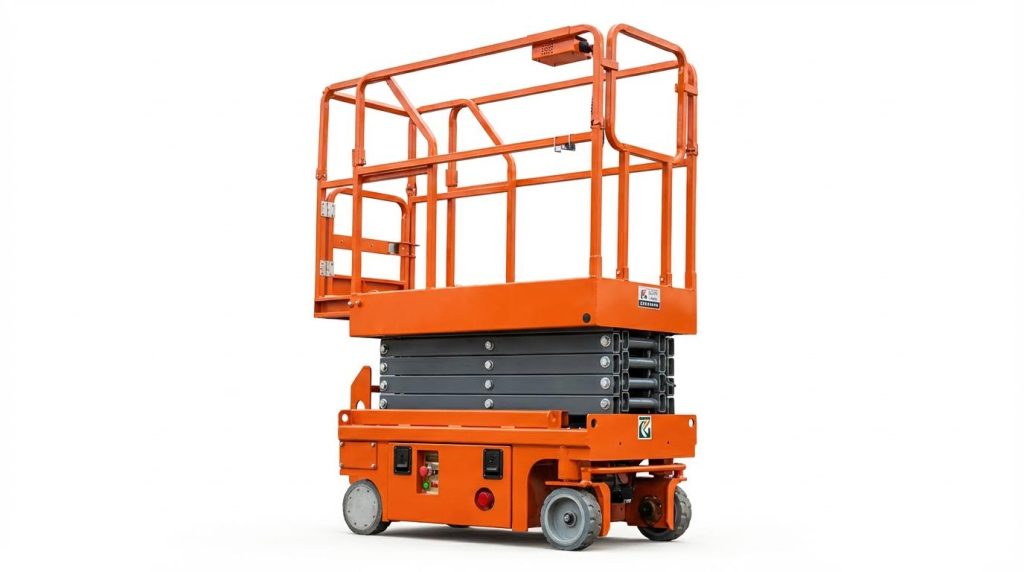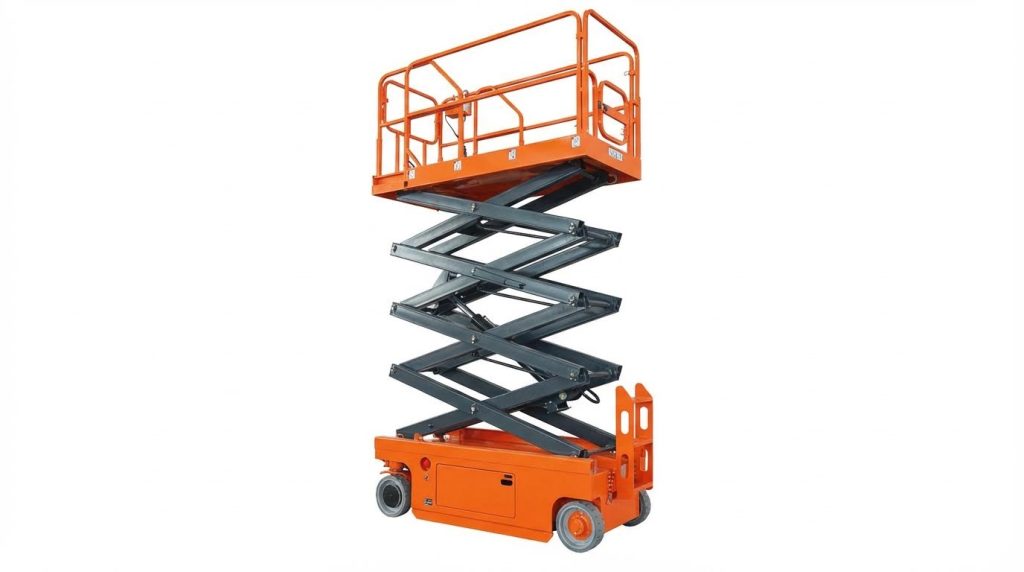
Scissor lift batteries determine how far you drive, how high you lift, and how safely you stop. This guide explains battery types, what size battery in an upright electric scissor lift actually means in volts and amp-hours, and how to maintain packs for maximum life and uptime. You will see how chemistry choice, tray space, weight limits, and charging routines all interact in real jobsite conditions. By the end, you can specify, operate, and look after scissor platform batteries with confidence.
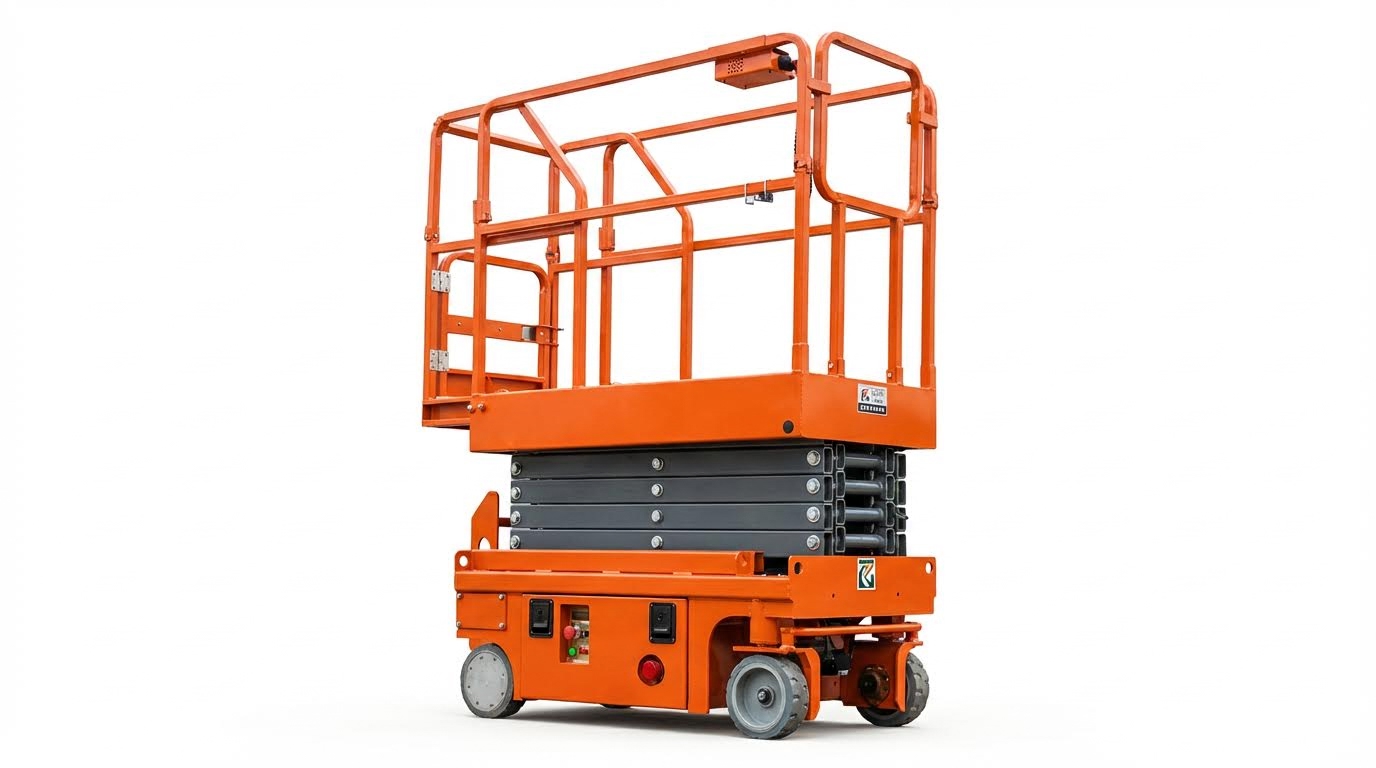
Core Battery Concepts For Upright Electric Scissor Lifts
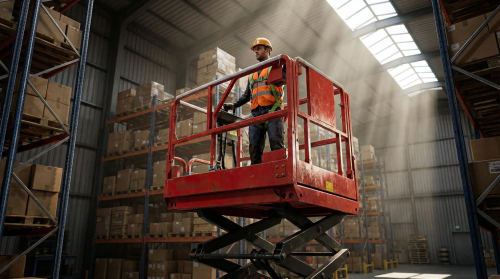
Core battery concepts for upright electric scissor lifts revolve around chemistry, system voltage, and duty cycle so you can correctly decide what size battery in an scissor platform lift will support a full work shift without premature failure.
Before you choose a pack, you must understand three linked questions: which chemistry fits your environment, what voltage architecture the lift uses, and how deeply you can discharge the pack per day without killing cycle life.
Common chemistries used in scissor lifts
Upright electric scissor lifts mainly use flooded lead-acid, AGM/VRLA, or lithium iron phosphate batteries, and each chemistry changes maintenance needs, cycle life, and usable capacity per shift.
These chemistries are the foundation for sizing because the same Ah rating delivers very different real-world runtime, charging flexibility, and lifetime cost.
- Flooded lead-acid: Vented cells with liquid electrolyte – Lowest upfront price but needs watering and regular equalization. Typical aerial platform batteries
- AGM/VRLA: Sealed lead-acid with immobilized electrolyte – Less daily maintenance and better spill safety for indoor warehouses. Industrial scissor lift packs
- Lithium iron phosphate (LFP): High-cycle lithium chemistry – Fast charging and long life, ideal for multi-shift or rental fleets. Cycle life data
| Chemistry | Typical Cycle Life | Maintenance Needs | Charging Time (typical) | Operational Impact |
|---|---|---|---|---|
| Flooded lead-acid | ≈300–700 cycles at 50% DoD | High: watering + equalization | ≈8 h charge + cooling | Best for low-cost, single-shift use with good maintenance discipline |
| AGM/VRLA | Higher than flooded at same DoD | Medium: no watering, still needs inspections | Similar to flooded; depends on charger | Good for indoor sites needing low spill risk and reduced daily service |
| Lithium iron phosphate | >3,500 cycles at moderate DoD | Low: BMS-managed, no watering | Often ≈1 h to full charge | Ideal for high-utilization fleets and opportunity charging between tasks |
Lithium iron phosphate packs often exceeded 3,500 cycles at moderate depth of discharge and supported fast charging, sometimes reaching full charge in about one hour, while flooded lead-acid typically achieved only 300–700 cycles at 50% depth of discharge. Documented scissor lift specs
💡 Field Engineer’s Note: For rental fleets that see irregular charging habits, lithium iron phosphate with a robust BMS tolerates abuse far better than flooded lead-acid, which suffers rapid sulfation when operators repeatedly leave lifts partially charged.
Voltage systems and typical battery sizes
Most upright electric scissor lifts use 24 V or 48 V DC systems, typically built from 6 V deep-cycle blocks in series, and this architecture strongly influences what size battery in an scissor platform lift you can install in the tray.
Higher voltage reduces current for the same power, which cuts cable losses and allows smaller conductors, but it also dictates how many physical blocks must fit into the battery compartment.
| System Voltage | Typical Configuration | Typical Ah Range (20 h rate) | Common Use Case | Operational Impact |
|---|---|---|---|---|
| 24 V DC | 4 × 6 V blocks in series | ≈200–260 Ah | Light to medium-duty indoor scissors | Supports a standard single shift if depth of discharge is controlled |
| 48 V DC | 8 × 6 V blocks in series | ≈300–400 Ah or higher | Heavier-duty, higher lift heights | Handles higher power with lower current and better efficiency |
Typical 24 V scissor lifts used batteries in the 200–260 Ah range at the 20-hour rate, while heavier-duty 48 V units often required 300–400 Ah or more to keep depth of discharge within life-extending limits. Engineering sizing guidance
From a geometric standpoint, each 6 V deep-cycle block typically measured about 260 mm × 180 mm × 275 mm and weighed around 30 kg, so a 24 V pack of four blocks weighed around 120 kg and a 48 V pack of eight blocks around 240 kg. Battery envelope data
How voltage choice affects what size battery in an upright electric scissor lift
A 24 V lift usually has space and mass budget for four 6 V blocks in the 200–260 Ah class, while a 48 V lift needs eight blocks but can use similar block size; the total Ah per string and daily depth of discharge determine whether the pack can support your shift length.
💡 Field Engineer’s Note: When retrofitting from lead-acid to lithium in a 24 V or 48 V scissor lift, always check the original battery tray height and cable routing; many lithium modules are shorter but longer, and a tight bend radius on heavy cables can cause premature insulation wear.
Duty cycles, depth of discharge, and cycle life
Duty cycle and depth of discharge (DoD) determine how long a scissor lift battery pack will last in cycles, so you must match Ah capacity to daily energy use instead of just asking what size battery in an scissor platform was originally installed.
Engineers estimate average current draw and operating hours per shift, then select a pack that keeps daily DoD in a range that the chemistry can tolerate for thousands of cycles.
- Lead-acid recommended DoD: ≈50–80% – Going deeper than 80% regularly shortens life below the 300–700 cycle band. Cycle life vs DoD
- Lithium iron phosphate recommended DoD: ≈70–90% – Higher usable window gives more runtime from the same nominal Ah. DoD guidance
- Typical 24 V pack: 200–260 Ah – Sized so a normal shift stays within the target DoD window.
- Typical 48 V pack: 300–400 Ah+ – Supports higher lift duty and travel without deep daily discharge.
| Chemistry | Recommended Daily DoD | Resulting Cycle Life Band | Best For… |
|---|---|---|---|
| Flooded/AGM lead-acid | ≈50–80% | ≈300–700 cycles at ≈50% DoD | Single-shift work where overnight 8 h charging is available |
| Lithium iron phosphate | ≈70–90% | >3,500 cycles at moderate DoD | Multi-shift, high utilization, or opportunity-charged fleets |
Engineers also considered C-rates: the selected batteries had to support peak current draw without excessive voltage sag or thermal rise, otherwise the platform could slow or fault during elevation even if the state of charge looked acceptable. Performance under load
Linking duty cycle to amp-hour sizing
If your upright electric scissor lift draws on average 40 A over a 6-hour effective workday, that is 240 Ah of energy. A 24 V, 260 Ah lead-acid pack would run near 90% DoD, which is too deep; you would either increase Ah or move to lithium, which can safely use a higher DoD window.
💡 Field Engineer’s Note: Many “range complaints” trace back to cold mornings; lead-acid capacity drops sharply below 0°C, so a pack that was marginally sized at 27°C can feel one size too small in winter unless you add heating or extra Ah margin.
Technical Comparison Of Scissor Lift Battery Options
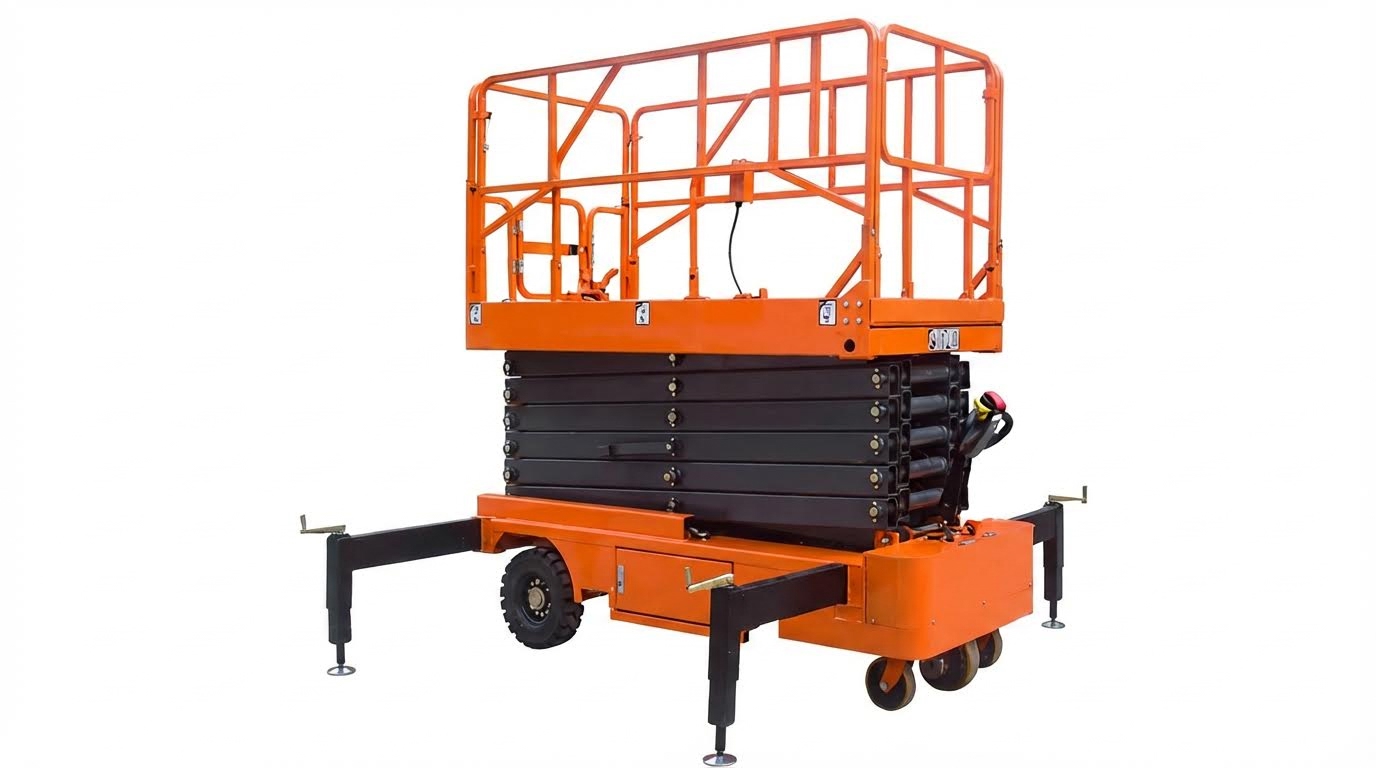
This section compares scissor lift battery chemistries, capacities, and environmental ratings so you can decide what size battery in an upright electric scissor platform best matches your duty cycle and site conditions.
💡 Field Engineer’s Note: When comparing packs, do not just match voltage; compare amp-hour rating at the same hour-rate (usually 20 h) and ask how many full-shift cycles you get before hitting your depth-of-discharge limit.
Lead-acid vs AGM/VRLA vs lithium iron phosphate
Lead-acid, AGM/VRLA, and lithium iron phosphate batteries all power upright electric scissor platform lift, but they trade cost, maintenance, and cycle life very differently.
| Chemistry | Typical Cycle Life & Depth of Discharge | Maintenance Needs | Cost Profile | Operational Impact for Upright Electric Scissor Lifts |
|---|---|---|---|---|
| Flooded lead-acid | ≈300–700 cycles at about 50% depth of discharge (DoD vs cycle data) | Regular watering, terminal cleaning, equalization charges, ventilation needed (maintenance practices) | Lowest upfront cost | Best where budgets are tight, shifts are short, and daily maintenance is reliable; common in 24 V packs around 200–260 Ah. |
| AGM/VRLA (sealed lead-acid) | Similar or slightly better than flooded at moderate DoD; sensitive to chronic overcharge | No watering; still needs torque and cleanliness checks (maintenance tips) | Higher cost than flooded, lower than lithium | Good for indoor rental fleets where low spill risk and low daily maintenance matter more than maximum life. |
| Lithium iron phosphate (LiFePO₄) | Often >3,500 cycles at moderate DoD, with 70–90% usable depth of discharge (cycle life data) | Minimal routine maintenance; relies on integrated BMS for protection (BMS role) | Highest upfront cost | Best for multi-shift or high-utilization fleets needing fast charge, long life, and strong cold-weather performance; common in higher-voltage, high-Ah packs. |
- Flooded lead-acid: Lowest purchase price – works if operators can manage watering and 8-hour charge windows.
- AGM/VRLA: Sealed and spill-resistant – reduces corrosion and ventilation issues in tight indoor spaces.
- Lithium iron phosphate: Longest life and fastest charging – supports opportunity charging between tasks and reduces downtime.
How this affects what size battery in an upright electric scissor lift
If you choose lead-acid, you often need a larger amp-hour size to limit daily depth of discharge to 50–80%. With lithium, you can usually select a smaller nominal Ah pack for the same runtime because 70–90% of capacity is usable without killing cycle life.
Amp-hour capacity, C-rates, and performance under load
The right amp-hour rating and C-rate capability determine what size battery in an upright electric aerial platform you need to finish a shift without voltage sag or overheating.
| System Type | Typical Voltage | Typical Capacity Range | Recommended Depth of Discharge | Operational Impact |
|---|---|---|---|---|
| Standard indoor scissor lift | 24 V DC (4 × 6 V in series) (24 V layout) | ≈200–260 Ah at 20 h rate for lead-acid (capacity ranges) | Lead-acid: 50–80% per day | Sized for single-shift warehouse use; going below 50% DoD regularly shortens life. |
| Heavy-duty / higher platform height | 48 V DC (8 × 6 V in series) (48 V layout) | ≈300–400 Ah or higher at 20 h rate (high-capacity packs) | Lead-acid: 50–80%; lithium: 70–90% | Supports higher motor power with lower current per cell, reducing cable losses and heat. |
| Lithium retrofit pack | 24 V or 48 V module | Engineered to match or slightly undercut lead-acid Ah while offering higher usable DoD | 70–90% usable daily DoD for long life (lithium DoD guidance) | Allows smaller physical pack with similar runtime, freeing tray space and reducing weight. |
- Amp-hour (Ah) rating: Indicates stored energy at a defined hour-rate – higher Ah usually means longer runtime but more weight and cost.
- C-rate capability: Defines how fast you can safely discharge or charge – critical for lifts that see frequent, high-current lifts and drives.
- Voltage sag under load: Excessive sag causes controller faults – select chemistries and capacities that hold voltage during peak lift current.
Quick way to estimate what size battery in an upright electric scissor lift
Estimate average current (A) during operation, multiply by operating hours to get required Ah, then divide by your target depth of discharge. For example, if you need 80 Ah per shift and want to limit lead-acid to 50% DoD, you size for roughly 160 Ah or higher; in practice, manufacturers standardize around 200–260 Ah at 24 V to cover inefficiencies and occasional heavy use.
💡 Field Engineer’s Note: If operators complain about the lift “getting weak” near the end of a shift, you likely undersized Ah or allowed too high a C-rate. Log current draw and voltage during peak lifts; if voltage collapses, you need either a higher Ah rating or a chemistry with lower internal resistance, such as lithium iron phosphate.
Temperature effects, IP ratings, and certification needs
Temperature range, enclosure IP rating, and compliance standards often decide which chemistry and what size battery in an upright electric semi electric order picker you can safely deploy on a given site.
| Factor | Lead-acid (Flooded / AGM) | Lithium Iron Phosphate | Operational Impact |
|---|---|---|---|
| Low-temperature performance | Capacity drops sharply below 0°C; cold cranking and runtime suffer (temperature effects) | Maintains function to about -20°C; many packs integrate heaters (low-temp capability) | In cold storage or winter sites, you may need to oversize lead-acid Ah or switch to lithium to keep the same usable runtime. |
| Ingress Protection (IP) rating | Often used in IP20–IP23 enclosures for indoor use (IP guidance) | Modules can reach IP54–IP67, protecting against dust and water jets or immersion (IP67 example) | Outdoor construction lifts benefit from higher IP; you can run in rain and muddy conditions with less corrosion risk. |
| Certifications | Typically designed to meet CE/UL/IEC safety standards and ISO 9001 quality systems (certification overview) | Must also comply with UN 38.3 transport tests for lithium transport safety | Compliance affects shipping, site acceptance, and insurance; always verify documents for the exact pack you specify. |
- Cold environments: Favor lithium with heaters or oversize lead-acid Ah – prevents mid-shift brownouts due to temperature-related capacity loss.
- Wet or dusty sites: Look for higher IP-rated modules – reduces failures from water ingress and conductive dust.
- Regulated projects: Check CE, UL/IEC, and UN 38.3 paperwork – avoids delays at commissioning or during audits.
Temperature and IP rating vs. battery sizing
At low temperatures, a nominal 240 Ah lead-acid pack can behave more like a 150–180 Ah pack. In practice, that means that for a freezer warehouse you either step up to a higher Ah tray option or move to a lithium pack that keeps most of its capacity down to about -20°C, often without increasing the tray footprint.
💡 Field Engineer’s Note: When a lift is specified for mixed indoor–outdoor use, I treat the worst-case environment (cold, wet, long ramps) as the design point. That often justifies a lithium pack with higher IP rating and slightly higher nominal Ah, even if indoor-only runtime calculations say a smaller lead-acid pack would be enough.
Selecting And Maintaining The Right Battery Pack
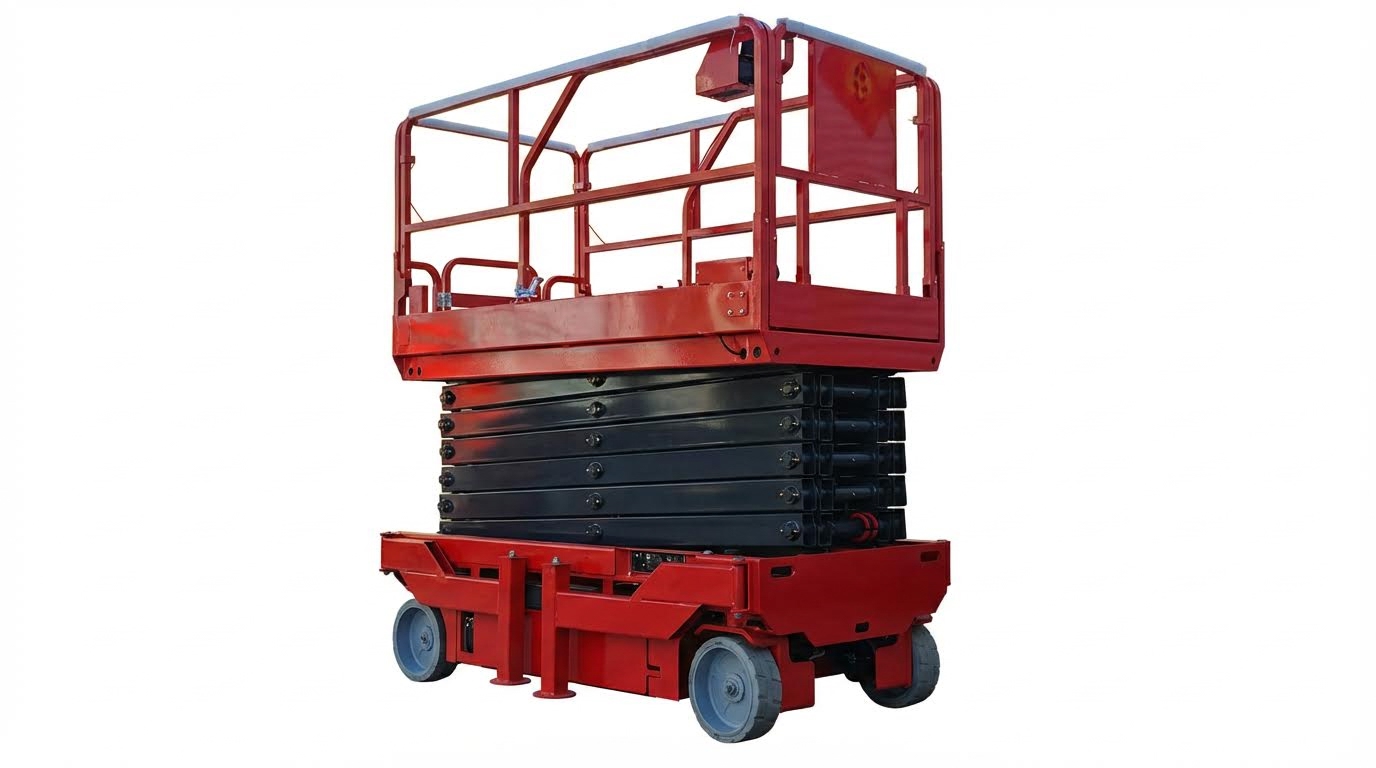
Selecting and maintaining the right battery pack for an scissor platform lift means matching voltage, Ah, and mass to the tray envelope and duty cycle, then running disciplined charging and inspection routines to maximize safe uptime.
This is also where most owners quietly answer the real question: what size battery in an scissor platform will cover a full shift without killing cycle life or overloading the chassis.
Matching battery size to tray, weight, and COG limits
Correctly matching battery size to tray, weight, and COG limits means you choose voltage and amp‑hours that physically fit, stay within stability calculations, and still deliver the runtime your duty cycle needs.
For anyone asking what size battery in an scissor platform lift is appropriate, you always start from three constraints: tray dimensions, allowable mass, and required run‑time at 24 V or 48 V.
| Selection Factor | Typical Data / Range | How To Use It | Operational Impact |
|---|---|---|---|
| System voltage | 24 V or 48 V DC architectures documented for modern scissor lifts | Match replacement pack to OEM voltage; do not mix 24 V and 48 V hardware. | Wrong voltage risks controller damage and severe performance loss. |
| Typical Ah capacity (24 V) | ≈200–260 Ah at 20‑h rate for standard 24 V lifts | Use in light/medium‑duty indoor lifts with one shift per day. | Covers a normal workday if depth of discharge stays around 50–80%. |
| Typical Ah capacity (48 V) | ≈300–400 Ah or higher for heavier-duty units | Use for tall platforms, rough terrain, or multi‑shift work. | Supports higher current draw without deep discharging every shift. |
| Tray space (footprint) | Example 6 V block ≈260 mm × 180 mm × 275 mm, ≈30 kg for deep-cycle units | Multiply block footprint by 4 (24 V) or 8 (48 V) and compare to tray envelope. | Ensures batteries slide in/out and leaves room for cabling and venting. |
| Depth of discharge (DoD) | Lead‑acid: ≈50–80% DoD; Lithium: ≈70–90% DoD to extend cycle life | Size Ah so a normal shift stays inside these DoD bands. | Too small a pack forces deep cycles and shortens life drastically. |
| Total battery mass | Sum of all blocks (e.g., 4 × 30 kg = 120 kg for a 24 V pack) | Compare to OEM spec for counterweight and axle load limits. | Overweight packs can push COG outside stability envelope. |
- Start with OEM spec: Confirm required system voltage and recommended Ah – this sets the safe baseline for what size battery in an scissor platform lift you can use.
- Check tray envelope: Measure internal length, width, and height of the steel tray – prevents interference with covers, cables, and vent caps.
- Count series blocks: 24 V typically uses four 6 V units; 48 V uses eight 6 V units – ensures correct voltage without parallel‑wiring mistakes.
- Respect COG limits: Compare total battery mass and location against the machine’s stability chart – avoids tipping risk when the platform is elevated.
- Match chemistry to duty: Use flooded lead‑acid for low‑cost single‑shift; lithium iron phosphate for high‑cycle or cold‑climate work – balances capex and lifetime energy cost.
How to estimate required Ah from your duty cycle
List all major loads (drive, lift pump, steering) and estimate average current draw during a typical hour of operation. Multiply average current by operating hours per shift to get required Ah. Then divide by your target depth of discharge (for example, 0.6 for 60% DoD) to find the minimum pack rating. Always round up to the next standard size and cross‑check that the battery dimensions and mass remain within tray and COG limits.
💡 Field Engineer’s Note: When upgrading from lead-acid to lithium in an existing tray, the lighter mass can move the center of gravity upward and inward. Always re-check stability and, if needed, add certified ballast rather than assuming “lighter is always safer.”
Charging profiles, watering, and equalization routines
Correct charging profiles, watering, and equalization routines keep internal chemistry healthy, preventing sulfation, dry plates, and overheating that silently destroy scissor platform batteries long before their rated cycle life.
The right maintenance program depends heavily on chemistry: flooded lead-acid demands regular fluid checks and equalization, while AGM/VRLA and lithium focus on correct charger settings and temperature control.
| Maintenance Task | Typical Practice / Data | Why It Matters | Operational Impact |
|---|---|---|---|
| Charge duration (lead-acid) | ≈8 hours charge plus cooling period for standard profiles | Allows absorption and finish stages to complete. | Consistently hitting full charge maximizes capacity and cycle life. |
| Charge behaviour (lithium iron phosphate) | Supports much faster charging and higher efficiency, often near 1‑hour full charge under proper control | Enables opportunity charging between tasks. | Ideal for multi‑shift fleets needing quick turnarounds. |
| Smart charger cut‑off (example 12 V block) | Cut off around 14.8 V; resume below ≈12.7 V for lead-acid charging | Prevents overcharge and excessive gassing. | Reduces water loss and plate corrosion. |
| Watering (flooded lead-acid) | Keep electrolyte above plates; add water after charging to avoid overflow | Dry plates overheat and shed active material. | Avoids permanent capacity loss and thermal damage. |
| Equalization charging | Periodic controlled overcharge to rebalance cells and reduce sulfate buildup in hard-cycled packs | Brings weak cells up and dissolves some sulfate. | Improves runtime consistency between charges. |
| Cleaning and neutralizing | Use ≈5 ml baking soda per 0.95 L warm water to neutralize acid residues on tops and terminals | Prevents stray currents and corrosion. | Maintains reliable connections and reduces self‑discharge. |
- Charge after every shift: Put the lift on charge as soon as it returns to the yard – avoids deep discharges that slash cycle life.
- Avoid partial top‑ups on lead-acid: Repeated “sip charging” without full cycles encourages sulfation – schedule full charges and equalization as per OEM.
- Check electrolyte levels regularly: Inspect flooded cells and top up with deionized water after charge – keeps plates submerged and temperature under control.
- Keep terminals tight and clean: Inspect monthly for abrasion, loose lugs, and corrosion as part of routine maintenance – prevents hot spots and voltage drops under load.
- Respect temperature limits: Charge and store batteries in cool, dry conditions to minimize degradation – high heat accelerates grid corrosion and electrolyte loss.
Equalization safety checklist
Only equalize flooded batteries, never sealed AGM/VRLA or lithium. Verify electrolyte covers the plates before starting. Isolate the area with ventilation, eye protection, and acid-resistant PPE. Use a charger with a dedicated equalize mode and follow the time and voltage limits specified by the battery manufacturer. Log pack temperature and stop if it rises excessively during the process.
💡 Field Engineer’s Note: If you see a scissor platform that “dies” quickly but charges to 100% very fast, suspect sulfation from chronic undercharging. A controlled series of equalization charges may recover some capacity, but often the most economical move is to budget for replacement.
BMS, telematics, and predictive maintenance practices
Modern BMS, telematics, and predictive maintenance practices turn the battery pack from a black box into a monitored asset, allowing you to catch abuse, mis‑sizing, and early failures before they strand an elevated platform.
This is especially important for lithium iron phosphate and advanced VRLA packs, where electronics supervise every cell and communicate with the lift or fleet software over digital buses.
| Technology / Practice | Key Functions | What It Protects Against | Best For… |
|---|---|---|---|
| Battery Management System (BMS) | Monitors cell voltages, pack current, and temperature; enforces limits on charge/discharge and short circuits in lithium packs | Overcharge, over‑discharge, thermal runaway, and unbalanced cells. | Lithium iron phosphate packs in high‑duty or rental fleets. |
| Communication (CAN bus / RS485) | Shares state‑of‑charge, state‑of‑health, and fault codes with the machine or fleet system for remote monitoring | Blind operation with no visibility into pack condition. | Sites with many lifts and centralized maintenance teams. |
| Predictive maintenance algorithms | Track internal resistance, temperature excursions, and deep‑discharge events to flag anomalies | Unexpected in‑service failures and sudden runtime loss. | Mission‑critical applications where unplanned downtime is costly. |
| Telematics dashboards | Aggregate runtime, charging patterns, and alarm history per unit. | Misuse such as repeated deep discharges or ignoring fault codes. | Fleet managers optimizing replacement timing and training. |
- Use BMS data in sizing decisions: Review historical peak currents and depth of discharge before upsizing or downsizing packs – ensures the next battery size in your scissor platform lift truly matches real usage.
- Set alarms for abusive behavior: Configure alerts for over‑temperature, deep discharge, and repeated under‑charging – catches bad habits before they become chronic damage.
- Trend internal resistance: Rising resistance in one block or module versus the rest signals developing failure – lets you replace weak elements proactively.
- Integrate with work orders: Link BMS or te
Final Thoughts On Optimizing Scissor Lift Battery Performance
Optimizing scissor lift battery performance is not about chasing the biggest pack. It is about matching chemistry, voltage, amp‑hours, and geometry to real duty cycles and stability limits. Correct sizing keeps daily depth of discharge inside safe bands, so packs deliver rated cycles instead of failing early. The right chemistry then fine‑tunes that choice: lead‑acid suits controlled single‑shift work, while lithium iron phosphate supports fast charging, cold sites, and high utilization.
Tray dimensions, mass, and center of gravity limits act as hard guards. Engineers must respect them when they retrofit or change chemistries, otherwise the lift can lose stability or overload axles. Maintenance routines and charger settings then lock in that design work. Good watering, equalization, cleaning, and temperature control keep lead‑acid healthy. BMS, telematics, and predictive analytics do the same for lithium packs and mixed fleets.
The best practice for operations teams is simple. Start from the OEM data, size to actual current draw and shift length, and verify geometry and mass. Then enforce disciplined charging and inspection rules, supported by BMS data where available. Done together, these steps give Atomoving scissor platforms safe runtime, predictable handling, and the lowest cost per operating hour.
Frequently Asked Questions
What size battery is used in an upright electric scissor lift?
Upright electric scissor lifts typically use a 24V system, which requires four 6V batteries with a minimum rating of 220 amp-hours. Batteries like the U.S. Battery US 2000 XC2 or US 2200 XC2 are ideal for these power requirements. Battery Power Guide.
What types of batteries are commonly used in scissor lifts?
Scissor lifts commonly use lead-acid batteries due to their reliability and low cost. However, lithium-ion batteries are becoming increasingly popular because they are maintenance-free and offer better efficiency. Battery Comparison.