55-gallon drums and other chemical containers. They supported compliance with EPA 40 CFR 264.175, OSHA expectations, SPCC plans, and local environmental rules by providing reliable secondary containment capacity. Engineering teams evaluated pallet materials, structural load ratings, sump integrity, and features such as drainage, forklift access, and weather protection to match specific plant risks. The full article examined how to interpret regulatory capacity requirements, design and select HDPE or steel pallets, integrate them into indoor and outdoor storage layouts, and implement inspection, monitoring, and predictive maintenance for long-term compliance.
Regulatory Requirements For Drum Spill Pallets
Regulatory requirements for drum spill pallets focused on preventing uncontrolled releases of hazardous liquids. Facilities needed secondary containment that matched drum storage configurations and site risk. Engineers had to interpret federal rules, then align pallet selection, layout, and operating procedures. The following subsections outlined the main compliance pillars that governed drum spill pallet design and use.
EPA 40 CFR 264.175 Secondary Containment Rules
EPA 40 CFR 264.175 defined performance criteria for secondary containment under hazardous waste regulations. The rule required containment to hold either 110% of the largest single container or at least 10% of the total volume stored, whichever value was greater. For drum spill pallets, this translated into minimum sump capacities that designers verified against 55-gallon (≈208-liter) drum volumes. The regulation also mandated impermeable construction, no cracks or gaps, and provisions to prevent run-on from external stormwater. Facilities had to drain accumulated liquids periodically to ensure the sump always retained the required free capacity before operations. Drain valves, when present, needed secure closure and controlled discharge to approved treatment or collection systems.
OSHA, SPCC, And Local Environmental Compliance
OSHA requirements primarily addressed worker safety around chemical storage, including stable drum support, safe access, and clear labeling. Spill pallets contributed by reducing slip hazards, containing leaks, and supporting compliant housekeeping under 29 CFR 1910.1200 and related standards. SPCC rules under 40 CFR Part 112 applied where facilities stored oil above threshold quantities; in these cases, spill pallets formed part of the secondary containment system sized for oil-bearing drums. Local and regional environmental agencies often added stormwater, fire code, and hazardous substances regulations that tightened requirements on outdoor storage, ignition separation distances, and drainage controls. Engineers therefore checked federal, state, and municipal codes together, ensuring pallet materials, covers, and bunded areas aligned with the strictest applicable standard.
Capacity Calculations For 55-Gallon Drum Storage
Capacity calculations started with converting drum volumes to liters and then applying the 40 CFR 264.175 criterion. A standard 55-gallon drum held about 208 liters, so a four-drum array represented roughly 832 liters of liquid. For four drums, the secondary containment had to hold at least 832 liters (largest drum) or 10% of 832 liters (≈83 liters); therefore, 832 liters governed. Engineers compared this requirement to catalog sump capacities, such as 488 liters or 1600 liters, to determine compliance margins. Where multiple pallet modules formed a system, calculations considered the hydraulically connected volume, not individual pallets in isolation. Designers also accounted for potential precipitation in uncovered outdoor applications, often oversizing sumps or adding roofs to maintain regulatory freeboard.
Inspection, Maintenance, And Documentation Duties
Regulators expected documented inspection and maintenance programs for spill pallets and associated containment infrastructure. Routine inspections checked for cracks, UV degradation, corrosion on steel units, blocked drains, and damaged grating that could compromise sump integrity. Operators recorded sump liquid levels, verified that drain plugs remained closed during normal operation, and confirmed that any drained liquids went to approved collection points. Written logs, integrated where possible into environmental management or EHS software, demonstrated ongoing compliance during audits under EPA, OSHA, or SPCC plans. Training programs ensured personnel recognized nonconforming conditions, such as insufficient free capacity or incompatible chemicals sharing a pallet, and initiated corrective actions with traceable records.
Engineering Design And Material Selection
Engineering design of drum spill pallets balanced regulatory capacity requirements, structural safety, and chemical compatibility. Designers selected geometry, wall thickness, and support ribs to achieve required sump volumes while maintaining stiffness under uniformly distributed drum loads. Material choices, primarily high-density polyethylene (HDPE) and steel, influenced resistance to acids, bases, oils, and solvents, as well as fire behavior and mechanical durability. Ancillary features such as drain plugs, forklift pockets, and removable grating affected usability, inspection efficiency, and lifecycle costs.
HDPE Vs. Steel Spill Pallets For Chemical Resistance
HDPE spill pallets used linear or high-density polyethylene that resisted corrosion and attack from most inorganic acids, bases, and salts. This polymer construction prevented rust and pitting, which steel pallets experienced when coatings failed or when exposed to aggressive chemicals. Steel pallets, however, offered higher inherent stiffness and better resistance to elevated temperatures and mechanical impact, which benefited flammable liquid storage in controlled environments. Designers typically specified HDPE for broad chemical compatibility and outdoor use, and steel for high-load or fire-risk areas, after cross-checking with safety data sheets and compatibility charts.
HDPE pallets such as the UP-1401 or UP-1503 models supported multiple 55-gallon drums while keeping the structure lightweight and easy to handle with forklifts. Steel models like the UP-412122 provided moderate sump capacities with compact footprints and suited indoor bunded stores or where hot work occurred nearby. Wooden pallets were not appropriate for hazardous chemical containment because they absorbed liquids and provided no integral sump. Engineers evaluated UV stability, impact resistance, and expected chemical exposure duration when deciding between HDPE grades and steel thicknesses.
Structural Load Ratings And Sump Integrity
Structural design centered on two independent criteria: the uniformly distributed load rating and the sump volume defined by EPA 40 CFR 264.175. Load ratings had to exceed the combined mass of full drums, often hundreds of kilograms per pallet, with safety factors against creep and impact. For example, a compact spill pallet with an 800 kg rating safely supported a single or pair of 55-gallon drums, while large platforms like the UP-1503 or UP-1506 handled ten or six drums respectively with sump capacities up to 1600 liters. Engineers validated these ratings through finite element analysis and physical testing for deflection, cracking, and long-term deformation.
Sump integrity required continuous, crack-free basins that contained at least the larger of 10% of total stored volume or the largest single container volume. Designers used ribbed bases, rounded internal corners, and uniform wall thickness to minimize stress concentrations that could initiate leaks. HDPE pallets used molded one-piece construction to eliminate joints, while steel pallets relied on fully welded seams and leak testing. Periodic inspections for cracks, corrosion, and impact damage were essential to maintain the certified load rating and containment capacity throughout the pallet’s service life.
Drainage, Run-On Prevention, And Weather Protection
Drainage features enabled controlled removal of accumulated liquids without dismantling drum layouts. Models such as UP-2402, UP-2401, and UP-2201 included drain plugs that allowed operators to decant collected rainwater or spills into approved waste containers, as required by EPA guidance on periodic draining. Engineers located drains at sump low points and protected them with recessed or shielded fittings to avoid impact from forklifts and pallet jacks. Removable grating above the sump allowed visual inspection of liquid levels and simplified decontamination after spill events.
Run-on prevention formed a critical part of secondary containment design, especially outdoors. Pallet sidewalls and integral berms had to block external stormwater from entering the sump, preserving capacity for actual spills. Weather protection solutions included fitted covers, warning-color lids, and integration into weather-resistant sheds with built-in sumps for long-term outdoor storage. For temporary or mobile operations, flexible PVC berms and modular spill decks provided additional containment around pallets, protecting against overflows beyond the primary sump volume. These design measures collectively reduced the risk of overflow, environmental discharge, and non-compliance during heavy rainfall.
Ergonomics, Forklift Access, And Grating Design
Ergonomic design reduced manual handling risks while maintaining compatibility with warehouse equipment. Spill pallets incorporated forklift pockets and pallet jack entry points so trained operators could move loaded units without tilting drums or stressing the sump. Low-profile models, such as 15 cm high designs, minimized
Selection, Sizing, And Application In Plants
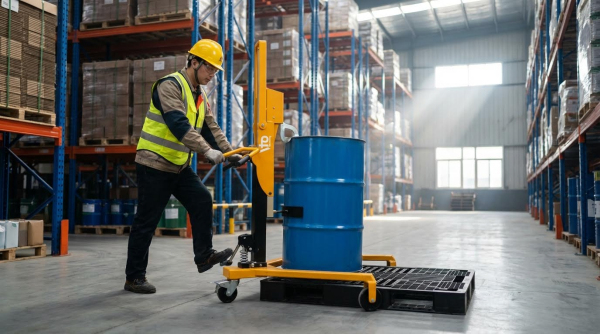
Engineers sized drum spill pallets to balance regulatory containment, floor space, and handling efficiency. Plants evaluated the largest credible spill, drum throughput, and segregation rules before selecting configurations. Correct application minimized environmental risk, reduced manual handling, and simplified emergency response planning.
Choosing Drum Capacity: 1, 2, 4, 6, And 10-Drum Pallets
Capacity selection started with inventory profiles and decanting patterns. Single-drum pallets, such as units around 67 cm by 67 cm with 42 L sumps, suited point-of-use dispensing or isolated high-hazard chemicals. Two- and four-drum pallets, with footprints near 132–133 cm by 66–133 cm and sump volumes from 80 L to 488 L, fit typical 55-gallon (≈208 L) drum clusters while meeting EPA 40 CFR 264.175 secondary containment criteria. Six- and ten-drum pallets, with sump capacities up to 1100–1600 L, supported high-throughput zones but required careful evaluation of floor loading and forklift turning radii. Plants often standardized on two- and four-drum units for flexibility, reserving large platforms for bulk storage blocks to limit cross-contamination risk.
Indoor Vs. Outdoor Storage And Bunded Solutions
Indoor drum storage usually relied on low-profile polyethylene pallets and modular spill decks, which simplified material flow and reduced trip hazards. Outdoor storage demanded additional bunded solutions, such as covered spill pallets, sheds with built-in sumps, or PVC berms, to prevent rainwater ingress and run-on. Designs with integrated covers, warning colors, and drain plugs helped maintain freeboard by allowing controlled drainage after visual inspection, in line with EPA requirements. For exposed yards, engineers placed pallets on hardstand areas, ensured drums sat above local flood levels, and specified UV-stable materials or steel constructions where mechanical damage risk was high. Bund height and access ramps were sized so trained forklift drivers could load drums safely without compromising containment wall integrity.
Integrating Spill Pallets With Racks And Material Flow
Integration with warehouse racking started from structural checks: racks had to carry the mass of several 208 L drums plus pallet weight and sump liquid. Engineers aligned pallet footprints, such as 130 cm by 130 cm four-drum units or 220 cm by 130 cm six-drum platforms, with bay dimensions and aisle widths to maintain forklift clearances. Spill pallets under lower rack levels or in staging lanes acted as secondary containment during storage, filling, and dispensing, while absorbents and overpack drums provided tertiary protection for incident response. Plants mapped drum flows from receiving to production and waste areas, then located pallets at transfer nodes to catch leaks during drum changeover. Standardized handling rules, including securing drums with bands during movement and restricting transport to certified operators, reduced impact loads on pallets and extended service life.
Digital Twins, Monitoring, And Predictive Maintenance
Digital twins of drum storage areas modeled pallet locations, sump capacities, and chemical segregation rules to test layout options before implementation. Engineers linked these models to inventory systems so they could verify that total stored volume and largest-container rules aligned with installed containment capacity. Sensors on selected pallets, such as level switches in sumps or strain gauges on support structures, fed monitoring dashboards that flagged overfilled sumps, abnormal loads, or frequent leak events. Historical data supported predictive maintenance by identifying pallets or zones with high incident rates, prompting targeted inspections, grating replacement, or material upgrades from HDPE to steel. This data-driven approach improved compliance documentation, supported SPCC reviews, and allowed continuous optimization of drum handling and containment strategies across the plant.
Summary Of Drum Spill Pallet Best Practices And Compliance
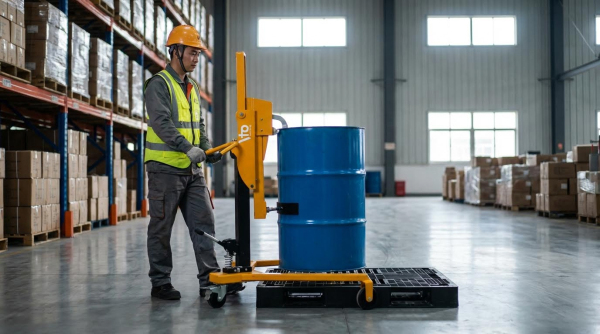
Drum spill containment pallets formed a critical layer of secondary containment for hazardous liquids in industrial plants. Facilities needed to size sumps to satisfy 40 CFR 264.175, which required either 10% of the total stored volume or the full volume of the largest container, whichever was greater. Engineers selected HDPE or steel constructions with verified chemical compatibility, corrosion resistance, and structural ratings that exceeded the combined mass of full 55-gallon drums. Designs also had to prevent run-on, allow controlled drainage, and remain free from cracks, gaps, and deformation throughout service life.
Industry practice evolved toward modular systems, including 1-, 2-, 4-, 6-, and 10-drum pallets, spill decks, and covered outdoor stores with integrated sumps. Plants increasingly integrated spill pallets with racking, forklift aisles, and material flow to minimize manual handling and reduce damage risk. Digital tools, including monitoring sensors and predictive maintenance models, started to support inspection intervals, documentation, and failure-mode trending. These developments aligned with OSHA and SPCC expectations for systematic hazard control and traceable records.
When implementing spill pallet programs, sites needed clear standards for inspection, retirement criteria, and repair, as well as operator training in spill prevention and emergency response. Future trends pointed toward smarter containment systems with level sensors, connectivity to environmental management software, and wider use of high-visibility warning colors to enhance situational awareness. A balanced approach combined robust mechanical design, regulatory compliance, and operational practicality, ensuring that containment infrastructure kept pace with changes in chemical inventories, throughput, and environmental expectations.