Safe drum handling starts with understanding how to move drums of chemicals using engineered equipment instead of manual force. This article covers risk assessment and regulatory requirements, selection of drum handling and transfer equipment, and best-practice spill prevention, containment, and response. It explains how to match dollies, grabs, clamps, cranes, and drum pumps to specific chemicals, viscosities, and duty cycles while maintaining compliance. The final section integrates these elements into a practical, site-wide strategy for safe, efficient chemical drum operations.
Risk Assessment And Regulatory Requirements
Risk assessment and regulatory alignment form the foundation of any strategy for how to move drums of chemicals safely. Engineers and EHS managers must understand the hazard profile, legal obligations, and mechanical load cases before selecting handling or transfer equipment. This section explains how to interpret SDS data and labels, map requirements from OSHA, EPA, DOT, and EU/ATEX, and translate them into concrete design and operational criteria for drum routes and duty cycles. A structured approach here reduces spill probability, personal injury risk, and non-compliance penalties.
Hazard Classification, SDS Review, And Labeling
The starting point for deciding how to move drums of chemicals is correct hazard classification. Treat every unmarked drum as hazardous until you identify the contents via documentation or analysis. Review the Safety Data Sheet to determine physical hazards (flammable, oxidizer, corrosive), health hazards (toxic, carcinogenic), and environmental hazards, along with key parameters like vapor pressure, flash point, and viscosity. These properties drive equipment selection, for example whether you can use standard steel trucks or need corrosion-resistant drum handlers and compatible pump materials such as PP, PVDF, PTFE, or stainless steel.
Label integrity is a critical control. Reject or re-label drums with missing, illegible, or damaged labels before movement, and ensure product name, hazard pictograms, signal word, and emergency contact are visible. Use over-labels or clear tape to protect worn labels without obscuring essential information. For flammable or reactive products, add handling instructions near the bung, such as “ground before pumping” or “do not roll on chime,” to influence operator behavior at the point of use. Consistent labeling across storage, internal transport, and outbound shipping simplifies training and reduces decision errors during routine handling and emergencies.
Applicable OSHA, EPA, DOT, And EU/ATEX Rules
Safe strategies for how to move drums of chemicals must comply with multiple regulatory frameworks that address worker safety, environmental protection, and transport. OSHA standards require employers to assess hazards, provide PPE, and design material handling tasks to minimize musculoskeletal and chemical exposure risks; this includes using mechanical aids instead of manual lifting for typical 200 L drums weighing 180–360 kg. EPA rules govern storage and secondary containment for hazardous substances, including minimum sump capacities and measures to prevent soil and water contamination from drum leaks or transfer spills. For on-road or rail transport, DOT regulations define packaging, segregation, placarding, and documentation requirements for hazardous materials in drums.
Within the European Union, ATEX directives apply when moving flammable or explosive atmospheres could occur, for example when pumping low-flash-point solvents in enclosed filling areas. In such zones, electrical drum pumps, hoists, and control panels require appropriate explosion protection markings, and facilities must implement bonding and grounding to control static discharge. Harmonizing OSHA/EPA or EU/ATEX obligations with company standards yields a single design basis for drum routes, equipment specifications, and inspection intervals. Engineers should translate regulatory text into checklists for route approval, equipment commissioning, and periodic audits to verify that real-world practices remain aligned with the certified design.
Defining Load Cases, Traffic Routes, And Duty Cycles
From a mechanical engineering perspective, defining load cases is essential before deciding how to move drums of chemicals through a facility. Establish drum dimensions, fill level, density, and worst-case mass, including allowances for sludge or high-viscosity products. Consider dynamic loads during starting, stopping, ramp transitions, and emergency maneuvers when specifying drum trucks, grabs, or crane attachments; safety factors should reflect both static capacity and shock loading. Include environmental conditions such as temperature extremes, corrosive atmospheres, and wet or uneven floors that influence traction, braking, and structural durability of handling devices.
Traffic route definition links these load cases to real geometry. Map all paths from storage to process lines, including door widths, turning radii, slopes, thresholds, and potential pinch points like narrow aisles or mezzanine edges. Prohibit manual rolling on steep gradients and specify where only powered equipment or overhead systems are allowed. Define one-way traffic, pedestrian exclusion zones, and protected staging areas to reduce collision risk. Finally, estimate duty cycles: drums per shift, operating hours per day, and peak throughput. High duty cycles justify powered drum dollies, conveyors, or fixed transfer pumps with predictive maintenance programs, while low duty applications may rely on manual dollies and rotary pumps. Align duty cycle assumptions with preventive maintenance intervals, inspection frequencies, and spares strategies to keep handling systems reliable over their design life.
Selecting Drum Handling And Transfer Equipment
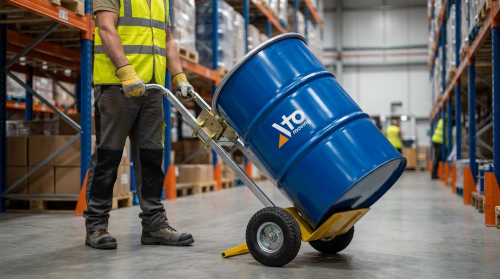
Knowing how to move drums of chemicals safely starts with selecting the correct mechanical aids. Engineers should match equipment to drum weight, chemical hazard class, transfer frequency, and the required flow or lift height. This section explains how to choose mobile handling devices, drum pumps, construction materials, and drive systems that reduce manual effort and control spill risk throughout the drum lifecycle.
Comparing Dollies, Trucks, Grabs, Clamps, And Cranes
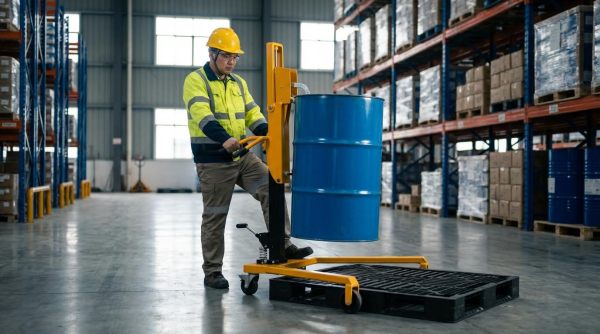
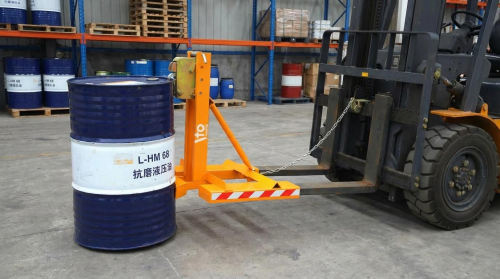
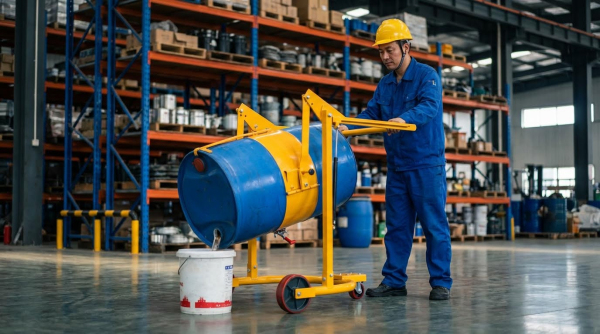
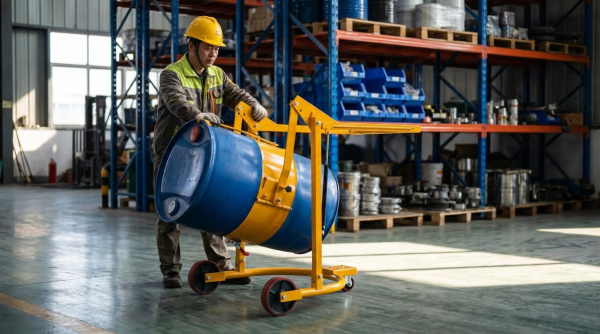
Choosing how to move drums of chemicals begins with defining the main transport task. Drum dollies suit short, flat transfers of upright drums with intact bases, typically up to 300–400 kg per unit. Two-wheel drum trucks with tilting cradles handle 200 L steel or plastic drums more safely over thresholds and ramps, because they shift the center of gravity onto the wheels. Powered drum handlers with grabs or clamps lift and rotate drums for stacking, racking, or decanting, reducing back injuries and improving control during pouring. Overhead cranes or hoists with certified drum grabs become necessary when engineers must lift drums vertically into process equipment or mezzanines, or when aisle width prevents floor-based equipment. For flammable or explosive atmospheres, select non-sparking contact points, conductive wheels, and ATEX-compliant lifting accessories, and ensure the rated capacity exceeds the maximum filled drum mass by a suitable safety factor.
Drum Pump Selection By Fluid, Viscosity, And Duty
Drum pumps determine how to move drums of chemicals from container to process without tipping or manual pouring. For low-viscosity, non-flammable liquids and intermittent duty, manual rotary or piston pumps offer low cost and inherent ignition safety, because they avoid electric motors. Continuous or high-volume transfer of corrosive or toxic liquids usually requires electric or air-driven drum pumps, sized by required flow rate, discharge head, and viscosity. Pneumatic pumps fit flammable or ATEX-classified zones, since they eliminate electrical ignition sources and integrate well with plant air systems. Highly viscous products such as resins, syrups, or heavy oils need positive displacement designs with appropriate torque and speed control to avoid cavitation and shear damage. Engineers should also specify safety features such as dry-run protection, self-priming capability, drip-free nozzles, and integrated grounding provisions to limit spills and static discharge during drum changeover.
Material Compatibility: PP, PVDF, PTFE, And Metals
Material compatibility directly affects equipment life and leak risk when deciding how to move drums of chemicals. Polypropylene (PP) worked well for acids, alkalis, and many aqueous solutions, including sodium hydroxide and lower-temperature sulfuric acid. PVDF provided higher resistance to halogens and aggressive solvents, making it suitable for chlorine, bromine, and oxidizing mixtures. PTFE showed the broadest chemical resistance envelope, handling strong oxidizers such as concentrated nitric acid, as well as polar solvents like acetone, but it increased cost and sometimes reduced mechanical strength. For metals, 316 stainless steel resisted many dilute acids and solvents but was vulnerable to chloride-induced pitting, while aluminum was generally unsuitable for chloride-rich or strongly alkaline media. Seal and gasket materials such as PTFE, FKM (Viton), or EPDM must match the wetted parts, since incompatibility at these small components often caused the first leaks. Engineers should always cross-check the Safety Data Sheet and a chemical resistance chart before finalizing pump tubes, hoses, and drum contact surfaces.
Energy-Efficient Drives And Predictive Maintenance
Energy-efficient drives support both sustainability targets and lower lifecycle cost when planning how to move drums of chemicals at scale. Variable-speed electric motors allow operators to match pump output to process demand, reducing throttling losses and heat generation in recirculation lines. High-efficiency motors and optimized impeller or rotor geometries cut electrical consumption during continuous drum emptying operations. For air-driven pumps, right-sizing orifices and using pressure regulators limit compressed air waste, which often represented a hidden energy penalty. Integrating basic condition monitoring, such as motor current tracking, vibration checks, and run-hour logging, enables predictive maintenance for drum pumps and powered handlers. Plants can schedule seal replacements, bearing changes, and hose renewals before failures lead to leaks or unplanned downtime. Digital maintenance logs and QR-coded equipment IDs further streamline inspections and ensure that critical devices used for hazardous chemical drums remain within calibration, certified, and ready for emergency use.
Spill Prevention, Containment, And Response
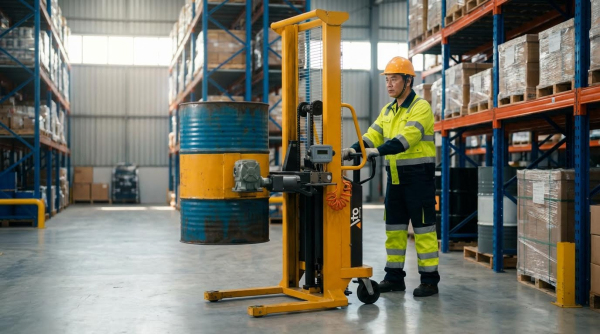
Engineers planning how to move drums of chemicals safely must treat spill prevention as a design requirement, not an afterthought. Effective control starts before the drum leaves its storage position and continues through transport, transfer, and emergency response. The following subsections describe inspection, securing, static control, and spill response practices that reduce incident probability and consequence in drum-handling operations.
Pre-Use Inspection Of Drums, Routes, And Vehicles
Pre-use inspection created the first barrier against spills and injuries when moving drums of chemicals. Start with the drum itself: verify legible labeling, hazard pictograms, and that the product matches the handling plan and SDS. Check bungs, lids, and gaskets for tightness, corrosion, bulging, or seepage, and quarantine any container that shows deformation or leakage. Inspect chimes, seams, and welds for dents or stress cracks, especially on reused or refurbished drums. Confirm the drum’s estimated mass from density and fill level to ensure compatibility with the selected truck, dolly, or forklift attachment.
Next, survey the travel route from storage to transfer or loading point. Remove debris, shrink-wrap, broken pallets, and liquid residues that could cause loss of control. Verify floor rating, slope, and surface friction, particularly at ramps, thresholds, and dock plates. Ensure adequate lighting and clearance for turning radii of drum handlers and pallet trucks. Finally, inspect vehicles or internal transport equipment: test brakes, steering, horns, lights, and verify that decks, guardrails, and tie-down points remain structurally sound and chemically resistant. A short checklist-based inspection process significantly reduced cargo-related claims in documented transport studies.
Load Securing, Segregation, And Secondary Containment
Once inspection is complete, the focus shifts to how to move drums of chemicals without load shift or incompatible contact. Position drums upright with closures accessible and orient markings outward for quick identification. Use rated straps, chocks, or drum clamps to prevent rolling and tipping on trucks, dollies, and pallets; avoid relying on friction alone. On flatbeds or open trailers, couple drums with containment pallets or bunded skids to capture leaks generated by vibration or impact. Maintain stack heights within conservative limits, typically no more than two high, unless engineered racking and drum specifications support higher loads.
Chemical segregation is critical to limit reaction hazards during transport and storage. Group drums by hazard class and consult SDS incompatibility sections before co-loading oxidizers, acids, bases, and flammables. Physically separate incompatible groups using bulkheads, pallet dividers, or distance, and avoid mixed loads with food, feed, or consumer goods. Implement secondary containment sized according to regulatory guidance, such as at least 10% of the stored volume or the largest single drum volume, whichever is greater, with higher factors where local codes or insurers require. For mobile operations, select portable spill decks or liners compatible with the transported chemicals and rated for the expected temperature range.
Static Control, Grounding, And Ignition Source Control
When deciding how to move drums of chemicals containing flammable or combustible liquids, controlling static and ignition sources becomes a primary engineering control. Rolling, pumping, and splashing liquids generated electrostatic charges that could discharge as sparks if not managed. Bond all conductive components in the transfer system, including drum, pump, hose, and receiving container, with low-resistance jumpers. Ground at least one point in the system to a verified earth connection, and periodically test continuity to maintain resistance within accepted limits. For non-conductive plastic drums, consider conductive inserts, external bonding straps, or alternative container strategies where regulations allow.
Control ignition sources along the entire drum movement route and at transfer points. Prohibit open flames, hot work, and non-rated electrical tools in classified areas; specify explosion-protected equipment in accordance with OSHA, NFPA, and ATEX zoning where applicable. Manage mechanical ignition risks by avoiding dragging steel drums across rough concrete or using unprotected metal tools that could create sparks. For powered drum handling and pumping, select motors and controls with appropriate temperature class and gas group ratings for the handled vapors. Combine static control with adequate ventilation so that any released vapors remain below critical concentration thresholds.
Spill Kits, Training, And Digital Response Tools
Even with robust prevention, engineers must assume that spills will occasionally occur when planning how to move drums of chemicals. Position spill kits at drum storage, transfer, and loading areas, and on vehicles that transport hazardous drums. Kits should match the chemical profile: acid-neutralizing absorbents for corrosives, hydrocarbon-specific media for oils, and universal sorbents where mixtures are possible. Include PPE matched to SDS recommendations, such as chemical-resistant gloves, footwear, eye and face protection, and respiratory protection where required by risk assessment. Add tools like non-sparking shovels, drain covers, overpack drums, and heavy-duty bags or containers labeled for hazardous waste.
Training converts equipment and procedures into effective spill response. Develop site-specific curricula that cover hazard recognition, the “control, contain, clean up” sequence, decontamination methods, and reporting thresholds. Use drills to practice drum uprightting, leak plugging, and deployment of booms or socks around secondary containment. Integrate digital tools such as mobile SDS libraries, QR-coded drum IDs, and incident-reporting apps to accelerate decision-making and documentation. Learning management systems allow consistent, trackable training delivery and quick updates when regulations or site layouts change. Together, prepared personnel, correctly specified kits, and digital support systems significantly reduce the impact of drum-related chemical spills.
Summary: Integrating Safe Drum Handling Practices
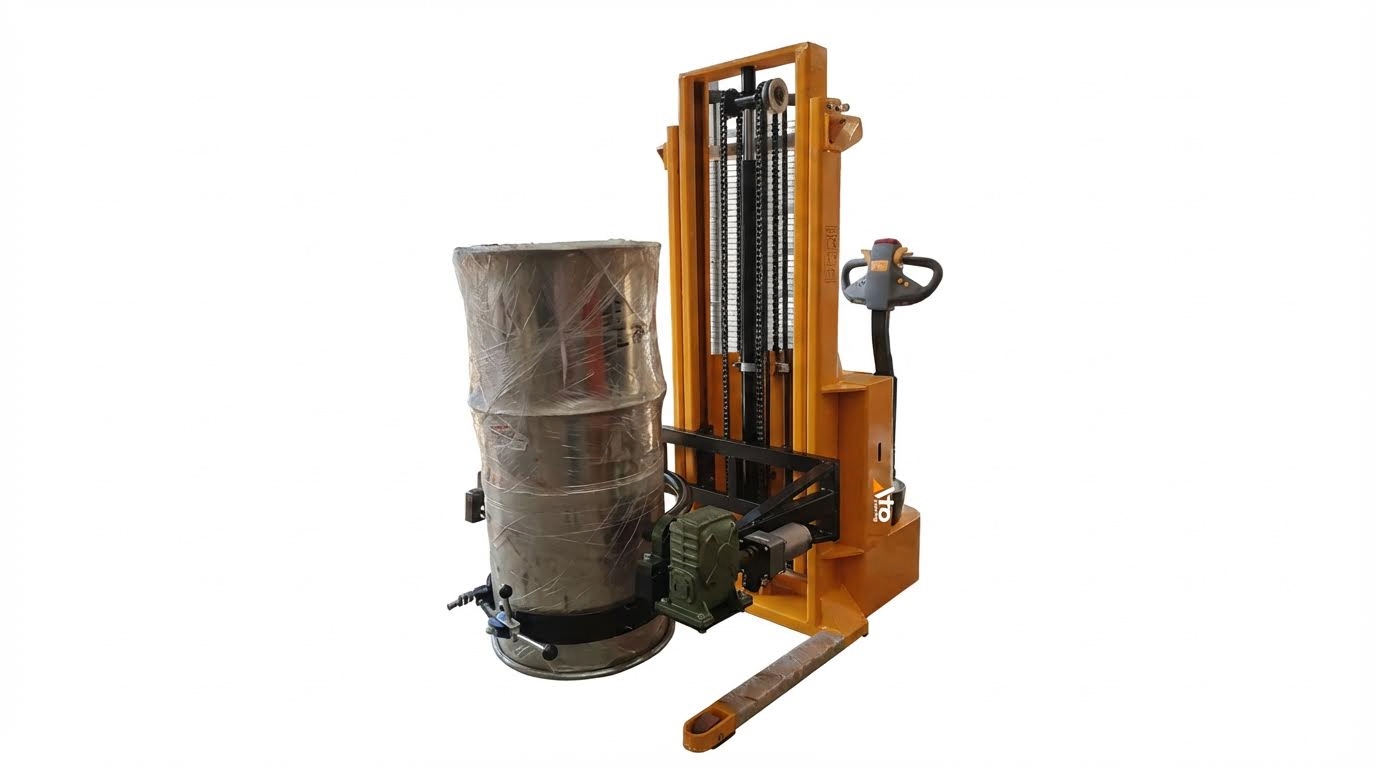
Safe drum handling for chemicals depends on integrating risk assessment, compliant equipment selection, and robust spill control into one system. Facilities that understand how to move drums of chemicals safely typically combine engineered controls, disciplined procedures, and trained operators. The goal is to keep the drum sealed, the load stable, and energy inputs predictable from storage rack to process point. This requires matching handling methods to the chemicals’ physical properties, packaging, and regulatory classification.
From a technical standpoint, the safest workflows start with classification and SDS review, then define load cases and traffic routes before equipment is specified. Drum trucks, dollies, grabs, and cranes must match drum mass, center of gravity, and route constraints, while transfer pumps must match fluid viscosity, corrosivity, and flammability. Material selection for pumps and wetted parts, such as PP, PVDF, PTFE, or stainless steel, should follow compatibility charts that consider concentration, temperature, and expected duty cycle. Static control, grounding, and correct motor types, including air-driven or explosion-proof drives, remain essential where vapors or dusts could create explosive atmospheres.
Industry trends pointed toward higher energy efficiency and predictive maintenance for drum handling and transfer systems. Variable-speed electric drives, low-friction casters, and optimized pump hydraulics reduced energy use per transferred litre. Sensor-based monitoring of motor load, vibration, and temperature enabled condition-based maintenance, which reduced unplanned downtime and leak risk from failing seals or bearings. Digital tools also improved spill response through app-based checklists, geo-tagged incident logs, and access to SDS data at the point of use.
Implementing these practices required practical steps at floor level. Operators needed standard routes with marked segregation zones, secondary containment under storage and transfer points, and pre-use inspections of drums, pallets, and vehicles. Spill kits, including compatible absorbents and PPE, had to be positioned along main drum corridors and at loading docks, with clear ownership for inspection and replenishment. Training programs worked best when they combined hands-on exercises in drum rolling and tipping techniques with scenario-based spill drills and refreshers aligned to OSHA, EPA, DOT, and EU/ATEX rules.
As technology evolved, the core principles did not change: minimize manual handling, maintain container integrity, and control every transfer step. Advanced drives, digital response tools, and more sophisticated materials broadened equipment choices, but they did not replace the need for accurate hazard data and disciplined procedures. Facilities that treated how to move drums of chemicals as a system-level engineering problem, rather than a series of isolated tasks, achieved lower incident rates, better regulatory compliance, and improved lifecycle costs for their handling assets.