Warehouses that ask how voice picking slashes warehouse costs are really asking how to redesign picking work around people, data, and flow. This article explains the core principles of voice-directed picking, then links those principles to measurable gains in labor cost, accuracy, and safety across different operation types.
You will see how hands-free, eyes-up workflows compare to paper, RF, and pick-to-light, and how ergonomics and multilingual support shape workforce performance. Later sections quantify cost savings using accuracy, lines-per-hour, training time, and ROI metrics, then show how to integrate voice with WMS, WES, and ERP for continuous improvement and sustainability. The final summary balances the benefits and risks so engineering, operations, and finance teams can make a defensible investment decision.
Core Principles Of Voice-Directed Picking
Voice-directed workflows show how voice picking slashes warehouse costs by changing how pickers move and think. The method keeps hands and eyes free, which reduces pauses, mispicks, and rechecks. These core principles apply across paper, RF, and pick-to-light operations. They also link directly to ergonomics, safety, and multilingual labor flexibility in modern distribution centers.
Hands-Free, Eyes-Up Workflow Mechanics
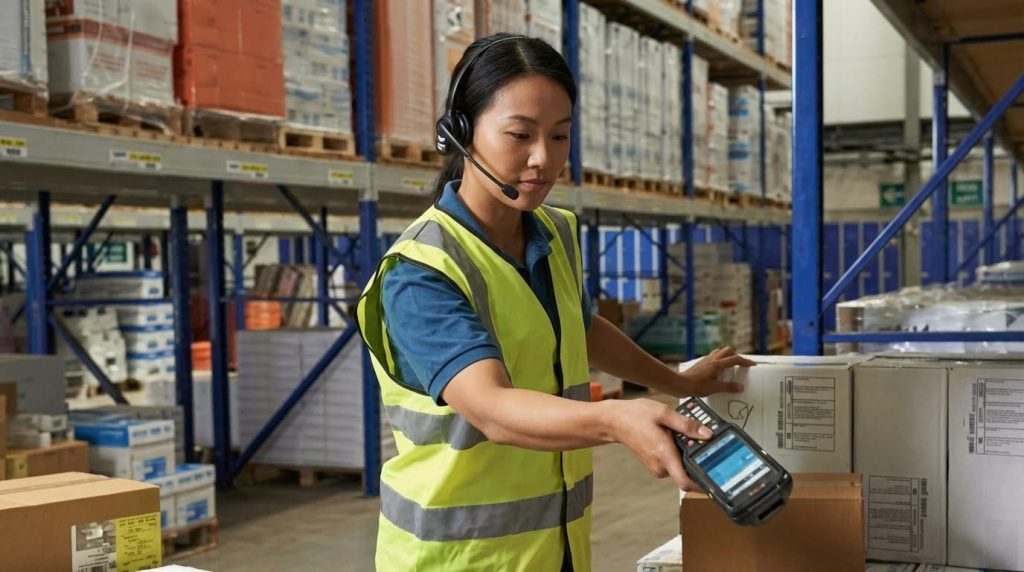
Voice picking replaces paper lists and screen checks with spoken tasks and verbal confirmations. Pickers wear a headset and a small device, then follow step-by-step instructions while they walk, lift, and scan. They do not stop to read or tap a screen, which cuts dead time and motion waste. This hands-free, eyes-up pattern is a main reason why voice picking slashes warehouse costs through higher lines per hour and fewer mistakes.
In a typical workflow, the system guides the route, confirms location with check digits, then captures quantity by voice. That flow reduces cognitive load because workers follow one clear instruction at a time. Fewer distractions mean fewer wrong locations and quantities. The result is higher first-pass accuracy, less rework, and lower QA effort.
Comparison To Paper, RF, And Pick-To-Light
Voice-directed picking outperforms paper, RF, and pick-to-light in both accuracy and productivity. Industry data showed up to 90% error reduction versus paper, 25% versus RF, and 15% versus pick-to-light. Productivity gains reached about 35% against paper and RF, and about 30% versus pick-to-light. These deltas explain why logistics teams search for how voice picking slashes warehouse costs at scale.
| Baseline method | Typical productivity gain with voice | Typical error reduction with voice |
|---|---|---|
| Paper lists | Up to 35% | Up to 90% |
| RF scanning | Up to 35% | About 25% |
| Pick-to-light | About 30% | About 15% |
Paper flows force constant reading, page flips, and manual checkmarks. RF devices reduce paper but still require screen focus and button presses. Pick-to-light speeds line picking but is fixed to specific rack positions and can be costly to expand. Voice works across zones, supports batch picking, and adapts fast when layouts change, which protects long-term cost per order.
Human Factors, Ergonomics, And Safety Impacts
Voice-directed work reduces awkward motions and split attention. Pickers keep both hands on cartons, pallets, and trucks, which lowers strain from one-handed handling. They do not twist to view screens while walking, which reduces fatigue and minor injuries. Better ergonomics support steady pace across a full shift, not just peak hours.
Safety improves because workers look forward, not down at paper or devices. They see forklift traffic, pedestrians, and floor hazards earlier. Studies reported fewer distraction-related incidents once sites moved to hands-free, eyes-up operation. These safety gains can reduce lost-time accidents and lower insurance costs, which is another way how voice picking slashes warehouse costs beyond labor minutes.
Higher accuracy also reduces stressful rework and customer complaints. Workers receive clear feedback through prompts and confirmations, which builds confidence. Sites often report lower turnover after voice deployment because jobs feel more manageable and fair, especially when combined with performance-based incentives.
Multilingual Support And Workforce Flexibility
Modern voice engines support dozens of languages and dialects. Workers can choose their native or preferred language, which cuts training time and errors from misread text. Reported training time cuts reached up to about 85% in some deployments. Faster onboarding is critical in peak seasons when temporary staff join for short periods.
Multilingual support also widens the recruitable labor pool. Sites can hire for reliability and work ethic rather than reading level in a single language. Voice prompts standardize process steps, so workers move between zones or tasks with less retraining. This flexibility lets managers rebalance staff by volume, which helps keep overtime and agency labor under control.
Because the system captures confirmations in real time, supervisors gain clear performance data across all language groups. They can coach based on objective metrics, not on who best understands printed instructions. That consistent guidance is a key factor in how voice picking slashes warehouse costs while keeping quality high.
Quantifying Labor Cost And Error Reductions

Operations teams that ask how voice picking slashes warehouse costs need hard numbers, not slogans. This section explains how voice workflows change accuracy, labor productivity, training effort, and financial returns. The focus stays on measurable impacts that engineers, finance leaders, and logistics managers can validate.
Accuracy Gains And Cost Per Picking Error
Voice-directed picking usually cuts picking errors by 50–90% compared with paper or RF processes. Case studies reported accuracy near 99.9% when workers used hands-free, eyes-up workflows with simple check digits. This accuracy gain matters because a single picking error can cost between about £10 and £250. The range depends on product value, reverse logistics, re-picking, and potential discounts on returned goods.
When you model how voice picking slashes warehouse costs, error cost is a main driver. Even a 1% accuracy improvement can save large six-figure amounts for high-volume sites. Fewer mis-picks also reduce soft costs. These include customer service calls, complaint handling, and damaged brand reputation.
Voice systems help prevent errors in several ways:
- Workers confirm locations and quantities with spoken responses.
- Workflows enforce lot, batch, and serial capture for regulated sectors.
- Systems block progress until each step passes validation.
Higher first-pass accuracy then allows leaner quality checks. Sites can shift from heavy sampling toward risk-based audits, which reduces indirect labor.
Productivity Uplift And Lines-Per-Hour Metrics
Voice workflows raise lines per hour because pickers stop pausing to read lists or screens. Reported productivity gains reached about 20–35% versus paper, RF, or pick-to-light in several deployments. One distribution center lifted order productivity by 35% after replacing paper with voice. Another pilot started with a 20% gain on day one and climbed past 30% within weeks.
Engineers should treat lines per hour as the core sizing metric. A 30% uplift means a picker who handled 200 lines per hour can reach about 260 lines per hour. That change reduces headcount for the same volume or creates spare capacity for growth. Top performers in some pilots achieved up to 60% more lines per hour, which shows the headroom when layouts and slotting are strong.
Key drivers behind the uplift include:
- Hands-free handling of cartons, totes, and pallets.
- Optimized pick paths generated by the WMS or WES.
- Continuous instructions without visual searching or page flips.
When you calculate how voice picking slashes warehouse costs, combine the productivity gain with reduced overtime and better use of peak-season temps.
Training Time, Turnover, And QA Labor Savings
Voice-directed workflows shorten training because tasks follow a simple “system says, worker does, worker confirms” pattern. Some implementations reported training time cuts up to about 85% for new or temporary staff. One case showed new operators reaching useful productivity in under 15 minutes because the system did not need voice template training. Multilingual prompts also let sites hire from a wider labor pool.
Shorter ramp-up times reduce supervisor hours spent on shadowing and re-training. They also lower the cost of seasonal onboarding. Workers usually feel more confident because the system guides each step and confirms success. That confidence supports better performance scores and can reduce turnover. Lower churn then cuts recurring hiring and induction costs.
Higher first-time accuracy also trims quality assurance labor. With error rates down by 50–90%, managers can reduce 100% checks and heavy sampling. Instead, they can focus QA on high-risk orders, new staff, or changeovers. This targeted approach saves inspection hours while keeping service levels high.
ROI, Payback, NPV, And IRR Considerations
Financial teams evaluating how voice picking slashes warehouse costs usually look at four indicators: ROI, payback period, net present value, and internal rate of return. Industry case work showed payback often under 10–12 months for well-scoped projects. One design study projected a one-year payback when moving from paper to voice. Vendors and consultants often validate this using current-state cost models and future-state simulations.
The main cash benefits fall into clear buckets:
- Labor savings from higher lines per hour and lower overtime.
- Error cost reductions from fewer mis-picks and returns.
- Lower QA, admin, paper, and label expenses.
- Avoided capital from delaying building expansion due to higher throughput.
NPV and IRR calculations then discount these savings over a three-to-five-year horizon against license, hardware, and integration costs. Strong projects show positive NPV at realistic discount rates and IRR above internal hurdle rates. To keep estimates credible, engineers should base models on measured pilot data, not optimistic vendor claims, and should include change management and IT support in the cost side.
System Design, Integration, And Optimization

System design decides how voice picking slashes warehouse costs. Good integration keeps data in sync and cuts manual checks. Strong analytics expose waste in travel, touches, and rework. Design choices also affect energy use, paper use, and long term support.
Integrating Voice With WMS, WES, And ERP
Voice systems cut cost only when they share data in real time with WMS, WES, and ERP. The WMS or WES should stay the “system of record” for orders, inventory, and tasks. Voice acts as the execution layer at the picker, turning tasks into clear steps. Tight links avoid double entry and reduce admin labor.
Most sites link voice by APIs, message queues, or lightweight socket messages. Engineers should keep messages small to reduce wireless load and latency. Typical designs send only pick lists, confirmations, and exceptions. This keeps devices fast and supports more users without network upgrades.
When planning integration, teams should map each event to a cost driver. For example:
- Real time pick confirmation reduces short shipments and credits.
- Exception codes feed root cause analysis for errors.
- Status updates let planners smooth work and reduce overtime.
Stable interfaces let operations extend voice from picking into put-away, replenishment, and loading. That reuse spreads the initial investment across more tasks. It also standardizes training and support.
Data Analytics, KPIs, And Continuous Improvement
Voice picking creates rich time-stamped data. This data shows exactly how voice picking slashes warehouse costs. Every pick, confirm, and exception becomes a record. Engineers can turn these into clear KPIs.
Useful KPIs include:
| KPI | What it shows | Cost impact |
|---|---|---|
| Lines per hour by worker | Labor productivity | Headcount and overtime |
| Pick error rate | Quality of fulfillment | Credits, returns, rework |
| Travel time share | Route efficiency | Non-value time and energy |
| Exception frequency | Process stability | Firefighting and QA checks |
Continuous improvement teams can use this data to test layout changes, slotting rules, or new routes. Short pilots can compare baseline and new methods over a few weeks. If lines per hour rise and errors fall, the change likely pays back. If not, teams can roll back fast.
Dashboards should be simple and near real time. Supervisors need clear alerts when a zone falls behind or error rates spike. That quick feedback prevents service failures and protects customer satisfaction.
Inventory Accuracy, Replenishment, And Cycle Counts
Voice workflows can improve inventory accuracy while operators pick. The system can insert short cycle count tasks between picks. Workers confirm quantities by voice as they pass locations. This reduces the need for large shutdown counts.
Better inventory data lowers safety stock and frees space. When stock levels stay accurate, planners can trust reorder points. This avoids rush orders and last minute expediting. It also reduces “empty location” walks that waste picker time.
Voice can also guide real time replenishment. The WMS or WES detects low stock and pushes a move task to a replenisher. The worker receives clear steps and confirms each move. That flow keeps forward pick faces full and avoids short picks.
Engineers should design location numbering and check digit schemes that are easy to speak and hear. Clear codes reduce mis-reads and wrong-bin picks. Over time this protects both inventory accuracy and labor cost.
Sustainability, Paper Reduction, And Energy Use
Voice picking supports greener warehouses while cutting cost. Removing paper pick lists reduces printing, storage, and shredding. It also reduces label use when workflows move to voice driven checks. These savings grow with order volume.
Energy use can drop when routes get shorter and touches fall. Fewer forklift trips and less walking mean lower power draw and less HVAC load in active zones. Voice devices use small batteries compared with fixed PCs and printers.
Sustainability teams should track three areas:
- Paper use per order before and after voice.
- Printer and label stock purchases.
- Equipment power use in pick zones.
Results feed ESG reports and support compliance efforts. At the same time they show how voice picking slashes warehouse costs beyond pure labor. Well designed systems align cost, service, and environmental goals in one program.
Summary Of Voice Picking Benefits And Risks

Voice workflows have shown how voice picking slashes warehouse costs by attacking waste on several fronts. Operations reduced picking errors, cut indirect labor, and shortened training time while keeping service levels high. At the same time, leaders had to manage change, integration effort, and device lifecycle risk. This section brings these points together for decision makers.
From a cost view, voice picking lowered labor spend through three main levers. First, higher accuracy reduced re-picks, returns handling, and credit processing. Error cuts of 50–90% removed a large share of avoidable touch time. Second, productivity gains of roughly 20–35% raised lines per hour, which reduced overtime and deferred headcount. Third, faster onboarding, sometimes by more than half, shrank training labor and made seasonal ramp-up cheaper.
Strategically, voice data streams improved control of inventory and service. Real-time task feedback supported tighter cycle counting and leaner safety stock. Better on-time and right-first-time shipments lifted customer satisfaction and repeat orders. Paper removal and lower label use supported sustainability goals and reduced consumable costs. Safety gains from hands-free, eyes-up work also helped limit injury risk and related insurance exposure.
These gains came with practical constraints. Sites needed solid wireless coverage, device management, and clean integration with WMS or ERP. Poor process design or rushed change management could mute benefits or create user resistance. Voice engines also had to cope with noise, accents, and multilingual crews. Looking ahead, the best results will likely come from voice combined with scanning, analytics, and task interleaving, not voice in isolation. Facilities that treat voice as a long-term platform, tune workflows, and track KPIs should capture the strongest and most durable cost savings.
,
Frequently Asked Questions
What is voice picking solution in warehouse?
Voice picking is a paperless, hands-free order fulfillment solution used in warehouses. It allows operators to receive voice prompts through a headset, directing them to the correct locations and items to pick. This system increases efficiency by freeing up the operator’s hands and eyes for the task at hand. Voice Picking Guide.
How does voice picking reduce warehouse costs?
Voice picking reduces warehouse costs by improving accuracy and speed in order fulfillment. It minimizes errors by providing clear instructions directly to workers, which reduces returns and rework. Additionally, it optimizes labor by allowing workers to focus on picking rather than managing paperwork. These efficiencies lead to lower operational costs. Voice Picking Benefits.
What are the benefits of using voice picking systems?
- Increased picking accuracy by reducing human error.
- Improved worker productivity as hands and eyes are free.
- Enhanced safety in the warehouse due to reduced distractions.
- Better inventory management through real-time tracking.