Knowing how to move 55 gallon drums safely and efficiently is critical in any warehouse that handles bulk liquids or chemicals. This article explains the core safety principles, key regulations, and the main types of drum handling equipment used in modern facilities. You will see how to match tools like dollies, carts, trucks, and forklift attachments to drum types, contents, and travel distances. The goal is to reduce manual strain, prevent spills, and design a drum handling system that fits your layout and throughput needs.
Core Principles Of Safe Drum Handling
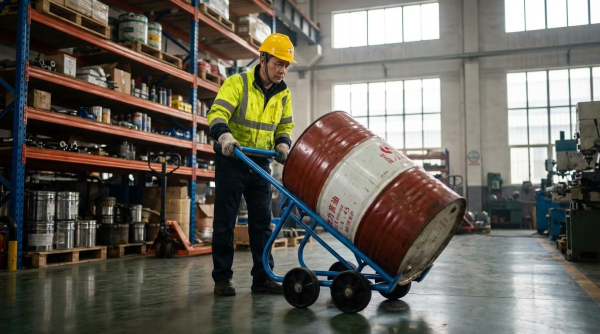
Typical drum weights and risk assessment
When planning how to move 55 gallon drums in a warehouse, start with an accurate weight assumption. A typical 55-gallon drum can weigh roughly 400–800 lb depending on the density of the contents and fill level 400-800 pounds depending on its contents. This weight range is beyond safe manual lifting limits for a single worker, so powered or wheeled drum handling equipment should be the default choice whenever possible drum cart. Before moving any drum, operators should read the label to identify if the contents are hazardous, corrosive, toxic, or flammable, and treat unlabeled drums as hazardous until confirmed otherwise If unlabeled, contents should be treated as hazardous.
A quick risk assessment for how to move 55 gallon drums should cover:
- Weight estimate and center-of-gravity stability (full vs. partially filled drums).
- Drum integrity: check for warping, dents, corrosion, leaks, or missing bungs/lids before movement ensure the drum is not warped or leaking, and confirm that the bung is tight.
- Route conditions: verify clear floor space, no trip hazards, and adequate turning radius for the chosen equipment hydraulic drum stacker.
- Need for assistance or mechanical devices based on distance, slope, and frequency of moves.
If manual rolling is unavoidable, operators should use correct body mechanics: balance the drum on the bottom chime, keep hands on the far side of the chime without crossing over, and lower or upend the drum using leg power rather than the back stand in front of it, place both hands on the far side of the chime, and pull forward until the drum balances on the bottom chime. However, in a modern warehouse, best practice is to minimize manual techniques and standardize on dollies, carts, drum trucks, or forklift-based systems sized for at least 800–1,000 lb capacity to provide a safety margin.
OSHA, PPE, and spill-control requirements
OSHA regulations for 55-gallon drums focus on preventing physical damage, fire, and exposure to hazardous contents. Drums of 30 gallons or more must be protected from physical injury or placed in low-traffic areas, and they must not be stored near open flames, hot metal, or artificial heat sources must be protected from physical injury unless placed in out-of-the-way areas… should not be stored near open flames, hot metal, or artificial heat sources. Containers of 55 gallons or more that hold flammable or toxic liquids must be surrounded by dikes or pans that contain at least 35% of the total volume, and suitable fire extinguishers must be readily available in storage areas must be surrounded by dikes or pans enclosing at least 35% of their total volume… Fire extinguishers suitable for the hazard must be readily available. Pressurizing drums to remove contents is prohibited because it can cause ruptures and uncontrolled releases.
Personal protective equipment is a core control measure when deciding how to move 55 gallon drums containing hazardous materials. Safety shoes are required to protect against crush injuries, and depending on the contents, gloves, eye protection, aprons, and sometimes face shields or respiratory protection may be necessary Safety shoes are required… gloves, eye protection, aprons, and other PPE may be necessary. Before moving a drum, operators should confirm that bungs and lids are tight, check for leaks or stains that indicate prior spills, and ensure spill kits and absorbents are available along the travel route electric drum stacker. Integrating these OSHA, PPE, and spill-control practices into standard operating procedures helps reduce injury risk, control environmental releases, and keep drum handling operations compliant and repeatable in busy warehouse environments.
Comparing Key Drum Moving Equipment Options
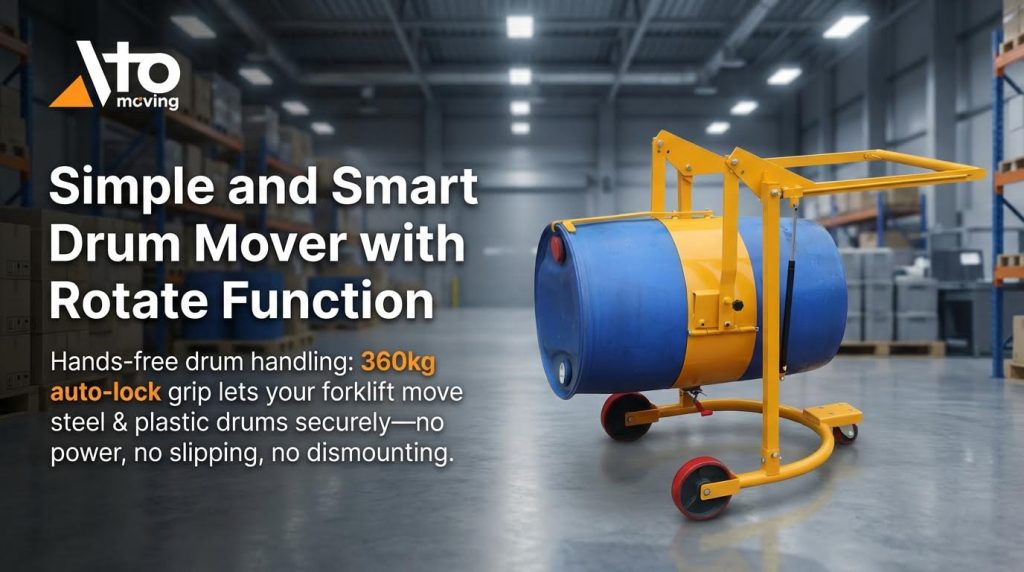
Drum dollies, carts, and trolleys
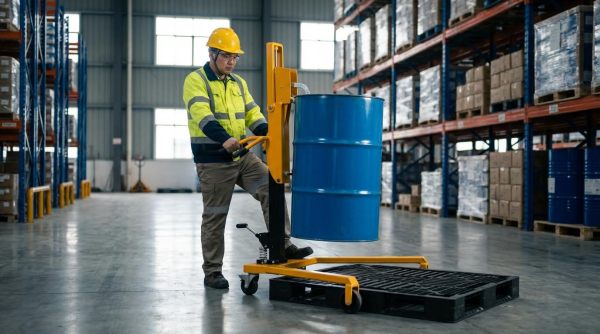
Drum dollies, carts, and trolleys are the simplest tools when you plan how to move 55 gallon drums safely over short or medium distances. Drum dollies are low platforms with castors that let you maneuver upright drums easily in tight spaces, making them ideal for short moves around workstations or between nearby storage areas. They are available for common drum sizes and may include a drawbar or tilt function for emptying, and stainless steel versions suit food, pharma, or corrosive environments with capacities typically up to around 1,200 lb. Drum carts and trolleys add an ergonomic handle and larger wheels, so they are better for longer routes and rougher floors, and some models allow vertical-to-horizontal rotation for draining or mixing contents while controlling drips and spills using rollers and drip pans. Where aisles are narrow but traffic is frequent, compact drum trolleys with anti-tip designs, locking mechanisms, and ergonomic handles help reduce strain injuries and improve productivity by eliminating manual lifting while remaining highly maneuverable in tight spaces.
Drum trucks, caddies, and lifter/rotators
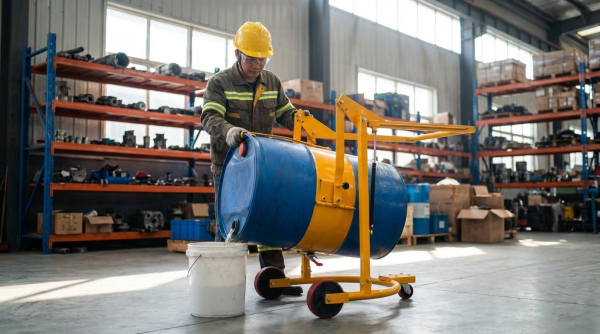
Drum trucks, caddies, and lifter/rotators are suited to facilities that move full drums frequently and need more control over tipping and pouring. Drum trucks use a tilted frame and wheels to let a single operator upend and transport a drum, often with a chime gripper or adjustable hook that secures loads up to about 1,000 lb and keeps the unit parked in a tilted position with a kickstand to minimize the risk of losing control. Drum caddies add a more stable base and often carry one 55‑gallon drum (or smaller drums and pails) with capacities up to roughly 1,200 lb, making them a good choice for moving hazardous contents where you want low center of gravity and positive retention during transport around production areas and storage rooms. Lifter/rotators go further by lifting, transporting, and rotating 55‑gallon drums; typical designs lock the drum vertically to prevent spills or horizontally for draining through a faucet, with manual crank rotation of roughly 120° and lift heights in the 50–60 inch range to position drums over sumps, mixers, or process vessels. Hydraulic drum transporters with hand pumps combine vertical lifting and travel, handling drum sizes from about 13 to 55 gallons at capacities in the 600–700 lb range, which is useful when you need repeatable, low‑effort lifting without a forklift for frequent charge-and-discharge tasks.
Forklift attachments and hydraulic lifters
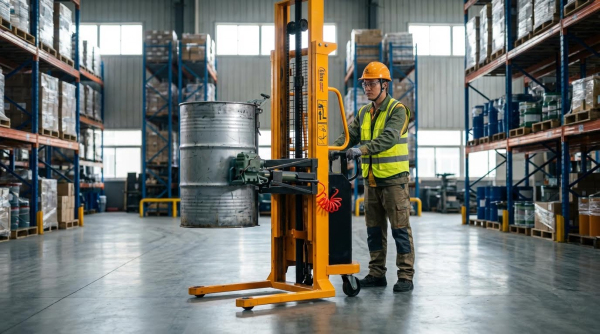
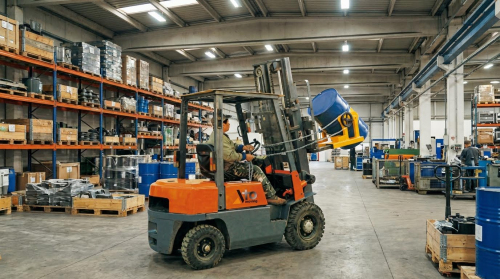
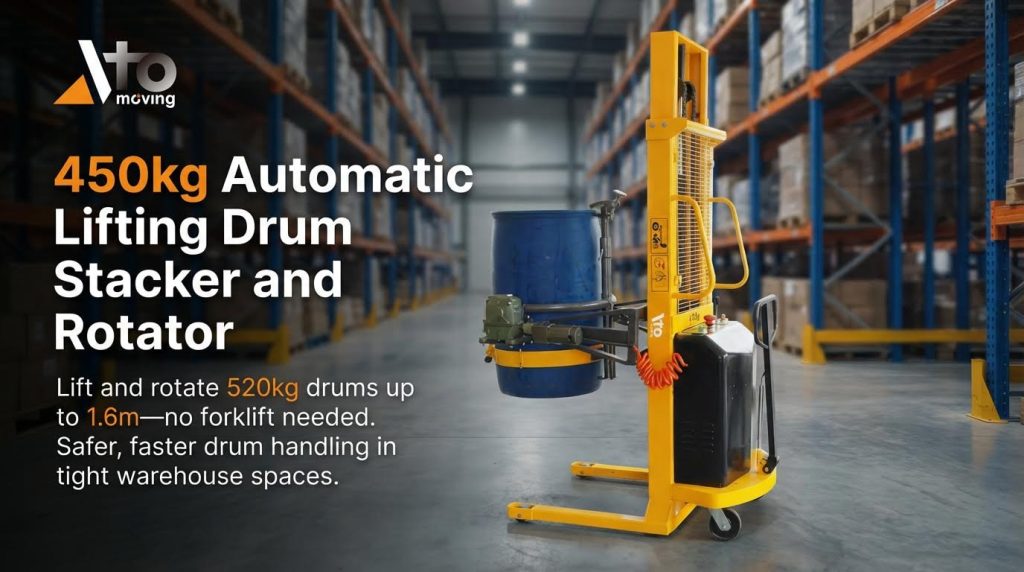
Forklift drum attachments and stand‑alone hydraulic lifters support higher throughput and heavier traffic patterns when planning how to move 55 gallon drums across a warehouse or yard. Forklift-mounted drum grippers allow an operator to pick up one or more drums without leaving the cab, and some designs handle two drums at once, improving productivity on long runs between receiving, storage, and production using grippers and turners for lifting or tilting. Drum-turner attachments can rotate drums for filling, draining, or reorienting from horizontal to vertical, which is helpful when working with racks, spill pallets, or containment systems that require precise drum positioning in compliance with spill-control practices. Stand‑alone hydraulic drum lifters use foot or hand hydraulics to raise and lower drums with minimal effort, and integrated castors allow short‑distance transport where forklifts are not practical, such as inside process rooms or around congested equipment while still providing precise height control. In operations that handle mixed drum sizes, hydraulic trucks and transporters with adjustable clamps and uniform capacities in the 600–700 lb range offer a flexible platform for safe lifting and controlled pouring, reducing manual handling and aligning with OSHA expectations for minimizing strain and spill risk across different drum types and contents.
Selecting The Right Drum Handling System
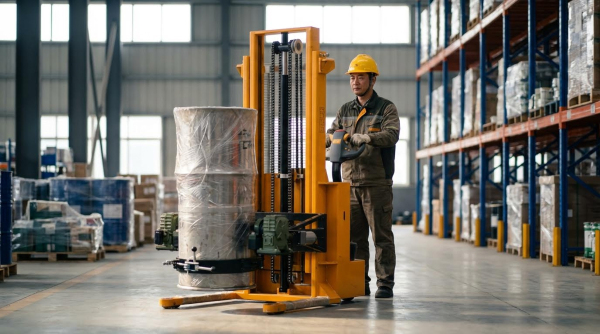
Matching equipment to drum type and contents
When planning how to move 55 gallon drums, start with drum construction and what is inside. Steel, plastic, and fiber drums need different gripping methods; adjustable clamps, straps, or chime grippers help one unit handle multiple drum types and sizes safely. Manual drum trolleys and carts use such adjustable interfaces to accommodate various drum sizes and weights, which makes them suitable for mixed fleets of containers. These trolleys are designed to handle different drum sizes and weights with adjustable clamps or straps.
Next, consider whether you only need to transport drums or also lift, rotate, and empty them. Drum carts and caddies can move drums and, in some designs, rotate them from vertical to horizontal for dispensing or mixing, with rollers and drip pans to control spills. Some drum carts allow rotation from vertical to horizontal and include rollers for mixing and a drip pan for cleanup. If you routinely pour product into process vessels or totes, a drum lifter/rotator that can lock the drum vertical for travel and horizontal for draining is more efficient and safer than manual tipping. A typical lifter/rotator can tilt a 55‑gallon drum up to about 120 degrees and raise it over 50 inches for dumping.
Capacity is critical because a full 55‑gallon drum can weigh 400–800 lb depending on contents. Select equipment with a safe working load comfortably above your heaviest drum, especially for dense chemicals. Drum dollies often support up to 1,200 lb, which covers most filled drums with margin. Drum dollies and caddies are rated up to about 1,200 lb for 5, 30, or 55‑gallon drums. For hazardous or high‑value contents, prioritize equipment that minimizes manual contact and offers secure clamping, anti‑tip designs, and provisions for spill containment during transfer.
Quick selection tips by drum/content type
- Flammable or toxic liquids: use equipment that keeps drums upright during travel and allows controlled dispensing with drip pans or containment.
- Viscous or high‑density products: check capacity ratings and choose powered or hydraulic lifters to avoid overexertion.
- Mixed drum materials (steel/plastic/fiber): prefer trolleys or trucks with adjustable clamps or straps rather than fixed chime grippers.
- Frequent mixing in-drum: consider carts or rotators with built‑in rollers for safe, consistent agitation.
Layout, travel distance, and aisle constraints
Warehouse layout strongly influences how to move 55 gallon drums efficiently. For short, point‑to‑point moves on smooth floors in tight spaces, compact drum dollies and manual drum trolleys are ideal because they are light, low‑profile, and easy to maneuver in congested areas. Drum dollies use a stable platform and smooth‑running castors for short‑distance moves and are specifically recommended for areas with limited space. Their small footprint helps maintain clear egress routes and reduces the risk of collisions in narrow aisles.
For longer internal transport runs between storage, processing, and loading docks, drum carts and trucks are more ergonomic. They place the drum on wheels with larger diameter tires and integrated transport restraints, which reduces push forces and operator fatigue. Drum carts are designed for longer‑distance transport and often include belts or chains as transport safety devices. Where aisles are narrow but travel distance is significant, manual drum trolleys with compact, nimble designs offer a good compromise between maneuverability and reduced manual handling effort. These trolleys are specifically described as compact and easy to navigate through tight spaces.
Floor conditions and traffic also matter. On smooth concrete inside racking, drum equipment with hard rubber or polyurethane wheels works well; for uneven floors, ramps, or outdoor yards, carts with pneumatic tires provide better shock absorption and stability. Some drum carts are offered with fully rubberized tires for smooth floors or pneumatic tires for uneven surfaces. In high‑throughput operations with forklifts already in use, drum forklift attachments or hydraulic drum lifters can move multiple drums or lift them to higher levels, but they require wider aisles and good traffic control. Forklift attachments can transport two drums at once, while hydraulic drum lifters use foot or drawbar hydraulics for precise lifting and short‑distance moves.
| Layout / Distance | Typical Constraints | Better‑fit Equipment |
|---|---|---|
| Very tight aisles, short moves | Limited turning radius, congested storage | Drum dollies; compact manual trolleys |
| Medium aisles, medium–long runs | Need lower push forces, repeated trips | Drum carts, drum trucks, caddies |
| Wide aisles, dock / yard interface | Mixed traffic, uneven surfaces | Carts with pneumatic tires; forklift drum attachments |
| Vertical storage or machine feeding | Need lifting and controlled dumping | Hydraulic drum lifters and lifter/rotators |
“”
Conclusion: Designing An Efficient Drum Handling Strategy
Safe drum handling starts with clear limits on what people and equipment can lift. A full 55‑gallon drum weighs far more than a person can safely manage, so every plan must default to wheeled or powered tools. When engineers size drum dollies, carts, trucks, or forklift systems above the heaviest expected drum, they build in a safety margin that protects operators and product.
Geometry and layout then decide which tool fits. Low, compact dollies suit tight aisles. Trucks, caddies, and lifter/rotators fit medium runs and controlled pouring. Forklift attachments and hydraulic lifters support high throughput and vertical storage, but only where aisles, traffic flow, and visibility allow safe use.
OSHA rules, PPE, and spill control tie the system together. Proper containment, secure closures, and ready spill kits turn equipment choices into a complete risk‑control plan. The best practice is to standardize on a small set of drum handling devices, train every operator, and enforce pre‑use checks and route inspections.
Operations teams that follow this approach can cut strain injuries, prevent leaks, and keep productivity high. Partnering with a specialist such as Atomoving helps align equipment selection, layout, and procedures into one coherent, compliant drum handling strategy.
Frequently Asked Questions
How to safely move a 55-gallon drum?
Moving a 55-gallon drum requires the right equipment to ensure safety and efficiency. Use tools like forklifts, pallet jacks, or drum dollies to handle the drum properly. Attempting to move these heavy containers manually can lead to accidents. For more detailed guidance, check out this guide on handling drums.
How do you lift a 55-gallon drum?
Lifting a 55-gallon drum safely involves using specialized drum lifting equipment designed to handle the full weight of the drum. Position the lifter around the drum’s center of gravity, typically at the upper third. Fully engage the lifting mechanism before raising the drum, and move it slowly while maintaining proper posture. Learn more about drum lifting techniques from this drum lifting resource.
How to move full 55-gallon drums?
To move full 55-gallon drums, brace the drum with your foot to prevent sliding. Shift your weight to the rear foot and use a push/pull method. Pull the far chime with one hand while pushing against a stable surface with the other. This technique helps in maneuvering the drum effectively. For additional tips, refer to this USDA guide on moving drums.