How Much Electricity an Electric Forklift Uses: kWh, Charging Costs, and Energy Savings
If you are trying to work out how much electricity does a forklift use, you need to look at kWh per hour, per shift, and per year, not just the battery size. This guide breaks down real-world energy use, typical charging costs, and where the biggest savings come from in multi-shift fleets. You will see how duty cycle, battery technology, and smart charging change your total cost of ownership and carbon footprint. Use it as a practical reference when sizing batteries, chargers, and infrastructure for an efficient electric fleet.
Understanding Electric Forklift Power Use in kWh
Typical kWh Use Per Hour and Per Shift
If you are asking “how much electricity does a forklift use,” you need hourly and per‑shift numbers, not guesses. The figures below summarize realistic ranges for a standard warehouse electric truck under typical conditions.
| Operating Scenario | Typical Energy Use | Notes |
|---|---|---|
| Light–medium duty, mixed driving and lifting | ≈2.1 kWh per operating hour (normal operation) | Baseline reference for “typical” warehouse use |
| Heavy lifting focus (e.g., many high lifts per hour) | ≈3–4 kWh per operating hour (intensive lifting) | Higher consumption due to frequent peak‑power lifts |
| Typical 8‑hour shift, mixed duty | ≈10–15 kWh per shift (shift total) | Assumes breaks and idle periods in the shift |
| High‑intensity 8‑hour shift | Up to ≈30 kWh per shift in extreme cases (intensive operations) | Continuous operation with frequent lifting and travel |
| Energy per full charge cycle (typical truck) | ≈3–5 kWh drawn from grid per cycle (per charge) | Small machines or partial charges; larger trucks use more |
To translate this into money, use your local kWh tariff. At roughly $0.12–$0.15 per kWh, a 24 kWh usable battery costs about $3.12–$3.90 to recharge fully, depending on how deeply it is discharged. This is far below the $12–$15 propane cost for a comparable shift.
Worked example: “How much electricity does a forklift use in my warehouse?”
Assume your truck averages 2.5 kWh per operating hour over a 7‑hour productive window in an 8‑hour shift. Energy per shift ≈ 2.5 × 7 = 17.5 kWh. At $0.13 per kWh, cost per shift ≈ 17.5 × 0.13 = $2.28. Over 300 shifts per year, this is ≈5,250 kWh and ≈$683 in electricity.
How Load, Lift Height, and Duty Cycle Change kWh
Electric forklift energy use is very sensitive to how hard you work the truck. Load, lift height, and duty cycle all change the answer to “how much electricity does a forklift use” for a given model.
- Load weight: Heavier pallets require more power to accelerate, lift, and brake.
- Lift height: Higher racking means more potential energy per lift and higher kWh per hour.
- Cycle frequency: More lifts per hour and less idle time increase average kW draw.
- Travel pattern: Long runs at speed plus frequent direction changes raise consumption.
- Operator behavior: Aggressive acceleration and hard braking waste energy if regen is limited.
The table below shows how a single lift operation scales up to hourly consumption in a high‑bay warehouse.
| Parameter | Typical Value | Impact on Energy Use |
|---|---|---|
| Example pallet load | ≈750 kg | Representative warehouse pallet weight |
| Lift height | ≈7 m | High‑bay racking level |
| Lift time | ≈8 s per lift | Short, high‑power burst |
| Power during lift | ≈8–10 kW per lift event (peak demand) | Drives battery and cable sizing |
| Energy per lift | ≈18–22 Wh (8–10 kW for 8 s) | Small per event, but adds up across a shift |
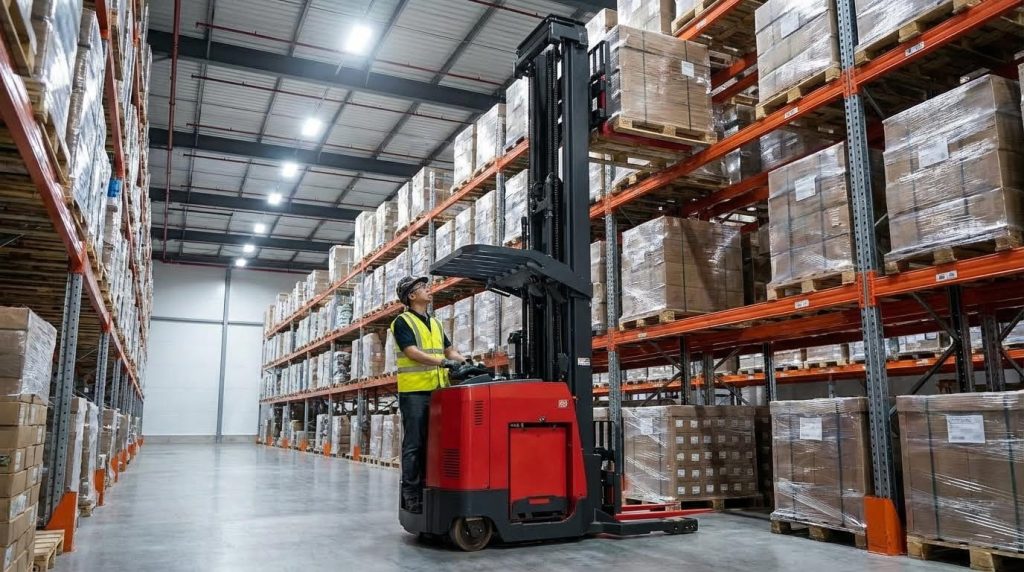
| Lifts per hour (intensive duty) | ≈75 lifts per hour | Common in high‑throughput aisles |
| Hourly consumption from lifting | ≈3–4 kWh per hour (lifting‑dominated) | Excludes travel and idle losses |
Duty cycle also includes non‑lifting time. When the truck is just driving, the draw can drop closer to 1–2 kW, bringing the average back toward ≈2.1 kWh per operating hour in mixed use. This is the figure many facilities see in practice.
Quick checklist to estimate your own kWh
To estimate how much electricity a forklift uses in your application, record for a typical shift:
- Average pallet weight (kg or lb)
- Average and maximum lift height (m or ft)
- Lifts per hour (by observation or WMS data)
- Travel distance per hour (km or miles)
- Actual “key‑on” operating hours vs total shift hours
Feed these into your dealer’s energy model or data logger reports to get a site‑specific kWh per shift.
Comparing Electric, LPG, and Diesel Energy Use
From an energy and cost standpoint, electric forklifts are much more efficient than LPG or diesel trucks. The key is to compare not just liters or cylinders, but useful work per unit of energy.
| Metric | Electric Forklift | LPG Forklift | Diesel Forklift |
|---|---|---|---|
| Typical energy use per operating hour | ≈2.1 kWh per hour (normal duty) (baseline) | ≈58% more energy than electric for same work (relative) | Higher fuel energy per hour than electric; depends on engine size |
| Energy per 8‑hour shift (typical) | ≈10–15 kWh, up to ≈30 kWh in intensive use (per shift) | Equivalent LPG cost ≈$12–$15 per shift for similar work (fuel spend) | Diesel fuel cost ≈2–3× electric energy cost over a year (annual) |
| Typical “fuel” cost per charge/shift | ≈$3–$5 per charge cycle or shift (electricity) | ≈$12–$15 per LPG bottle/shift (propane) | ≈$18–$25 per day typical diesel fuel cost (diesel) |
| Relative energy efficiency | Baseline (100%) | Uses ≈58% more energy for same throughput (vs electric) | Combustion losses make diesel less efficient in stop‑start duty |
| Annual energy/fuel cost (750 shifts, typical fleet) | ≈£2,000–£3,000 for electricity (per truck) | Higher than electric; LPG spend often >2× | ≈£5,000–£6,000 for diesel fuel (per truck) |
- Across a multi‑truck fleet, switching from gas to electric typically saved $6,000–$14,000 per year in reduced fuel and maintenance. These savings came from lower kWh cost and fewer service hours.
- Total cost of ownership over five years for an all‑electric fleet was about 43% lower than for internal‑combustion trucks, driven largely by cheaper energy and 60% lower maintenance spending. This highlights how energy efficiency compounds over time.
From an engineering standpoint, the electric drivetrain converts a much higher share of input energy into useful lifting and traction work. That is why, in real warehouses, electric trucks deliver the same throughput with roughly half to two‑thirds of the energy that LPG or diesel machines burn, and at a much lower cost per shift.
Battery Technologies, Charging Costs, and Efficiency
Lead-Acid vs Lithium-Ion vs Fuel Cell Efficiency
Battery chemistry is the biggest lever in how much electricity does a forklift use over its life. Different technologies convert grid kWh into useful work with very different losses and charging behavior.
| Battery / Power Source | Typical Use Case | Energy & Charging Efficiency (Qualitative) | Runtime / Cycle Life (Typical Ranges) | Operational Advantages | Main Limitations |
|---|---|---|---|---|---|
| Lead-acid | Single-shift, low–mid duty, budget-focused fleets | Lowest efficiency of the three; more heat loss during charge/discharge and equalization | Shorter cycle life; long charge times (often 6–8 hours) with cool-down needed | Lower upfront cost; well understood; simple charging infrastructure | Cannot opportunity charge freely; risk of sulfation; more maintenance and watering; higher kWh drawn from grid for same work |
| Lithium-ion | Multi-shift, high-utilization warehouses and cold stores | Higher round-trip efficiency; less heat loss and better energy use than lead-acid Cited Text or Data | Fast charge (often full charge in about 90 minutes) and >2,000 cycles possible Cited Text or Data | High efficiency, low heat, no equalization; true opportunity charging during breaks without damage Cited Text or Data | Higher initial cost; requires compatible chargers and controls; thermal management needed in some environments |
| Hydrogen fuel cell | Very high-utilization, multi-shift, quick-refuel operations | High conversion efficiency at the truck; stable power output over shift | 8–10 hours continuous operation typical, with strong cold-temperature performance and ~95% charge retention at -20°C Cited Text or Data | Very fast refuel; minimal performance drop in cold stores; stable voltage profile | Complex fueling infrastructure; hydrogen supply chain; higher system cost; safety and compliance complexity |
Because lithium-ion wastes less energy as heat, the truck needs fewer kWh from the grid to move the same number of pallets than with lead-acid. Opportunity charging also flattens peaks in how much electricity does a forklift use by spreading energy intake into short breaks instead of one big nightly charge.
Why chemistry changes your energy bill
Lead-acid batteries draw more kWh from the charger than they deliver to the motor because of gassing and heat. Lithium-ion reduces these losses, so a fleet can see lower total kWh per shift for the same throughput. Fuel cells shift most energy losses upstream to hydrogen production, so site electricity use may drop while total system energy depends on the hydrogen source.
Charging Profiles, kWh Costs, and Smart Charging
Charging strategy strongly affects how much electricity does a forklift use on your utility bill and what each shift costs. You control not only kWh per charge but also when those kWh are drawn from the grid.
| Parameter | Typical Value / Range | Impact on Cost |
|---|---|---|
| Usable battery energy (example truck) | ≈24 kWh usable from a 48 V, 625 Ah class pack Cited Text or Data | Defines base kWh per full charge; higher capacity = more kWh if fully cycled |
| Typical kWh consumed per charge in real use | ≈24–30 kWh, depending on duty intensity Cited Text or Data | Directly sets energy cost per shift |
| Electricity price (commercial) | ≈$0.12–$0.15 per kWh typical; can be as low as $0.08/kWh off-peak Cited Text or Data Cited Text or Data | Small changes in tariff significantly change $/shift |
| Cost per full charge (24 kWh) | ≈$3.12 at typical U.S. commercial rates; ≈$3.90 if 30 kWh are used in heavy duty Cited Text or Data | Shows why electric energy cost per shift is far below LPG or diesel |
| Typical energy per charge cycle (other fleets) | ≈3–5 kWh in some light-duty scenarios, with $3–$5 per charging day vs $18–$25 for diesel fuel Cited Text or Data | Illustrates how duty cycle and charging frequency change daily electricity use |
Smart charging systems go beyond “plug in at end of shift.” They manage when and how the truck draws kWh from the grid to cut demand charges and improve battery life.
- Off-peak scheduling: Shift most charging to low-tariff windows (e.g., $0.08/kWh) to reduce cost per kWh by 30–40% compared with peak rates Cited Text or Data.
- Charge limit control: Limiting frequent charges to ~80% state of charge in continuous multi-shift work reduces heat and extends battery life while still delivering required runtime Cited Text or Data.
- Cooling and thermal management: Coordinating charging with active cooling keeps internal resistance low and improves round-trip efficiency.
- Fleet-level load balancing: Staggering charger start times keeps site peak demand down even if total daily kWh (how much electricity does a forklift use across the fleet) stays the same.
How smart charging affects annual energy spend
One study showed facilities running three shifts saved about $28,000 per year on energy by optimizing charging and switching from combustion to electric fleets. Smart charging used off-peak tariffs and limited charge levels to 80% during continuous operation to reduce both kWh cost and battery degradation Cited Text or Data.
Regenerative Braking, Hybrids, and Supercapacitors
Regeneration and hybrid energy storage directly reduce how much electricity does a forklift use from the grid by recycling energy that would otherwise turn into heat. They also smooth power peaks that stress batteries and electrical infrastructure.
- Regenerative braking and lowering: Modern electric forklifts can recover about 23% of kinetic energy during load-lowering operations, extending battery cycle life by around 18% and cutting total facility costs by roughly 6–9% in multi-shift operations Cited Text or Data.
- Energy payback per cycle: When a truck lowers a loaded pallet, the traction and hydraulic systems act as generators, feeding kWh back into the battery instead of wasting it in friction brakes.
| Hybrid / Regeneration Feature | Typical Numbers | Effect on Electricity Use |
|---|---|---|
| Regenerative braking recovery | ≈23% of kinetic energy recovered on lowering cycles; ≈18% longer battery life Cited Text or Data | Less net kWh drawn from grid for same vertical work; fewer full charge cycles per year |
| Li-ion + supercapacitor hybrid (example) | 48 V, 500 Ah lithium battery ≈24 kWh plus supercapacitor (100–1000 F at 48 V). Supercapacitor supplies 8–10 kW for 10 s lifts, using about 22–28 Wh per lift and recovering ≈15 Wh via regeneration when lowering Cited Text or Data. | Battery sees smoother current draw; peak kW from grid drops; more of each lift’s energy is recycled instead of coming from the charger. |
| Supercapacitor recharge between lifts | Recharged from battery at ≈20–30 A over 30–60 s between lifts Cited Text or Data | Converts sharp 8–10 kW spikes into lower, longer draws; improves charger and grid utilization efficiency. |
Supercapacitors excel in logistics because they charge and discharge 10–100 times faster than batteries, making them ideal for repetitive, high-power bursts like lifting and acceleration Cited Text or Data. In a typical warehouse cycle with many short lifts and lowers, this architecture means a larger share of the mechanical work is powered by recovered energy instead of new kWh from the grid.
Practical impact on fleet energy and maintenance
By offloading peak power to supercapacitors and using regeneration aggressively, fleets reduce heating in batteries and brakes. That lowers maintenance hours, supports the 40% maintenance-hour reduction often seen in electric fleets, and helps explain why total energy and operating costs can be up to 43% lower than combustion fleets over five years Cited Text or Data.
Specifying and Managing an Energy-Efficient Fleet
Sizing Batteries and Chargers for Your Duty Cycle
Correct battery and charger sizing starts with your real duty cycle, not the catalog rating. You need to translate “hours and loads” into daily kWh so you can answer how much electricity does a forklift use for your site, then back-calculate battery capacity and charger power.
| Step | What to Calculate | Typical Values / Guidance |
|---|---|---|
| 1. Define operating hours | Hours per shift and shifts per day | Single shift: 6–8 h on-truck; multi-shift: 14–20 h |
| 2. Estimate kWh per hour | Average traction + lifting energy | Normal use ≈ 2.1 kWh/h, rising to 3–4 kWh/h in heavy lift cycles for intensive operations |
| 3. Daily energy per truck | kWh/h × operating hours per day | Example: 3 kWh/h × 8 h ≈ 24 kWh/day |
| 4. Battery usable capacity | Daily kWh ÷ allowed depth-of-discharge | Lead-acid: use 70–80% of nameplate; Li-ion: 85–95% |
| 5. Charger power | Battery kWh ÷ available charging hours | Example: 24 kWh over 8 h break → 3 kW charger |
Use a conservative kWh/h figure if you have frequent heavy lifts, long travel distances, or high lift heights. A typical mid-size unit can consume 10–15 kWh over an 8-hour shift in moderate duty, but intensive cycles can push that higher. Documented data shows 10–15 kWh per shift in many applications.
Example: Sizing for a Single-Shift Warehouse
Assume: 8 h shift, moderate duty, 2.5–3.0 kWh/h average. Daily energy ≈ 20–24 kWh. For a lead-acid pack, target nameplate ≈ 30–35 kWh so you only use 70–80% per shift. For lithium-ion, a 24–28 kWh pack can be enough if you allow opportunity charging during breaks. Charging cost at $0.12–0.15/kWh is roughly $3.12–$3.90 per full charge for a 24–30 kWh usable battery, much lower than propane fuel per shift. Documented comparisons show propane shifts at $12–$15.
For multi-shift fleets, decide early whether you will use battery swapping, fast charging, or large lithium packs with opportunity charging. Lithium-ion’s higher efficiency and ability to accept frequent partial charges during breaks makes it attractive for high-utilization sites. Short 30-minute breaks can recover meaningful energy without damage for lithium systems.
- Use logged truck data (hour meters, telematics) whenever possible instead of estimates.
- Size chargers so you can recover at least 110–120% of the daily kWh in the available charging window to cover losses.
- For future growth, add 10–20% headroom to both battery capacity and installed charger kW.
Infrastructure, Standards, and Safety Compliance
Once you know daily energy per truck, you can size the electrical infrastructure. Under-sizing will cause bottlenecks and nuisance trips; over-sizing wastes capital. Safety and compliance requirements protect both staff and equipment.
| Infrastructure Element | Key Design Points | Why It Matters |
|---|---|---|
| Charging stations | Number of points vs. trucks, clearances, cable routing | Prevents queues and unsafe cable runs through aisles |
| Power supply | Total kW of chargers vs. panel capacity and utility feed | Avoids overloads and allows for future fleet expansion |
| Ventilation | Critical for lead-acid rooms; less demanding for sealed Li-ion | Controls hydrogen and acid mist where applicable |
| Protection & interlocks | Breakers, lockout/tagout, emergency stops, signage | Reduces arc-flash and shock risk during charging and service |
| Standards & codes | Follow electrical, fire, and energy-management standards | Ensures regulatory compliance and insurance acceptance |
Charging infrastructure has an upfront cost, but it reduces downtime and long-term maintenance. Documented analyses highlight that well-designed charging facilities pay back through higher uptime.
- Plan charger locations to keep travel distance from work areas short but out of main traffic lanes.
- Group chargers to simplify power distribution, but check that diversity in charge times will not overload one panel.
- For lead-acid, design dedicated rooms or zones with ventilation, spill containment, and eyewash facilities.
- Implement lockout/tagout and clear SOPs for connecting and disconnecting high-current connectors.
Energy Management and Smart Charging
Smart charging systems can shift part of your load to off-peak tariffs, cool batteries, and cap charge levels to extend life. Facilities running three shifts have documented annual energy savings of around $28,000 by optimizing electric forklift charging and replacing combustion fleets. These systems also limit charge to about 80% in continuous operation to reduce stress.
Standards for energy management, such as ISO 50001, support systematic monitoring of how much electricity a forklift uses across the fleet. Regenerative braking and optimized charging together can reduce total facility energy costs by 6–9% in multi-shift operations. Documented case data links regenerative systems and energy-management standards to these savings.
TCO Modeling and Carbon, Maintenance, and Downtime
A proper total cost of ownership (TCO) model combines energy, maintenance, downtime, and carbon. Electric fleets usually cost more up front but less over the life of the trucks.
| Cost Component (per fleet) | Electric Forklifts | ICE / Fuel Forklifts | Notes |
|---|---|---|---|
| 5-year TCO (10 units) | ≈ $720,000 | ≈ $1,265,000 | Electric shows ~43% lower TCO over five years based on documented fleet comparisons |
| Energy / fuel costs | Charging: about $3–$5 per cycle | Fuel: about $18–$25 per day | Energy savings drive most of the TCO gap in documented cases |
| Annual operating energy cost (750 shifts) | ≈ £2,000–£3,000 | ≈ £5,000–£6,000 | Electric energy cost is roughly half or less of diesel fuel in documented European fleets |
| Annual maintenance | ≈ £1,000 per truck | ≥ £1,600 per truck | Electric units need ~40% fewer maintenance hours and have fewer moving parts according to documented comparisons |
| Maintenance savings in high-intensity use | Up to $15,000 per year advantage | Higher due to engines, transmissions, and brakes | High-hour fleets see the largest maintenance gap in documented high-utilization sites |
| Carbon and credits | 72% fewer emissions; ≈ 0.86 t CO₂e avoided per shift | Higher emissions; no inherent credits | Carbon credit value around $580 per truck per year in some markets based on EU ETS pricing |
When you model how much electricity does a forklift use across the whole fleet, you can convert that into annual kWh, cost at your tariff, and CO₂ avoided per year. This makes it easier to compare against fuel spend and to justify infrastructure upgrades.
- Include purchase price, residual value, energy, maintenance, and expected downtime in your TCO spreadsheet.
- Run scenarios for single-shift vs multi-shift use; multi-shift fleets usually reach breakeven on electrification 18 months sooner than single-shift fleets. Documented cases show 43% lower TCO over five years despite higher purchase prices.
- Account for indirect savings: fewer ventilation requirements, cleaner indoor air, and lower risk of environmental fines from fuel storage and exhaust emissions. Documented analyses link electric fleets to lower compliance costs.
Quick Checklist for an Energy-Efficient Fleet Plan
- Measure actual truck hours and lift profiles for at least two weeks.
- Calculate per-truck kWh/h and daily kWh to size batteries and chargers.
- Design charging infrastructure with code-compliant safety and room for growth.
- Implement smart charging to target off-peak tariffs where possible.
- Build a 5–7 year TCO model including carbon benefits and maintenance savings.
“”
Final Thoughts on Electricity Use and Savings
Electric forklifts turn detailed energy planning into lower cost, higher uptime, and smaller carbon footprints. When you quantify kWh per hour and per shift, you can right-size batteries, chargers, and infrastructure instead of guessing and overpaying. Load, lift height, and duty cycle drive real consumption, so engineers must start with measured truck data, not catalog figures.
Battery choice then sets how much of that grid energy reaches the wheels. Lithium-ion, regeneration, and even supercapacitor hybrids cut waste heat and recycle lifting energy, so the fleet needs fewer kWh from the grid for the same throughput. Smart charging shifts those kWh into off-peak windows and protects battery life, which keeps long-term TCO low.
Compared with LPG or diesel, electric fleets deliver the same work with far less input energy and maintenance. Over five years, this gap becomes a strategic advantage, not just an energy line item. The best practice is clear: log real duty cycles, model kWh and costs over the life of the fleet, and design charging and infrastructure as a system. Teams that follow this method with partners like Atomoving gain predictable energy use, safer operations, and durable savings.
Frequently Asked Questions
How much electricity does a forklift use?
An electric forklift’s energy consumption depends on factors like its load capacity, operating hours, and battery type. On average, an electric forklift uses about 5 to 10 kWh per hour of operation. For example, a standard 48-volt forklift with a 500Ah battery can run for approximately 6-8 hours on a full charge, consuming around 25-30 kWh. Efficient energy usage also depends on proper maintenance and operator skills.
What factors affect the electricity consumption of a forklift?
Several factors influence how much electricity a forklift uses:
- Load Weight: Heavier loads require more energy to lift and move.
- Operating Time: Longer usage increases total energy consumption.
- Battery Condition: Older or poorly maintained batteries may consume more electricity.
- Driving Habits: Aggressive acceleration or braking can increase energy use.
To optimize energy efficiency, regular maintenance and operator training are recommended Energy Usage Tips.