
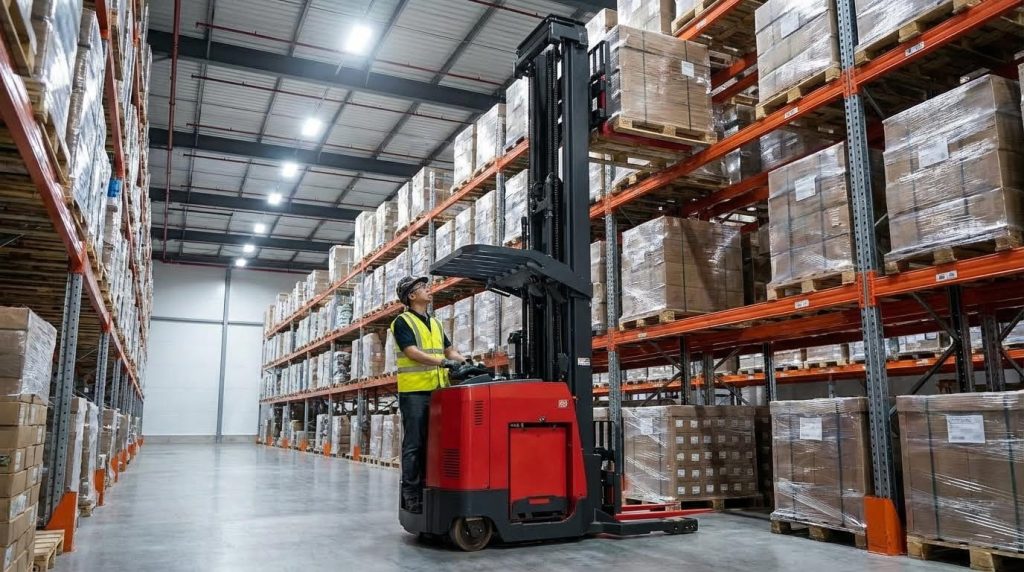
When people ask “how much does an electric forklift weigh,” they usually care about three things: safety, floor capacity, and the right truck for the job. This guide breaks down typical truck mass by capacity, how battery weight affects stability and axle loads, and what that means for slab and floor design. You will see real-world weight ranges, battery options, and simple ways to estimate PSF so your forklifts and floors work together safely and efficiently.
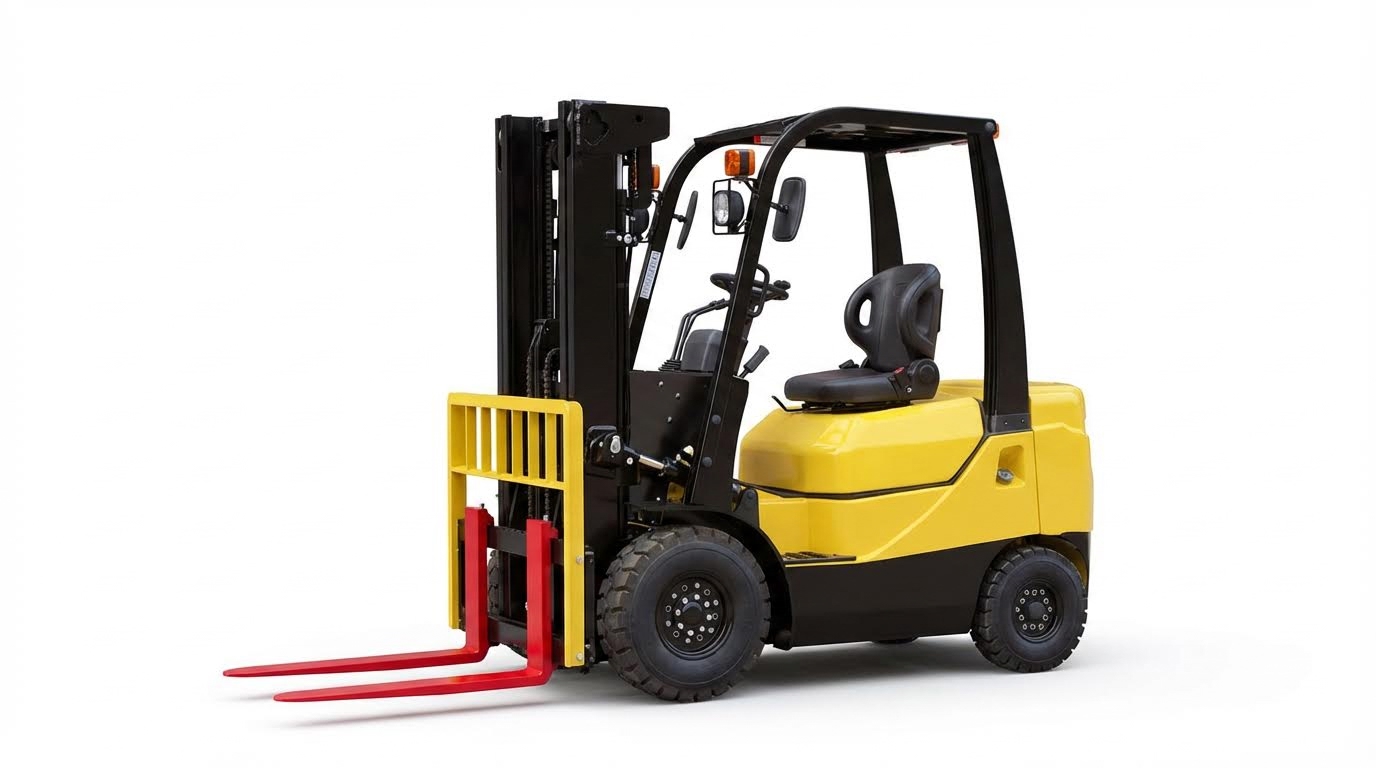
“`html
Understanding Electric Forklift Weight And Components

Typical truck weights by capacity class
When people ask “how much does an electric forklift weigh,” they usually underestimate the answer. The truck must be heavy enough to safely counterbalance its rated load, so operating weight is often 2–4 times the lift capacity.
The table below uses published data to show typical electric forklift weight ranges by capacity band, and how that compares to the rated load. This is the first step in understanding floor loading, transport needs, and clearances in your facility.
| Rated capacity (at load center) | Example operating weight | Typical range in practice | Weight : capacity ratio | What this means for your floor |
|---|---|---|---|---|
| 1.0 t (≈ 2,200 lb) | ≈ 2,940 kg (6,480 lb) example data | 2,800–3,200 kg (6,200–7,050 lb) | ≈ 2.8–3.2 × rated capacity | Behaves like a 3 t machine for floor design, not “1 t” |
| 2.0–2.5 t (≈ 4,400–5,500 lb) | — | 4,000–5,000 kg (8,800–11,000 lb) | ≈ 2.0–2.3 × rated capacity | Common warehouse size; axle loads already high at front wheels |
| 3.5 t (≈ 7,700 lb) | ≈ 5,450 kg (12,015 lb) example data | 5,000–6,000 kg (11,000–13,200 lb) | ≈ 1.5–1.8 × rated capacity | Often near or above typical 150–200 PSF warehouse design loads |
| 4.0–5.0 t (≈ 8,800–11,000 lb) | — | 6,000–8,000 kg (13,200–17,600 lb) | ≈ 1.4–1.7 × rated capacity | Front-axle point loads can exceed 250–400 PSF in aisles in high-traffic zones |
From these ranges you can see why asking “how much does an electric forklift weigh” is critical for engineers and safety teams, not just buyers. A “small” 1.0 t truck can still weigh close to 3 t overall, and higher-capacity electrics quickly reach 6–8 t with load and battery.
Why operating weight is so high compared to capacity
The truck frame, mast, counterweight, battery, and attachments all add mass. Designers size these so the combined center of gravity stays within the stability triangle at maximum rated load and mast height. As capacity goes up, the counterweight and chassis must grow even faster than the nominal load, which is why total truck mass climbs steeply with capacity.
Battery mass and its role in counterbalance

The traction battery is one of the heaviest single components on an electric forklift. Its job is not only to store energy but also to act as part of the counterweight system that keeps the truck stable under load.
Typical industrial lead-acid batteries for mid-size electrics can weigh 2,000–5,000 lb per unit, driving floor loads up into the 250–400 PSF range in busy aisles according to industry data. Some specific electric forklift models list battery weight at around 2,160 kg (≈ 4,760 lb) across several configurations in published specs.
- Heavier battery = more rear counterweight: This helps the truck lift its rated load without tipping forward, especially at higher mast heights.
- Battery weight is “baked into” capacity charts: Change the battery mass and the safe lifting capacity and stability envelope change with it.
- Floor loading rises with battery mass: Concentrated weight over the drive axle and small tire footprints pushes PSF values up, which affects slab thickness and reinforcement.
Modern lithium batteries change this balance. They offer far higher energy density (roughly 150–200 Wh/kg vs. 30–50 Wh/kg for lead-acid) based on comparative data, so you can get the same runtime with significantly less mass.
| Battery example | Approx. weight | Relative energy density | Effect on truck & floor |
|---|---|---|---|
| Typical lead-acid pack for mid-size forklift | 2,000–5,000 lb industry range | Low (≈ 30–50 Wh/kg) | High counterweight effect but drives floor loads up to 250–400 PSF in high-traffic aisles |
| 48 V, 400 Ah lithium vs. lead-acid equivalent | ≈ 1,300 lb (lithium) vs. ≈ 3,200 lb (lead-acid) reported comparison | Lithium ≈ 3–5× higher | Lithium cuts floor load impact from about 350 PSF to 180 PSF in busy aisles while maintaining runtime |
| 36 V, 600 Ah lithium vs. 36 V, 400 Ah lead-acid | ≈ 900 lb (lithium) vs. ≈ 1,600 lb (lead-acid) example data | Lithium much higher | Similar runtime at much lower mass, reducing axle loads and structural stress |
Because the battery is part of the counterweight, moving to a lighter lithium pack can slightly reduce rear mass and change the truck’s stability characteristics. Forklift capacity charts and, in some cases, additional ballast must be reviewed whenever you change battery technology or weight.
Key engineering takeaways about battery mass
First, when you ask “how much does an electric forklift weigh,” you must include the installed battery, not just the chassis. Second, battery mass directly affects center of gravity, safe lift capacity at height, and front-axle loads. Finally, heavy lead-acid batteries can push dynamic floor pressures well above typical 150 PSF warehouse design values, so switching to lighter lithium packs is often both a safety and a civil-structural decision, not just an energy choice.
“`
“”
Specifying Forklift Weight For Your Facility
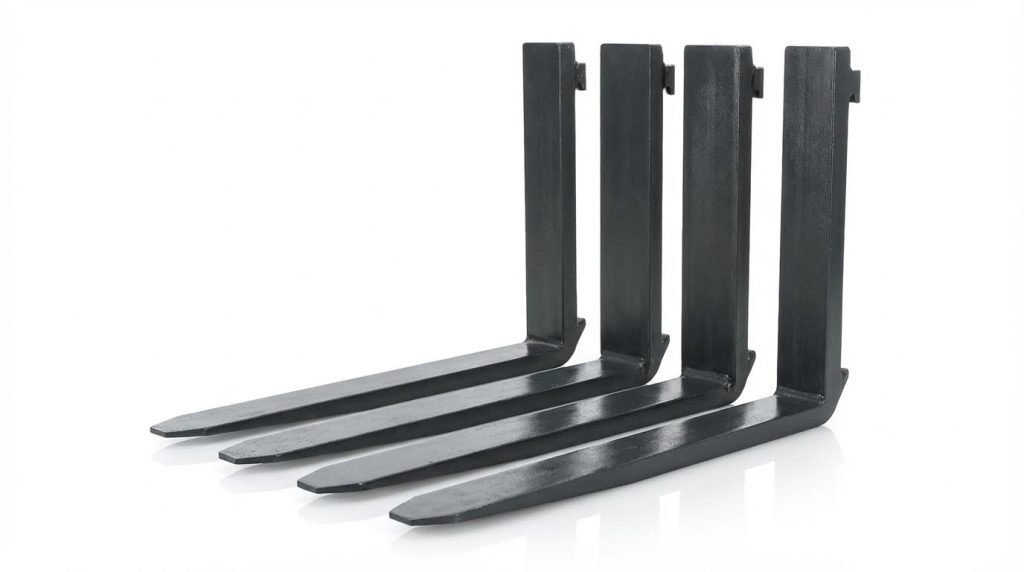
Matching forklift class to floor and slab capacity
When you ask “how much does an electric forklift weigh,” you also need to ask “what can my floor safely carry?” Forklift selection must align truck weight, axle loads, and battery mass with your slab design and rack layout, not just rated lift capacity.
Use the steps below to match forklift class and weight to your floor system.
- Define your load and lift needs (capacity, height, attachments).
- Estimate operating truck weight with battery.
- Convert that weight into axle loads and PSF on the slab.
- Compare with slab capacity and reinforcement details.
- Refine truck class, tire type, and battery choice as needed.
Typical electric forklift weights by capacity
These examples show how much an electric forklift weighs for common capacity bands. Values are indicative and help you understand order of magnitude.
| Rated lift capacity (kg) | Example operating weight (kg) | Notes |
|---|---|---|
| 1,000 | ≈ 2,940 | Documented for a compact electric model (1,000 kg capacity, 2,940 kg truck weight) |
| 3,500 | ≈ 5,450 | Larger chassis, higher counterweight (3,500 kg capacity, 5,450 kg truck weight) |
| 4,000–5,000 | ≈ 7,000–9,000+ | Heavier frames and batteries for high-capacity, 3–6.5 m lift heights (4–5 ton trucks with 3,000–6,500 mm lift) |
The heavier the truck, the higher the axle and point loads on your slab. Heavy batteries (often 2,000–5,000 lb each) alone can drive floor pressures to 250–400 PSF in busy aisles (250–400 PSF in high‑traffic aisles).
Compare that to common building design loads around 50–70 lb/ft² (≈240–340 kg/m²) for general floors (typical 50–70 lb/ft² design loads). A warehouse slab designed only for light storage can be overstressed quickly by heavy trucks and batteries.
- If calculated forklift-induced PSF > slab design PSF → reduce truck weight or strengthen slab.
- If axle loads approach structural limits → review joint design, dowels, and reinforcement.
- If dynamic loads (braking, turning) are high → consider lighter batteries and lower-capacity trucks.
Battery choice and slab thickness
Battery technology changes how much an electric forklift weighs and what your slab must carry.
| Battery type | Typical battery weight range | Resulting aisle floor load | Indicative slab thickness need |
|---|---|---|---|
| Lead‑acid | ≈ 2,000–5,000 lb per unit (2,000–5,000 lb) | ≈ 250–400 PSF in high‑traffic aisles (250–400 PSF) | Often 8–10 in slabs with heavier reinforcement for high‑duty areas (thicker slabs, deeper foundations) |
| Lithium‑ion | Up to ~60% lighter than lead‑acid equivalents (≈60% weight reduction) | ≈ 150–200 PSF in similar aisles (150–200 PSF) | Can allow 6 in slabs and ~30% lower reinforcement cost in new builds (6 in slabs, ~30% savings) |
When you specify “how much does an electric forklift weigh” for your site, treat battery type as a structural decision, not just an energy choice. Lighter lithium packs often bring your PSF back into the 150–200 range, closer to conventional warehouse designs, and reduce the need for thickened slabs or local footings under high-traffic aisles.
Considering aisles, racking, and duty cycle in selection
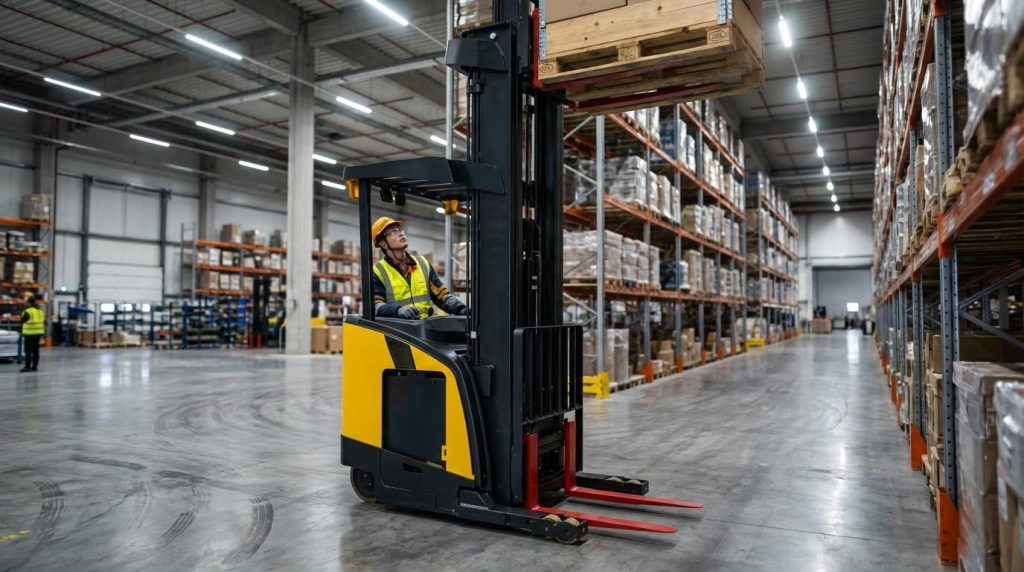
Forklift weight interacts with aisle layout, racking geometry, and duty cycle. A truck that is safe in open loading areas can overstress narrow aisles and rack post foundations once you add tight turns, stacking heights, and continuous operation.
Use the checklist below to tie forklift weight to layout and usage.
- Aisle width and turning: Heavier trucks with large batteries generate higher dynamic loads (up to ~500 PSF) in tight turns in narrow aisles (dynamic loads up to 500 PSF). Narrow aisles magnify this effect.
- Rack post bearing: Heavy forklifts and batteries increase impact forces at rack uprights. This can demand larger base plates and thicker local slab zones.
- Lift height: Higher masts (3,000–6,500 mm common for 4–5 ton trucks (3,000–6,500 mm)) require more counterweight. That pushes up total truck mass and rear axle loads.
- Duty cycle: High‑traffic fleets running heavy lead‑acid batteries have shown floor loads in the 250–400 PSF range and significant slab wear (250–400 PSF, frequent reinforcements).
- Traffic patterns: Concentrated travel in front of docks, doors, and battery rooms multiplies the effect of heavy trucks and batteries on slab fatigue.
Duty cycle vs. truck and battery choice
| Duty profile | Preferred truck/battery strategy | Why it matters for floor loading |
|---|---|---|
| Light (single shift, low utilization) | Moderate‑weight trucks, either battery type | Fewer passes; slab fatigue less critical, but axle loads must still be within limits. |
| Medium (two shifts, mixed traffic) | Consider lithium to reduce truck+battery mass | Lighter packs lower PSF and reduce long‑term cracking and joint spalling. |
| Heavy (multi‑shift, high‑traffic aisles) | Prioritize lithium and possibly lower capacity class where feasible | High passes plus 2,000–5,000 lb batteries can push floors to 250–400 PSF and accelerate damage (250–400 PSF, frequent repairs). |
When deciding how much does an electric forklift weigh for your project, do not simply choose the heaviest capacity “just in case.” Oversized trucks bring larger batteries, higher PSF, and more slab wear without adding value if your loads and rack heights do not require that capacity.
- Right‑size capacity to your heaviest real pallet plus attachments.
- Prefer lighter battery technologies when floor capacity is tight.
- Align aisle widths, rack base plates, and slab design with the chosen truck weight, not with generic warehouse load assumptions.
For specific applications like manual pallet jack, drum dolly, hydraulic pallet truck, and semi electric order picker, ensure compatibility with your floor’s load-bearing capacity.
Final Thoughts On Forklift Weight And Floor Safety
Electric forklift weight is not just a catalog number. It is a structural and safety load that your floor, racks, and operations must carry every day. Truck mass, battery weight, and axle geometry together set the real forces your slab will see, especially in tight aisles and high-traffic zones.
Lead-acid batteries and high-capacity trucks push axle and point loads into ranges that can exceed typical warehouse design values. Lithium batteries reduce weight and PSF, but they also change counterbalance and stability, so you must review capacity charts and, if needed, add ballast. Engineers must always calculate operating weight with the actual battery, attachments, and load, then convert this to axle loads and PSF before approving a truck for a given floor.
The best practice is simple. Right-size forklift capacity to real loads, not wish lists. Choose lighter battery technology when floor margins are tight. Match aisle width, rack base plates, and slab thickness to the confirmed truck and battery combination. Finally, treat every new truck or battery change as an engineering check, not a purchasing decision alone. This approach keeps people safe, protects slabs and racking, and keeps Atomoving equipment and your facility working together for the long term.
Frequently Asked Questions
How much does an electric forklift weigh?
An electric forklift’s weight depends on its capacity and design. For example, a 5,000 lb capacity electric forklift typically weighs around 8,000 lbs. Larger models, like those with a 12,000 lb capacity, can weigh up to 16,840 lbs. The weight includes the battery, which significantly contributes to the overall mass.
- A 3,500 lb capacity electric forklift may weigh approximately 7,645 lbs.
- Heavier models are designed for stability during lifting operations.
What factors influence the weight of an electric forklift?
The weight of an electric forklift is influenced by several factors, including its lifting capacity, battery size, and build materials. Forklifts with higher capacities need stronger frames and larger batteries, increasing their weight. Additionally, features like cushion tires or extended masts can add to the overall mass. For more details, you can check Electric Forklift Specifications.